

Stepping into a high-stakes meeting can often feel like the first time you step onto a salsa dance floor. The music is loud, the rhythm is fast, and if you’re overthinking your footwork, you’re bound to trip. In my years studying social psychology, I’ve found that many professionals approach their careers with that same paralyzing self-consciousness. We focus so much on not making a mistake that we forget to actually lead.
Building confidence at work isn’t about an absence of fear; it’s about developing the self-awareness to recognize your rhythm and the mindfulness to stay present in the dance. Early in my journey, I used to wait for a “permission slip” to feel confident, thinking it would arrive once I had one more degree or one more successful project under my belt. But true confidence is a skill you build in real-time by acknowledging your inherent strengths and owning your unique perspective.
It starts with knowing exactly what you excel at so you can navigate challenges with grace rather than hesitation. When you understand your core competencies, you stop trying to mimic someone else’s style and start perfecting your own. Let’s explore how we can turn that internal self-doubt into a solid foundation for professional fulfillment.
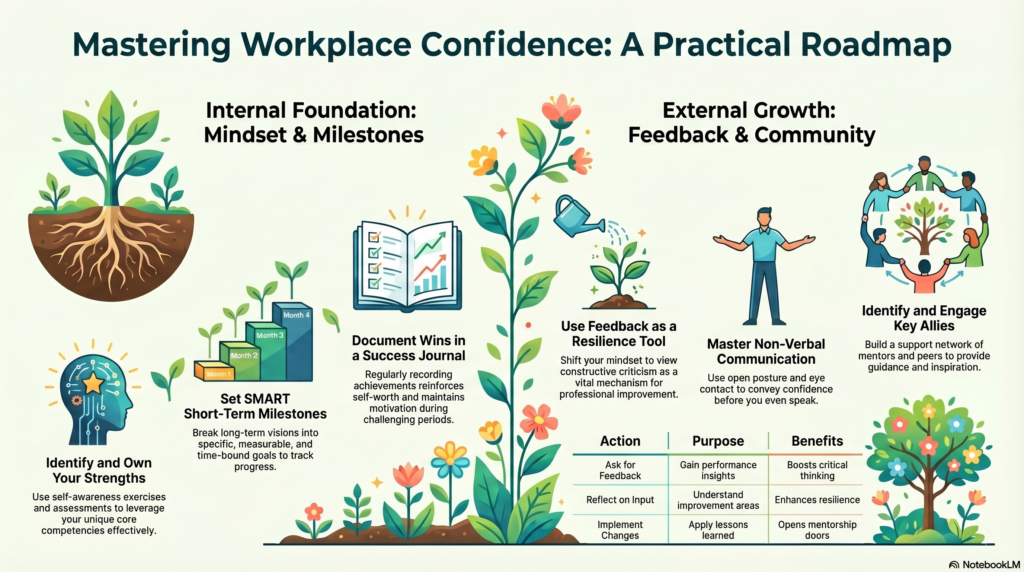
Building confidence at work starts with knowing your strengths. Reflect on past successes and seek feedback from colleagues to uncover skills you may overlook. Set achievable goals to create a clear roadmap and keep track of your progress. Embrace constructive criticism as a tool for growth, and practice effective communication to foster open dialogue. Continuous learning is key, so explore training opportunities and professional development. Build a supportive network of mentors and peers who can encourage your growth. Celebrate your achievements to boost morale and motivation. There’s much more you can discover to enhance your journey toward career success.
KEY TAKEAWAYS
- Engage in self-awareness exercises and seek feedback to identify and leverage your strengths for greater confidence in tackling challenges.
- Set clear, achievable goals with a long-term vision to maintain motivation and track your progress effectively.
- Embrace constructive criticism and practice open communication to foster an environment of continuous improvement and personal growth.
- Commit to lifelong learning through online courses, professional development opportunities, and staying updated on industry trends.
- Build a strong support network by seeking mentors, networking, and collaborating on projects to enhance confidence and professional relationships.
UNDERSTAND YOUR STRENGTHS
Understanding your strengths is essential for building confidence at work. When you know what you excel at, you can leverage those skills to navigate challenges and seize opportunities. Start by engaging in self-awareness exercises. These can be as simple as reflecting on your past successes or journaling about tasks you enjoy. Consider what activities energize you—this can give you clues about your innate strengths. Taking time to reflect on past successes through journaling or quiet self-reflection can also serve as a calming self care activity, helping you reconnect with your strengths while reducing work-related stress.
Next, conduct a strengths assessment. There are many tools available online that can help you identify your core competencies. Taking the time to complete one of these assessments can provide you with valuable insights into your unique abilities. Once you’ve identified your strengths, think about how you can apply them in your current role or in future opportunities.
Don’t hesitate to seek feedback from colleagues or mentors; they can often highlight strengths you may overlook. Incorporating their perspectives can enrich your understanding and encourage you to embrace your talents more fully. Remember, it’s not just about knowing your strengths—it’s about owning them.
As you build your confidence, you’ll find that acknowledging your strengths empowers you to take on new challenges and express your ideas more freely. Embrace this journey of self-discovery, and you’ll create a solid foundation for professional growth and fulfillment.
Set Achievable Goals
Setting achievable goals is a powerful way to boost your confidence at work. When you set clear, attainable objectives, you create a roadmap that leads to success. Start by defining your long-term vision. What do you want to achieve in your career? Having this overarching goal in mind helps you stay motivated and focused.
Next, break down that vision into short-term milestones. These smaller, actionable steps make your big goals feel less overwhelming and more manageable. For instance, if your long-term vision is to become a team leader, your short-term milestones could include completing a leadership training program, leading a small project, or seeking mentorship. Each milestone you achieve will bolster your confidence and reinforce your belief in your capabilities, making goal-setting an essential part of building confidence through consistent progress and small wins at work.
It’s crucial to guarantee your goals are specific, measurable, and time-bound. Instead of saying, “I want to improve my skills,” specify, “I will complete two online courses in my field within the next three months.”
This clarity not only helps you track your progress but also gives you a sense of accomplishment as you check off each milestone.
Seek Feedback Regularly
In my research and personal experience, I’ve noticed a common misconception: that confidence is a solitary pursuit. In reality, some of my most significant breakthroughs happened when I stopped trying to be an island and started building a supportive network. Whether it’s salsa dancing or executing a complex project, we need partners who can offer a different vantage point. This is why seeking feedback regularly is so vital, it’s like having a mirror that reflects the strengths you might be overlooking and the areas where you can sharpen your steps.
I know that receiving constructive criticism can feel like a blow to the ego, but if we shift our mindset to see it as a tool for “resilience development,” it becomes a game-changer. By actively requesting input from peers, you create a collaborative environment where everyone feels heard, which naturally boosts the collective confidence of the team. I always recommend setting specific milestones to track this growth.
For example, instead of a vague goal to “be more assertive,” commit to leading a small project or attending a specific training program. When you act on suggestions promptly and commit to continuous learning, you aren’t just improving your resume; you’re showing yourself, and your colleagues, that you are dedicated to the best version of your professional self.
Seeking feedback regularly is essential for your growth at work.
Embrace constructive criticism, as it helps you identify areas for improvement. Another way to boost your confidence at work is to volunteer for high-profile assignments. Projects that increase your visibility help you get ahead in your career.
Don’t hesitate to request input from peers and act on their suggestions promptly to build your confidence and enhance your skills.
Embrace Constructive Criticism
At various points in your career, embracing constructive criticism can be a game-changer for your professional growth. It allows you to engage in self-reflection practices that enhance your emotional intelligence and foster a growth mindset. Regularly seeking constructive feedback helps you identify areas for performance improvement and develop adaptive strategies to overcome challenges.
Here’s a quick guide on how to effectively embrace constructive criticism:
| Action | Purpose | Benefits |
| Ask for feedback | Gain insights on performance | Boosts critical thinking |
| Reflect on the feedback | Understand areas to improve | Enhances resilience development |
| Implement changes | Apply lessons learned | Opens mentorship opportunities |
Request Input From Peers
Regularly requesting input from peers can greatly enhance your professional development and foster a collaborative work environment. Engaging in peer collaboration not only broadens your perspective but also strengthens relationships within your team.
When you invite feedback, you create an atmosphere of constructive dialogue, where everyone feels valued and heard.
To get started, consider setting up regular check-ins or feedback sessions with your colleagues. Ask specific questions about your projects or performance to guide the conversation. This approach encourages open communication and helps you gain insights you mightn’t have considered.
Remember, feedback isn’t just about critiques; it can also highlight your strengths and successes.
Be open to different viewpoints and be willing to explore new ideas. Accepting feedback can be challenging, but it’s essential for growth. When you actively seek input, you’re not only improving your own skills but also contributing to a culture of continuous improvement within your workplace.
Embrace the process and see it as an opportunity to learn. By fostering peer collaboration and engaging in constructive dialogue, you’ll build confidence in your abilities and strengthen your professional relationships.
Act on Suggestions Promptly
Taking action on suggestions promptly is essential for demonstrating your commitment to growth and improvement. When you receive feedback, don’t let it sit idle; instead, embrace it as a valuable opportunity. This proactive mindset not only enhances your skills but also shows others that you value their insights.
To manage your time effectively, set aside specific moments to review feedback and outline actionable steps. Break down larger suggestions into manageable tasks, making it easier to incorporate them into your daily routine. Prioritizing these actions helps you stay focused and organized, ultimately leading to quicker results.
Regularly seeking feedback reinforces your dedication to personal development and fosters a culture of open communication. By acting on suggestions, you invite more input, creating an ongoing cycle of improvement.
This responsiveness builds trust among colleagues and can open doors to new opportunities.

PRACTICE EFFECTIVE COMMUNICATION
Effective communication is the cornerstone of building confidence at work. When you express yourself clearly and listen actively, you create an environment where ideas flow freely, and collaboration thrives.
Start by honing your active listening skills. This means truly focusing on what others say, without interrupting or planning your response while they’re talking. Acknowledge their points with nods or verbal affirmations; it shows you value their input and encourages open dialogue.
Your body language also plays an essential role in how you communicate. Maintain an open posture, make eye contact, and smile genuinely. These non-verbal cues convey confidence and make you more approachable. Remember, people often interpret your body language even before they hear your words.
To enhance your communication, practice being clear and concise. Whether you’re giving a presentation or engaging in a casual conversation, aim to articulate your thoughts without unnecessary jargon or filler. This not only helps others understand you better but also reinforces your own confidence in expressing ideas.
Lastly, don’t shy away from asking for feedback. Invite colleagues to share their thoughts on your communication style, and be receptive to their suggestions. This illustrates your commitment to personal growth and can lead to more effective interactions in the future.
Embrace Continuous Learning
Continuous learning is a powerful tool for building confidence at work. When you actively seek out new knowledge and skills, you empower yourself to tackle challenges with greater assurance.
Start by exploring online courses that align with your career goals. These resources often provide flexibility, allowing you to learn at your own pace while fitting into your busy schedule.
Consider attending skill workshops or industry conferences to deepen your expertise. These settings not only enhance your skills but also offer valuable networking opportunities. Engaging with peers can lead to knowledge sharing that enriches your understanding and fosters collaboration.
Don’t underestimate the power of mentorship programs, either. Finding a mentor can provide you with insights from someone who’s walked the path you aspire to take. Their guidance can accelerate your personal development and boost your confidence in steering your career journey.
Joining learning communities can also enhance your experience. Surrounding yourself with like-minded individuals encourages motivation and accountability.
These communities often share training resources, tips, and the latest trends in your field, keeping you informed and engaged.
Build a Support Network
Building a support network is essential for boosting your confidence at work.
Start by identifying key allies who can offer guidance and encouragement, and don’t hesitate to attend networking events to expand your connections.
Surrounding yourself with supportive colleagues can make a significant difference in your professional journey.
Identify Key Allies
Finding key allies in your workplace can greatly boost your confidence and overall success. Being confident in your abilities can help you be more productive. This can make you a more desirable candidate for hiring managers or your current employer.
Building a strong support network isn’t just about having friends; it’s about identifying individuals who can help you grow professionally. These allies can provide guidance, share resources, and inspire you to take on new challenges.
Here are some practical tips to help you identify and connect with key allies:
- Look for mentors: Seek out experienced colleagues who can offer valuable insights and mentorship opportunities.
- Engage in collaborative projects: Participate actively in team efforts where you can showcase your skills and build relationships.
- Attend team meetings: Be present and contribute, allowing others to see your enthusiasm and commitment.
- Join interest groups: Connecting with colleagues who share your passions can lead to supportive partnerships.
- Be genuine: Authentic relationships are built on trust; be yourself and show genuine interest in others.
Attend Networking Events
Attending networking events can be a game-changer for your career, offering a unique opportunity to connect with professionals who share your interests and goals. To make the most of these events, start with solid event preparation. Take time to learn, improve, and become the best version of yourself in your job. Research attendees and professional associations relevant to your field. This knowledge will boost your confidence and help you develop effective networking strategies.
As you arrive, engage with icebreaker questions to initiate conversations. Remember, your social skills are key to building lasting relationships. Craft a concise elevator pitch to introduce yourself and your aspirations effectively. This will set the stage for meaningful interactions.
Once the event wraps up, don’t forget follow-up techniques. Sending a quick thank-you email or connecting on LinkedIn reinforces the relationships you built. Consistent relationship management will keep your network alive and thriving.
Additionally, consider online networking opportunities if in-person events aren’t feasible. Virtual meetups can also enhance your network and offer flexibility.
Celebrate Your Achievements
Celebrating your achievements is essential for boosting confidence and motivation in the workplace. You work hard, and it’s important to recognize milestones along your journey. Recognizing milestones—no matter how small—not only reinforces your self-worth but also mirrors strategies used in building confidence in kids, where consistent encouragement and acknowledgment help develop long-term self-belief.
When you take the time to acknowledge your successes, you not only reinforce your self-worth but also create a positive environment for growth. Here are some practical ways to celebrate your achievements:
- Keep a Success Journal: Write down your accomplishments, big or small, to reflect on your progress regularly.
- Share Successes with Colleagues: When you achieve something remarkable, share it with your team or manager. This not only boosts your visibility but encourages others to celebrate their achievements too.
- Reward Yourself: Treat yourself to something special after completing a project or reaching a goal. It could be a nice dinner, a day off, or a small gift.
- Set New Goals: After celebrating, think about what you want to achieve next. Setting new targets can keep the momentum going and fuel your passion.
- Create a Recognition Ritual: Whether it’s a monthly meeting or a quick shout-out in team chats, find a way to routinely recognize everyone’s efforts, including your own.

RELATED STUDIES ABOUT BUILDING CONFIDENCE AT WORK
Building confidence at work is like nurturing a garden; it takes time, effort, and the right conditions to flourish. Just as a gardener recognizes the strengths of each plant, take a moment to acknowledge your own skills. Set achievable goals, seek feedback, and embrace learning. Surround yourself with a supportive network, and don’t forget to celebrate your accomplishments. With these practical steps, you’ll cultivate a thriving career that blossoms with confidence and success. You’ve got this!
Building Clean Economies through Clean Governance: Why Government Effectiveness Matters for Green Innovation and Business Confidence in Diverse National Culture
Study Objective:
This research examines the interplay between national culture (specifically power distance) and government effectiveness in driving green innovation and business confidence across developed and emerging economies. It investigates whether effective governance can moderate the cultural barriers to innovation, particularly in societies with high power distance.
Key Findings:
- National Culture (Power Distance) Negatively Impacts Green Innovation:
- Societies with high power distance (hierarchical, autocratic structures) generally show lower engagement in green innovation.
- High power distance can lead to resource misallocation, suppressed creativity, and limited bottom-up participation, hindering innovative activities.
- Government Effectiveness is a Critical Moderator:
- Effective governance (transparency, rule of law, low corruption, quality institutions) can mitigate the negative effects of high power distance on green innovation.
- In emerging economies, government effectiveness is positively associated with green innovation, as strong leadership and centralized coordination help overcome structural and resource constraints.
- In developed economies, the effect is more complex: high government effectiveness in high-power-distance contexts may sometimes reduce innovation due to potential conflicts and reduced autonomy.
- Divergence Between Emerging and Developed Economies:
- Emerging economies often have higher power distance and lower government effectiveness scores but can achieve green innovation through effective, directive governance.
- Developed economies typically have lower power distance and higher government effectiveness; however, overly hierarchical cultures can still stifle innovation even within effective governance systems.
- Business Confidence and Corruption:
- Government effectiveness boosts business confidence, especially in high-corruption environments.
- In low-corruption settings, the relationship is less pronounced or negative, possibly due to higher scrutiny and perceived risks.
- Qualitative Insights from Practitioners:
- Interviews with sustainability professionals in Malaysia identified key drivers of green innovation:
- Primary pull factor: Customer demand for eco-friendly products.
- Key government roles: Regulatory frameworks (e.g., climate policies, disclosure standards) and investment in green infrastructure.
- Main barriers: Cultural resistance to change, especially among SMEs, and lack of urgency.
Conclusion and Implications:
- Government effectiveness is paramount for fostering green innovation, especially in culturally hierarchical societies. It can align national culture with innovation goals through transparent policies, infrastructure investment, and strong regulatory frameworks.
- Policy should be context-sensitive: In emerging economies, governments should focus on building institutional capacity and leveraging centralized leadership. In developed economies, policies should encourage participatory and decentralized innovation ecosystems.
- Cultural competency is crucial for international collaboration and technology transfer. Cross-cultural training, adaptive governance, and inclusive policy design can enhance global green innovation partnerships.
- Future research should explore sector-specific dynamics, use more dynamic cultural measures, and investigate policy frameworks that facilitate cultural adaptation in green transitions.
Significance:
This study bridges the gap between cultural studies and governance literature, highlighting that effective, culturally-aware governance is essential for transitioning to clean, innovative economies—particularly in emerging markets where institutional development and cultural factors intersect.
| REFERENCE: Ennie Salina Roseli, Wan Masliza Wan Mohammad, Building clean economies through clean governance: Why government effectiveness matters for green innovation and business confidence in diverse national culture, Development and Sustainability in Economics and Finance, Volume 9, 2026, 100115, ISSN 2950-5240, https://doi.org/10.1016/j.dsef.2026.100115. (https://www.sciencedirect.com/science/article/pii/S2950524026000028) |
Building Trust in Community-Academic Partnerships: Strategies for Enhancing Vaccine Confidence and Demand – Lessons from Prevention Research Centers
Study Objective:
This study examines how trust is built and maintained in community-academic partnerships, specifically within the Centers for Disease Control and Prevention’s (CDC) Prevention Research Centers (PRCs) and their Community Advisory Boards (CABs). It explores the role of these trusted partnerships in increasing COVID-19 vaccine confidence and demand during the pandemic.
Key Findings:
- Key Strategies for Building and Maintaining Trust:
- Frequent & Transparent Communication: Open, honest dialogue where community input is valued and respected.
- Active CAB Engagement: Involving CABs in all research phases—from goal-setting and grant writing to budget discussions and implementation—ensures shared decision-making.
- Mutually Beneficial Partnerships: Relationships must provide tangible benefits to the community, such as resource sharing, funding assistance, and professional development opportunities for CAB members.
- Long-Term Relationship Investment: Trust is built over time through consistent actions, dependability, and personal connections extending beyond formal work settings.
- Barriers to Building Trust:
- Funding Issues: Short funding cycles, lack of transparency in budgets, and inadequate compensation for community members undermine trust.
- Historical Distrust: Past unethical research (e.g., Tuskegee Study) and perceptions of being “abandoned” after projects create skepticism toward academic institutions.
- Structural & Cultural Differences: Differing priorities, communication styles, and operational speeds between academic and community partners.
- Lack of Community Empowerment: Hesitancy to share power and decision-making authority with community members.
- Leveraging Trust for Public Health Response:
- PRCs with established, long-standing community partnerships were uniquely positioned to rapidly pivot to COVID-19 vaccine efforts.
- Existing trust allowed PRCs to:
- Serve as reliable sources of pandemic information.
- Engage trusted messengers (e.g., community health workers, faith leaders) to disseminate culturally appropriate messages.
- Use CABs as intermediaries to understand and address community concerns.
- Trust was identified as the third most important facilitator of vaccine uptake, after perceived benefits and effective communication.
- The Role of Community Advisory Boards (CABs):
- 88% of PRCs engaged a CAB in their vaccine confidence work.
- CABs were most involved in: disseminating materials (85%), identifying partners/participants (82%), and helping plan interventions (76%).
- Financial compensation for CAB members was highlighted as a critical, yet often unmet, need for equitable partnership.
- Differences in Perceptions of Trust:
- While both CAB members and Principal Investigators (PIs) valued trust elements, CAB members placed higher importance on receiving accurate information and sharing power/responsibilities, whereas PIs emphasized supportiveness and openness.
Conclusion and Implications:
- Trust is foundational for effective community-engaged public health research and emergency response. It must be intentionally built through transparency, reciprocity, and long-term commitment.
- Funders and institutions should:
- Provide flexible, sustained funding to support long-term partnerships.
- Compensate community members fairly for their time and expertise.
- Develop and validate standardized tools to measure trust across diverse populations and settings.
- The PRC model demonstrates that investing in community-academic partnerships enhances public health resilience, enabling a more trusted and effective response to crises like the COVID-19 pandemic.
Significance:
This research provides a practical framework for building trustworthy partnerships in public health, emphasizing that trust is not merely an outcome but a continuous process requiring institutional commitment, shared power, and genuine community benefit. These lessons are vital for future pandemic preparedness and routine public health initiatives.
| REFERENCE: lyssa Jeffers, Nicole M. Kuiper, Aparna Ramakrishnan, Hepsi Swarna, Kenneth Goodman, Pooja Gandhi, Monica I. Mendez Morello, Building trust in community-academic partnerships: Strategies for enhancing vaccine confidence and demand – Lessons from Prevention Research Centers, Vaccine, Volume 60, Supplement 1, 2025, 127624, ISSN 0264-410X, https://doi.org/10.1016/j.vaccine.2025.127624. (https://www.sciencedirect.com/science/article/pii/S0264410X25009211) |
Engaging Trusted Messengers in Public Health Response: Key Strategies to Building Community Trust among CDC’s Prevention Research Center’s Vaccine Confidence Network
Study Objective:
This article describes the experiences and lessons learned from the Centers for Disease Control and Prevention’s (CDC) Prevention Research Center Vaccine Confidence Network (PRC VCN), a national initiative across 26 academic institutions, with a focus on six sites. The goal was to identify effective strategies for engaging trusted messengers to build community trust and increase COVID-19 vaccine confidence and uptake.
Key Findings:
- Role and Recruitment of Trusted Messengers:
- Trusted messengers included healthcare professionals, community health workers (CHWs), and other community representatives (e.g., peers, influencers, faith leaders).
- Recruitment focused on individuals with strong community ties and credibility, who could effectively communicate with priority populations.
- Their roles varied from providing feedback on materials, developing tailored messaging, conducting outreach, navigating resources, and building networks.
- Training and Support:
- Flexible, responsive training formats (e.g., small groups, role-play, virtual modules) were essential to address evolving pandemic information and varying levels of messenger familiarity with public health topics.
- Training content extended beyond COVID-19 to include capacity-building in social media use, data literacy, and community-based research methods.
- Support mechanisms included compensation, regular reflective meetings, peer-learning forums, and ongoing engagement to empower messengers as active partners.
- Challenges and Opportunities:
- Challenges: Tight timelines, shifting community needs, limited bandwidth, language barriers, and the need to transition from a research to a programmatic mindset.
- Opportunities: Flexible funding allowed for adaptive interventions; integrating messenger feedback improved responsiveness; aligning with existing community coalitions enhanced reach and sustainability.
- Key Lessons for Future Public Health Initiatives:
- Community-Engaged Approach: Trusted messengers are critical for building trust, tailoring messages, and ensuring community voices guide public health strategies.
- Flexible Funding: Agile, developmental funding enabled rapid, innovative partnerships and responsive interventions.
- Data-Informed Strategies: Implementation science and local data should guide the adaptation and scaling of effective messaging and outreach.
- Coordination Across Levels: Federal, state, and local agencies can support trusted messengers by providing timely data, adaptable materials, and aligned funding streams.
Conclusion:
Trusted messengers proved to be invaluable beyond simply amplifying messages—they co-created strategies, bridged institutional-community gaps, and fostered trust in real-time during a public health crisis. The PRC VCN model highlights the importance of sustained investment in community partnerships, flexible operational structures, and ongoing support for trusted messengers to build resilient public health infrastructure for future emergencies.
Implications:
Future public health initiatives should prioritize dedicated funding for trusted messenger engagement, incorporate community input at all stages, and foster multi-level coordination to effectively address vaccine hesitancy and other public health challenges.
| REFERENCE: Emily Stiehl, Amy Borg, John P. Cullen, AnaÏs Mendiola, Olivia Dominguez, Danielle Pester, Shan Qiao, Pooja Gandhi, Nicole Kuiper, Princilla Minkah, Shekwonya Samuel, Stephen Flores, Richard Quartarone, Grace W. Ryan, Paula Cuccaro, Maria E. Fernández, Sage Kim, Engaging trusted messengers in public health response: Key strategies to building community trust among CDC’S prevention research center’s vaccine confidence network, Vaccine, Volume 60, Supplement 1, 2025, 127474, ISSN 0264-410X, https://doi.org/10.1016/j.vaccine.2025.127474. (https://www.sciencedirect.com/science/article/pii/S0264410X25007716) |
CONCLUSION
I often tell my clients that building career confidence is a lot like tending a garden. You don’t just plant a seed and walk away; it requires consistent effort, the right conditions, and, most importantly, the patience to let things bloom in their own time. As we’ve discussed, this process involves setting achievable goals, embracing lifelong learning, and leaning on a strong support network of mentors and allies. But there is one final step that many high-achievers skip: the celebration.
In our rush to reach the next milestone, we often forget to acknowledge how far we’ve already come. Celebrating your achievements, no matter how small, is essential for maintaining your morale and fueling your long-term passion. I personally love keeping a “success journal” to reflect on progress, and I encourage you to find a recognition ritual that works for you.
Whether it’s sharing a win with your team or treating yourself to a healthy, home-cooked meal after a big project, these moments of reflection reinforce your self-worth. Remember, you are the architect of your own growth. By combining academic insights with actionable steps, you are creating a career that isn’t just successful on paper, but deeply fulfilling in practice. You’ve got this!