

When we talk about building a healthy self-reward system, most people immediately jump to the “what”, the coffee, the new gadget, or the weekend getaway. But as a behavioral economist, I’m far more interested in the “why” and the “how.” We often treat self-rewards as an afterthought, a random indulgence when we’re feeling burnt out. However, if you want a system that actually moves the needle on your long-term motivation and emotional resilience, you have to move from random acts of consumption to intentional rituals of recognition.
In my travels and research, I’ve seen that the most effective reward systems are those that serve as a bridge between our daily grind and our deepest values. It’s not just about a dopamine hit; it’s about signaling to your brain that your effort has inherent worth. This is what we call nurturing a “healthy” system, one that doesn’t just rely on external validation, but reinforces your internal drive.
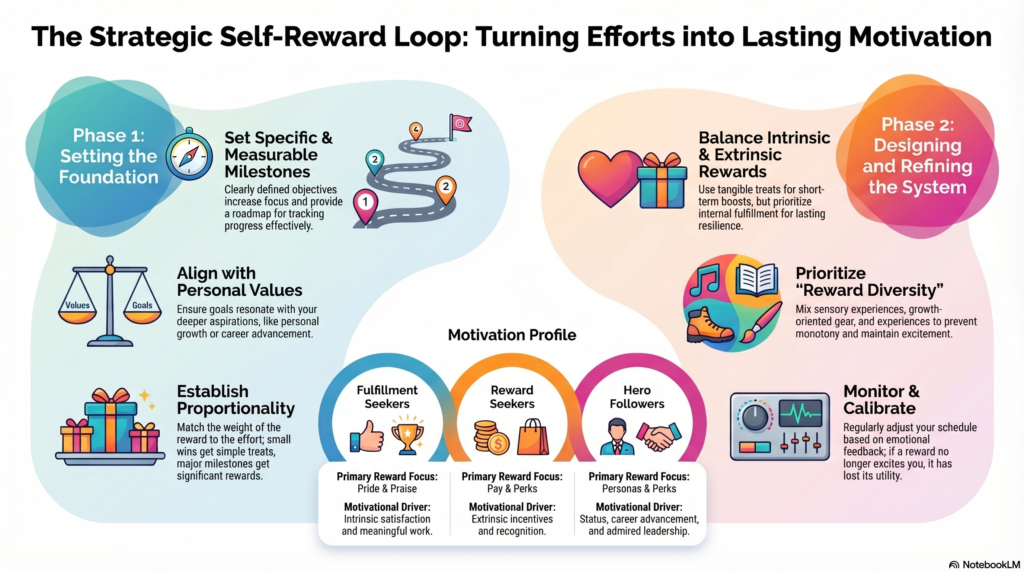
When you set clear, measurable milestones, you aren’t just checking boxes; you’re creating a roadmap for success that respects your autonomy. By blending tangible treats with experiential rewards, you keep the psychological momentum fresh and engaging. Let’s look at how to build this framework with the precision of a strategist and the heart of someone who truly knows how to enjoy the journey.
To build a healthy self-reward system, start by setting clear personal goals that resonate with your values. Identify specific, measurable milestones and celebrate each achievement to nurture your motivation. Choose meaningful rewards that genuinely excite you, blending tangible and experiential options to keep things fresh. Create a flexible reward schedule with clear criteria to maintain accountability and recognize your progress. Regularly monitor your advancements, adjusting your system as needed to stay engaged. Remember, the right balance between intrinsic and extrinsic rewards is essential for lasting motivation, and there’s more to explore on refining your system effectively.
KEY TAKEAWAYS
- Establish clear, specific, and measurable goals to provide direction and enhance motivation in your self-reward system.
- Break down objectives into manageable milestones to celebrate progress and reinforce positive behavior.
- Choose meaningful rewards that align with personal values and contribute to skill enhancement to boost intrinsic motivation.
- Create a structured reward schedule with clear criteria to maintain accountability and momentum without overwhelming yourself.
- Regularly monitor progress and adjust your system based on experiences and feedback to keep it engaging and effective.
UNDERSTAND THE IMPORTANCE OF REWARDS
Recognizing the significance of rewards can profoundly influence your motivation and overall well-being. Rewards serve as a powerful tool in shaping your behaviors and reinforcing positive habits. When you engage in activities that align with your intrinsic motivation—those actions driven by personal satisfaction or fulfillment—you’re more likely to experience a genuine sense of achievement. This internal drive is vital for long-term success and emotional health.
However, it’s important to balance intrinsic motivation with external validation. While external rewards, like praise or tangible incentives, can boost your drive in the short term, relying solely on them might diminish your intrinsic motivation. Research shows that when you prioritize external validation, you risk becoming dependent on others’ approval, potentially stifling your autonomy and creativity.
Instead, you should create a self-reward system that nurtures both types of motivation. Acknowledge your accomplishments, no matter how small, and celebrate them in a way that resonates with you personally. This could be as simple as taking a break to enjoy a favorite hobby or choosing gifts for yourself after reaching a goal.
Identify Your Personal Goals
To create a successful self-reward system, you need to clearly define your objectives and set achievable milestones along the way. With a treat in mind for reaching a target you may be more likely to commit to working towards the goal, and less inclined to procrastinate.
Research shows that specific, measurable goals increase motivation and help you track progress effectively.
Define Your Objectives
Defining your objectives is essential for creating a self-reward system that truly resonates with your personal aspirations. When you take the time to clarify what you want to achieve, you lay the groundwork for meaningful rewards that foster real motivation.
Engage in self-reflection practices to gain insight into your values and desires. Ask yourself what truly matters to you—whether it’s personal growth, career advancement, or fostering relationships.
Once you identify your objectives, you can apply motivation techniques that align with your goals. Research shows that having clear goals increases your chances of success by providing direction and purpose.
Break down your objectives into specific, manageable components that feel attainable yet challenging. This way, you empower yourself to celebrate progress along the way, ensuring that each reward feels justified and inspiring.
Set Achievable Milestones
Setting achievable milestones is an essential step in your self-reward system, as it transforms broad objectives into actionable goals that can be tracked and celebrated. By breaking down your larger aspirations into smaller, manageable milestones, you create a clear path forward. This not only enhances your focus but also fosters a sense of accomplishment along the way. Larger tasks should result in larger rewards whereas smaller tasks should result in smaller rewards.
To effectively implement milestone tracking, start by identifying specific, realistic goals that resonate with your personal values and desires for freedom. Consider what motivates you and use those insights to craft milestones that inspire. For instance, if you’re aiming for a fitness goal, set weekly targets that progressively challenge you without overwhelming your capacity.
Incorporating motivation techniques, like celebrating each milestone achieved, reinforces positive behavior. Whether it’s treating yourself to a favorite activity or simply acknowledging your progress, these rewards keep your momentum alive.
Remember, the journey is just as important as the destination. By setting achievable milestones, you empower yourself to navigate challenges, experience growth, and ultimately, enjoy the freedom that comes with realizing your goals.
Stay committed, stay focused, and watch your dreams become reality.
Choose Meaningful Rewards
Rewards can be powerful motivators in your journey toward self-improvement, but their effectiveness hinges on one essential factor: meaning. When you choose rewards that resonate with your values and aspirations, you enhance your intrinsic motivation and reduce reliance on external validation.
Meaningful rewards not only affirm your accomplishments but also align with your personal goals, making them more impactful.
To guarantee your rewards are meaningful, consider the following:
- Personal Relevance: Choose rewards that reflect your interests or desires. They should feel like a natural extension of your journey.
- Emotional Connection: Opt for rewards that evoke positive emotions. Whether it’s a favorite activity or a cherished experience, emotional resonance can amplify the reward’s effectiveness.
- Growth-Oriented: Select rewards that contribute to your growth. Think about how they can enhance your skills or knowledge, reinforcing the behavior you want to encourage.
Set Clear Criteria for Rewards
Clarity is essential when it comes to establishing a self-reward system, as it guides your decision-making process and enhances your commitment to achieving your goals. To create an effective system, you need to set clear criteria for the rewards you’ll give yourself. Start by identifying different reward types that resonate with you—these could be tangible items, experiences, or even the best gifts for yourself.
Categorizing rewards helps you understand what truly motivates you, allowing for a more personalized approach.
Next, consider reward frequency. How often do you want to reward yourself? Setting a schedule helps in maintaining momentum. For instance, you might decide to reward yourself weekly for smaller accomplishments, while reserving larger rewards for bigger milestones. This balance guarantees that you stay engaged and feel recognized for your efforts without overwhelming yourself.
Be specific about what achievements warrant a reward. Instead of vague goals like “exercise more,” define a measurable target, such as “work out three times a week.” When you meet these criteria, you’ll know exactly when to indulge in your chosen reward type.
This specificity fosters accountability and reinforces your commitment, creating a positive feedback loop.

CREATE A REWARD SCHEDULE
One of the biggest mistakes I see in lifestyle strategy is the “mismatched reward.” If you’ve just completed a grueling three-month project, a single fancy cupcake, while delicious, might not be the right weight for that achievement. On the flip side, rewarding a Tuesday morning workout with a high-end designer watch is a recipe for a system that isn’t sustainable. The magic happens in the proportionality: larger tasks should result in larger rewards, while smaller daily wins should be met with simple, fulfilling acknowledgments.
I always suggest incorporating “reward diversity” to prevent monotony. For some of my intensive writing weeks, my “small” reward is a specific bean from a local roaster I’ve been wanting to try, a sensory experience that aligns with my love for coffee. My “large” reward might be a weekend photography excursion to a place I’ve never been. This diversity creates emotional triggers that make achieving a goal feel like an adventure rather than a chore.
Furthermore, don’t underestimate the power of “growth-oriented” rewards. If you’re working on a fitness goal, a reward could be high-quality gear that makes the activity more enjoyable, effectively reinforcing the positive behavior you’re trying to build. Remember to monitor your progress and be willing to recalibrate; if a reward no longer excites you, it has lost its functional utility in your system.
Creating a reward schedule is essential for reinforcing your progress and maintaining motivation.
Start by defining clear criteria for when you’ll earn rewards, and set realistic timelines to keep yourself accountable. People automatically think of the tangible upon hearing the word “reward”, but research has shown that intrinsic rewards are more powerful. Finding ways to tap into the intrinsic can be a tremendous asset in achieving your goals.
As you implement this schedule, be open to adjusting it based on your experiences and changing goals, ensuring it remains effective and supportive of your journey.
Define Reward Criteria
When you think about what motivates you, establishing clear reward criteria becomes essential for maintaining a healthy self-reward system. By defining what you’ll reward yourself for, you align your actions with your goals, fostering both intrinsic and extrinsic motivation. This clarity helps you stay accountable and reinforces positive behavior.
Consider the following factors when defining your reward criteria:
- Reward diversity: Incorporate various rewards to keep things exciting and prevent monotony. This could range from a day off to a favorite treat.
- Emotional triggers: Identify what makes you feel good and use those feelings to create positive associations with your achievements.
- Reward frequency: Balance short-term rewards for small milestones with larger rewards for significant achievements to maintain motivation over time.
Set Timelines for Rewards
Establishing a clear reward schedule can greatly enhance your motivation and accountability. When you set specific timelines for rewards, you create a structure that helps you stay committed to your goals.
Consider your reward frequency; whether it’s daily, weekly, or monthly, aligning your rewards with your progress can make the experience more satisfying and meaningful.
Think about the different reward types that resonate with you. Some people thrive on tangible rewards, like a special treat or a new book, while others may prefer experiential rewards, such as a day off or a fun outing.
By mixing reward types, you keep your motivation fresh and engaging.
It’s crucial to guarantee that the rewards are proportionate to the effort you’ve invested. If you’ve accomplished a significant milestone, a larger or more exciting reward might be appropriate.
On the other hand, smaller achievements could earn you something simple yet fulfilling.
Adjust as Needed
A flexible reward schedule can considerably enhance your motivation and help you stay aligned with your goals. Adjusting your rewards as needed not only supports habit formation but also nurtures your emotional well-being.
You’ll discover that intrinsic motivation thrives when you engage in a self care activity that resonates with you, rather than relying solely on external validation.
Consider incorporating these elements into your reward schedule:
- Regular Check-Ins: Assess your progress with accountability partners to guarantee your rewards align with your growth.
- Variety of Rewards: Mix up your rewards to keep them exciting and relevant to your journey.
- Adapt Based on Feedback: Listen to your feelings and experiences; adjust rewards that may not serve you well anymore.
Monitor Your Progress
Monitoring your progress is essential in building a healthy self-reward system. It allows you to understand what’s working and what needs adjustment. By actively engaging in progress tracking, you create a clearer picture of your achievements and setbacks. This awareness empowers you to celebrate victories, no matter how small, and recalibrate your efforts when necessary.
When you set specific goals, establish regular intervals for evaluating your progress. This could be weekly or monthly—whatever suits your lifestyle. Use journals, apps, or spreadsheets to record your milestones. This tangible evidence of your journey fosters a sense of accountability and motivation.
Additionally, the act of documenting your progress creates feedback loops, reinforcing positive behaviors and helping you identify patterns. You’re not just measuring success; you’re cultivating a deeper understanding of yourself. Each time you review your progress, you gain insights into your strengths and areas for growth.
This reflection can be incredibly liberating, as it encourages a mindset of continuous improvement rather than a fixed outcome. As you monitor your progress, be open to the emotions that surface. It’s natural to feel a mix of pride and disappointment. Acknowledge these feelings, and use them as fuel to propel you forward.
Adjust and Refine Your System
As you progress in building your self-reward system, it’s vital to adjust and refine your approach based on what you’ve learned through monitoring. This adaptability is fundamental for creating a system that truly resonates with your desires and motivations.
By evaluating your current reward types and reward frequency, you can make informed adjustments that enhance your experience.
Consider the following strategies to fine-tune your system:
- Evaluate Reward Types: Are your rewards still meaningful? If you find that certain rewards no longer excite you, it’s time to explore new options. Experiment with different types of rewards, such as experiences, treats, or leisure activities, to keep things fresh.
- Adjust Reward Frequency: Reflect on how often you reward yourself. Too frequent rewards may lessen their impact, while infrequent ones mightn’t provide enough motivation. Striking the right balance can make a significant difference in your commitment to your goals.
- Solicit Feedback: Share your system with trusted friends or mentors. They can offer valuable insights and suggestions that you mightn’t have considered, helping you refine your approach further.

RELATED STUDIES ABOUT SELF REWARD SYSTEM
Building a healthy self-reward system is essential for motivation and personal growth. By understanding your goals and choosing rewards that resonate with you, you create a positive feedback loop. As you monitor your progress and refine your approach, ask yourself: how does it feel to celebrate your achievements, no matter how small? Embracing this journey not only boosts your confidence but also fosters a deeper connection to your aspirations, empowering you to reach new heights.
Fulfillment or Status: Job Seekers’ Reward Expectations Towards Family and Non-Family Employers
Objective & Research Question
The study investigates whether and how senior-level job seekers applying for management positions differ in their reward expectations between family-owned firms (FFs) and non-family-owned firms (NFFs). It explores how distinct combinations of expected rewards influence applicants’ decisions to apply to one type of employer over the other.
Methodology
- Data Source: 756 senior-level job applicants in Switzerland (2009–2013), drawn from actual job advertisements.
- Method: Qualitative Comparative Analysis (QCA) to identify configurations of reward preferences (“profiles”) that consistently lead to applying to FFs or NFFs.
- Key Rewards Analyzed (5 Ps):
- Pay (high salary)
- Perks (additional benefits)
- Personas (working for admired superiors)
- Praise (recognition for performance)
- Pride (sense of accomplishment)
Key Findings
- Two Distinct Profiles Apply to Family Firms:
- Fulfillment Seekers: Value Praise and Pride, but do not prioritize Pay or Personas. They are intrinsically motivated and seek personal recognition and meaningful work.
- Reward Seekers: Value Praise, Pay, and Perks, but not Personas. They are extrinsically motivated but still desire recognition and financial rewards.
Both groups share a strong need for praise and no desire to work for admired superiors.
- One Overarching Profile Applies to Non-Family Firms:
- Hero Followers: Value Personas (admired leaders) and Perks, but do not value Praise or Pride. They are motivated by status, career advancement, and extrinsic rewards, and prefer working under respected leaders in larger, professionally managed firms.
- Recurring Patterns:
- Family firm applicants consistently seek praise and avoid prioritizing personas.
- Non-family firm applicants prioritize personas and perks, while downplaying praise and pride.
- Economic rewards (Pay) alone do not differentiate applicants; they matter only in combination with non-economic rewards.
Theoretical Contributions
- Extends Person-Organization Fit Theory to the family business context, showing that reward expectations shape employer attractiveness.
- Demonstrates that applicants use ownership status (family vs. non-family) as a cue to infer reward structures and cultural fit.
- Highlights asymmetric and configurational relationships between rewards—different combinations attract different applicant types.
Practical Implications
For Family Firms:
- Tailor employer branding to highlight non-economic rewards (e.g., recognition, pride, community) to attract Fulfillment Seekers.
- Communicate family ownership clearly—it serves as a signal for relational and stable work environments.
- For Reward Seekers, emphasize fair compensation, job security, and praise—not just lower salaries.
For Recruitment:
- Segment job ads and interviews based on reward profiles to improve person-organization fit.
- Understand that not all applicants value the same rewards—family firms can compete by leveraging their unique cultural and relational strengths.
Limitations & Future Research
- Cross-sectional data limits causal inference.
- Sample restricted to Swiss German-speaking region and post-2008 crisis period.
- Excluded applicants who applied to both FF and NFF.
- Future studies should use longitudinal or qualitative designs to explore underlying mechanisms and cross-cultural differences.
Conclusion
Family and non-family firms attract different types of senior management candidates based on distinct reward expectations. Family firms can improve recruitment by strategically emphasizing praise, pride, and relational rewards, while non-family firms appeal to those seeking status, admired leadership, and perks. Understanding these profiles helps both types of employers design more effective recruitment and retention strategies.
| REFERENCE: Annika Ehlers, Ryan Rumble, Claudia Binz Astrachan, Massimo Baù, Fulfillment or status: Job seekers’ reward expectations towards family and non-family employers, Journal of Family Business Strategy, Volume 15, Issue 4, 2024, 100634, ISSN 1877-8585, https://doi.org/10.1016/j.jfbs.2024.100634. (https://www.sciencedirect.com/science/article/pii/S1877858524000299) |
Enhancing Team Creativity Among Information Technology Professionals Through Knowledge Sharing and Motivational Rewards: A Self-Determination Perspective
Objective & Research Questions
The study investigates how knowledge sharing (KS) and motivational rewards enhance team creativity among IT professionals. It specifically examines:
- How in-role KS (formal, job-required sharing) and extra-role KS (voluntary, beyond-requirements sharing) affect team creativity.
- How different motivational rewards (intrinsic vs. extrinsic) drive employees to engage in both types of KS.
- Whether extrinsic rewards (relationship and image rewards) are internalized into intrinsic motivation.
Theoretical Foundation
- Self-Determination Theory (SDT): Explains how intrinsic and extrinsic motivations influence behavior.
- Organizational Citizenship Behavior (OCB): Distinguishes between in-role (required) and extra-role (voluntary) behaviors, applied here to KS.
Methodology
- Sample: 322 employees in 80 IT teams across China (Hong Kong, Beijing, Shenzhen).
- Design: Paired surveys from team leaders and members; analyzed using CB-SEM and PROCESS mediation models.
- Key Variables:
- Motivational Rewards: Intrinsic rewards, relationship rewards, image rewards.
- KS Types: In-role KS, extra-role KS.
- Outcome: Team creativity (rated by team leaders).
Key Findings
- Effects of KS on Team Creativity:
- Extra-role KS has a direct positive effect on team creativity.
- In-role KS does not directly affect team creativity but indirectly enhances it by increasing extra-role KS (full mediation).
- Extra-role KS is a stronger driver of creativity than in-role KS.
- Effects of Motivational Rewards on KS:
- Intrinsic rewards strongly drive both in-role and extra-role KS, with a stronger effect on extra-role KS.
- Relationship rewards positively affect both KS types (no significant difference in strength).
- Image rewards significantly affect only in-role KS (not extra-role KS).
- Internalization of Extrinsic Rewards:
- Both relationship and image rewards positively influence intrinsic rewards, confirming internalization.
- This means extrinsic rewards can enhance intrinsic motivation, which in turn boosts KS.
Theoretical Contributions
- Extends SDT and OCB to the KS context in IT teams.
- Demonstrates internalization of extrinsic rewards as a key mechanism.
- Provides a comparative analysis of how different rewards affect in-role vs. extra-role KS.
- Confirms extra-role KS as a critical mediator between in-role KS and team creativity.
Practical Implications
For IT Managers & Leaders:
- Promote extra-role KS through supportive climates, recognition, and fairness.
- Boost intrinsic motivation by granting autonomy, providing positive feedback, and using engaging KS channels (e.g., social media).
- Leverage relationship-building (e.g., open office layouts, team-building) to enhance KS.
- Use image rewards (e.g., praise, recognition programs) to encourage in-role KS and indirectly strengthen intrinsic motivation.
For HR & Organizational Design:
- Design reward systems that blend intrinsic and extrinsic motivators.
- Foster collaborative cultures that reduce unhealthy competition and encourage voluntary sharing.
Limitations & Future Research
- Cultural limitation: Data collected only in China; cross-cultural validation needed.
- Cross-sectional design: Longitudinal studies could examine reciprocal relationships.
- Unexplored mechanisms: Future research should investigate how KS translates into creative ideas.
- Competition effects: Interpersonal competition may inhibit KS and should be studied.
Conclusion
Team creativity in IT is best enhanced by fostering extra-role knowledge sharing, which is most effectively motivated by intrinsic rewards. Extrinsic rewards—especially relationship and image rewards—can be internalized to boost intrinsic motivation. Managers should create environments that encourage voluntary, beyond-role sharing while recognizing and rewarding collaborative behaviors.
| REFERENCE: Xiling Cui, Xuan Yang, Jifan Ren, Paul Benjamin Lowry, Timon Chih-ting Du, Enhancing team creativity among information technology professionals through knowledge sharing and motivational rewards: A self-determination perspective, Data and Information Management, Volume 9, Issue 2, 2025, 100075, ISSN 2543-9251, https://doi.org/10.1016/j.dim.2024.100075. (https://www.sciencedirect.com/science/article/pii/S2543925124000111) |
Social Stress Enhances Intuitive Prosocial Behavior In Males While Disrupting Self-Reward Processing: Evidence From Behavioral, Computational, And Neuroimaging Studies
Key Question: How does acute social stress influence prosocial decision-making, and what are the underlying neural mechanisms?
Core Findings:
- Behavioral & Hormonal Effect: In male participants, elevated cortisol levels following a social stressor were associated with increased generosity in a specific context: when choosing a “disadvantageous unequal” option (giving more money to another person than to oneself). Stress reduced aversion to personal disadvantage, making individuals more likely to act prosocially even when it was personally costly.
- Neural Mechanism – A Dual-Process Shift: Neuroimaging (fMRI) revealed that stress reconfigures the brain’s value-computation system:
- It enhanced activity in the ventral medial prefrontal cortex (vmPFC), a region linked to intuitive, emotional, and social reward processing.
- It suppressed activity in the dorsal medial prefrontal cortex (dmPFC), a region responsible for deliberative, strategic thinking and integrating contextual information (like social distance).
- Mediation analyses confirmed that these distinct neural patterns (increased vmPFC and decreased dmPFC signaling) explained the link between higher cortisol and reduced inequality aversion.
- Brain Network Communication: Effective connectivity analysis showed that cortisol differentially modulates cortico-striatal brain loops:
- It strengthened the “ventral” pathway (ventral striatum to dmPFC), associated with intuitive/habitual responses.
- It weakened the “dorsal” pathway (dorsal striatum to dmPFC), crucial for goal-directed, deliberative control. This disruption hinders the cognitive processing of self-reward and disadvantage.
Interpretation: Social stress promotes intuitive prosociality by shifting decision-making from a slow, deliberate, self-interested mode (dmPFC/dorsal loop) to a fast, intuitive, socially-oriented mode (vmPFC/ventral loop). In contexts where generosity is the intuitive response, stress makes it the “path of least resistance.”
Methodology Highlights:
- Participants: 49 healthy males (41 analyzed).
- Stress Induction: Montreal Imaging Stress Task (MIST) inside the MRI scanner.
- Key Task: Modified social discounting task with equal (self and other get same amount) and disadvantageous unequal (other gets more than self) conditions across varying social distances.
- Measures: Salivary cortisol, fMRI, computational modeling (hierarchical Bayesian) to separate motivational components (social discounting, self-reward sensitivity, inequality aversion).
Limitations:
- Participants were all male to control for menstrual cycle effects on cortisol.
- The laboratory stressor may not fully capture real-world stress complexity.
- The design cannot definitively separate intuitive from deliberative processes.
- The causal brain connectivity model (DCM) has inherent assumptions.
Conclusion: This study provides an integrated mechanistic account of how acute social stress can enhance prosocial behavior. It is not a uniform boost in “niceness,” but rather a reconfiguration of neural value computation that favors intuitive, socially-rewarding choices while impairing the deliberative cost-benefit analysis typically used to maximize self-interest in unequal situations.
| REFERENCE: Kun Il Kim, Jeung-Hyun Lee, Woo-Young Ahn, Hackjin Kim, Social stress enhances intuitive prosocial behavior in males while disrupting self-reward processing: Evidence from behavioral, computational, and neuroimaging studies, NeuroImage, Volume 315, 2025, 121273, ISSN 1053-8119, https://doi.org/10.1016/j.neuroimage.2025.121273. (https://www.sciencedirect.com/science/article/pii/S1053811925002769) |
CONCLUSION
As we wrap up this exploration of self-reward systems, I want to leave you with a thought on the concept of “fulfillment” versus “status”. In my study of behavioral patterns, it’s clear that the rewards that truly stick, the ones that foster lasting confidence and a deeper connection to our aspirations, are those that provide a sense of personal pride and accomplishment. While external perks like praise or tangible incentives have their place in the short term, they should ideally be internalized to boost your intrinsic motivation.
I often find that the most profound rewards are those that allow us to reflect on how far we’ve come. Whether it’s documenting your wins in a journal or sharing a milestone with a trusted mentor, these acts of recognition create a positive feedback loop that empowers you to reach new heights. Don’t be afraid to be your own best advocate.
In a world that often demands we move constantly to the next task without a pause, taking the time to celebrate your achievements, no matter how small, is a radical act of self-care. By refining your system over time and listening to your own emotional feedback, you transform the way you work and live. So, go ahead: set that goal, hit that milestone, and treat yourself with the intentionality you deserve. It’s not just an indulgence; it’s a strategy for a life well-lived.