In our current culture of relentless optimization, we often view our time through a lens of ROI, what am I gaining from this hour? Even our relaxation is sometimes “productive,” like listening to a business podcast while at the gym. But there is a profound, scientifically-backed magic in doing something purely for the joy of it, and painting is perhaps the most accessible portal to that state. For me, picking up a brush isn’t about creating a masterpiece for a gallery; it’s about giving my brain permission to play.
I’ve seen firsthand how an “unproductive” hobby like painting can actually be the most productive thing you do for your mental health. It provides a calming retreat from the sensory overload of everyday life, allowing you to reveal your own emotional landscape through color and movement. It’s a safe space to be vulnerable, where the stakes are zero but the personal rewards are enormous.
Whether you are an accountant looking to quiet a busy mind or a designer wanting to explore divergent thinking, painting forces you to slow down and reconnect with yourself. It’s not just a pastime; it is a vital self-care activity that nurtures emotional balance and inner calm.
Painting is the perfect hobby for you because it helps you grow personally while offering a calming retreat from everyday stress. As you explore colors and strokes, you uncover your own emotions and thoughts, fostering self-discovery. This creative process not only provides a safe space for vulnerability, but it also enhances your focus and sharpens your motor skills. Engaging with painting encourages mindfulness and allows you to express yourself authentically. Plus, connecting with fellow artists can enrich your experience and build confidence. There’s so much more to uncover about the benefits of embracing this art form.
KEY TAKEAWAYS
- Painting fosters self-discovery by revealing emotions and thoughts, making the creative process as meaningful as the final artwork.
- Engaging in painting reduces stress, providing a therapeutic escape that encourages vulnerability and emotional exploration.
- The act of painting enhances focus and concentration, improving motor skills and sensory awareness through learned techniques and composition.
- Painting cultivates mindfulness by promoting present-moment engagement, allowing for a peaceful and meditative creative experience.
- Participation in painting communities builds social connections, enhancing confidence and providing opportunities for collaboration and feedback.
BENEFITS OF CREATIVE EXPRESSION
Creative expression isn’t just a pastime; it’s a powerful tool for personal growth and relaxation. When you engage in artistic exploration, you reveal a world where your imagination can run wild. This imaginative freedom allows you to investigate your thoughts and feelings, creating a safe space for self-discovery. Each brushstroke or pencil line becomes a pathway to understanding yourself better, revealing layers you may not have known existed.
As you paint, you shift your focus away from daily stressors, immersing yourself in the present moment, making painting a powerful self care activity that nurtures both emotional balance and inner calm. This act of creation can be meditative, allowing your mind to reset. You may find that the colors and shapes you choose reflect your inner state, offering insights into your emotional landscape. It’s not about the end product; it’s about the journey and the joy that comes with it.
Moreover, embracing creative expression fosters resilience. You learn to take risks, experiment, and embrace imperfections, which can translate to other areas of your life. Every time you pick up a brush, you give yourself permission to explore new ideas and perspectives, nurturing a sense of freedom that’s often hard to come by.
Emotional Release Through Painting
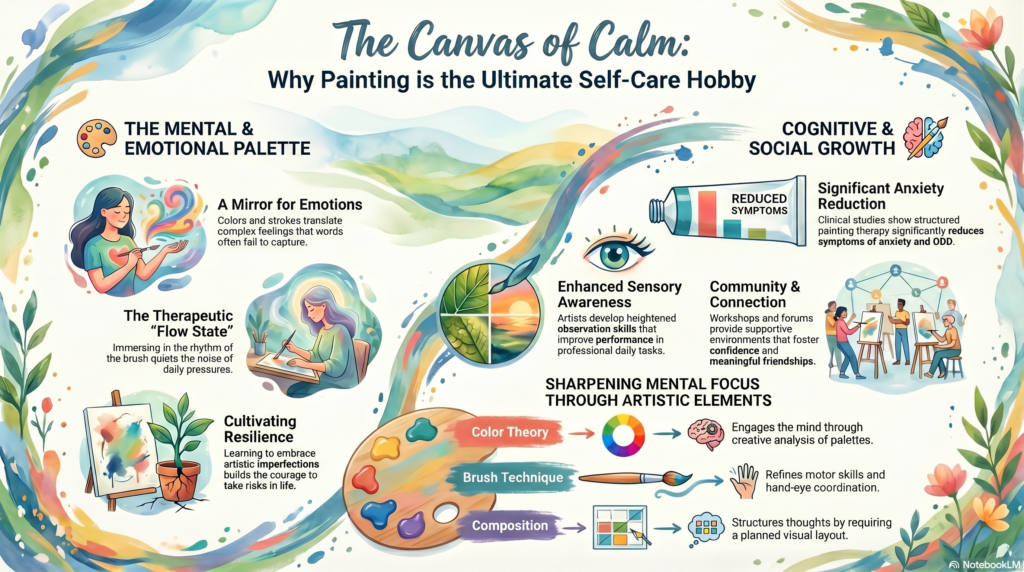
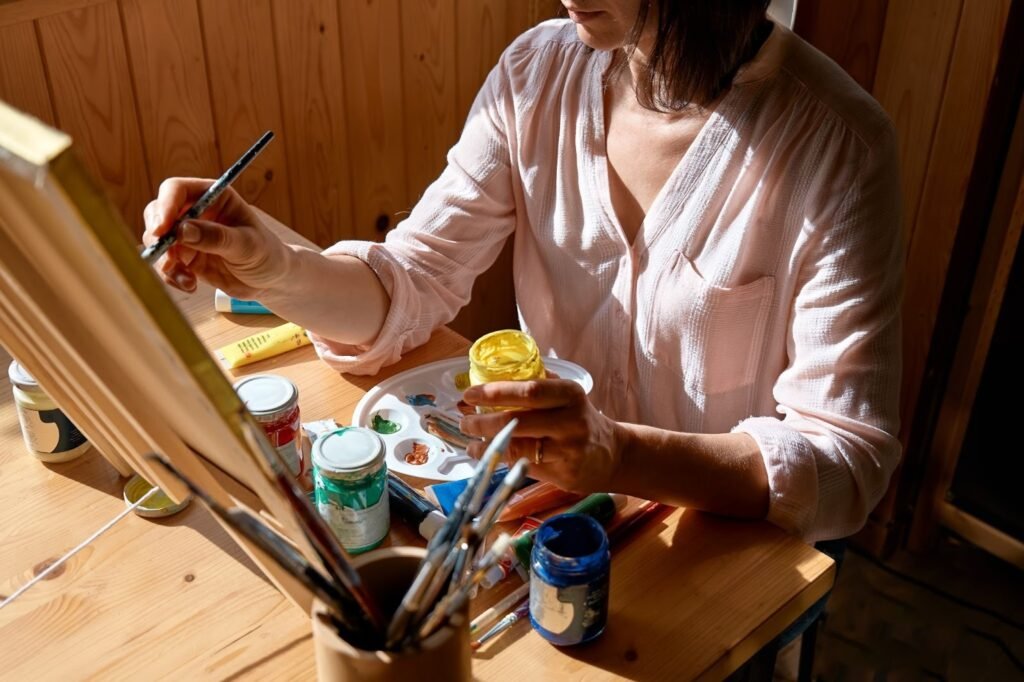
When you dive into the technical side of painting, the color theory, the brush techniques, the composition, something shift internally. You aren’t just learning to arrange elements harmoniously on a canvas; you are training your brain to focus and stay present. This “flow state” is where the real healing happens. By immersing yourself in the rhythm of the brush, you create a mindful escape that quiets the noise of daily pressures.
I often tell my clients that the canvas is a mirror. Each stroke reflects your mood and gives a voice to feelings that words often fail to capture. We see this in clinical studies too; for example, structured painting therapy has been shown to significantly reduce symptoms of anxiety and oppositional behavior in children by providing a healthy outlet for emotional expression. But you don’t need a diagnosis to benefit from this.
The simple act of choosing a blue for calm or a yellow for joy allows you to navigate complex feelings in a tangible way. Moreover, embracing the creative process builds a resilient “inner strength.” Every time you embrace an imperfection or try a new technique, you are building the courage to take risks, a skill that spills over into your professional and personal life. You learn to trust your instincts and value your unique perspective, which is the ultimate foundation for self-esteem.
Painting offers a unique way to express your inner feelings, letting colors and strokes translate emotions that words sometimes can’t capture.
As you immerse yourself in this creative process, you might find that stress levels begin to melt away, replaced by a sense of calm and clarity—similar to how physical activities like painting or even learning about hiking benefits for legs contribute to overall well-being by strengthening both body and mind.
Embracing this emotional release can be a powerful step toward personal growth and well-being.
Expressing Inner Feelings
Art can serve as a powerful outlet for emotions that often remain locked inside. When you pick up a brush, you’re not just creating a picture; you’re giving a voice to your inner feelings. Each stroke can reflect your mood, allowing you to express what words sometimes can’t. Through color symbolism, you can intuitively choose hues that resonate with your emotions—red for passion, blue for sadness, or yellow for joy. This artistic interpretation helps you navigate complex feelings, turning them into something tangible.
As you paint, you might find that the act itself becomes therapeutic. The canvas becomes a safe space where you can explore vulnerability without judgment. You can let go of societal expectations and embrace your unique emotional landscape. Every color, every shape, has meaning, and you hold the power to translate your experiences into visual form.
This journey of self-expression through painting isn’t just about the final product; it’s about the release, the exploration, and the freedom to be authentically you.
Reducing Stress Levels
When you immerse yourself in the act of painting, you might find that stress begins to melt away. This isn’t just a coincidence; it’s a powerful form of art therapy. By focusing on colors and brush strokes, you create a safe space for your emotions to flow. As you mix colors and apply them to the canvas, you reveal a world of expression that can lift the weight of your worries.
Color psychology plays an essential role in this process. Different colors evoke specific feelings—blues can calm you, while yellows can energize you. As you choose hues that resonate with your mood, you actively engage in a dialogue with your inner self. This connection allows for emotional release, helping you to let go of anxiety and tension.
Painting also offers a mindful escape from daily pressures, much like engaging in gentle physical activities and experiencing swimming benefits, where rhythmic movement and focus promote relaxation, mental clarity, and emotional balance. You can lose yourself in the rhythm of the brush, finding clarity and peace. Embracing this creative outlet not only reduces stress but also empowers you to explore your emotions freely.
Developing New Skills
Stepping into the world of painting opens up a unique opportunity for you to develop new skills that can enhance both your creativity and self-expression. Every brushstroke is a chance to explore your potential. Studies show that despite those fears, “engaging in any sort of visual expression results in the reward pathway in the brain being activated,”. As you immerse yourself in color theory, you’ll learn how different hues interact, evoke emotions, and transform your artwork. Understanding this fundamental aspect not only broadens your palette but also empowers you to convey feelings in a way that resonates with others.
Equally important are brush techniques. Experimenting with various strokes can greatly impact the texture and depth of your work. Whether it’s a gentle wash or a bold swipe, each technique adds a new dimension to your artistic journey.
Here’s a quick overview of some essential skills you can develop through painting:
| Skill | Description |
| Color Theory | Learn how colors work together and influence mood. |
| Brush Techniques | Master different strokes for varied effects. |
| Composition Basics | Understand how to arrange elements harmoniously. |
As you practice and refine these skills, you’ll discover a newfound freedom in your artistry. Embrace the process, allowing yourself to make mistakes and learn from them. Each piece you create reflects your growth, creativity, and unique voice. So grab your brushes, let go of any inhibitions, and start this beautiful journey of self-discovery through painting!
CULTIVATING MINDFULNESS
Painting offers a powerful avenue for cultivating mindfulness, allowing you to fully engage with the present moment. When you immerse yourself in the process of creating art, you’re not just putting brush to canvas; you’re inviting your thoughts to settle and your worries to fade. Painting is a way for children to do many important things: convey ideas, express emotion, use their senses, explore color, explore process and outcomes, and create aesthetically pleasing works and experiences.
This is where art therapy shines, as it encourages you to express emotions and explore your inner world without judgment. As you focus on each stroke, color, and texture, you can tap into a state of mindful creativity. This practice enables you to let go of distractions, fostering a deeper connection with yourself and the act of creation.
You may find that simply observing how the paint flows or how the colors blend can ground you, making the chaos of life seem more manageable. Embracing this mindful approach can lead to a profound sense of peace and clarity.
It’s about being present and aware of each moment, allowing your feelings to surface and transform through your art. Whether you’re a seasoned painter or just starting, you have the opportunity to experience personal growth through this journey.
Building Confidence and Self-Esteem
How can engaging in the creative process boost your confidence and self-esteem? When you pick up a paintbrush, you’re not just creating art; you’re initiating a journey of self-discovery. Each stroke allows you to express your feelings, thoughts, and artistic identity. This expression fosters a sense of ownership over your work, and with it, a burgeoning confidence that spills into other areas of your life.
As you experiment with colors, techniques, and styles, you’re offering yourself the space to explore and reflect on who you are. This personal reflection isn’t merely about the final product; it’s about the courage to make mistakes, to learn, and to grow. Every completed piece, regardless of its perceived quality, becomes a reflection of your effort and creativity. You start to see the value in your unique perspective, and that realization can be incredibly empowering.
With every layer of paint, you’re not only building art; you’re building self-esteem. You learn to trust your instincts and appreciate your choices, which leads to a more profound acceptance of yourself. Instead of seeking validation from others, you find it within.
This inner strength gives you the freedom to explore more than just painting; it opens the door to new experiences and challenges in your life.
Social Connections and Community
As you build confidence and self-esteem through your artistic journey, you may find that this newfound sense of self extends beyond your canvas and into your relationships. Engaging in painting opens doors to social connections, allowing you to connect with like-minded individuals who share your passion.
Participating in art workshops or local art groups can help you forge meaningful friendships while exploring your creativity together. You’ll likely discover community events and social gatherings centered around art that invite you to showcase your work.
These experiences not only boost your confidence but also place you in a supportive environment where you can learn from others. Collaborative projects can foster a sense of belonging, as you contribute to something greater than yourself, creating bonds that often last beyond the final brushstroke.
Don’t underestimate the power of online forums, either. They can provide a platform for sharing your art, getting feedback, and connecting with fellow artists from around the world. These virtual spaces can enhance your sense of community, particularly if local options are limited.
Moreover, group exhibitions and art classes are fantastic ways to celebrate your progress alongside others. You’ll witness diverse styles and approaches, inspiring you to grow further in your craft.
Embracing these social aspects of painting not only enriches your creative experience but also nurtures your soul, allowing you to thrive in a supportive environment filled with opportunities for connection and collaboration.
Enhancing Focus and Concentration
Many artists find that immersing themselves in their craft can greatly enhance their focus and concentration. When you plunge into painting, you’re not just creating art; you’re also honing your ability to concentrate deeply on a single task. The vibrant colors you mix and the brush techniques you employ demand your undivided attention. This process can help quiet the noise of everyday life, allowing you to become fully present.
Take a moment to explore how painting can sharpen your focus through various elements:
| Aspect | Impact on Focus | Example |
| Color Theory | Engaging the mind creatively | Experimenting with palettes |
| Brush Techniques | Refining motor skills | Practicing strokes |
| Composition | Structuring thoughts | Planning your layout |
| Texture | Heightening sensory awareness | Incorporating mixed media |
| Observation | Enhancing detail recognition | Studying subjects closely |
As you explore color theory, you’ll find yourself analyzing hues and relationships, which requires a level of concentration that translates into other areas of life. Practicing brush techniques not only makes your art more refined but also improves your hand-eye coordination. The more you paint, the more you train your brain to focus, leading to increased productivity and clarity in your daily tasks. Like many things in life, practicing art means one will be increasing in skill and persevering through struggle, which helps improve confidence. Another confidence builder is that once some art has been created, this can be something that you and others value.
RELATED STUDIES ABOUT BENEFITS OF PAINTING
Painting isn’t just a hobby; it’s a journey of self-discovery and healing. It helps you express emotions, develop skills, and cultivate mindfulness. As you build confidence and forge connections with others, you’ll find joy and purpose in each brushstroke. Embrace the process, savor the colors, and let your creativity flow. In every canvas, you’ll uncover new layers of yourself, and in every moment spent painting, you’ll discover peace and personal growth waiting to be revealed.
The Effect of Art Therapy Based on Painting Therapy in Reducing Symptoms of Oppositional Defiant Disorder (ODD) in Elementary School Boys
Study Objective: This research aimed to investigate the effectiveness of art therapy, specifically painting therapy, in reducing the symptoms of Oppositional Defiant Disorder (ODD) in boys aged 7–12 years.
Methodology:
- Participants: 30 elementary school boys with ODD symptoms were selected through a two-step process:
- Initial screening using the Child Symptom Inventory-4 (CSI-4).
- Final confirmation via a Structured Diagnostic Interview based on DSM-IV-TR criteria.
- Design: An experimental pretest-posttest control group design was employed.
- Intervention: The experimental group underwent a painting-based art therapy program consisting of 12 sessions (twice weekly, 40 minutes each). The sessions incorporated discussion and reviews with parents and teachers.
- Analysis: Data were analyzed using descriptive statistics and Analysis of Covariance (ANCOVA).
Key Findings:
- The experimental group showed a statistically significant reduction in ODD symptoms following the art therapy intervention.
- The control group showed no significant change in symptoms.
- Statistical analysis (ANCOVA) confirmed that the painting therapy had a significant effect on reducing ODD symptoms (F(1,27) = 18.018, p < 0.05).
- Qualitative observations noted improvements in the experimental group, including more adaptive behaviors and emotions, increased sharing of feelings, and enhanced communication skills.
Conclusion: The study provides evidence that structured painting therapy is an effective intervention for reducing symptoms of Oppositional Defiant Disorder in elementary school-aged boys. The results suggest that art therapy can facilitate emotional expression, improve social communication, and promote adaptive behaviors in this population.
Implications: The findings support the integration of art therapy into comprehensive treatment plans for children with ODD, particularly in school or counseling settings. Further research is recommended to explore long-term effects and applications across diverse groups.
| REFERENCE: Mojtaba Gholamzade Khadar, Jalil Babapour, Hassan Sabourimoghaddam, The Effect of Art Therapy Based on Painting Therapy in Reducing Symptoms of Oppositional Defiant Disorder (ODD) in Elementary School Boys, Procedia – Social and Behavioral Sciences, Volume 84, 2013, Pages 1872-1878, ISSN 1877-0428, https://doi.org/10.1016/j.sbspro.2013.07.051. (https://www.sciencedirect.com/science/article/pii/S187704281301923X) |
The Effect of Art Therapy Based on Painting Therapy in Reducing Symptoms of Separation Anxiety Disorder (SAD) in Elementary School Boys
Study Objective: This research aimed to investigate the effectiveness of art therapy, specifically painting therapy, in reducing the symptoms of Separation Anxiety Disorder (SAD) in boys aged 7–12 years.
Methodology:
- Participants: 30 elementary school boys with SAD symptoms were selected through a two-step process:
- Initial screening using the Child Symptom Inventory-4 (CSI-4).
- Final confirmation via a Structured Diagnostic Interview based on DSM-IV-TR criteria.
- Design: An experimental pretest-posttest control group design was employed.
- Intervention: The experimental group underwent a painting-based art therapy program consisting of 12 sessions (twice weekly, 40 minutes each). The sessions incorporated discussion and reviews with parents and teachers.
- Analysis: Data were analyzed using descriptive statistics and Analysis of Covariance (ANCOVA).
Key Findings:
- The experimental group showed a statistically significant reduction in Separation Anxiety Disorder symptoms following the art therapy intervention.
- The control group showed no significant change in symptoms.
- Statistical analysis (ANCOVA) confirmed that the painting therapy had a significant effect on reducing SAD symptoms (F(1,27) = 35.062, p < 0.05).
- Qualitative observations noted improvements in the experimental group, including more adaptive behaviors and emotions, increased sharing of feelings, and enhanced communication skills.
Conclusion: The study provides evidence that structured painting therapy is an effective intervention for reducing symptoms of Separation Anxiety Disorder in elementary school-aged boys. The results suggest that art therapy can provide a valuable outlet for emotional expression, reduce anxiety related to separation, and improve overall psychosocial functioning in this population.
Implications: The findings support the use of art therapy as a beneficial component in the treatment plan for children with SAD, particularly in school or clinical counseling settings. Further research is recommended to explore long-term outcomes and the therapy’s efficacy across different age groups and settings.
| REFERENCE: Mojtaba Gholamzade Khadar, Jalil Babapour, Hassan Sabourimoghaddam, The Effect of Art Therapy based on Painting Therapy in Reducing Symptoms of Separation Anxiety Disorder (SAD) in Elementary School Boys, Procedia – Social and Behavioral Sciences, Volume 84, 2013, Pages 1697-1703, ISSN 1877-0428, https://doi.org/10.1016/j.sbspro.2013.07.016. (https://www.sciencedirect.com/science/article/pii/S1877042813018880) |
Lineal Development Characteristics of Preschool Children’s Paintings
Study Objective: This descriptive research aimed to identify the characteristics of lineal (graphic/line-based) development in the paintings of children aged 2 to 6 years, observing how their drawing skills evolve through defined developmental periods.
Methodology:
- Participants: 125 preschool children (62 girls, 63 boys), with 25 children from each single-year age group from 2 to 6.
- Procedure: Children were given approximately 40 minutes to draw on A4 paper using crayons or pastels on the theme “our home, our family.” Accompanying interviews and personal information were recorded.
- Analysis: Drawings were analyzed by three independent experts against pre-defined critical characteristics for three developmental periods:
- Scribbling Period (ages 2-4)
- Pre-Schema Period (ages 4-7), subdivided for ages 4-5 and age 6.
- Schematic Period (ages 7-9) — included to identify advanced skills.
Key Findings:
- Age-Appropriate Development: Children’s drawings generally exhibited the lineal characteristics typical of their chronological age group.
- Individual Variation: Within each age group, some children displayed characteristics of either a preceding (lower) or subsequent (upper) developmental period, indicating that lineal development does not occur uniformly.
- Specific Observations by Age:
- Ages 2-3: Predominantly scribbling (horizontal, vertical, circular lines drawn without lifting the tool). Limited control and short drawing duration were noted.
- Age 4: Drawings showed disorderly placement of shapes (e.g., coarse human figures, houses), but the transition from scribbling to more representational forms began.
- Age 5: Increased schematic ability; human figures featured a head with attached lines for body and limbs (tadpole/stick figures).
- Age 6: Further progression within the Pre-Schema Period; some children began showing early Schematic Period traits (e.g., better spatial organization, baseline use).
Conclusion: The study confirms that lineal development in children’s art follows a general, stage-like progression but is significantly influenced by individual differences and environmental factors. The presence of drawings with characteristics from adjacent periods highlights the variability in developmental pace.
Implications: The findings underscore the importance for preschool teachers and parents to:
- Observe children’s artistic development while considering individual differences.
- Use knowledge of lineal development stages to understand a child’s motor and cognitive growth.
- Inform the planning and supportive follow-up of artistic activities tailored to a child’s specific developmental level.
| REFERENCE: Betül Soylu, Perihan Ünüvar, Sevinç Pişgin Çivik, Lineal Development Chracteristics of Preschool Children Paintings, Procedia – Social and Behavioral Sciences, Volume 174, 2015, Pages 687-692, ISSN 1877-0428, https://doi.org/10.1016/j.sbspro.2015.01.602. (https://www.sciencedirect.com/science/article/pii/S1877042815006539) |
CONCLUSION
As we look at the broader picture, it becomes clear that painting is a journey of self-discovery that never truly ends. It’s not just about what happens on the canvas; it’s about how it changes your vision of the world. You begin to observe colors, textures, and opacities in your surroundings that you previously ignored. This heightened sensory awareness makes you more interactive and observant, which can even improve your professional performance, whether you’re a surgeon or a driver.
But perhaps the most beautiful part of this hobby is the community it fosters. Whether through local art workshops, group exhibitions, or even online forums, painting connects you with like-minded individuals. These social connections provide a supportive environment where you can celebrate your progress alongside others, forging bonds that last far beyond the final brushstroke.
As you continue to practice, you’ll find that your confidence grows, not because you’ve reached “perfection,” but because you’ve honored your own creative voice. So, I encourage you to grab a brush, embrace the process, and savor the colors. In every moment spent painting, you aren’t just making art, you are uncovering a more peaceful, grounded, and authentic version of yourself.