

When I talk about fitness, I’m not just discussing sets and reps; I’m talking about a conversation you have with your body. Every time you finish a challenging session, your physiology is in a state of transition, your muscles have worked hard, and your energy stores are naturally depleted. From my perspective as a wellness expert, the window immediately following your workout is a sacred time for self-care. I often see people view post-workout nutrition as a chore or a math problem involving grams of protein and carbs. But I believe it should be an act of gratitude toward your physical self.
Choosing a meal that takes five minutes or less isn’t just about convenience; it’s about honoring your time and reducing the stress of a busy lifestyle. If a recovery routine is too complex, we tend to skip it, which disrupts the harmony between our mental intentions and physical needs.
I’ve found that when we simplify our nutrition with vibrant, nutrient-dense options like a quick smoothie bowl or a protein wrap, we are more likely to stay consistent. It’s about creating a ritual that says, “I hear what my body needs, and I am providing it.” This mindful approach to refueling ensures that you aren’t just surviving your workouts, but truly thriving and recovering with intention.
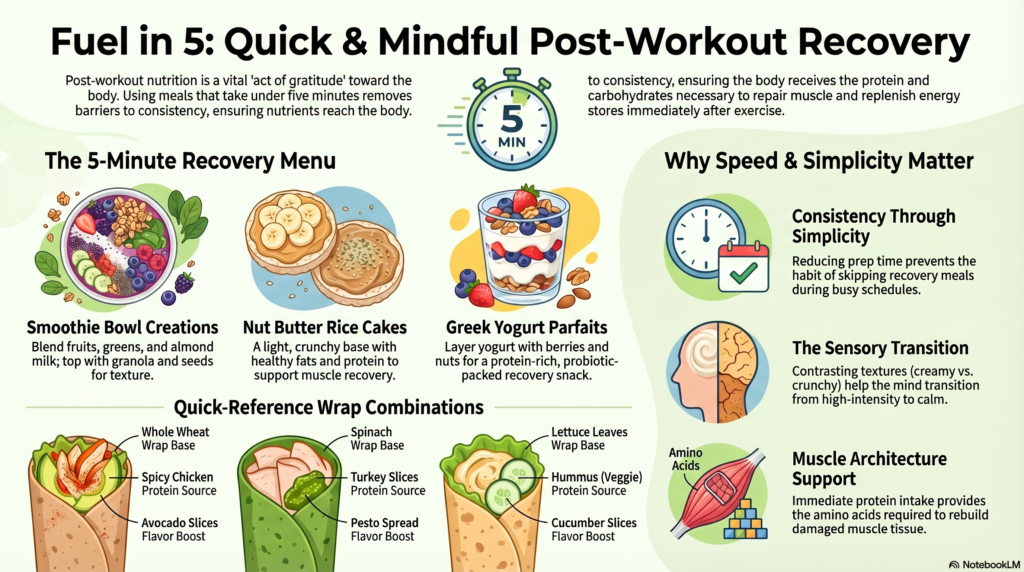
Post-workout meals can be quick and nutritious, taking just five minutes to prepare. Try a smoothie bowl with blended fruits and greens topped with granola. Or, prepare a protein wrap with whole wheat or lettuce leaves filled with turkey, hummus, and veggies for a satisfying meal. Nut butter rice cakes with banana slices offer a great balance of carbohydrates and protein. Greek yogurt parfaits layered with berries and nuts are another excellent option. For a convenient treat, energizing overnight oats provide a nutritious base. Keep going to discover more easy post-workout meal ideas!
KEY TAKEAWAYS
- Smoothie bowls are quick to prepare, blending fruits and greens with a liquid base for a nutrient-rich post-workout meal in minutes.
- Quick protein wraps can be assembled in five minutes using wraps, protein sources, and flavorful additions like avocado or pesto.
- Energizing overnight oats require no cooking, simply soak oats in milk or yogurt overnight for a convenient breakfast that’s ready to enjoy.
- Nut butter rice cakes topped with fruits and seeds offer a satisfying mix of carbohydrates and protein, easily prepared within five minutes.
- Greek yogurt parfaits can be layered with fruits, granola, and honey, allowing for quick assembly and nutritious snacking post-exercise.
SMOOTHIE BOWL CREATIONS
After intense cardio workouts, replenishing your body with nutrient-rich foods is essential to restore energy levels and support faster muscle recovery.
These bowls not only provide a quick recovery but also allow you to customize ingredients to suit your preferences. You can blend your favorite fruits, veggies, and liquid bases to create a thick, satisfying base.
Start by choosing a combination of fruits like bananas, berries, or mangoes, which are rich in vitamins and antioxidants. For added nutrients, consider tossing in a handful of spinach or kale. Blend these with a base like almond milk or coconut water for a rejuvenating texture.
Now, let’s talk about smoothie toppings, which are key to elevating your bowl. You can sprinkle granola for crunch, drizzle honey for sweetness, or add nuts and seeds for healthy fats. Fresh fruit slices, shredded coconut, or cacao nibs can enhance both the flavor and aesthetics of your creation.
Experiment with flavor combinations to find what excites your palate. How about a tropical mix of pineapple and coconut topped with chia seeds? Or a berry blend with almond butter and sliced almonds?
The possibilities are endless, and you can tailor your smoothie bowl to meet your nutritional needs and flavor preferences.
In just a few minutes, you can whip up a satisfying smoothie bowl that fuels your recovery, turning post-workout nutrition into a nourishing self care activity that supports both physical recovery and overall well-being. Embrace this freedom to create, and enjoy every bite!
Quick Protein Wraps
Protein wraps are a fantastic, quick option for refueling your body after a workout. They’re versatile, easy to make, and packed with nutrients to aid your recovery. You can whip up a protein wrap in just five minutes, making them perfect for your post-exercise routine. This healthy smoothie is not only delicious–it also boosts your daily dose of anti-inflammatory foods. It starts with a base of creamy gut-friendly kefir and includes cherries, which can lower the inflammatory marker C-reactive protein. Heart-healthy fats in avocado, almond butter and chia seeds deliver additional anti-inflammatory compounds to the body, while spinach offers a mix of antioxidants that sweep up harmful free radicals. Fresh ginger adds zing, plus a compound called gingerol, which preliminary studies suggest may improve inflammatory markers of heart disease if consumed daily.
Here’s a simple table that highlights some delicious quick protein wrap ideas:
| Wrap Base | Protein Source | Flavor Boost |
| Whole Wheat Wrap | Spicy Chicken | Avocado Slices |
| Spinach Wrap | Turkey Slices | Pesto Spread |
| Lettuce Leaves | Hummus (Veggie) | Cucumbers Slices |
| Gluten-Free Wrap | Tuna Salad | Tomato Chunks |
You can customize your wraps according to your taste and dietary preferences. For a zesty kick, you might try spicy chicken, which is not only flavorful but also rich in protein. Pair it with some crunchy veggies for added texture. If you’re looking for a vegetarian option, veggie hummus makes an excellent base. It’s creamy, delicious, and loaded with plant-based protein.
Feel free to mix and match ingredients. The beauty of protein wraps is the freedom they offer regarding flavor and nutrition. With just a few simple ingredients, you can create a satisfying meal that helps your muscles recover while keeping you energized throughout the day. So grab your favorite wrap base and get creative!
Energizing Overnight Oats
In my work blending modern physiology with integrative health, I’ve realized that the “best” post-workout meal is the one that actually gets eaten and enjoyed. We often get bogged down in the science, which is important, but we forget the sensory experience of eating. For instance, I love recommending Greek yogurt parfaits or nut butter rice cakes because they offer a beautiful contrast of textures: the creamy yogurt against crunchy granola, or the smooth nut butter against a crisp rice cake.
These textures provide a grounding, mindful experience that helps transition the mind from the high intensity of exercise back to a state of calm and recovery. From a physiological standpoint, your body is craving amino acids to repair muscle tissue and carbohydrates to replenish glycogen. But from a holistic standpoint, you are also feeding your spirit. I often encourage my clients to “eat the rainbow” even in their quick snacks.
Adding berries to your oats or fresh greens to a smoothie isn’t just for the antioxidants; it’s for the life and vitality those colors represent. When you assemble a protein wrap with pesto and fresh veggies in under five minutes, you are engaging in a quick, creative process that reinforces your commitment to health. This isn’t just fuel; it’s a functional form of art that supports your physical architecture and your mental clarity simultaneously.
Energizing overnight oats are a perfect post-workout meal that combines convenience with nutrition. With just a few minutes of preparation, you can create a delicious and satisfying dish packed with essential nutrients to help your muscles recover. While this article focuses on post-workout recovery, planning balanced pre workout meals can also help ensure you have enough energy to perform at your best and maximize the benefits of your training sessions.
The base is simple: rolled oats soaked in your choice of milk or yogurt overnight. This not only softens the oats but also enhances their digestibility, allowing your body to absorb nutrients effectively.
You can customize your overnight oats with various oatmeal variations. For instance, you might choose steel-cut oats for a chewier texture or gluten-free oats if you’re sensitive to gluten. The key is to find what works best for your palate and nutritional needs.
When it comes to toppings, the options are limitless. Add fresh fruits like berries, bananas, or apples for natural sweetness and a boost of vitamins. Nuts and seeds, such as almonds, chia, or flaxseeds, provide healthy fats and protein, keeping you satiated longer.
For an extra flavor kick, consider drizzling honey, maple syrup, or a spoonful of yogurt on top.
Don’t hesitate to experiment with spices, too. A dash of cinnamon or vanilla can elevate your oats without added sugar.
NUT BUTTER RICE CAKES
If you’re looking for a quick and satisfying post-workout option, nut butter rice cakes can be a fantastic choice. They’re not only easy to prepare but also provide a perfect balance of carbohydrates and protein, essential for muscle recovery. Rice cakes serve as a light base, while nut butter adds healthy fats and protein, fueling your body after exercise.
To make your nut butter rice cakes even more nutritious, consider adding healthy toppings. Sliced bananas or strawberries can enhance the flavor and provide additional vitamins and minerals. A sprinkle of chia seeds or hemp seeds can boost the omega-3 fatty acid content, making your snack even healthier. If you’re in the mood for something sweeter, a drizzle of honey or agave syrup can add a delightful touch. Exercise triggers the breakdownTrusted Source of muscle protein. The rate at which this happens depends on several factors, such as training volume, intensity, and frequency. Consuming an adequate amount of protein throughout the day gives your body the amino acids it needs to repair and rebuild these proteins. It also gives you the building blocks required to build new muscle tissue.
Experimenting with flavor combinations keeps this snack exciting. You might enjoy almond butter with apple slices for a crunchy, invigorating bite or peanut butter topped with a sprinkle of cinnamon for a warm, comforting flavor. For a more exotic twist, try cashew butter with a smear of coconut flakes and a touch of dark chocolate shavings.
In just five minutes, you have a versatile and satisfying post-workout meal that caters to your taste preferences. Nut butter rice cakes not only nourish your body but also provide the freedom to mix and match toppings, turning a simple snack into an enjoyable experience that supports your fitness journey.
Greek Yogurt Parfaits
Greek yogurt parfaits offer a delicious and nutritious way to replenish your energy after a workout. Packed with protein, probiotics, and essential nutrients, they can help you recover quickly and keep you feeling satisfied. With just a few minutes of prep, you can create a customizable parfait that aligns with your taste preferences. If you crave comfort food after a workout, try this healthy seafood bake. Delivering on protein from the cod, prawns and cheese, it also provides an impressive four of your five-a-day from the veg inside (broccoli, tomato, onion and red pepper), along with vitamin C and iron. Potato dishes such as this can make a good gluten-free option to supply energy-replenishing carbohydrates after exercise.
Choose your favorite yogurt brand—options like Chobani, Fage, or Oikos are popular choices. Then, layer it with your desired toppings variations to add flavor and texture. Here’s a simple table to inspire your parfait creations:
| Layer | Yogurt Brand | Toppings Variations |
| Base | Chobani | Berries, nuts, granola |
| Middle | Fage | Honey, seeds, coconut |
| Top | Oikos | Dark chocolate, banana |
To make your parfait, start by spooning yogurt into a bowl or jar. Add your first layer of toppings, then repeat for additional layers. Not only does this give you a visual treat, but it also guarantees you get a mix of textures and flavors. If you’re in a hurry, consider prepping multiple servings in advance.

RELATED STUDIES ABOUT POST WORKOUT MEALS
So, next time you finish a workout, don’t just grab any snack. You’ve got options that are not only quick but packed with nutrients to fuel your recovery. Imagine the creamy texture of a smoothie bowl or the crunch of nut butter rice cakes. Each choice is just a few minutes away, ready to elevate your post-workout routine. Are you ready to transform your recovery game, or will you settle for something less? The choice is yours.
“What’s For Dinner?” Understanding Family Food Decision-Making And Wishes Of Children And Their Caregivers For Plant-Based Alternatives In Family Main Meals
Objective: To investigate the perspectives of children (9–11 years old) and their caregivers on family food decision-making, specifically regarding the transition to plant-based alternatives during family main meals.
Methods:
- Participants: 36 caregivers and 37 children from diverse Dutch households.
- Approach:
- Caregivers: Participated in semi-structured, photo-elicited interviews using self-taken photos of dinner meals.
- Children: Engaged in creative tasks using design probe boxes, followed by semi-structured interviews.
- Analysis: Thematic analysis was applied to interview transcripts and visual materials to identify key patterns and insights.
Key Findings:
- Family Food Decision-Making:
- Caregiver Perspective: Most caregivers (33/36) involve children in food decisions, influenced by:
- Child’s presence during shopping.
- Desire to please the child.
- Designated days (e.g., weekends) when children can choose.
- Need for meal inspiration.
- Child Perspective: Most children (30/37) report having influence, especially on specific days or special occasions.
- Decision Drivers: Include child preferences, available time, routines, food already at home, price, and healthiness.
- Drivers and Barriers for Plant-Based Alternatives:
- Drivers: For children, animal welfare is a key motivator. For caregivers, healthiness and environmental concerns are primary.
- Barriers: Both groups cited taste as the most significant barrier. Children also emphasized unfamiliarity and appearance, while caregivers noted perceived lack of healthiness, naturalness, convenience, and higher price.
- Openness to Transition:
- Most caregivers (34/36) are willing to incorporate plant-based alternatives if requested by their child.
- Approaches vary: some would serve alternatives to the whole family, others only to the child, depending on ease of meal separation and desire to maintain personal food choices
- Wishes for Facilitating Transition:
- Caregivers: Requested lower prices, cooking inspiration (simple recipes), and improved taste/texture of alternatives.
- Children: Desired better sensory appeal (taste and appearance resembling meat) and clearer labeling.
Conclusions:
- Children significantly influence family food choices, both directly and indirectly.
- A successful transition to plant-based family meals requires addressing four key areas:
- Sensory quality (taste, appearance, satiety).
- Meal inspiration (easy, family-friendly recipes).
- Healthiness (clear nutritional communication).
- Integration into routines (practicality and convenience).
- Price reduction is also crucial for accessibility.
Recommendations:
- Food Companies: Develop tastier, affordable plant-based products and provide simple recipes on packaging/online.
- Government/Institutions: Implement school programs to educate children about plant-based foods and their benefits, empowering them to inspire family meals.
Implication: Engaging both children and caregivers is essential to drive the protein transition within households, leveraging children’s influence to promote sustainable eating habits.
| REFERENCE: Lotte Pater, Elizabeth H. Zandstra, Vincenzo Fogliano, Bea L.P.A. Steenbekkers, “What’s for dinner?” understanding family food decision-making and wishes of children and their caregivers for plant-based alternatives in family main meals, Appetite, Volume 209, 2025, 107970, ISSN 0195-6663, https://doi.org/10.1016/j.appet.2025.107970. (https://www.sciencedirect.com/science/article/pii/S0195666325001230) |
Overall and Differentiated Session Ratings of Perceived Exertion at Different Time Points Following a Circuit Weight Training Workout
Objective: To investigate the usefulness of Session Ratings of Perceived Exertion (SRPE) in evaluating the overall strain of a Circuit Weight Training (CWT) session, and to examine the influence of the time delay between exercise cessation and SRPE reporting. Additionally, the study aimed to compare undifferentiated (overall) and differentiated (chest, active muscle) RPE responses during the workout with SRPE.
Methods:
- Participants: 10 healthy, resistance-trained male volunteers (mean age 22.3 ± 2.8 years).
- Protocol: Participants completed a CWT session consisting of 3 circuits of 5 multi-joint exercises (lying row, squat, shoulder press, dead lift, bench press). Each set involved 20 repetitions at 30% of their 1-repetition maximum (1-RM), with short (30-second) rest intervals between exercises and 3-minute rests between circuits.
- Measurements:
- Physiological: Heart rate (HR) and blood lactate were measured after each circuit.
- Perceptual (During Exercise): Overall (RPE-O), chest (RPE-C), and active muscle (RPE-AM) ratings of perceived exertion were collected after each circuit using the Borg 6–20 scale.
- Perceptual (Post-Exercise): Corresponding Session RPE (SRPE-O, SRPE-C, SRPE-AM) were collected at 10, 20, and 30 minutes post-exercise using Foster’s modified CR-10 scale.
Key Findings:
- Physiological & Perceptual Responses During CWT:
- Heart rate, blood lactate, and all three RPE measures (overall, chest, active muscle) increased significantly from the first to the third circuit.
- No significant differences were found between RPE types (overall vs. chest vs. active muscle) at any point, indicating no dominant perceptual signal (central vs. peripheral) in this CWT format.
- Effect of Reporting Time on SRPE:
- The time at which SRPE was collected (10, 20, or 30 minutes post-exercise) had no significant effect on the ratings.
- There was no interaction between SRPE type and time point.
- Correspondence Between RPE and SRPE:
- No significant differences were found between the average RPE (taken during the session) and the SRPE (taken after the session) for overall, chest, or active muscle ratings.
- SRPE accurately reflected the average perceptual strain experienced throughout the entire workout.
Conclusions:
- SRPE is a valid and practical tool for quantifying the global strain of a Circuit Weight Training session in healthy, trained young men.
- The utility of SRPE is not compromised by the time of assessment within the 10–30 minute window post-exercise.
- For this specific CWT protocol (low-load, high-repetition, full-body circuit), differentiating SRPE into central (chest) and peripheral (muscle) components did not provide additional unique information, as ratings were consistent across categories.
- SRPE provides coaches, clinicians, and exercisers with a simple, subjective method to monitor training load in CWT, effectively capturing the integrated strain of the entire session.
Practical Implication: Practitioners can confidently use a single overall SRPE, collected anytime within 30 minutes after a CWT session, as a reliable indicator of the session’s total perceptual strain, simplifying training load monitoring.
| REFERENCE: Luiz Fernando Paulino Ribeiro, Viviane Valentim Alves, Luiz Henrique da Silva, Eduardo Bodnariuc Fontes, Overall and differentiated session ratings of perceived exertion at different time points following a circuit weight training workout, Journal of Exercise Science & Fitness, Volume 11, Issue 1, 2013, Pages 19-24, ISSN 1728-869X, https://doi.org/10.1016/j.jesf.2013.03.001. (https://www.sciencedirect.com/science/article/pii/S1728869X1300004X) |
Rapeseed Meal As A Partial Replacement For Sunflower Meal In Diets For Growing Rabbits – Gastrointestinal Tract Response And Growth Performance
Objective: To evaluate the effects of partially replacing sunflower meal with low-glucosinolate rapeseed meal (RSM) on the gastrointestinal health and growth performance of growing rabbits.
Methods:
- Subjects: 24 male New Zealand white rabbits (40 days old) divided into 3 groups.
- Experimental Diets: Over a 36-day period, groups were fed iso-nutritive diets where sunflower meal was replaced by RSM at 0% (control, RSM₀), 5% (RSM₅), or 10% (RSM₁₀).
- Measurements:
- Performance: Feed intake, body weight gain, and feed conversion ratio (FCR).
- Gastrointestinal Physiology: Weight of digestive tract segments, pH, dry matter, ammonia concentration, viscosity, bacterial enzyme activity, and short-chain fatty acid (SCFA) production in ileal, cecal, and colonic digesta.
Key Findings:
- Gastrointestinal Tract Benefits:
- Cecum & Colon: Diets containing RSM (5% and 10%) led to significantly lower pH and ammonia concentrations, and higher dry matter content in cecal and colonic digesta compared to the control.
- Fermentation: The 10% RSM diet significantly increased total SCFA production (particularly acetate, propionate, and butyrate) in the cecum, indicating enhanced beneficial microbial fermentation.
- Microbial Activity: RSM inclusion increased α-galactosidase activity (linked to SCFA production) and decreased β-glucuronidase activity (a marker for potentially harmful bacterial processes) in the lower gut.
- Growth Performance:
- No Negative Impact: There were no significant differences in final body weight, total weight gain, feed intake, or feed conversion ratio (FCR) between the control group and the groups fed 5% or 10% RSM.
- Glucosinolate Tolerance:
- The RSM contained 18.6 μmol/g glucosinolates, resulting in dietary levels of 0.8 and 1.7 μmol/g in the RSM₅ and RSM₁₀ diets, respectively.
- These levels did not adversely affect rabbit health or performance, confirming a high tolerance in this species.
Conclusion:
Partial replacement of sunflower meal with up to 10% low-glucosinolate rapeseed meal in the diet of growing rabbits improves indicators of gastrointestinal health (e.g., enhanced fermentation, reduced ammonia) without compromising growth performance or feed efficiency. RSM appears to mitigate some negative effects of sunflower meal on hindgut fermentation.
Practical Implication: RSM can be considered a viable, economical, and beneficial alternative protein source in commercial rabbit feed formulations, supporting gut health while maintaining productivity.
| REFERENCE: P. Matusevičius, Z. Zdunczyk, J. Juskiewicz, H. Jeroch, Rapeseed meal as a partial replacement for sunflower meal in diets for growing rabbits – gastrointestinal tract response and growth performance, European Poultry Science, Volume 78, 2014, Pages 1-11, ISSN 0003-9098, https://doi.org/10.1399/eps.2014.18. (https://www.sciencedirect.com/science/article/pii/S0003909825015954) |
CONCLUSION
As we wrap up these ideas, I want to remind you that your fitness journey is a marathon, not a sprint, and how you treat yourself after the sweat stops matters just as much as the workout itself. I truly believe that nutrition is the bridge between the effort you put in today and the strength you will have tomorrow. By embracing these five-minute meal ideas, you are removing the barriers to success. You are proving to yourself that nourishing your body doesn’t require hours in the kitchen; it only requires a few minutes of presence and the right ingredients.
Whether you find yourself gravitating toward the cooling sensation of a tropical smoothie bowl or the warming comfort of cinnamon-spiced overnight oats, listen to that intuition. My hope is that you view these meals as more than just “recovery”, see them as a vital part of your holistic wellness practice.
When we take the time to refuel properly, we aren’t just repairing muscle; we are cultivating a deeper respect for our physical capabilities and ensuring we have the energy to show up fully in all areas of our lives. So, next time you finish that final set or stow your yoga mat, take a deep breath, head to the kitchen, and give your body the quick, loving nourishment it deserves.