

Your fashion choices speak volumes about your identity and emotions, influencing both how you perceive yourself and how others view you. Clothing isn’t just fabric; it’s a medium for self-expression and a canvas for your unique narrative. The colors you wear can evoke specific feelings, while the fit can boost your confidence or diminish it. Cultural factors also play a role, shaping your style and grounding you in heritage. By understanding these connections, you can harness fashion to reflect your authentic self. Stay tuned to explore how fashion psychology can elevate your self-expression even further.
KEY TAKEAWAYS
- Fashion choices serve as a reflection of personal identity, influenced by cultural norms and historical contexts.
- Clothing acts as a powerful medium for self-expression, telling individual stories and showcasing unique styles.
- Psychological effects of fit significantly impact body image and self-esteem, with well-fitting garments promoting body positivity.
- Color psychology plays a crucial role in fashion, as specific colors evoke emotional responses and convey identity.
- Attire influences social perception, shaping first impressions and serving as a tool for personal branding and impression management.
THE SCIENCE OF FASHION CHOICES
When you think about the clothes you wear, it’s not just a matter of style; it’s a complex interplay of psychology and personal identity. Your fashion choices reflect more than trends; they’re influenced by historical backgrounds, societal norms, and the ever-evolving landscape of social media. Each outfit you select carries a narrative—one that can convey your beliefs and aspirations. The psychology of fashion studies why people dress the way they do. Reflecting self-expression and identity, clothing choices are influenced by personality, cultural norms and social expectations. Factors like conformity, originality, and social status boost confidence and help people make conscious fashion choices that make them feel comfortable.
Trend forecasting plays an essential role here, offering insights into what’s likely to resonate with your audience. You’re often swayed by the historical influences that shape contemporary styles, blending past and present. Your material preferences, whether for comfort or sustainability, reveal your values. For instance, choosing eco-friendly fabrics isn’t just a fashion statement; it’s a reflection of your commitment to sustainability.
As you curate your personal brand, think about how your clothing choices impact your body image and how they resonate with others. In a world dominated by fashion cycles, where trends come and go, you’re tasked with balancing fleeting styles against authentic self-expression. Social media amplifies this dynamic, allowing you to showcase your unique style while also inviting external judgment.
Ultimately, your fashion choices are a powerful form of self-expression. They allow you to navigate cultural expectations while asserting your individuality. Embrace this freedom, and recognize that each garment you wear not only shapes how you see yourself but also how others perceive you. Fashion, at its core, is a dialogue—a conversation between you and the world.
Colors and Mood Association
Your choice of colors plays a significant role in how you express yourself and how others perceive you. When you wear specific hues, you tap into the powerful domain of color psychology, which reveals that colors can evoke distinct emotional responses. Understanding color symbolism allows you to create emotional palettes that resonate with your inner self and influence the mood shifts around you.
For instance, wearing vibrant reds may enhance your confidence and energy, while softer blues often promote tranquility and calmness, making intentional color choices a subtle self care activity that supports emotional balance and self-awareness. These hue preferences aren’t just personal; they reflect your current emotional state and can even affect those who see you. Engaging with color theory empowers you to use color as a tool for mood enhancement, crafting visual aesthetics that align with your desired self-expression.
Consider how you feel in different colors. Do you gravitate towards warm tones that inspire passion, or cooler shades that ground you? By being mindful of these choices, you can strategically evoke specific feelings or reactions in both yourself and others. This awareness fosters not only authenticity in your style but also a deeper connection to your emotional landscape.
Ultimately, your color selections can serve as a form of self-communication, allowing you to articulate who you’re without saying a word. Embrace the freedom that comes from understanding how colors shape your identity, and use them to celebrate your individuality in the vibrant tapestry of life.
Cultural Influences on Style
Embracing cultural influences in style allows you to tap into a rich tapestry of traditions, beliefs, and aesthetics that shape how we express ourselves through fashion. As you navigate through various influences, you’ll discover that traditional attire often carries deep cultural symbolism that resonates with your identity. By blending these elements with modern trends, you showcase a unique style evolution that reflects both your heritage and contemporary life.
The interplay of global influences has led to fascinating regional variations in fashion. Each culture brings its own historical context and societal norms, enriching your wardrobe with diverse expressions of ethnic identity. This fusion not only celebrates your roots but also invites dialogue around cultural appreciation and respect.
Here’s a table to illustrate some key aspects of cultural influences on style:
| Influence Type | Description | Example |
| Traditional Attire | Clothing rooted in cultural heritage | Kimono from Japan |
| Modern Trends | Contemporary fashion movements | Streetwear aesthetics |
| Cultural Symbolism | Meanings behind clothing styles | Maasai shuka in Kenya |
As the world becomes increasingly interconnected, your fashion choices can reflect a broader narrative. By understanding the nuances of cultural influences, you empower yourself to express your individuality while honoring the traditions that have shaped you. So go ahead, embrace the freedom to mix and match, and let your style tell your story.
Clothing as Identity Expression
Cultural influences shape not just what we wear but also how we perceive ourselves and communicate our identities. Your wardrobe choices aren’t merely practical; they’re a powerful medium for self-expression and identity formation. Each piece of clothing you select contributes to a personal style that reflects your values, beliefs, and aspirations. This is your fashion narrative, a story you curate through expressive fashion that conveys who you’re to the world.
When you wear something that resonates with your self-image, you signal your individuality. It’s an unspoken language, one that speaks volumes about your personality, mood, and even your aspirations. Consider how your choices in clothing can enhance your confidence or even reshape how others perceive you. Every outfit can act as a canvas for individuality expression, allowing you to explore different facets of your identity.
Fashion isn’t just about trends; it’s about how you choose to present yourself in a society that often seeks conformity. By embracing your unique style, you challenge norms and foster a deeper connection to your identity. This act of identity signaling not only empowers you but also invites others to embrace their authentic selves.
Ultimately, your clothing choices are essential to your self-expression, shaping how you navigate social landscapes. They’re a reflection of your journey toward understanding who you’re and who you want to be, reinforcing the notion that fashion is a crucial part of your identity.
Psychological Effects of Fit
Fit plays an essential role in shaping how we perceive ourselves and how others perceive us, making the choice of well-fitting garments an important form of self care that supports positive body image and emotional well-being. When you wear a garment that fits well, it can greatly boost your body image and self-esteem. Conversely, ill-fitting clothes can lead to discomfort and even reinforce negative self-perceptions.
Here are three critical aspects of fit that impact psychological well-being:
- Garment Comfort: When clothes fit properly, you feel at ease, allowing you to express yourself freely. Uncomfortable garments can distract you and hinder your confidence.
- Silhouette Impact: The way a garment shapes your body can affect how you feel about your physical appearance. A well-tailored outfit enhances your natural silhouette, promoting body positivity and a sense of empowerment.
- Fit Perception and Fashion Conformity: Society often dictates what’s considered “fashionable,” leading to pressure to conform. Understanding your unique body shape and embracing it can help you break free from these constraints and celebrate your individuality.
Tailoring effects can also transform a piece, making it more suited to your personal style and ensuring that it complements your body perfectly.
When you prioritize fit, you not only enhance your appearance but also affirm your worth. As you navigate the world of fashion, remember that embracing your body, regardless of societal standards, is an act of self-love and freedom.

FASHION’S ROLE IN CONFIDENCE
When you put on an outfit that resonates with your personal style, it can elevate your confidence in remarkable ways. This connection often stems from your unique fashion identity, which reflects your journey and style evolution. Each piece you choose serves as a canvas for self-expression, allowing you to curate a wardrobe that empowers you.
Emotional dressing connects your attire to your self-image, and experimenting with styles that make you feel good can be one of the simplest self care ideas for boosting confidence and reinforcing a positive relationship with yourself. When you wear clothes that make you feel good, you experience a significant confidence boost. This boost isn’t just superficial; it’s deeply rooted in wardrobe psychology. Your choices affect how you perceive yourself and how you project your personal branding to the world.
You may find that certain outfits allow you to embody a specific persona, giving you the courage to tackle challenges with grace. This attire empowerment can transform mundane moments into opportunities for self-assurance. Fashion becomes a tool; it shapes not just how others see you, but how you see yourself, reinforcing your belief in your capabilities.
As you explore different styles, you’ll notice how they influence your mood and outlook. Fashion’s role in confidence is profound—it’s not merely about looking good; it’s about feeling good. Each outfit tells a story, and when you dress authentically, you align your external appearance with your inner self.
This alignment fosters a powerful sense of freedom, allowing you to embrace who you truly are.
Social Perception and Attire
Your attire often shapes how others perceive you, influencing first impressions in ways you mightn’t even realize. Fashion is much more than just fabric; it is an expressive medium that allows people to convey identity, foster confidence, and navigate social dimensions of life. Color analysis—which helps people discover complementary colors for skin tone, eyes, and hair—can change mood and confidence. For example, dressing for body shape and using body shape as a dimension of body acceptance and healthy body image can allow one to identify as someone that is authentically themself, increasing confidence.
The colors and styles you choose can evoke specific emotional responses, both in yourself and those around you, affecting social interactions.
Additionally, cultural influences play a significant role in how fashion communicates identity, creating a rich tapestry of personal expression and societal norms.
Clothing and First Impressions
Dressed to impress, individuals often underestimate the profound impact their clothing has on first impressions. Your attire serves as a powerful tool for impression management, shaping how others perceive you before you even speak.
It’s more than just fabric; it’s a form of personal branding that conveys your identity and values. Drawing links between fashion psychology and self-expression, one can discern a relationship of reciprocity. Our choice of clothing articulates our identity outwardly, thus fashion serves as a tool for expressing our inner selves. At the same time, the way others perceive our style shapes their perception of us, impacting our social interactions.
Using fashion as a tool for self-expression stimulates authenticity, facilitates communication, and contributes to better mental health. Fashion psychology empowers us to use this expression consciously, optimizing our wardrobe to express who we truly are.
Consider these three key aspects of clothing and first impressions:
- Visual Cues: What you wear provides immediate visual signals, influencing style perceptions and the narratives others create about you.
- Attire Symbolism: Different outfits can embody various meanings, from professionalism in a business suit to creativity in casual attire, reinforcing or challenging fashion stereotypes.
- Dressing Contexts: The setting matters—your choice of clothing reflects your understanding of social norms and expectations, adapting to clothing trends while expressing your unique style evolution.
Ultimately, your outfit tells a story. By consciously selecting your attire, you harness the power of attire symbolism and visual cues to craft the impression you want to leave.
Embrace this freedom to express your authentic self through your clothing choices, and watch how it transforms the way others engage with you.
Colors and Emotional Responses
Clothing choices extend beyond mere aesthetics; they also tap into the psychology of color, influencing not only how you feel but also how others perceive you. Understanding color symbolism can enhance your self-expression and mood. Each hue carries emotional triggers that can evoke specific responses, making your color preferences essential in your wardrobe choices.
For example, wearing red might project confidence and passion, while blue tends to convey calmness and trustworthiness.
Color psychology suggests that the colors you choose can greatly affect your mood and how you interact with the world. Think about how vibrant yellows can uplift your spirits, or how soft pastels might create a soothing effect.
These color associations are universal yet deeply personal, reflecting both individual taste and cultural significance.
Cultural Influences on Fashion
Fashion isn’t just about personal style; it’s shaped by cultural influences that dictate how attire is perceived and valued within different societies. You mightn’t realize it, but your clothing choices reflect a tapestry of heritage influences and societal norms. From traditional attire to modern trends, every garment tells a story.
Here are three key ways cultural influences shape fashion:
- Cultural Symbolism: Each piece of clothing can symbolize different values or beliefs, grounding you in your heritage.
- Fashion Rituals: Many cultures have specific attire for events, reinforcing connections to history and community.
- Subculture Expressions: Within broader cultures, various subcultures often adopt unique styles, showcasing diversity and individuality.
Understanding the historical context of ethnic patterns and global styles enables you to appreciate the depth of your wardrobe.
As you navigate your fashion choices, consider how they resonate with cultural symbolism and reflect personal identity. Embracing these influences not only enhances your self-expression but also fosters a sense of connection to the rich, diverse world of fashion.
In this way, your attire becomes a powerful medium for expressing who you’re and where you come from.
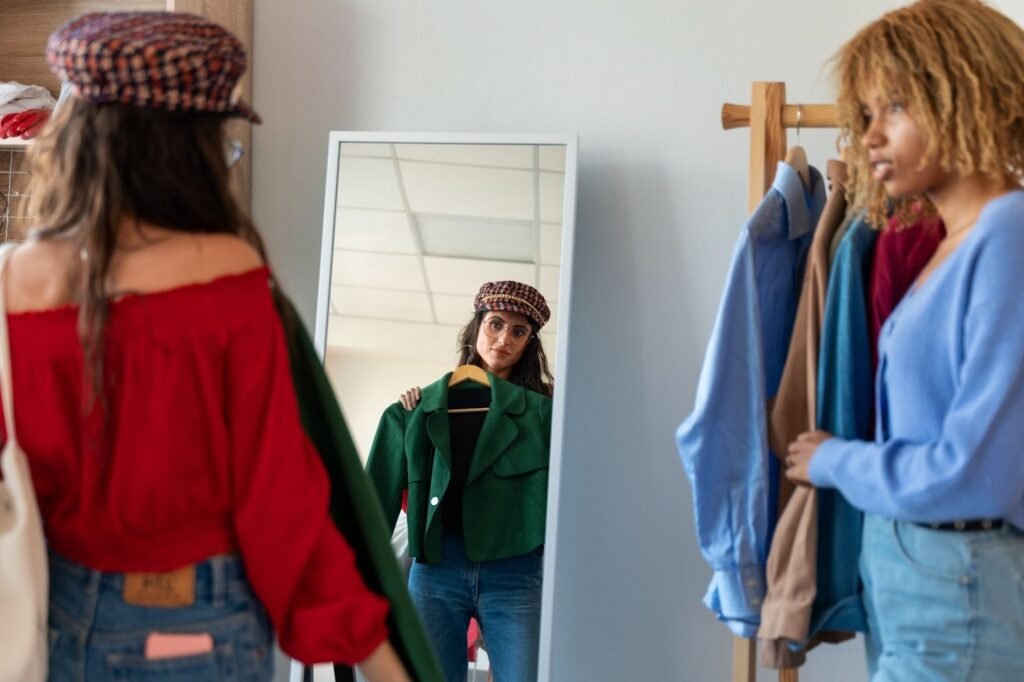
RELATED STUDIES ABOUT FASHION PSYCHOLOGY
Just as a chameleon adapts its colors to blend into its surroundings, your fashion choices reflect your inner self and the world around you. Each outfit you wear is a brushstroke on the canvas of your identity, communicating emotions and beliefs without uttering a word. Embracing the psychology behind your style empowers you to express who you truly are. So, next time you choose an outfit, remember: it’s not just clothing; it’s your story painted in fabric.
Gratitude’s Impact: The Positive Influence of Larger-Sized Female Shoppers on Online Fashion Retailer Ratings
Study Purpose:
This research investigates the attitudes and behaviors of larger-sized female consumers during online fashion shopping. It specifically examines how their body size, product choices (notably black garments), and personal psychological states (particularly perceived weight stigma) can lead to feelings of gratitude towards online retailers, which in turn translates into higher seller ratings and increased sales.
Key Findings:
- Gratitude as a Key Mechanism: Larger-sized female consumers experience heightened gratitude when shopping for fashion online. This gratitude stems from the perceived “psychological safety” of the online environment, which mitigates the social stigma and negative body image concerns often encountered in physical stores.
- Moderating Factors:
- Garment Colour (Black): Choosing black clothing—associated with slimming and camouflaging effects—enhances feelings of safety and self-image, thereby strengthening the positive relationship between body size and gratitude (supported in two of three controlled studies).
- Perceived Weight Stigma: Consumers who are more conscious of weight-based discrimination experience a stronger sense of gratitude for the anonymity and reduced judgement of online shopping. This factor consistently strengthened the body size-gratitude link across studies.
- Impact on Retailer Metrics:
- Seller Ratings: The gratitude experienced by larger-sized female consumers leads them to give significantly higher ratings to online sellers.
- Sales: Analysis of real-world transaction data (over 6.5 million sales from Wish.com) confirmed a positive correlation between higher seller ratings and increased sales, establishing the downstream commercial benefit.
Managerial Implications:
- Strategic Inclusion: Online retailers should proactively include larger sizes in their assortments. Catering to this segment not only serves a growing market but can indirectly boost ratings and sales from all customers by improving overall seller reputation.
- Foster Gratitude: Retailers can actively cultivate gratitude through marketing language (e.g., using words like “grateful,” “thankful”), showcasing diverse and confident models, and ensuring website experiences reinforce a sense of safety and inclusion.
- Product Strategy: While advocating for diverse styles and colors, the research indicates that prominently offering black garment options can be a strategically sound choice to support the psychological comfort of larger-sized shoppers.
- Insights for Physical Stores: Brick-and-mortar retailers can learn from these findings by enhancing privacy (e.g., in fitting rooms), using inclusive mannequins and signage, and training staff to create a more welcoming environment for all body types.
Theoretical Contribution:
This study makes several key contributions by:
- Establishing consumer body size as a critical variable influencing post-purchase emotions and behaviors in online retail, moving beyond just channel preference.
- Identifying gratitude—rather than mere satisfaction—as a powerful mediating emotion that links inclusive retail practices to positive business outcomes.
- Demonstrating how product attributes (color) and consumer psychology (perceived stigma) interact with body size to shape the online shopping experience.
Limitations & Future Research:
The study focused on female consumers in the US and UK. Future research could explore these dynamics across genders, cultures, and other vulnerable consumer groups. The correlational nature of some findings also invites longitudinal studies to better establish causality.
Conclusion:
For online fashion retailers, creating an inclusive and psychologically safe shopping environment for larger-sized female consumers is not just a matter of social responsibility—it is a sound business strategy. By reducing stigma and fostering gratitude, retailers can unlock significant benefits in the form of enhanced seller ratings and ultimately, greater sales.
| REFERENCE: Anne-Maree O’Rourke, Hiba Khan, Frank Mathmann, Shasha Wang, Gratitude’s impact: the positive influence of larger-sized female shoppers on online fashion retailer ratings, European Journal of Marketing, Volume 59, Issue 13, 2025, Pages 535-569, ISSN 0309-0566, https://doi.org/10.1108/EJM-01-2024-0003. (https://www.sciencedirect.com/science/article/pii/S030905662500070X) |
Revolutionizing Consumption: Unveiling the Allure of NFTs and Digital Twins for Sustainable Luxury Fashion
Study Purpose:
This research investigates how Non-Fungible Tokens (NFTs) and digital twins influence consumer perceptions and behavior in the luxury fashion sector. Specifically, it examines whether these digital innovations enhance perceived sustainability and brand legitimacy, and how these perceptions ultimately affect the likelihood to purchase.
Key Findings:
- Hybrid Formats Win: Digital twin products (which combine a physical item with a linked NFT) consistently generated the highest purchase likelihood, outperforming both NFT-only and traditional non-NFT (physical-only) products. This indicates consumer preference for a hybrid model that merges digital innovation with physical tangibility.
- Sustainability is a Critical Moderator: The positive impact of NFTs on purchase likelihood is not automatic. It depends heavily on the product’s perceived sustainability. NFTs and digital twins only enhanced purchase intentions when consumers viewed the product itself as highly sustainable.
- A Legitimacy Paradox: A key, nuanced finding reveals a potential risk: when a product is perceived as highly sustainable, the introduction of an NFT can actually undermine brand legitimacy. This suggests consumers may see a contradiction between strong environmental credentials and the energy-intensive blockchain technology underlying NFTs, leading to a negative indirect effect on purchase likelihood.
- Theoretical Insights: The study bridges several theories, showing that:
- Dematerialization (shifting from physical to digital) is most acceptable to consumers in a hybrid form.
- Brand Legitimacy is fragile and contingent on the perceived coherence between a brand’s technological innovations (like NFTs) and its sustainability narrative.
- The Sufficiency Model (prioritizing durable, low-impact consumption) is supported by NFTs only when they are credibly framed within a sustainability story.
Managerial Implications:
- Prioritize Digital Twins: For luxury brands, launching digital twin offerings is a lower-risk, higher-reward strategy compared to NFT-only products, as it caters to consumer desire for both innovation and physical ownership.
- Embed NFTs in Authentic Sustainability Narratives: Do not treat NFTs as a standalone tech gimmick. Successfully market them by explicitly highlighting their role in reducing material waste, enabling digital ownership, and supporting sustainable practices.
- Mitigate Legitimacy Risks: Be acutely aware of the potential for NFTs to damage brand credibility among sustainability-conscious consumers. Ensure high transparency about the environmental footprint of the blockchain used (e.g., promoting energy-efficient protocols like proof-of-stake).
- Communicate Coherence: Carefully manage the alignment between your product’s sustainability profile and your NFT initiatives to avoid perceptions of greenwashing or inconsistency.
Methodology:
The research employed a mixed-methods approach:
- A preliminary qualitative study with luxury brand managers and NFT consumers identified key themes like sustainability and legitimacy.
- Three controlled experimental studies tested a conceptual model across different luxury product categories (backpacks, jackets, sunglasses), manipulating product type (non-NFT, NFT-only, digital twin) and measuring perceived sustainability, brand legitimacy, and purchase likelihood.
Conclusion:
NFTs and digital twins present a significant opportunity for luxury fashion brands to innovate and engage with new, digitally-native consumers. However, their success is highly conditional. To harness their potential, brands must strategically integrate these technologies within credible and coherent sustainability narratives, preferably through hybrid digital twin formats, to enhance legitimacy and drive consumer adoption without triggering backlash.
| REFERENCE: Marta Massi, Andrea Vocino, Chiara Piancatelli, Paola Cillo, Anna Claudia Pellicelli, Revolutionizing consumption: Unveiling the Allure of NFTs and digital twins for sustainable luxury fashion, Journal of Business Research, Volume 202, 2026, 115757, ISSN 0148-2963, https://doi.org/10.1016/j.jbusres.2025.115757. (https://www.sciencedirect.com/science/article/pii/S0148296325005806) |
The Impact Of Fashion Clothing Involvement And Self-Objectification On Women’s Mental Health: A Cross-Sectional Study Among Brazilian Women
Study Objective: This study aimed to explore the complex relationship between fashion clothing involvement (FCI) and the mental health of Brazilian women, specifically examining its associations with self-objectification, body shame, disordered eating attitudes, acceptance of cosmetic surgery, and self-esteem. A key focus was to investigate whether self-objectification acts as a confounding variable that explains the observed links between FCI and mental health outcomes.
Methodology:
- Design: Cross-sectional online survey.
- Sample: 710 Brazilian women (mean age = 34.2).
- Measures: Validated scales were used to assess FCI, self-objectification (via self-surveillance), body shame, acceptance of cosmetic surgery, self-esteem, and disordered eating attitudes.
- Analysis: Bivariate correlations, partial correlations controlling for self-objectification, and hierarchical multivariable regression analyses to test for confounding effects.
Key Findings:
- Initial Correlations: Higher FCI was associated with higher self-objectification (medium effect), higher acceptance of cosmetic surgery, and higher self-esteem (both small effects).
- Role of Self-Objectification: When statistically controlling for self-objectification, the relationships changed significantly:
- The positive link between FCI and self-esteem strengthened.
- FCI became associated with lower body shame and lower disordered eating attitudes.
- The initial link between FCI and acceptance of cosmetic surgery became non-significant, suggesting this association is largely explained by self-objectification.
- Confounding Effect: Regression analyses confirmed that self-objectification acts as a confounder. It masks the potential positive association between FCI and self-esteem while inflating the apparent link between FCI and acceptance of cosmetic surgery.
Conclusions:
- The relationship between fashion involvement and mental health is complex and dual-faceted. FCI is not inherently harmful or beneficial.
- Self-objectification is a critical psychological mechanism that influences whether engagement with fashion clothing is linked to positive (higher self-esteem) or negative (body shame, disordered eating, cosmetic surgery acceptance) outcomes.
- Statistically isolating FCI from self-objectification reveals potential positive aspects of fashion involvement, such as its association with higher self-esteem and lower body shame.
- The findings challenge purely pathologizing views of clothing practices and suggest that fashion-based interventions (e.g., image consulting) could have mental health benefits if they actively counteract self-objectification and promote positive body image and embodiment.
Implications:
- For Practice: Interventions aimed at improving body image and mental health should target reducing self-objectification. Fashion and clothing could be integrated as tools for embodiment and self-expression within therapeutic or psychoeducational frameworks.
- For Research: Future studies should use longitudinal designs to establish causality, include broader positive body image measures, and explore these relationships in more diverse populations (e.g., different genders, ethnicities, socioeconomic backgrounds). A full validation of the FCI scale in Brazilian Portuguese is also recommended.
Strengths & Limitations:
- Strengths: Large, nationally recruited sample; use of validated and adapted measures; novel investigation of FCI and mental health in the Brazilian context.
- Limitations: Cross-sectional design prevents causal inferences; sample skewed toward white, educated, higher-income women from Southeast Brazil; use of a single-item self-esteem measure; and the FCI scale required adaptation but not full validation for this study.
Overall Significance: This study provides pioneering evidence that fashion clothing involvement can be associated with both risks and benefits for women’s mental health, with self-objectification being a key determinant of these outcomes. It highlights the need for a nuanced understanding of appearance-related practices in culturally specific contexts like Brazil.
| REFERENCE: Debora Blaso, Nicole Paraskeva, Paul White, Helena Lewis-Smith, The impact of fashion clothing involvement and self-objectification on women’s mental health: A cross-sectional study among Brazilian women, Body Image, Volume 55, 2025, 101955, ISSN 1740-1445, https://doi.org/10.1016/j.bodyim.2025.101955. (https://www.sciencedirect.com/science/article/pii/S1740144525001068) |