
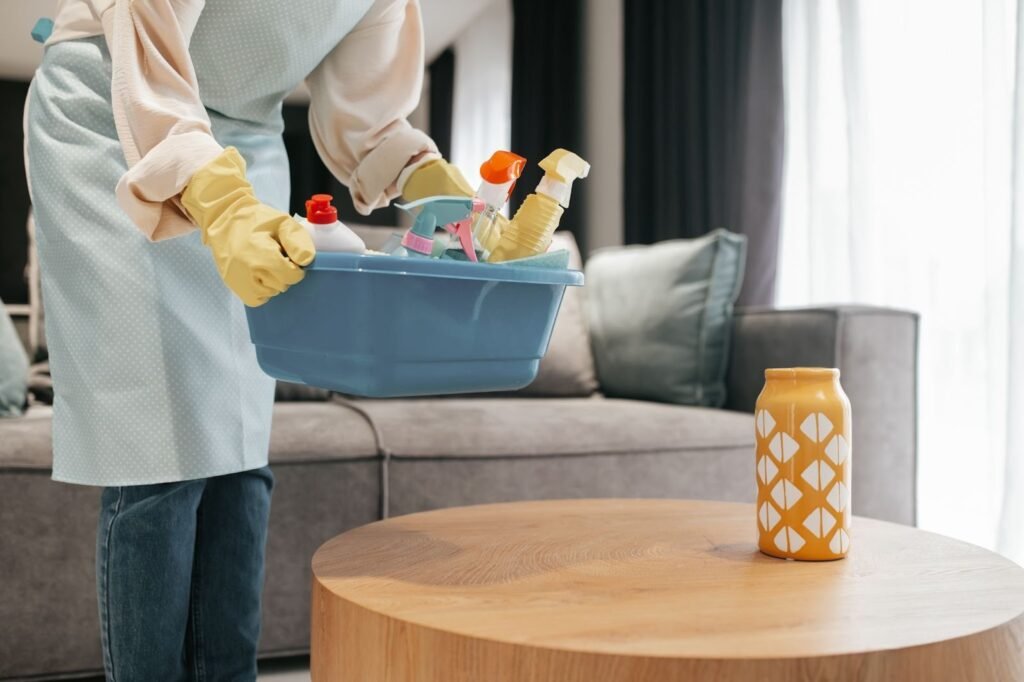
A clear cleaning schedule can make managing your small apartment or condo easy and efficient. Start each day with quick tasks like wiping down countertops and organizing clutter. Set aside time weekly for deeper cleaning, focusing on high-traffic areas, while monthly sessions should include dusting and systematizing storage spaces. Consider seasonal changes and adapt your routine accordingly to tackle specific challenges, like humidity in summer. Use baskets for organization and keep cleaning supplies easy to grab. With a structured plan, you’ll see quick results and enjoy a clutter-free home—there’s a lot more to explore for an effective schedule ahead.
KEY TAKEAWAYS
- Establish a daily cleaning routine focusing on high-traffic areas like the kitchen and bathroom to maintain cleanliness.
- Implement a weekly checklist to tackle essential tasks such as laundry, dusting, and deep cleaning surfaces.
- Create a monthly deep cleaning plan that includes decluttering, reorganizing storage, and thorough cleaning of each room.
- Utilize time-saving tips like portable caddies for supplies, setting timers, and breaking tasks into manageable segments.
- Regularly reassess and adapt your cleaning schedule to accommodate seasonal changes and personal lifestyle needs.
BENEFITS OF A CLEANING SCHEDULE
Creating a cleaning schedule can greatly simplify your life, especially in a small apartment. By establishing a routine, you’re not just keeping your space tidy; you’re also freeing up your mental energy. When you know what needs to be done and when, you can focus on the things that truly matter to you.
One of the primary benefits of a cleaning schedule is the development of effective cleaning habits. Instead of waiting for a mess to build up, you’ll tackle tasks consistently. This prevents overwhelming clutter and helps maintain a fresh environment.
With a set plan, you can sprinkle in cleaning tasks throughout your week, making it feel less like a chore and more like a manageable part of your life. Incorporating organization strategies into your schedule can further enhance efficiency. Break down your cleaning tasks by area and frequency—daily, weekly, or monthly.
This way, you won’t find yourself cleaning the entire apartment all at once. You can prioritize high-traffic areas, like your kitchen and bathroom, while still keeping your living space under control.
Additionally, a cleaning schedule allows for flexibility. You can adjust your tasks based on your lifestyle or any unexpected changes. This adaptability guarantees that you maintain a clean home without feeling constrained.
Ultimately, having a cleaning schedule provides structure, minimizes stress, and creates a more enjoyable living environment, giving you the freedom to enjoy life outside of cleaning.
Daily Cleaning Tasks
A clean apartment starts with daily cleaning tasks that keep your space organized and inviting. By dedicating just a few minutes each day, you can maintain a fresh environment without feeling overwhelmed, turning simple routines into a practical form of self care.
Begin each day in the kitchen. After breakfast, quickly wipe down countertops and the dining table to guarantee kitchen cleanliness. Load any dirty dishes into the dishwasher or wash them by hand. Sweep or vacuum the floor if crumbs or spills are present. A tidy kitchen sets a positive tone for the rest of your day.
Next, address bathroom upkeep. Each morning, take a moment to wipe down the sink and faucets with a disinfectant cloth. This simple task prevents buildup and keeps the area sparkling.
After your shower, hang up towels neatly and verify the floor is dry to avoid slips and maintain hygiene.
In addition to these specific tasks, make it a habit to declutter as you go. Put items back in their designated spots, whether it’s your shoes by the door or books on a shelf.
This small effort helps maintain order and gives you a sense of freedom in your space.
Weekly Cleaning Checklist
Now that you’ve tackled your daily cleaning tasks, it’s time to focus on your weekly checklist. Following a structured checklist similar to professional housekeeping tips hotel staff rely on can help you maintain a consistently fresh and organized living space.
This list includes essential tasks that keep your small apartment looking its best while saving you time.
Let’s break down what needs to be done and how to streamline the process.
Essential Weekly Tasks
Maintaining a clean and organized apartment is essential for a comfortable living space. To achieve this, you need to establish essential cleaning routines that work within your schedule.
Start by tackling high-traffic areas like the kitchen and living room. Wipe down surfaces, vacuum or sweep the floors, and make sure to clean the kitchen sink.
Next, focus on the bathroom. Scrub the toilet, sink, and shower, and don’t forget to replace any used towels with fresh ones. This simple step can make a significant difference in your space.
Don’t overlook your bedroom; change your sheets and dust surfaces to keep allergens at bay. A quick decluttering session can also enhance the overall feel of your apartment. Use effective organization strategies like baskets or bins to store items neatly.
Lastly, dedicate some time to laundry—wash, dry, and fold your clothes to maintain order. Completing these essential weekly tasks won’t only keep your apartment neat but also give you the freedom to enjoy your space without the nagging feeling of chores hanging over your head.
Stick to this checklist, and you’ll find it easier to maintain a welcoming environment.
Time-Saving Tips
Creating an efficient weekly cleaning checklist can save you time and help keep your small apartment in top shape. Start by breaking tasks down into manageable segments, focusing on high-traffic areas like the kitchen and living room.
Dedicate specific days for each cleaning task, such as dusting on Mondays and vacuuming on Wednesdays. This organization strategy allows you to maintain a clean space without feeling overwhelmed.
Incorporate cleaning hacks to streamline your routine. For instance, keep all your cleaning supplies in a portable caddy, so you can easily move from room to room.
Utilize multi-purpose cleaners to cut down on the number of products you need, saving both time and storage space. In order to begin, establish a cleaning routine that outlines exactly what needs to be done for a tidy home. Grab a pen and a clipboard, and walk through your home room by room. Take note of different areas and tasks to include in your deep-cleaning house schedule.
Set a timer for 15-20 minutes and tackle one task at a time. This approach not only enhances focus but also makes cleaning feel less intimidating.
Finally, schedule a weekly “quick clean” session every Saturday to address any areas needing extra attention, ensuring your apartment stays inviting and organized.
With these tips, you’ll enjoy a cleaner home and more freedom to focus on what truly matters in your life.
Monthly Deep Cleaning Guide
For your monthly deep cleaning, you’ll want to gather essential supplies to tackle the job efficiently. The key to a clean house is finding a system that works for you and your schedule. What worked before you had kids may need some modifications. And empty nesters may have a busier schedule than before the days of carpools and kids sports.
Creating a room-by-room checklist will help you stay organized and guarantee you cover every area.
Plus, I’ll share some time-saving tips to make the process quicker and easier.

ESSENTIAL CLEANING SUPPLIES NEEDED
A well-stocked cleaning supply kit is essential for tackling monthly deep cleaning in your small apartment. Start by gathering versatile cleaning tools like microfiber cloths, a good broom, a mop, and a vacuum cleaner. These tools can handle various surfaces, ensuring efficiency and effectiveness in your cleaning routine.
Next, choose eco-friendly cleaning solutions. All-purpose cleaners, glass cleaners, and disinfectants should be part of your arsenal. Don’t forget specialized products for bathrooms and kitchens, as these areas often require extra attention.
For organization, invest in smart storage solutions. Use caddies or baskets to keep your supplies together, making it easy to grab what you need when it’s time for a deep clean. This not only saves time but also helps maintain a clutter-free home.
Lastly, consider including a rubber glove, a scrubbing brush, and a lint roller in your kit. These items can tackle stubborn stains and pesky pet hair, ensuring no corner of your apartment is overlooked.
With the right supplies at hand, you’ll feel empowered to keep your space clean and inviting, giving you more freedom to enjoy your home.
Room-by-Room Checklist
With your cleaning supplies ready, it’s time to tackle each room in your small apartment systematically. A monthly deep cleaning can revitalize your space and enhance room organization.
Follow this checklist and incorporate effective decluttering strategies to keep your home feeling fresh and inviting.
- Clear surfaces: Remove items from countertops and tables.
- Deep clean: Dust, vacuum, and mop floors thoroughly.
- Assess storage: Reorganize closets and cabinets for efficiency.
Start with the kitchen. Wipe down appliances, scrub the sink, and declutter your pantry.
Move to the living room, where you should dust shelves, vacuum upholstery, and sort through magazines or books you no longer need.
In the bedroom, wash linens, tidy your closet, and clear out anything that doesn’t spark joy.
Time-Saving Cleaning Tips
Saving time while deep cleaning your small apartment is possible with some strategic planning. Start by establishing a monthly cleaning routine that breaks down tasks into manageable segments. Choose one or two rooms to focus on each month, which prevents overwhelm and keeps your cleaning efficient.
Next, embrace efficient organizing. Use bins or baskets to categorize items, making it easier to declutter and clean surfaces quickly. Designate a spot for everything to streamline the process. For example, as you clean your kitchen, gather all cleaning supplies in one place. This way, you won’t waste time searching for what you need.
Combine tasks for even greater efficiency. While you let cleaning solutions sit, tackle another area. For instance, while the bathroom cleaner works its magic, dust your living room. Keeping up with household chores can feel overwhelming, but a weekly cleaning schedule makes it easier to stay on top of things. Instead of trying to clean the entire house in one day, breaking tasks down helps spread the work throughout the week. This approach keeps your home consistently tidy without spending hours cleaning at once. A weekly cleaning checklist is also a great way to make sure nothing gets overlooked. By designating certain tasks to specific days, you create a simple cleaning routine that works for you and your family members.
Seasonal Cleaning Considerations
As the seasons change, your cleaning routine should adapt to address the unique challenges each one brings. Seasonal cleaning isn’t just about tidiness; it’s about optimizing your living space for comfort and health. Here are a few key considerations:
- Spring cleaning helps clear out the clutter and refresh your environment.
- Holiday preparations require a focus on organizing and deep cleaning to make room for festivities.
- Seasonal decluttering can transform your space, ensuring you keep only what you need.
In spring, tackle allergy management by deep cleaning your home. Dust, pollen, and other allergens can accumulate, so focus on windows, vents, and your outdoor spaces.
Use this time for seasonal organization; declutter closets and get rid of items you no longer use.
As summer approaches, consider the temperature impacts on your space. High humidity can lead to mold, so prioritize humidity control by regularly checking for leaks and ensuring proper ventilation.
When autumn arrives, it’s time for holiday preparations. Start early by organizing decorations and cleaning common areas to make entertaining easier.
Tips for Small Spaces
Maximizing space in small apartments requires smart strategies that enhance both functionality and aesthetics. To achieve this, effective space organization is key.
Start by decluttering. Be honest about what you genuinely need and use. If an item hasn’t served a purpose in six months, consider letting it go. This aligns perfectly with the principles of minimalist living, allowing you to simplify your surroundings and create a more open environment.
Utilize vertical space. Install shelves or cabinets that reach up to the ceiling, providing you with extra storage without consuming floor space. Use multifunctional furniture, like ottomans that double as storage bins or a coffee table with drawers. These pieces not only serve their primary function but also help keep your home organized.
Incorporate clear storage solutions. Use bins or baskets that allow you to see what’s inside, making it easier to find what you need without rummaging through clutter. Labeling can also help maintain order and save time.
Don’t forget about hidden spaces. Make use of under-bed storage or the area above kitchen cabinets. These often-overlooked spots can be invaluable for keeping your space tidy.
Lastly, maintain a routine to keep your home organized. Regularly reassess your belongings and make adjustments as necessary.
Embracing these tips can transform your small apartment into a functional, stylish haven that reflects your desire for freedom and simplicity.
Staying Motivated and Consistent
Consistency is key when it comes to maintaining a clean and organized small apartment. When you stay on top of your cleaning tasks, you create a space that feels inviting and free.
Here are a few motivation techniques to keep you engaged:
- Set small goals. Break down your cleaning tasks into manageable chunks.
- Create a cleaning rewards system. Treat yourself after completing a task.
- Use timers. Challenge yourself to finish a chore in a set amount of time.
By implementing these strategies, you can transform cleaning from a chore into a rewarding self care activity that supports both your space and your well-being. Start each week by establishing a cleaning schedule that outlines daily and weekly tasks. This structure helps you stay accountable and makes it easier to track your progress.
Incorporating cleaning rewards can also boost your motivation. Whether it’s a favorite snack, a relaxing bath, or binge-watching a show, these incentives keep your spirits high and your momentum going.
Additionally, don’t forget to celebrate your accomplishments. Each time you complete a task, acknowledge it. This positive reinforcement can make a world of difference in how you perceive cleaning.

RELATED STUDIES ABOUT HOME CLEANING SCHEDULE
By following this cleaning schedule, you’ll transform your small apartment or condo into a sparkling sanctuary that feels as grand as a palace. Staying organized with daily, weekly, and monthly tasks not only keeps clutter at bay but also makes cleaning feel manageable. Remember, consistency is key! With these tips, you’ll maintain a fresh space that invites relaxation and joy. So grab your cleaning supplies and get started—your dream home is just a schedule away!
Optimizing The Cleaning Plan Of A Solar Pv System Plant
Study Objective:
This study addresses a critical operational challenge for photovoltaic (PV) plants in arid environments: soiling (dust accumulation). In desert climates like the UAE, soiling can reduce energy output by up to 30–60% if left unmanaged. The objective is to optimize the cleaning schedule for a utility-scale solar plant by balancing two competing costs: cleaning expenses vs. revenue loss from soiling-induced energy degradation. The study develops a mathematical optimization model to determine which rows to clean, and when, over a given planning horizon.
Methodology:
- Site: Masdar City Solar PV Plant, Abu Dhabi (10 MW capacity; 87,780 panels; 40 rows analyzed).
- System: Fixed-tilt CdTe thin-film panels; cleaned by Ecopia H4 robotic dry-cleaning systems (3 robots available).
- Horizon: 90 days (daily cleaning decisions).
- Modeling Approach:
- Environmental Inputs: NASA MERRA-2 irradiance, temperature, soiling rate data (0.02–0.09%/day).
- Energy Yield Modeling: Equations for tilted surface irradiance, PV cell temperature, and maximum clean energy (EmaxClean).
- Soiling Dynamics: Loss rate (LR) accumulates daily unless reset by cleaning.
- Optimization: Mixed-Integer Programming (MIP) solved via IBM CPLEX. Objective function minimizes total cost = cleaning cost + energy loss cost.
- Constraints: Daily cleaning capacity (C=3 rows/day); loss rate reset logic.
- Sensitivity Analysis: Tested variations in robot count, soiling rate, cleaning cost, and energy tariff.
Key Findings:
- Optimal Cleaning Schedule:
- Cleaning intervals of 3 to 20 days are optimal.
- Most rows should be cleaned 6 or 7 times over 90 days.
- Total optimal cost: USD 7,987 (combining cleaning labor and soiling loss).
- Energy Loss Dynamics:
- Without cleaning, loss rates accumulate linearly; each cleaning event resets loss near zero.
- The model dynamically triggers cleaning when accumulated loss justifies the intervention cost.
- Sensitivity Insights:
- Soiling rate and energy price are the dominant cost drivers. When both are low, cleaning is not economically justified.
- Cleaning cost is a secondary factor; the model tolerates moderate cost increases by extending intervals.
- More robots enable shorter intervals and lower energy loss, but capital costs must be evaluated separately.
- Comparison to Literature:
- Robotic dry cleaning (this study) achieves 90–97% cleaning efficiency, 0–20% energy gain, at USD 0.11–0.25/m², with zero water use—superior to manual/water-based methods for arid regions.
Conclusions:
- A fixed-interval cleaning policy (e.g., every 14 days) is suboptimal. Optimal schedules are dynamic and row-specific, responding to soiling accumulation and economic thresholds.
- The developed MIP framework provides prescriptive, operational guidance for plant managers, moving beyond heuristic or simulation-only approaches.
- The model is adaptable to other PV technologies (monocrystalline, polycrystalline, thin-film) and geographic contexts with modified input parameters.
Managerial & Policy Implications:
- For Plant Operators:
- Implement data-driven cleaning schedules rather than calendar-based routines.
- Invest in real-time soiling monitoring (sensors, drones) to feed optimization models.
- Evaluate robot fleet size considering both operational savings and capital expenditure.
- For Utility-Scale Project Developers:
- Include cleaning optimization in O&M contract design and performance guarantees.
- Use the model to benchmark cleaning service-level agreements (SLAs).
- For Policymakers (e.g., UAE Energy Strategy 2050):
- Support R&D into low-water, automated cleaning technologies.
- Encourage performance-based standards that reward adaptive maintenance.
Methodological Contributions:
- First application of MIP with CPLEX to row-level cleaning scheduling in a 10 MW desert PV plant.
- Integration of physical energy yield models (irradiance, temperature, soiling) with economic optimization.
- Transparent handling of soiling rate variability and capacity constraints.
Limitations & Future Research:
- Optimality gap: 21.65%—solution is near-optimal but not proven optimal; longer run times or heuristic methods (e.g., NSGA-II) could improve.
- Spatial homogeneity assumption: Soiling rate treated as uniform across rows; real-world spatial variation not captured.
- No empirical validation: Results not yet validated against PVsyst simulations or SCADA data (planned).
- Robot investment cost excluded: Model optimizes operational cleaning cost only; total cost of ownership analysis needed.
Overall Significance:
This study provides a rigorous, generalizable optimization framework for one of the most pressing operational challenges in desert solar energy. By shifting from fixed-interval to condition-based, cost-optimized cleaning, it offers a pathway to improve plant profitability, reduce water usage, and support renewable energy targets in arid climates. The methodology is transferable to other large-scale PV plants globally and contributes to the growing field of data-driven operations and maintenance (O&M) in renewable energy systems.
| REFERENCE: Abdelrahman Mohamed Al Marri, Malek Masmoudi, Ahmed Amine Hachicha, Atidel B. Hadj-Alouane, Optimizing the cleaning plan of a solar PV system plant, Sustainable Futures, Volume 10, 2025, 101313, ISSN 2666-1888, https://doi.org/10.1016/j.sftr.2025.101313. (https://www.sciencedirect.com/science/article/pii/S2666188825008743) |
Transforming Smart Homes Via P2p Energy Trading Using Robust Forecasting And Scheduling Framework
Study Objective:
This research addresses the growing complexity of decentralized energy systems by proposing a novel Peer-to-Peer (P2P) Home Energy Management System (HEMS) . The objective is to enable prosumers and consumers to trade energy directly, reducing reliance on centralized utilities. To achieve this, the study develops a three-stage hybrid AI framework for accurate demand and generation forecasting, optimal load scheduling, and real-time supply-demand balancing in P2P networks.
Methodology:
The proposed framework integrates three advanced computational techniques in a sequential pipeline:
- Stage 1 – Feature Selection (WHO):
- Wild Horse Optimization (WHO) is applied to reduce dimensionality and select the most relevant features from historical energy, environmental, and market data.
- This eliminates noise, improves model interpretability, and reduces computational load.
- Stage 2 – Forecasting (Bi-LSTM with Attention):
- A Bidirectional Long Short-Term Memory (Bi-LSTM) network, enhanced with an attention mechanism, is used to predict short-term energy demand and PV generation.
- Bi-LSTM captures both past and future temporal dependencies, significantly improving forecast accuracy over unidirectional models.
- Stage 3 – Hyperparameter Optimization (GHO):
- Grasshopper Optimization (GHO) fine-tunes the Bi-LSTM hyperparameters (learning rate, layers, dropout, etc.) to maximize performance and adapt to dynamic conditions.
- Scheduling & Control:
- A probabilistic closed-loop control model maintains load flow balance between supply Pe(t) and demand Le(t).
- A P2P transaction model optimizes energy exchange between paired homes, minimizing total energy cost and battery degradation while respecting bidirectional flow constraints.
Key Findings:
- Forecasting Accuracy:
- The WHO-Bi-LSTM-GHO model was tested on three residential prosumers (Homes A, B, C) with varying demand (5–12 kW) and PV generation (1.75–10 kW).
- The model achieved tight alignment between forecasted and actual values, demonstrating high precision even under uncertainty.
- P2P Trading Simulation:
- Home C (excess generation) supplied deficit power to Homes A and B during critical intervals (e.g., 4200h, 6000h).
- The closed-loop controller successfully minimized randomness Ap(t) by synchronizing a0 and a(t), achieving load flow equilibrium.
- Comparative Validation:
- The framework was benchmarked against existing literature and a real-world testbed (Benguerir, Morocco).
- Results confirm that the hybrid model outperforms single-algorithm approaches in scalability, adaptability, and economic efficiency.
- Scalability & Interoperability:
- WHO ensures efficient data handling via dimensionality reduction.
- Bi-LSTM provides modular, scalable forecasting suitable for expanding smart home networks.
- GHO enables real-time parameter adaptation, ensuring robustness across regulatory, environmental, and market changes.
Conclusions:
- The proposed WHO-Bi-LSTM-GHO framework offers a comprehensive, scalable, and adaptive solution for P2P energy trading in smart homes.
- It addresses critical gaps in existing literature:
- Lack of integrated feature selection + forecasting + optimization pipelines.
- Insufficient handling of probabilistic uncertainty in P2P transactions.
- Poor scalability in multi-cluster, multi-operator networks.
- The framework is technology-agnostic and can be deployed across diverse PV-battery systems, regulatory environments, and market structures.
Managerial & Policy Implications:
- For Prosumers/Homeowners:
- Enables autonomous energy trading, reducing electricity bills and increasing ROI on PV-battery systems.
- Provides real-time scheduling recommendations for shiftable appliances.
- For Utilities & Grid Operators:
- Reduces peak load stress through localized P2P balancing.
- Offers a decision-support tool for demand response aggregation and grid stability.
- For Policymakers:
- Supports the development of regulatory sandboxes for decentralized energy markets.
- Provides a data-driven framework for designing fair P2P tariff structures and interoperability standards.
Limitations & Future Research:
- Computational Complexity: Joint optimization across multiple homes increases processing time; future work should explore federated learning and edge computing to distribute the load.
- Real-World Validation: While validated against a Moroccan testbed, broader pilot studies across different climates and grid configurations are needed.
- Battery Degradation Modeling: The current model includes a simplified degradation cost; future iterations should integrate electrochemical aging models.
- Multi-Home Simultaneous Trading: The current study assumes paired transactions; future work should extend to n-party simultaneous P2P auctions.
Overall Significance:
This study presents a paradigm shift in smart home energy management—moving from passive consumption and utility-centric control to active, AI-driven P2P collaboration. By integrating bio-inspired optimization, deep learning, and probabilistic control, it delivers a holistic, future-proof architecture for the next generation of decentralized, carbon-neutral energy communities. The framework is directly applicable to smart city initiatives, virtual power plants, and transactive energy markets, positioning it as a foundational contribution to the field of cyber-physical energy systems.
| REFERENCE: Ali Raza, Li Jingzhao, Muhammad Adnan, Muhammad Sajid Iqbal, Transforming smart homes via P2P energy trading using robust forecasting and scheduling framework, Results in Engineering, Volume 23, 2024, 102766, ISSN 2590-1230, https://doi.org/10.1016/j.rineng.2024.102766. (https://www.sciencedirect.com/science/article/pii/S2590123024010211) |
Cleaning Products: Their Chemistry, Effects On Indoor Air Quality, And Implications For Human Health
Study Objective:
This comprehensive review synthesizes the current scientific evidence on the chemical composition of cleaning and disinfecting products, their impact on indoor air quality (IAQ), and the associated human health risks. It addresses a critical knowledge gap heightened by the COVID-19 pandemic, during which the frequency and intensity of cleaning increased dramatically worldwide. The review aims to provide actionable recommendations for reducing harmful exposure and to identify future research priorities.
Methodology:
- Systematic Literature Review: 26 search terms across PubMed, Google Scholar, Scopus, and Web of Science (2013–2024), supplemented by key older literature.
- Final Dataset: 202 studies included after multi-stage screening and expert consultation.
- Scope: Residential and public buildings (schools, offices, healthcare); occupational and non-occupational exposure; chemical, particulate, and biological impacts.
Key Findings:
- Chemistry of Cleaning Products & Indoor Air Quality (IAQ)
- Hazardous Ingredients: Cleaning products contain surfactants, acids/bases, solvents, preservatives (isothiazolinones, formaldehyde releasers), fragrances (26 EU allergens), and bleaching agents (hypochlorite, H₂O₂).
- Reactive Chemistry: Many products undergo unintended chemical reactions indoors:
- Terpenes + Ozone → Secondary Organic Aerosols (SOAs), formaldehyde, and respiratory irritants (Criegee mechanism).
- Bleach (HOCl) → Forms trichloramine (NCl₃), dichlorine monoxide (Cl₂O), nitryl chloride (ClNO₂), and chlorinated VOCs.
- Hydrogen Peroxide: High emissions persist for hours; reacts with VOCs to form secondary pollutants.
- Secondary Organic Aerosols (SOAs): Cleaning activities generate ultrafine particles (<100 nm) at concentrations up to 1.25 × 10⁵ particles/cm³, comparable to cooking emissions.
- Exposure & Human Health Effects
- Occupational Exposure (Cleaners, Healthcare Workers):
- Strong causal evidence for increased risk of asthma (new-onset and exacerbation), rhinitis, and COPD.
- Spray application is the most hazardous delivery method.
- Cleaning work is associated with accelerated lung function decline and all-cause mortality in some cohorts.
- Residential Exposure (Adults & Children):
- Children are particularly vulnerable due to higher breathing rates, near-floor activity, and hand-to-mouth behavior.
- Frequent use of cleaning products linked to persistent wheezing, asthma onset, rhinitis, and reduced lung function.
- Prenatal and early-life exposure is associated with respiratory morbidity.
- Pandemic-Related Overuse: 47% of users reported new health symptoms (skin irritation, shortness of breath); 33% of U.S. adults engaged in unsafe cleaning practices during COVID-19.
- Endocrine & Cellular Effects: QACs detected in human blood correlate with inflammatory cytokines, mitochondrial dysfunction, and cholesterol disruption.
- Means to Reduce Exposure (10 Key Recommendations)
- Optimize Product Selection: Avoid terpene-based cleaners; prefer ready-to-use H₂O₂ over bleach; eliminate air fresheners.
- Schedule Cleaning When Unoccupied: Especially in schools/offices; allow ≥5 hours re-entry time.
- Improve Ventilation: Increase air exchange during and after cleaning.
- Use Personal Protective Equipment (PPE): Gloves (task-matched) and respiratory protection for high-risk tasks.
- Maintain Tools Properly: Remove cleaning supplies from occupied spaces immediately.
- Educate Users: Raise awareness of product hazards and safe practices (lay users and professionals).
- Enforce Clear Labeling: Improve hazard communication on consumer products.
- Adopt Alternative Technologies: Probiotic cleaning systems show promise in healthcare (reduced HAI without toxic chemistry).
- Regulate Fragrance Allergens: Strengthen disclosure requirements.
- Implement Targeted Hygiene: Focus on high-risk moments/sites to balance infection control and chemical exposure.
Conclusions:
- Cleaning is both essential and hazardous. The benefits of hygiene must be weighed against the proven respiratory and systemic risks of cleaning chemicals.
- Current cleaning practices are not optimized for health. Most protocols prioritize disinfection efficacy over occupant and worker safety.
- Indoor air chemistry is complex and reactive. Cleaning introduces precursors that form secondary pollutants long after application ceases.
- Vulnerable populations (children, cleaners, asthmatics) require immediate protection through policy, product reformulation, and behavioral change.
Implications for Policy & Practice:
- Regulators (EU CLP, EPA): Should accelerate substitution of hazardous substances (e.g., QACs, isothiazolinones, certain fragrances) and mandate clearer consumer labeling.
- Facility Managers: Implement procurement policies favoring low-emission, fragrance-free, non-reactive products. Schedule cleaning during unoccupied periods.
- Healthcare Administrators: Evaluate trade-offs between disinfection efficacy and staff/patient exposure; consider probiotic cleaning systems where evidence supports.
- Public Health Authorities: Launch awareness campaigns on safe cleaning, particularly targeting parents, schools, and domestic workers.
- Product Manufacturers: Reformulate to reduce terpene content, eliminate hazardous preservatives, and develop non-chemical disinfection technologies.
Research Gaps & Future Directions:
- Long-term health effects of chronic low-dose exposure to cleaning chemicals (especially QACs, fragrances, and SOAs).
- Real-time personal exposure monitoring (vs. room-averaged measurements).
- Intervention studies evaluating the health impact of switching to greener or alternative cleaning systems.
- Child-specific exposure assessment integrating inhalation, dermal, and ingestion pathways.
- Mechanistic studies on TH2-adjuvant effects and endocrine disruption.
Overall Significance:
This review provides a definitive, interdisciplinary synthesis of the chemistry, exposure science, and epidemiology of cleaning products. It demonstrates that cleaning is not a chemically inert act—it actively transforms indoor air and leaves a persistent chemical and biological legacy. By bridging the gap between molecular reactions and population health, the authors provide a roadmap for evidence-based, health-centered cleaning that preserves hygiene without compromising indoor environmental quality.
| REFERENCE: Heidi Salonen, Tunga Salthammer, Emmanuelle Castagnoli, Martin Täubel, Lidia Morawska, Cleaning products: Their chemistry, effects on indoor air quality, and implications for human health, Environment International, Volume 190, 2024, 108836, ISSN 0160-4120, https://doi.org/10.1016/j.envint.2024.108836. (https://www.sciencedirect.com/science/article/pii/S0160412024004227) |