
When I first transitioned into full-time remote writing and teaching, I naively assumed working from home would naturally translate into a calmer existence. Without a frantic morning commute or rigid office politics, peace felt guaranteed. Yet, within months, I realized the trap many of us fall into: when your living room doubles as your headquarters, work quietly seeps into every unoccupied hour.
The lack of physical boundaries creates subtle psychological friction. Suddenly, you feel an unwritten pressure to remain perpetually available, answering messages in your slippers while a creeping sense of isolation and cognitive fatigue builds beneath the surface. In positive psychology, we often talk about sustainable flourishing—the idea that genuine productivity cannot thrive without intentional replenishment.
Yet in the remote world, rest is frequently treated as something we must justify rather than an essential physiological need. True balance doesn’t happen by accident; it demands deliberate, mindful intention. Setting down our digital baggage and stepping into real, grounded awareness is how we protect our mental well-being in spaces where the line between ‘office’ and ‘sanctuary’ has become paper-thin.
As a remote worker, you might feel heightened stress and burnout. Incorporating relaxation habits is vital for your well-being. Evidence shows that mindfulness meditation, breathing exercises, and regular breaks can enhance focus and creativity. Even simple activities like stretching or spending time outdoors can recharge your mind. By establishing a dedicated relaxation routine and designing a calming workspace, you can combat isolation and improve productivity. Discover more strategies to effectively integrate relaxation into your workday.
KEY TAKEAWAYS
- Incorporate mindfulness meditation and breathing exercises to lower stress and enhance mental clarity during work hours.
- Design a calming workspace with ergonomic furniture, natural lighting, and indoor plants to promote relaxation and productivity.
- Allocate specific times for regular breaks and relaxation activities to prevent burnout and improve focus.
- Engage in physical activity, such as stretching or short walks, to relieve tension and rejuvenate the mind and body.
- Limit screen time and practice digital detox to enhance mental clarity and promote a healthier work-life balance.
UNDERSTANDING STRESS AND BURNOUT IN REMOTE WORK
As you navigate the challenges of remote work, it’s vital to recognize how stress and burnout can sneak up on you. Remote isolation can amplify feelings of loneliness and disconnect, making it easier for stress triggers to take hold.
You might find that the lack of in-person interactions can create a sense of emptiness, leading to decreased motivation and increased anxiety. Research shows that prolonged exposure to these stressors can result in burnout, which can seriously impact your well-being and productivity.
To safeguard your mental health, stay vigilant for signs of burnout, such as irritability or exhaustion. Establishing boundaries between work and personal life is important; designate specific work hours and stick to them.
Why Remote Workers Need Relaxation Strategies
Highly successful remote workers know that their environment shapes their mindset. Instead of balancing your laptop on the couch or bed, set up a dedicated workspace—even if it’s just a corner of a room. A proper desk and chair, good lighting, and minimal distractions can make all the difference. This separation helps signal your brain that it’s work time, not relaxation time, and makes it easier to focus.
Recognizing the signs of stress and burnout is just the first step; implementing effective relaxation strategies is where the real change happens.
As a remote worker, you might feel isolated, and finding a healthy work-life balance can be challenging. Without proactive steps, stress can escalate, impacting both your productivity and well-being.
Here’s why you need relaxation strategies:
- Combat remote isolation: Regular breaks help you reconnect with yourself and your surroundings.
- Boost mental clarity: Relaxation techniques improve focus, making your work time more effective.
- Enhance creativity: Taking time to unwind allows your mind to generate fresh ideas.
- Foster resilience: Building relaxation habits equips you to handle stress better in the long run.
Effective Evidence-Based Relaxation Techniques for Remote Workers
Being a remote worker brings both advantages and disadvantages to the table. On the one hand, your commute is relatively short or non-existent. This is great for saving money on gas and enjoying your mornings without the madness of rushing. On the other hand, lines between your work and personal life often blur together. This makes it hard to differentiate between when your home is your work space versus your home.
As a remote worker, it’s essential to incorporate effective relaxation techniques into your routine to enhance your well-being.
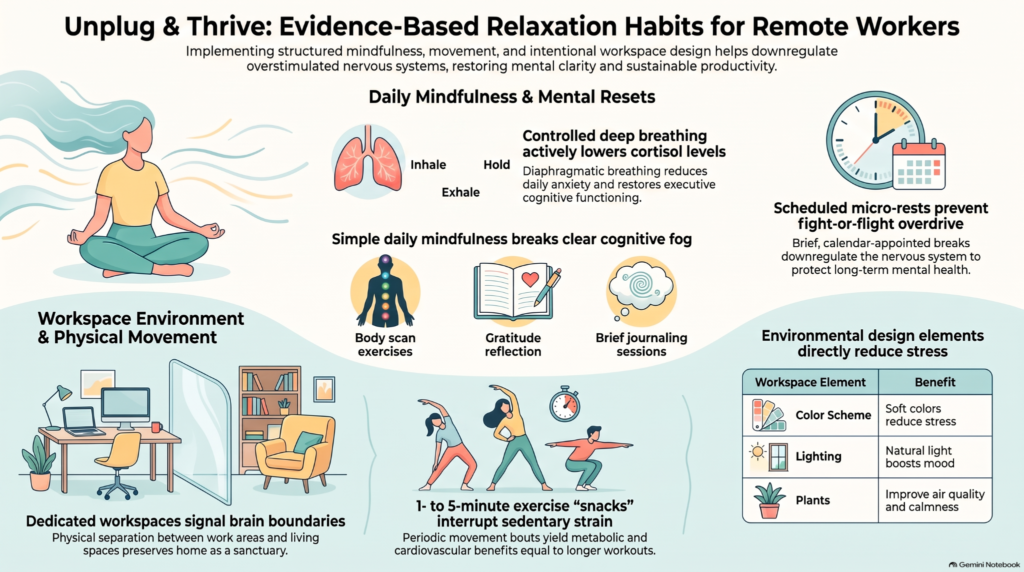
Mindfulness meditation practices and breathing exercises have proven benefits, helping you reduce stress and improve focus.
Let’s explore how these evidence-based methods can transform your work-from-home experience.
Mindfulness Meditation Practices
While juggling the demands of remote work, incorporating mindfulness meditation practices can greatly enhance your well-being and productivity. By focusing on mindful breathing, you can reduce stress and improve your mental clarity. Practicing evidence based meditation techniques regularly can help remote workers manage daily stress, strengthen emotional resilience, and maintain better focus throughout the workday.
Here are some meditation benefits you can expect:
- Increased focus and concentration
- Enhanced emotional resilience
- Improved overall mood
- Greater sense of calmness
Start with just a few minutes each day, allowing yourself to be present in the moment. As you cultivate this practice, you’ll find it easier to navigate the challenges of remote work.
Breathing Exercises Benefits
Breathing exercises can be a game-changer for remote workers seeking effective relaxation techniques. By incorporating simple breathing techniques into your daily routine, you can greatly enhance your stress reduction efforts.
Research shows that deep, intentional breathing lowers cortisol levels, promoting a sense of calm and focus. When you practice these exercises, you not only reduce anxiety but also improve your overall well-being. Understanding breathwork and cortisol reduction can help remote workers manage stress more effectively, as controlled breathing may support relaxation and promote a calmer state of mind.
Just a few minutes of focused breathing can clear your mind, helping you feel more grounded and present. Whether you’re managing deadlines or juggling multiple tasks, taking a moment to breathe deeply can empower you to reclaim your peace.
HOW TO INCORPORATE MINDFULNESS INTO YOUR WORKDAY
In my meditation courses and positive psychology work, people often confess that their biggest hurdle isn’t lacking relaxation techniques—it’s permitting themselves to pause without guilt. We tell ourselves that closing our eyes for a five-minute breathwork session or stepping outside during lunch is indulgent when deadlines loom. But here is what the research consistently demonstrates: intentional micro-rests actually downregulate our overstimulated nervous systems, dropping cortisol levels and allowing executive functioning to reset.
On days when my home studio feels heavy with screen glare, I use brief sensory transitions to disrupt continuous strain. I might put on a soft piece of classical cello, make a warm cup of herbal tea, and step away entirely, letting my rescue pup Luna nudge me toward the garden for five minutes of grounding breaths.
These aren’t wasted minutes; they are tiny neural resets that pull the brain out of fight-or-flight overdrive. By treating mindful pauses like non-negotiable appointments on your calendar, you stop waiting for burnout to force rest upon you and instead build genuine psychological resilience right where you sit.
Collaboration is the backbone of an efficient team. It bridges gaps, fosters creativity, and strengthens cohesion — all of which are critical for thriving in a remote or flexible setup.
Incorporating mindfulness into your workday can considerably enhance your focus and reduce stress.
Taking daily mindfulness breaks and practicing focused breathing techniques are effective ways to center yourself amid a busy schedule.
Research shows that even short moments of mindfulness can improve your overall well-being and productivity.
Daily Mindfulness Breaks
How can you find moments of calm amidst the hustle of remote work? Daily mindfulness breaks can be your sanctuary.
By taking just a few minutes, you can recharge and refocus. Here are some simple ways to incorporate mindfulness into your workday:
- Mindfulness journaling: Write down your thoughts or feelings to clarify your mind.
- Body scan: Take a moment to focus on each part of your body, releasing tension as you go.
- Nature pause: Step outside for a breath of fresh atmosphere, engaging your senses.
- Gratitude reflection: List three things you’re grateful for to shift your mindset.
Incorporating these practices can help you cultivate a more peaceful and productive work environment.
Embrace the freedom of mindfulness!
Focused Breathing Techniques
While you navigate the demands of remote work, focused breathing techniques can serve as a powerful tool to enhance your mindfulness practice.
By incorporating breath awareness into your day, you can create a sense of calm and clarity. Start with diaphragmatic breathing: sit comfortably and place one hand on your belly. Inhale deeply through your nose, allowing your belly to rise, then exhale slowly through your mouth. Aim for a few minutes of this practice whenever stress arises.
Research shows that focused breathing can reduce anxiety and improve concentration, allowing you to reclaim your focus. By regularly practicing these techniques, you’ll cultivate a greater sense of freedom and control over your work environment.
Embrace the power of your breath!
Why Taking Breaks Can Boost Your Productivity?
Taking regular breaks isn’t just a luxury; it’s a necessity for maintaining high productivity levels. When you allow yourself moments of cognitive rest, you give your brain a chance to recharge and refocus. This simple act can lead to a significant productivity boost.
Here’s how taking breaks can enhance your work performance:
- Improved focus: Short pauses help clear mental fog.
- Enhanced creativity: Fresh perspectives often arise during breaks.
- Reduced burnout: Regular intervals can prevent overwhelm and fatigue.
- Better decision-making: A rested mind makes clearer choices.
Embracing breaks allows you to work smarter, not harder. When you prioritize these moments, you’ll find that your efficiency increases, and you’ll enjoy your work more.
Designing a Relaxing Workspace for Enhanced Relaxation
Creating a relaxing workspace is essential for fostering a calm and productive environment. To enhance your workspace aesthetics, focus on elements that promote tranquility and comfort. Incorporating ergonomic furniture is a vital step; it supports your body and reduces strain, allowing you to work more efficiently.
| Element | Benefits |
| Color Scheme | Soft colors reduce stress |
| Lighting | Natural light boosts mood |
| Plants | Improve air quality and calmness |
Consider personal touches like art or photos that inspire you, as they can meaningfully elevate your mood. Remember, a well-designed workspace doesn’t just look good; it enhances your overall well-being. Prioritize creating a space that feels like your own sanctuary, allowing you to relax and thrive while working remotely. Making small adjustments can lead to a more enjoyable and productive experience.
Creating a Sustainable Relaxation Routine
A well-designed workspace sets the stage for productivity, but without a sustainable relaxation routine, stress can still creep in.
You deserve to strike a balance that enhances your well-being. Here are some strategies to create that balance effectively:
- Schedule Breaks: Use time management techniques like the Pomodoro method to incorporate regular, scheduled breaks into your day.
- Mindful Moments: Dedicate a few minutes to mindfulness practices, such as deep breathing or meditation, to clear your mind.
- Physical Activity: Incorporate movement, like stretching or a short walk, to rejuvenate your body and mind.
- Digital Detox: Set boundaries with technology during your relaxation time to truly disconnect and recharge. Taking time to stretch, practice deep breathing, or step away from your screen can become a simple self care activity that helps remote workers manage stress, restore focus, and maintain a healthier work-life balance.

RELATED STUDIES ABOUT RELAXATION HABITS FOR REMOTE WORKERS
In the fast-paced world of remote work, remember that you’re not just a cog in the machine. Like a well-tended garden, your well-being needs care and attention. By weaving relaxation into your daily routine, embracing mindfulness, and designing a soothing workspace, you’ll not only fend off stress and burnout but also cultivate productivity. Just as the seasons change, so can your habits—nurture yourself, and watch your professional life blossom. It’s time to prioritize your peace.
Did remote working push the growth of coworking spaces? The Italian cities case study
This mixed-methods study examines the determinants of growth and geographic distribution of coworking spaces (CSs) across Italian municipalities before and after the COVID-19 pandemic (2018–2023), evaluating how remote working arrangements, market potential, occupational task structures, and digital infrastructure reshape the geography of collaborative workspaces.
Study Overview & Methodology:
- Background & Research Scope: The COVID-19 pandemic induced a major restructuring of work patterns in Italy, where remote and smart workers expanded from 570,000 in 2019 to 6.58 million in March 2020 before stabilizing around 3.58 million by 2023. This study investigates whether the accompanying growth of CSs reflects traditional urban agglomeration dynamics or a decentralized spread into medium-sized and peripheral areas.
- Mixed-Methods Architecture: Integrated qualitative key informant interviews with quantitative econometric modeling and spatial autocorrelation analysis to triangulate determinants across regional scales.
- Qualitative Phase: Conducted semi-structured interviews (April–July 2023) with 22 key informants across Italy, including 12 CS managers/founders, 3 coworkers, 2 corporate real estate executives, 3 coworking association representatives, and 2 policymakers.
- Data Sources & Longitudinal Corpus: Merged multiple national datasets, including Italiancoworking (tracking CS facilities from 2018 to 2023), the INAPP Italian Survey of Professions (ICP; analyzing task content across 811 five-digit occupational codes based on the O*NET taxonomy adapted to the Italian labor structure), the ISTAT Labour Force Survey, the Italian Ministry of Economic Development, AGCOM broadband records, and the National Strategy for Inner Areas (SNAI).
- Econometric Specification: Evaluated CS absolute growth across 7,808 municipalities (measured as the net change in CSs between 2018 and 2023) using a Zero-Inflated Negative Binomial (ZI-NB) model. This accounted for substantial over-dispersion and excess zeros (97.17% of municipalities had no CS growth), supported by Vuong’s non-nested test (z = 2.74, p < 0.01).
- Explanatory Variables: Built a standardized provincial Market Potential Index using factor analysis loadings on six correlated indicators: knowledge workers, work-from-home (WFH) capacity, computer-use intensity, occupational social skill intensity, self-employed workers, and innovation concentration. Models controlled for municipal broadband coverage, provincial unemployment, macro-regions, and classification as an inner/peripheral area.
- Spatial Analysis: Conducted global Moran’s I simulations (1,000 runs) and Local Indicators of Spatial Association (LISA / Local Moran’s I) to identify spatial clustering and local autocorrelation patterns across Italian municipalities.
Key Quantitative & Econometric Findings:
- National Growth Dynamics: Total CSs in Italy increased by 55.3%, rising from 661 in 2018 to 1,027 in 2023. While Northern Italy maintains absolute concentration (372 in Northwest, 233 in Northeast), the highest relative growth rates occurred in Southern Italy (+81.4%, increasing from 86 to 156) and the Northwest (+68.3%).
- Market Potential as the Primary Growth Driver: The Market Potential Index exerted a positive and statistically significant effect on municipal CS growth (coefficient = 0.053, p < 0.01). A 1-point increase in market potential corresponds to a 5.4% increase in the expected number of CSs.
- Infrastructure & Periphery Penalties:
- Municipal broadband availability significantly spurred CS expansion (coefficient = 0.020, p < 0.01), where each 1-percentage-point increase in broadband-connected households increased CS counts by 2.0%.
- Classification within an “Inner Area” severely suppressed CS proliferation (coefficient = -2.323, p < 0.01), representing a greater than 90% reduction in expected CS growth compared to non-inner municipalities.
- Geographic Macro-Trends: Relative to the Northwest baseline, positive growth coefficients were observed in the Northeast (0.689, p < 0.1), Central Italy (0.694, p < 0.1), Southern Italy (0.829, p < 0.1), and the Islands (1.124, p < 0.1), confirming a catch-up dynamic in previously underserved regions.
Spatial & Qualitative Insights:
- Spatial Clusterization vs. The Suburban Vacuum:
- Global Moran’s I confirmed that spatial clustering of CSs intensified significantly between 2018 and 2023.
- LISA analysis revealed statistically significant local spatial autocorrelation in 231 municipalities. Crucially, 197 of these exhibited negative spatial autocorrelation, predominantly clustered in suburban rings surrounding major metropolises (Milan, Rome, Turin).
- Remote and hybrid workers living in suburban belts prefer commuting into core metropolitan centers to leverage urban amenities, face-to-face networking, and urbanization economies rather than utilizing local suburban CSs.
- Demand Drivers in Medium-Sized Cities:
- In contrast to suburban commuter belts, medium-sized cities (e.g., Ferrara, Como, Treviso, Reggio Emilia) saw robust demand for local “near working” hubs. Workers in these areas face high travel friction to major metropolises, making local collaborative spaces an attractive alternative to isolated home working.
- Evolution of Space Typologies:
- Interviews highlighted an expansion of larger (>1,000 m²) and hybrid coworking formats offering well-being amenities (relaxation lounges, fitness rooms, cafes, and childcare facilities) to support work-life balance and counter the professional isolation of home working.
- The “South Working” phenomenon brought approximately 45,000 workers back to southern hometowns during the pandemic, stimulating community hubs (“presidi di comunità”) integrated into cultural spaces and public libraries, though corporate return-to-office mandates partially moderated post-2022 occupancy.
Policy, Urban Planning, & Economic Implications:
- CSs as Public Production Factors: Medium-sized city CSs act as connective infrastructure linking urban and rural economic systems, functioning as quasi-public goods that facilitate local economic retention, shorten daily commutes, and support “15-minute city” frameworks.
- Mitigating Brain Drain: In southern and non-metropolitan hubs, CSs serve as platforms for startup incubation, digital skill training, and youth retention, creating focal points to attract remote talent and counter regional brain drain.
- Targeted Public Support: Because inner and peripheral areas face strong structural impediments (weak market demand and inadequate connectivity), public initiatives should prioritize digital infrastructure investments and targeted workspace subsidies rather than relying solely on private market deployment.
| REFERENCE: Marco Biagetti, Ilaria Mariotti, Federica Rossi, Sergio Scicchitano, Did remote working push the growth of coworking spaces? The Italian cities case study, Cities, Volume 166, 2025, 106272, ISSN 0264-2751, https://doi.org/10.1016/j.cities.2025.106272. (https://www.sciencedirect.com/science/article/pii/S0264275125005736) |
A Work-Based, Fully Remote, and Peer-Supported Exercise Snack Behavior Change Intervention (MOV’D): Protocol for a Randomized Controlled Pilot Trial
This protocol describes the study rationale, design, and feasibility/acceptability evaluation plan for MOV’D (Move Often Every Day)—a fully remote, peer-supported behavioral pilot trial developed to interrupt prolonged workplace sitting and accumulate moderate-to-vigorous physical activity (MVPA) using “exercise snacks”.
Study Overview & Theoretical Framework:
- Clinical & Behavioral Rationale: Uninterrupted sedentary sitting and insufficient MVPA represent two independent risk factors for cardiovascular disease (CVD). Interrupting prolonged sitting with periodic 1- to 5-minute bouts of MVPA (“exercise snacks” or “snacktivities”) yields cardiorespiratory, metabolic, and affective benefits comparable to single prolonged exercise sessions. However, workplace uptake is frequently impeded by habit initiation barriers, social frictions, and fading engagement.
- Design Precursor: MOV’D builds directly upon findings from the Tweet4Wellness pilot, which tested Twitter-delivered walking breaks. While Tweet4Wellness improved active hours and daily steps, engagement dropped substantially after two weeks, and participants expressed a need for matched peer support. MOV’D incorporates three modifications: upgrading walking breaks to MVPA exercise snacks, introducing a “learning-by-teaching” peer-coaching model, and pairing participants with matched accountability buddies.
- Theoretical Grounding: Framed around the ORBIT (Obesity-Related Behavioral Intervention Trials) model for behavioral treatment development (Phase IIb, Aim 2), integrating Michie et al.’s Behavior Change Technique (BCT) taxonomy, Social Cognitive Theory (role modeling, vicarious learning), and Social Support frameworks.
Intervention Architecture & Methodology:
- Participants & Recruitment: Screened full-time sedentary adult workers (aged 25–75 years) fluent in English who regularly use smartphones/social media and have no medical contraindications to physical activity (verified via PAR-Q). Recruitment operated via university healthcare listservs and the ResearchMatch non-profit platform.
- Randomization & Matched Buddy Pairing: Block-randomized across three cohorts using a block-of-4 design stratified by baseline physical activity levels (International Physical Activity Questionnaire [IPAQ] metabolic equivalent of task [MET] minutes). Each participant was assigned an accountability buddy within their block, adjusting pairs to prevent major age or workplace mismatches. Treatment buddies were formally introduced via Zoom and encouraged to interact directly in cohort chats, whereas control buddies remained unnotified of their pairing.
- Study Arms (4-Week Intervention + 4-Week Follow-Up):
- MOV’D Experimental Group: Wore a Fitbit Inspire 2 with automated hourly “reminders to move” activated. Received:
- Weekly BCT educational videos (3–5 short 4–5 minute modules weekly via EdPuzzle teaching strategies such as overcoming the “what the hell” effect, cognitive reframing, and situation planning).
- A “learning-by-teaching” structure where buddy pairs watched distinct videos and coached each other on the strategies.
- Daily weekday reinforcement prompts delivered to the private group chat (Twitter for Cohort 1; GroupMe for Cohorts 2–3).
- Daily weekday follow-along exercise snack video suggestions (2–5 minutes; e.g., jump squats, mountain climbers, stair climbs filmed with diverse-bodied models in workplace attire).
- Daily evening SMS self-monitoring text prompts tracking completed snacktivity counts.
- Goal setting every Sunday for targeted daily workday snack counts.
- Fitbit-Only Control Group: Wore the identical Fitbit Inspire 2 device for physical activity self-monitoring, but with hourly reminders to move disabled and no access to group chats, videos, or behavioral prompts. Control participants received intervention educational materials after study completion.
- MOV’D Experimental Group: Wore a Fitbit Inspire 2 with automated hourly “reminders to move” activated. Received:
Evaluation Matrix & A Priori Success Benchmarks:
- Primary Feasibility Metrics (Pre-Set A Priori Targets):
- Recruitment Rate: Ratio of retained participants to interested screeners >25%.
- Diversity Representation: Percentage of retained racial and ethnic minority participants >50%.
- Study Retention Rate: Percentage of randomized participants completing follow-ups >80%.
- Wearable Compliance: Valid Fitbit wear on >=80% of study days by >80% of participants.
- BCT Video Adherence: 100% of participants watching >=4 BCT videos.
- Group Chat Engagement: >80% of participants active in chat on >=50% of study days.
- Snack Video Usage: 100% of participants viewing >=4 snack videos.
- Daily SMS Response Rate: Ratio of replied tracking texts to total sent >90%.
- Acceptability Metrics:
- Quantitative Acceptability: >70% positive endorsement across study components on 5-point Likert scales at Week 4.
- Qualitative Acceptability: Semi-structured post-study exit interviews evaluated via reflexive thematic analysis.
- Exploratory & Behavioral Endpoints:
- Daily self-reported workday snacktivity volume and within-participant shifts in overall MVPA.
- Secondary psychometric batteries (baseline, Week 4, Week 8): Pittsburgh Sleep Quality Index (PSQI), Perceived Stress Scale (PSS-10), Need for Recovery Scale (workplace fatigue proxy), exercise self-efficacy, exercise mindset, and Rapid Assessment Disuse Index (sedentary behavior proxy).
Pilot Implementation Status & Methodological Considerations:
- Recruitment & Retention Yield: Between March and June 2022, 506 individuals were screened, 94 attended Zoom info sessions, and 72 were randomized (36 MOV’D, 34 Fitbit control, 2 lost prior to allocation). Data collection concluded in October 2022 with 68 participants completing all longitudinal surveys (exceeding feasibility retention targets).
- Measurement Limitations: The protocol notes the technical constraint of consumer-grade accelerometers (Fitbits), which frequently fail to capture exercise snacks performed in place (squats, jumping jacks) as steps, and whose smoothing algorithms may filter out brief, high-intensity heart rate spikes.
- Translational Trajectory: Demonstrating feasibility and acceptability through this protocol positions the MOV’D framework for iterative optimization (MOV’D 2.0 initiated recruitment in 2024) ahead of a fully powered Phase III multi-site randomized efficacy trial evaluating workplace cardiovascular risk reduction.
| REFERENCE: Ashley Monteiro, Jessie Moore, Rocky Aikens, Angela Duckworth, James J Gross, Dan Schwartz, Mike Baiocchi, Judith J Prochaska, Marily Oppezzo, A Work-Based, Fully Remote, and Peer-Supported Exercise Snack Behavior Change Intervention (MOV’D): Protocol for a Randomized Controlled Pilot Trial, JMIR Research Protocols, Volume 14, 2025,, ISSN 1929-0748, https://doi.org/10.2196/64455. (https://www.sciencedirect.com/science/article/pii/S1929074825004810) |
Behaviour change techniques used in interventions targeting dementia risk factors amongst older adults in rural and remote areas: A systematic review and meta-analysis
This systematic review and meta-analysis investigates the application and effectiveness of behaviour change techniques (BCTs) within lifestyle interventions targeting late-life modifiable dementia risk factors—physical inactivity, poor diet, social isolation, and depression—among older adults residing in rural and regional areas.
Study Overview & Methodology:
- Background & Rural Health Disparities: While multidomain dementia prevention initiatives (e.g., FINGER) show promise, their components are predominantly developed within metropolitan contexts. Rural and regional older adults face distinct socio-environmental barriers, including geographical isolation, limited healthcare access, reduced transport, and distinct community norms, contributing to higher dementia risk and disparate health outcomes.
- Review Protocol & Search Architecture: Registered on PROSPERO and structured following PRISMA guidelines, six electronic databases (MEDLINE, Embase, PsycINFO, Web of Science, CINAHL, and Cochrane Library) were searched from 2000 through November 2023.
- Eligibility Criteria: Enrolled peer-reviewed studies evaluating non-pharmacological behavioural interventions delivered outside clinical/hospital settings that targeted adults aged 55 years and older living in rural or remote areas. Interventions had to target one of four single modifiable dementia risk factors: physical inactivity, poor diet, social isolation, or depression.
- Corpus Characteristics: From 42,529 initial records, 49 unique empirical studies met inclusion criteria:
- Physical Inactivity: 22 studies (10 RCTs; total n=2,720).
- Poor Diet: 6 studies (2 RCTs).
- Social Isolation: 9 studies (2 RCTs).
- Depression: 12 studies (8 RCTs).
- BCT Taxonomy Coding: Interventions were coded using Michie et al.’s Behaviour Change Technique Taxonomy version 1 (BCTTv1, comprising 93 distinct BCTs across 16 categories) by independent coders with discrepancy resolution.
- Quantitative Synthesis: Random-effects meta-analyses using standardized mean differences (SMD, Cohen’s d) were performed where homogeneous outcome data existed, evaluating physical function, loneliness, and depressive symptoms. Methodological quality was evaluated using Cochrane RoB 2.0 and the GRADE certainty framework.
Application of Behaviour Change Techniques (BCTs):
- Distribution & Density Across Risk Domains: Interventions incorporated an overall average of 14.8 BCTs (SD = 10.0). The average number of BCTs applied varied across domains:
- Social isolation programs utilized the highest density of BCTs (mean = 18.3, SD = 8.5).
- Depression interventions averaged 17.6 BCTs (SD = 10.7).
- Physical inactivity interventions averaged 16.0 BCTs (SD = 11.5), while coding the highest total variety of BCT categories (67 of 93 BCTs; 72.0%).
- Dietary interventions utilized the lowest number of BCTs (mean = 5.2, SD = 3.0; 12 of 93 BCTs represented).
- Dominant Shared BCT Clusters: Across all 49 studies, interventions converged on four primary BCT categories:
- Goals and planning (present in 100% of interventions; 49/49).
- Shaping knowledge (95.9%; 47/49).
- Social support (87.8%; 43/49).
- Comparison of outcomes (77.6%; 38/49).
- Most Frequently Deployed Individual BCTs:
- “Instruction on how to perform the behaviour” (coded in 50.5% of studies; 47/93 overall BCT scope).
- “Action planning” (49.4%; 46/93).
- “Credible source” (40.9%; 38/93).
Meta-Analytic & Narrative Efficacy Findings:
- Significant Efficacy for Depression (CBT):
- Meta-analysis of 7 RCTs evaluating Cognitive Behavioural Therapy (CBT; including Behavioural Activation and Acceptance and Commitment Therapy) showed a statistically significant, moderate reduction in depressive symptoms (SMD = -0.39, 95% CI [-0.55, -0.24], $I^2 = 49\%$).
- GRADE certainty of evidence was rated as moderate.
- Effective programs routinely incorporated structured cognitive restructuring, emotional regulation, and “action planning”. The sole ineffective depression trial failed to incorporate action planning and relied solely on passive recreational activities.
- Ineffective Physical Inactivity Interventions:
- Meta-analysis of 6 RCTs revealed that physical activity interventions had no significant effect on objective physical function compared to usual care (SMD = 0.01, 95% CI [-1.12, 1.14], $I^2 = 95\%$).
- GRADE certainty of evidence was rated as very low, driven by extreme statistical heterogeneity, small study samples, and baseline ceiling effects (participants were relatively healthy and active at baseline). In addition, 19 of 24 physical activity interventions lasted under 6 months, an insufficient duration to achieve durable neuromuscular or anthropometric adaptations.
- Ineffective Social Isolation Interventions:
- Meta-analysis of 2 RCTs evaluating loneliness outcomes showed no statistically significant reduction (SMD = -4.95, 95% CI [-12.92, 3.01], $I^2 = 99\%$) with low certainty of evidence.
- Conventional social isolation protocols did not align with social prescribing principles, frequently relying on digital-only formats lacking the direct in-person contact or local community integration necessary to offset rural isolation.
- Favorable Anthropometric Trends in Diet (Narrative Synthesis):
- While high outcome heterogeneity prevented quantitative pooling, 63% of dietary interventions lasted 3 months and consistently demonstrated significant within-study improvements in body weight, waist circumference, blood glucose, and lipid profiles.
Mechanisms of Action (MoAs) & Socio-Environmental Gaps:
- Alignment of BCTs and MoAs: The most common BCTs (“action planning,” “instruction,” “credible source”) align with intra-individual MoAs such as behavioural regulation and knowledge acquisition. However, expert consensus frameworks suggest that action planning alone is insufficient without pairing with problem-solving and negative affect management.
- Socio-Environmental Disconnect: Interventions rarely addressed structural, rural-specific Mechanisms of Action, such as environmental context and resources. Critical physical barriers—such as sparse transport infrastructure, poor road walkability, extreme distances to food retailers, and digital connectivity deficits—consistently undermined individual-level behavioural intentions.
- Feasibility & Acceptability Under-Reporting: Only 7 of the 49 included studies explicitly evaluated feasibility and acceptability parameters, reflecting a general tendency to deploy urban “one size fits all” designs without community co-design.
Translational & Policy Implications:
- Tailoring Beyond Individual Agency: Dementia prevention interventions in rural and regional areas cannot rely solely on educational and individual planning techniques. Programs must integrate environmental restructuring (e.g., active transport options, community walking routes) and social prescribing initiatives that leverage existing local organizations.
- Structural Intervention Design: Future trials should prioritize longer intervention and follow-up durations (>6 months), recruit at-risk non-active baselines, and integrate co-design methodologies with rural older adults to optimize program retention, feasibility, and sustained risk-factor mitigation.
| REFERENCE: Laura Dodds, Kay Deckers, Celia B. Harris, Joyce Siette, Behaviour change techniques used in interventions targeting dementia risk factors amongst older adults in rural and remote areas: A systematic review and meta-analysis, The Journal of Prevention of Alzheimer’s Disease, Volume 12, Issue 4, 2025, 100093, ISSN 2274-5807, https://doi.org/10.1016/j.tjpad.2025.100093. (https://www.sciencedirect.com/science/article/pii/S2274580725000378) |
CONCLUSION
Cultivating workplace well-being isn’t about overhauling your entire life overnight with elaborate, unrealistic wellness rituals. Instead, it comes down to honoring the small, sacred margins of your day. When five o’clock rolls around, shutting your laptop screen should serve as a firm boundary—a gentle, closing chord that signals your mind to return home to yourself. For me, that transition is anchored in putting on my walking shoes and heading out with Luna as the evening light softens, breathing in the fresh air and leaving the chatter of notifications behind.
In remote work, it is easy to forget that you are an entire human being outside of your output and digital presence. Give yourself permission to step away from the keyboard, embrace true stillness, and create a daily rhythm where you don’t just endure remote work, but genuinely thrive within your own space.
By gently weaving these micro-habits of mindfulness and movement into your everyday routine, you protect your peace, reclaim your focus, and restore harmony between your career and your inner life.