

When people first sit across from me in wellness consultations or holistic workshops, they often carry a profound misconception about what confidence actually entails. They assume it is an innate, loud charisma—an unshakeable armor that protects you from ever feeling doubt, awkwardness, or hesitation. I used to fall into that exact trap myself. Early in my career, whenever imposter syndrome crept in before leading a group session, I thought I had to put on a mask of effortless perfection to be taken seriously.
In reality, genuine self-assurance is far quieter, more grounded, and far more attainable than society leads us to believe. It is not about looking flawless or knowing every answer upfront; it is rooted in emotional intelligence and the deep conviction that you can hold space for your own vulnerabilities without falling apart.
Whenever I find my internal narrative spiraling into self-criticism, I pull out my journal and ask: Where did this belief come from, and is it genuinely serving my peace? When we untangle our self-worth from external validation, confidence ceases to be an exhausting performance. Instead, it becomes an inner harbor of self-compassion, patience, and realistic self-trust that you can return to whenever life feels turbulent.
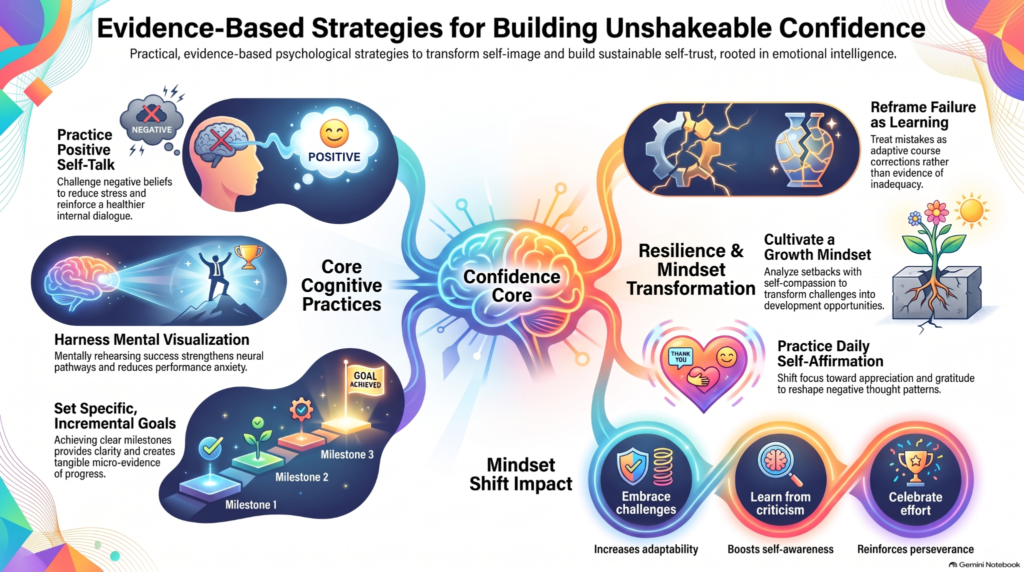
Building confidence is a systematic approach rooted in psychology. By utilizing positive self-talk, you can challenge negative beliefs and enhance your self-esteem. Visualization techniques allow you to mentally rehearse successful outcomes, strengthening your self-image. Setting specific goals gives clarity and motivates you, while embracing failure helps cultivate resilience. Adopting a growth mindset transforms setbacks into learning opportunities. These evidence-based strategies can greatly improve your self-image, and there’s much more to explore on this essential topic.
KEY TAKEAWAYS
- Utilize positive self-talk and self-affirmation techniques to challenge negative beliefs and enhance self-esteem, fostering a more resilient self-image.
- Set specific, measurable goals to provide clarity and motivation, celebrating achievements to reinforce belief in your abilities.
- Embrace failure as a growth opportunity, reframing setbacks to build resilience and adaptability in facing future challenges.
- Engage in visualization techniques to mentally rehearse positive outcomes, strengthening self-efficacy and reducing anxiety around performance.
- Practice gratitude journaling and self-affirmation exercises to shift focus towards appreciation and reshape negative thought patterns for improved self-worth.
WHAT’S THE PSYCHOLOGY BEHIND SELF-CONFIDENCE?
Confidence is a belief in oneself, the conviction that one can meet life’s challenges and succeed, and the willingness to act accordingly. Being confident requires a realistic sense of one’s capabilities and feeling secure in that knowledge.
Self-confidence is fundamentally rooted in psychological theories that explain how individuals perceive themselves and their abilities. Various self-esteem theories, such as Maslow’s hierarchy of needs and Rosenberg’s self-esteem scale, illustrate how your self-assessment shapes your confidence.
These frameworks suggest that a strong sense of self-worth directly influences your confidence levels. When you recognize your strengths and understand your limitations, you create a more realistic self-view.
Confidence influences arise from both internal and external factors, including social comparisons and feedback from others. You’re likely to feel more confident when you receive positive reinforcement, while negative feedback can undermine your self-image.
Research also indicates that individuals with high self-esteem are more resilient in the face of challenges. Understanding these dynamics can empower you to cultivate a positive self-image, ultimately leading to greater confidence in various aspects of your life.
The Role of Positive Self-Talk in Building Confidence
Building on the understanding of how self-perception shapes confidence, positive self-talk emerges as a significant tool in enhancing self-esteem. Engaging in affirmative phrases can directly influence your mindset, allowing you to challenge negative beliefs and reinforce a healthier self-image.
Research indicates that self-affirmation techniques, such as repeating empowering statements, can reduce stress and increase resilience.
By consciously choosing positive self-talk, you create an internal dialogue that affirms your worth and capabilities. This practice encourages a constructive outlook, enabling you to approach challenges with confidence.
When you encounter self-doubt, utilizing affirmative phrases can shift your focus from perceived shortcomings to your strengths, fostering a more optimistic self-perception. Understanding how to gain confidence starts with recognizing your strengths, setting realistic goals, and treating mistakes as opportunities to learn rather than reasons to doubt yourself.
Ultimately, by integrating positive self-talk into your daily routine, you can cultivate an environment conducive to self-growth and empowerment, transforming how you view yourself and your potential.
Boosting Self-Image With Visualization
Something deeper is the key: Confidence is not about your appearance. It’s not about your facial structure, or body type, or eye color, or how lucky you got in the gene pool. “How you appear” is not the same thing as “what you look like.”
Visualization techniques can greatly enhance your self-image by allowing you to create and mentally rehearse positive scenarios.
Research shows that regularly practicing these exercises can lead to improved confidence and a more optimistic outlook.
Harnessing Mental Imagery Techniques
Mental imagery techniques serve as powerful tools for enhancing self-image and confidence. By engaging in mental rehearsal, you can visualize your success in various scenarios, making the outcome feel more attainable.
Research indicates that imagery techniques can strengthen neural pathways associated with performance, effectively bridging the gap between thought and action. When you vividly imagine positive outcomes, you activate the same brain regions involved in actual experiences, fostering a sense of competence and self-worth.
This process not only boosts your confidence but also mitigates anxiety related to performance. By incorporating these techniques into your routine, you can reshape your self-image, empowering yourself to navigate challenges with renewed assurance and freedom.
Embrace mental imagery as a catalyst for personal growth.
Creating Positive Future Scenarios
While you may face uncertainties about the future, creating positive scenarios can markedly enhance your self-image and overall confidence.
Future visualization, a technique rooted in psychological research, allows you to mentally project yourself into successful outcomes. This process involves scenario planning, where you outline specific, achievable goals and envision the steps to reach them.
By vividly imagining these positive experiences, you train your mind to recognize your potential, reinforcing a sense of agency and control over your life. Studies indicate that this method can reduce anxiety and increase resilience, empowering you to navigate challenges more effectively.
Embracing positive future scenarios not only bolsters your self-image but also cultivates a proactive mindset, essential for achieving personal freedom and growth.
Practicing Daily Visualization Exercises
Incorporating daily visualization exercises into your routine can greatly enhance your self-image and boost overall confidence. By consistently applying visualization techniques, you can create a mental environment that fosters positive beliefs about yourself. Research shows that individuals who practice visualization regularly experience increased self-efficacy and reduced anxiety.
Here’s a simple guide to help you get started:
| Time of Day | Visualization Technique | Duration |
| Morning | Success Scenario Visualization | 5 minutes |
| Afternoon | Affirmation Visualization | 5 minutes |
| Evening | Reflection Visualization | 5 minutes |
Engaging in these visualization practices daily can empower you to reshape your self-image, leading to a more liberated and confident life.
How Goal Setting Builds Self-Confidence
Confidence is key to our mental wellbeing, increasing our resilience, supporting goal attainment and building better relationships. It isn’t about being successful, happy or good. Those things come and go. It is about trusting in your abilities.
Setting specific, measurable goals can greatly enhance your self-confidence by providing a clear path to success.
When you focus on goal achievement, you create opportunities for self-reflection, allowing you to recognize your progress and capabilities.
Here’s how goal setting can boost your self-confidence:
- Clarity: Clearly defined goals give you a roadmap, reducing uncertainty and increasing motivation.
- Milestones: Achieving smaller, incremental goals allows you to celebrate your successes, reinforcing your belief in your abilities.
- Accountability: Setting goals helps you commit to your aspirations, fostering a sense of responsibility that empowers you to take action.
As you accomplish these goals, you’ll notice a shift in your self-image.
Each step reinforces your belief in your potential, paving the way for even greater achievements. Applying these strategies can be especially helpful for building confidence at work, where recognizing your strengths and celebrating small achievements can improve your professional self-image and help you approach new challenges with greater assurance.
Embracing this process can lead to a more confident and liberated you.

HOW TO EMBRACE FAILURE TO BUILD RESILIENCE
Throughout my counseling work and personal wellness rituals, I have observed that confidence rarely arrives from sitting still and waiting to “feel ready.” True self-efficacy is an active practice that is forged through tangible, everyday choices. Years ago, during a solitary wellness retreat tucked away in a quiet mountain village, I realized how much emotional energy I wasted by overthinking small decisions and downplaying my skills. I had fallen into the subtle habit of underselling my capabilities to others just to avoid appearing arrogant, which only reinforced my internal insecurity.
Everything shifted when I began grounding my confidence in small, concrete actions rather than grand, sweeping milestones. Tackling a delayed chore, mastering a new grounding breathwork sequence, or leaning into an uncomfortable conversation at work builds micro-evidence that your mind can actually rely on.
Just as importantly, it requires practicing fierce self-compassion when things inevitably fall flat. Whenever you miss the mark, speak to yourself as you would to a close, valued friend facing that same misstep. Confidence does not demand that you never stumble; it simply asks that you treat your mistakes as gentle course corrections rather than proof that you are fundamentally inadequate.
Embracing failure is essential for building resilience, as it allows you to redefine what failure means in your life.
By learning from mistakes and viewing them as opportunities for growth, you cultivate a mindset that thrives on challenges rather than shies away from them.
This shift not only enhances your self-confidence but also equips you to handle future obstacles more effectively.
Redefining Failure’s Meaning
While many view failure as a setback, redefining its meaning can transform it into a powerful tool for building resilience. Embracing failure acceptance allows you to shift your perspective, fostering growth.
Consider these strategies for failure redefinition:
- Learn and Adapt: Treat failures as lessons that inform future decisions, enhancing your adaptability.
- Reframe Your Narrative: Change how you talk about your failures. Instead of seeing them as defeats, recognize them as steps toward growth.
- Cultivate a Growth Mindset: Understand that failure is a natural part of the learning process, essential for personal development.
Learning From Mistakes
Recognizing failure as a stepping stone rather than a dead end is essential for personal growth. Embracing imperfections allows you to view setbacks as learning opportunities.
Research shows that individuals who examine their mistakes rather than avoid them develop greater resilience. By evaluating what went wrong, you gain insights that can inform future decisions, enhancing your ability to navigate challenges.
This reflective process not only bolsters your self-image but also fosters a sense of freedom, as you realize that failure doesn’t define you. Instead, it’s a valuable part of your journey.
Commit to this mindset, and you’ll find that each stumble becomes a significant lesson, shaping a more confident and adaptable self.
Cultivating a Growth Mindset
To cultivate a growth mindset, you must first understand that failure isn’t a reflection of your abilities, but rather an essential component of the learning process.
Embracing failure fosters resilience building and prompts important mindset shifts.
Here are three strategies to help you embrace failure:
- Reframe your perspective: View setbacks as opportunities for growth rather than obstacles.
- Analyze the experience: After a failure, reflect on what went wrong and what you can learn from it.
- Practice self-compassion: Treat yourself kindly when things don’t go as planned; remember, everyone faces challenges.
Cultivating a Growth Mindset to Transform Your Confidence
Cultivating a growth mindset can greatly enhance your confidence by reshaping how you perceive challenges and setbacks. Instead of viewing failures as reflections of your abilities, you start to see them as opportunities for learning and growth. This shift in mindset encourages resilience training, allowing you to bounce back more effectively from difficulties.
| Mindset Shift | Impact on Confidence |
| Embrace challenges | Increases adaptability |
| Learn from criticism | Boosts self-awareness |
| Celebrate effort | Reinforces perseverance |
Practical Exercises to Boost Your Self-Image Today
Building on the foundation of a growth mindset, practical exercises can greatly enhance your self-image and overall confidence.
Implementing structured activities not only fosters a positive self-view but also reinforces personal growth. Incorporating a simple self care activity, such as journaling, taking a relaxing walk, or practicing mindfulness, can help you strengthen your self-image and maintain a positive relationship with yourself.
Here are three effective exercises to reflect upon:
- Self Affirmation Exercises: Spend a few minutes each day reciting positive affirmations that resonate with your goals and values. Research shows that this practice can uplift your mood and reshape negative thought patterns.
- Gratitude Journaling: Write down three things you’re grateful for each day. This exercise shifts your focus from what’s lacking to appreciating what you have, enhancing your self-worth.
- Visualization Techniques: Picture yourself achieving your goals or overcoming challenges. Visualizing success can create a powerful sense of self-efficacy, boosting your confidence.
Incorporating these strategies into your routine can lead to profound improvements in your self-image.

RELATED STUDIES ABOUT CONFIDENCE BUILDING BACKED BY PSYCHOLOGY
To sum up, building self-confidence is like nurturing a garden; it requires consistent effort and the right conditions. By harnessing positive self-talk, visualization, and goal setting, you cultivate a richer self-image. Embracing failure and adopting a growth mindset act as sunlight and water, fostering resilience and strength. Engage in practical exercises today, and watch as your self-confidence blossoms, transforming your inner landscape into a vibrant, flourishing haven of self-worth and potential.
Rock climbing as experiential pedagogy in outdoor education: The positive psychology outcomes and students’ well-being
This qualitative study investigates the educational and psychological value of rock climbing within Chinese higher education, evaluating students’ lived experiences through constructivist learning theory and an extended PERMA+IT positive psychology framework.
Study Overview & Methodology:
- Background & Context: Outdoor education (OE) and lifestyle sports are rapidly growing in China alongside shifting cultural views and educational policies emphasizing holistic development, physical literacy, and character building. The study examined an undergraduate elective rock climbing module delivered over two months in Yangshuo County, Guangxi—a premier karst limestone climbing region—at Moon Hill and Mini Krabi.
- Theoretical Framework: Grounded in experiential constructivist theory (knowledge co-creation through embodied practice, interaction, and critical reflection) and Seligman’s positive psychology model of flourishing. To account for the specific demands of high-risk adventure education in China, the traditional PERMA model (Positive Emotion, Engagement, Relationships, Meaning, Accomplishment) was inductively extended to include Independence and Trust (PERMA+IT).
- Participants & Sampling: Utilized purposive sampling across multiple universities in Guangxi offering outdoor education programs. The total sample comprised 36 undergraduate students (70% male, 30% female; aged 18–21 years) with outdoor education involvement ranging from 1 to 4 years and climbing experience from a single ascent to over 25 expeditions.
- Data Collection: Conducted in two phases: Phase 1 involved pilot semi-structured individual interviews with 6 students (lasting 30–50 minutes) to refine the interview guide; Phase 2 comprised five stratified focus group discussions with 36 students (6–8 participants per group; lasting 60–90 minutes). Data collection was augmented by participant observation at climbing sessions and informal post-activity follow-ups via WeChat and phone calls.
- Data Analysis: Transcripts were translated from Chinese using DeepL with back-translation checks, followed by two-coder independent thematic coding, iterative peer debriefing, and deductive/inductive mapping onto the 7 dimensions of the PERMA+IT model, yielding 23 discrete subthemes.
Key Findings Across the PERMA+IT Dimensions:
- Positive Emotion: Climbing in natural karst environments evoked feelings of awe, joy, vitality, and somatic empowerment. Students described aesthetic appreciation of landscape and bodily movement, reporting that confronting physical challenges against gravity fostered emotional resilience and durable affective well-being that contrasted sharply with comfortable campus routines.
- Engagement: Participants reported intense cognitive absorption, emotional focus, and physical exertion, describing states of optimal flow—integrating “flow of thought,” “flow of mind,” and “flow of body”. The demands of reading rock surfaces and executing sequential movements compelled complete present-moment concentration.
- Relationships: Natural rock climbing reshaped relationships both with nature (fostering eco-sensitivity, ecological consciousness, and environmental stewardship) and with peers. Participants contrasted outdoor ascents with isolated indoor wall training, noting that outdoor climbing required holistic awareness of surroundings and mutual encouragement.
- Meaning: Surmounting vertical obstacles and navigating uncertainty served as mastery experiences that bolstered self-efficacy, stress tolerance, and adaptive coping. The experience allowed students to confront personal fears and extract deeper existential significance from their academic journeys.
- Accomplishment: Success was framed not merely as reaching the physical summit, but as an ongoing, continuous process of incremental skill mastery, self-enhancement, and communal contribution within the climbing subculture.
- Independence (Emergent Dimension): Students emphasized self-determination, autonomy, and self-governance. Ascending required total reliance on personal judgment, physical capabilities, and internal accountability, helping students discover latent potential transferable to decisions beyond sports.
- Trust (Emergent Dimension): Relational trust emerged as an essential psychological prerequisite in high-risk outdoor settings, operating both interpersonally (mutual confidence between climber, belayer, and instructor) and intrapersonally (trusting one’s own physical capacities and judgments under stress). Trusting the safety system allowed learners to push past perceived psychological limitations.
Pedagogical, Policy, & Research Implications:
- Structured Reflection Scaffolding: To translate raw adventure experiences into enduring personal and cognitive growth, outdoor curricula must integrate structured post-climbing reflection sessions focusing on fear management, trust, perseverance, and emotional regulation.
- Curricular Integration in Higher Education: Recommends transitioning outdoor adventure programs from isolated extracurricular novelties into accredited, credit-bearing components of undergraduate curricula aimed at student well-being and life-skill development.
- Institutional Partnerships & Assessment Standards: Regional and national educational authorities should provide funding for university collaborations with local outdoor clubs and embed positive psychology outcomes (self-determination, collaboration, affective resilience) into formal academic evaluation criteria.
- Limitations & Future Research: The study was constrained by its qualitative design, sample size (n=36), and focus on a single geographic setting (Yangshuo). Future research should employ longitudinal tracking, incorporate quantitative psychometric assessments of well-being, evaluate other outdoor sports, and explore diverse cultural contexts.
| REFERENCE: Jinsheng (Jason) Zhu, Qideng Mo, Rock climbing as experiential pedagogy in outdoor education: The positive psychology outcomes and students’ well-being, Acta Psychologica, Volume 264, 2026, 106414, ISSN 0001-6918, https://doi.org/10.1016/j.actpsy.2026.106414. (https://www.sciencedirect.com/science/article/pii/S0001691826002155) |
Artificial intelligence as a training tool in clinical psychology: A comparison of text-based and avatar simulations
This experimental study evaluates postgraduate clinical psychology trainees’ perceptions of two artificial intelligence (AI) simulation modalities—a text-based conversational chatbot (OpenAI ChatGPT-4o) and a voice-based digital avatar (HeyGen)—for preliminary counseling skill rehearsal and cognitive-behavioral therapy (CBT) case formulation.
Study Overview & Methodology:
- Theoretical Framework: Grounded in media richness theory, social presence theory, the Computers Are Social Actors (CASA) paradigm, and the Metacognitive-Affective Model of Self-Regulated Learning. The study examines whether multimodal embodiment (voice, facial expression, gaze) enhances social presence, perceived usefulness, and reflective clinical learning compared to text-based interaction.
- Participants & Design: Employed a counterbalanced within-subjects repeated-measures design with 24 postgraduate students enrolled in the MSc Clinical Psychology program at the University of Kent (mean age = 24.6 years; 22 female, 1 male, 1 non-binary).
- Simulated Clinical Scenarios: Participants acted as the therapist across two simulated client cases drawn from psychiatric curricula: an adult experiencing anxiety following a relationship breakdown, and an international student exhibiting low motivation and social withdrawal. Sessions were structured around the CBT “Hot Cross Bun” formulation model (thoughts, emotions, behaviors, physical sensations).
- Intervention Delivery: To equalize conversational opportunities given typing speeds, participants completed a 12-minute text-based session with ChatGPT and a 10-minute spoken session with HeyGen. Both systems utilized the same underlying large language model with matched clinical prompt scripts.
- Assessment Strategy: Administered a post-session 21-item questionnaire (scored on a -2 to +2 Likert scale) evaluated via Principal Component Analysis (yielding three multi-item themes: Responsiveness and Engagement, Perceived Usefulness, and Skill Application) alongside a standalone single-item metric for Perceived Skill Improvement. Frequentist tests (paired t-tests/Wilcoxon signed-rank) were complemented by Bayesian analysis (BF10).
- Qualitative Analysis: Conducted post-interaction semi-structured interviews analyzed via inductive thematic analysis (Braun and Clarke framework) with double-coding (95% inter-coder agreement).
Key Quantitative Findings:
- Universal Baseline Utility: Mean ratings for both AI tools across all domains were significantly positive and greater than zero (ps < 0.05), demonstrating that postgraduate trainees perceived both chatbot and avatar formats as clinically valuable training aids.
- Modality Advantage of the Embodied Avatar:
- Perceived Usefulness: The avatar was rated significantly higher than the chatbot (M = 0.96 vs. 0.62; p = 0.004, d = 0.65, BF10 = 10.70 [strong evidence]).
- Skill Application: Trainees reported significantly greater ability to apply clinical skills with the avatar (M = 1.01 vs. 0.81; p = 0.040, d = 0.44, BF10 = 1.55 [anecdotal evidence]).
- Perceived Skill Improvement: The avatar produced significantly higher perceived skill improvement ratings (M = 1.21 vs. 0.58; p = 0.025, rank-biserial correlation = -0.70, BF10 = 4.46 [moderate evidence]).
- Parity in Interaction Quality: There was no statistically significant difference between modalities on Responsiveness and Engagement (avatar M = 1.14 vs. chatbot M = 0.68; p = 0.154, BF10 = 0.90 [anecdotal evidence favoring null]), indicating that the underlying conversational content was perceived as comparable regardless of embodiment.
Key Qualitative Findings:
- Theme 1: Clinical Skill Development:
- Low-Risk Psychological Safety: Both modalities provided an anxiety-reducing, safe sandbox where trainees could practice phrasing questions, structuring formulations, and testing intervention techniques without fear of causing real-world client harm.
- Modality-Specific Pedagogical Strengths: The chatbot offered a slower, reflective pace with lower performance pressure, allowing novice students time to pause and compose questions. In contrast, the avatar demanded spontaneous verbal replies and real-time listening, better mirroring dynamic clinical interactions.
- Theme 2: Emulating Client-Based Interactions: Trainees reported that both platforms generated plausible, coherent client histories and affective disclosures. However, the avatar’s visual presence, gaze, and facial expressions enabled students to practice reading and responding to non-verbal cues essential for rapport and therapeutic attunement.
- Theme 3: Human Touch and “Uncanny” Boundaries:
- Artificiality Constraints: Participants noted that both tools occasionally generated repetitive phrasing, rapid responses without human hesitation, and formal, emotionless language that hindered the establishment of a genuine therapeutic alliance.
- Non-Verbal Mismatches: The avatar occasionally exhibited flat vocal inflections or incongruous expressions (e.g., smiling inappropriately during distressing disclosures), causing jarring user discomfort.
- Theme 4: Breadth and Depth of Clinical Application: Students viewed AI simulations as well-suited for structured modalities (such as CBT) and common presentations (mild-to-moderate anxiety and depression). However, trainees strongly cautioned against applying current AI to complex conditions (e.g., schizophrenia, personality disorders, trauma, suicidality) or minoritized/vulnerable groups (children, individuals with disabilities) due to risks of algorithmic stereotyping, hallucinated nuances, and ethical vulnerabilities.
- Theme 5: Awareness of AI and Reduced Responsibility: Awareness that the client was synthetic diminished the sense of interpersonal responsibility and therapeutic stakes, leading trainees to warn against over-reliance, which could induce an inflated sense of clinical competence.
Pedagogical, Technical, & Practical Implications:
- Scaffolded Curricular Integration: Rather than treating modalities as competitors, clinical programs should implement a staged model: beginning with text chatbots to teach cognitive formulation, question construction, and reflective pacing, then advancing to voiced avatars for spontaneous conversational coordination before progressing to peer role-play, standardized human patients, and supervised practicum.
- Supplementary Positioning: AI simulations must function strictly as an adjunctive rehearsal tool to complement, rather than displace, faculty-led supervision, clinical mentoring, and lived client encounters.
- Human-Computer Interface Design Guidelines: Future clinical AI developers should incorporate human-like irregularities—such as natural response latency, vocal hesitation, affective prosody modulation, and emotional variability—while avoiding overly polished or instantaneous answers.
- Quality Assurance & Clinical Guardrails: Scaled educational deployments require strict institutional governance, GDPR-compliant privacy protections, prompt safeguards to prevent clinical hallucinations, and clear boundaries that flag conversational risks.
| REFERENCE: V. El Sawah, A. Bhardwaj, A. Pryke, D. Gamaleldin, J. Nice, C.S. Ang, A.K. Martin, Artificial intelligence as a training tool in clinical psychology: A comparison of text-based and avatar simulations, Computers in Human Behavior: Artificial Humans, Volume 9, 2026, 100383, ISSN 2949-8821, https://doi.org/10.1016/j.chbah.2026.100383. (https://www.sciencedirect.com/science/article/pii/S2949882126001362) |
The animal behaviour collective: building confidence and breaking barriers through community
This article reviews the development, operations, and community impact of the Animal Behaviour Collective (ABC), a volunteer-led initiative founded in 2020 to address financial and structural barriers faced by students and early-career researchers (ECRs) in animal behaviour, with a specific focus on underrepresented and underfunded groups.
Study Overview & Core Mission:
- Systemic Gaps in Academic EDI: Traditional equity, diversity, and inclusion (EDI) efforts often prioritize recruitment over retention, overlooking ongoing structural hurdles. Conventional research grants typically fund project costs (field equipment, bench fees, formal tuition) while excluding personal living costs, hidden academic expenses, and unpaid field experience demands.
- Mission & Model: Founded in late 2020 and officially launched in January 2021, ABC operates on a people-over-projects model designed to provide low-barrier financial relief and accessible professional guidance. The collective is organized into three volunteer branches: Microgrants, Mentorship, and Fundraising/Outreach.
Key Programmatic Pillars & Operations:
- “No Questions Asked” Microgrants:
- Structure: Provides awards up to 200 British pounds (originally capped at 300 pounds) designed to cover essential non-research personal expenses, including food, transport, emergency medical needs, childcare, internet bills, rent, and textbooks.
- Eligibility & Allocation: Open globally to any student enrolled in a degree program containing animal behaviour coursework, requiring only minimal proof of enrolment. Applicants are not required to justify personal expenses, submit receipts, or provide bank statements.
- Selection Process: Reviewed quarterly by at least three team members. Grants are awarded through randomized allocation among eligible applicants, with explicit prioritization given to self-identified historically excluded groups (such as racial minorities, disabled individuals, and those experiencing housing instability).
- Fiscal Governance: Administered via the Open Collective platform with The Social Change Nest acting as fiscal host, providing transparent public financial tracking.
- Community-Led Mentorship:
- Network: Maintains an international volunteer registry of researchers holding master’s degrees or higher, alongside industry professionals with academic backgrounds in animal behaviour.
- Matching Structure: Transitioned from an intensive, continuous individual-matching model to biannual online matching events hosted on Zoom. These events feature open introductions followed by interactive breakout rooms, allowing prospective mentees to directly evaluate mentor bios and choose their preferred pairings.
- Standards: Mentors and mentees must agree to a standardized Code of Conduct prior to formalized pairings to ensure safety, mutual respect, and accountability.
- Grassroots Fundraising & Outreach:
- Funding Base: Raised a cumulative total of 25,717.13 British pounds by May 2025. The primary financial core consists of monthly recurring contributions via Open Collective (averaging 340 pounds monthly from 42 recurring backers), supported by community-led events, online art workshops, themed donation rounds, and branded merchandise sales.
- Outreach Channels: Maintained multi-platform social media engagement, distributed open slide decks, and presented posters at eight international conferences across North America, Europe, and Asia.
Quantitative Impact & Geographic Reach:
- Financial Relief: Distributed 23,261 British pounds across 126 microgrants between 2021 and early 2025.
- Mentorship Volume: Recruited 237 volunteer mentors and facilitated 121 international mentor-mentee pairings spanning six continents.
- Geographic Dispersion: Connected early-career scholars from developing and under-resourced regions (e.g., across Africa, South Asia, Latin America) to mentors globally, assisting students navigating international relocation, graduate school applications, and fieldwork challenges.
Operational Lessons & Adjustments:
- Managing Volunteer Workload: Operating with an unpaid, fluctuating volunteer base (68 rotating contributors over 4.5 years) prompted structural adaptations to prevent volunteer burnout. The Microgrants Team transitioned from biweekly meetings to a quarterly schedule, and the Mentorship Team replaced individualized rolling matching with grouped biannual events.
- Eliminating Hidden Bias: The initial microgrant application allowed applicants to mark requests as “urgent” for biweekly consideration. Recognizing that this introduced subjective bias favoring applicants comfortable claiming urgency, the collective removed the designation and shifted to equitable quarterly batch processing.
- Open-Source Organizational Knowledge: ABC published its governance models, codes of conduct, application forms, and operational guides openly on GitHub and within the article’s supplementary files to facilitate replication across other scientific fields.
Strategic Implications for Higher Education & Scientific Societies:
- Rethinking Hardship Funding: Academic institutions and academic societies should simplify hardship grant criteria by removing punitive administrative hurdles, invasive financial audits, and rigid expense justifications that deter marginalized students from seeking aid.
- Sustainable Funding Ecosystems: Volunteer initiatives alone cannot resolve systemic academic inequalities; institutional leaders, granting agencies, and professional bodies must fund personal living stipends and establish accessible mentorship networks to ensure equitable career retention.
- Cultivating Reciprocity: The collective’s model fosters circular community reinvestment, where prior mentees and microgrant recipients transition into mentors, advocates, and donors, supporting long-term cultural change in the biological sciences.
| REFERENCE: Delphine De Moor, Stotra Chakrabarti, Diana da Silva, Catherine Hobaiter, Nicola Khan, Emma Suvi McEwen, Hella Péter, Zakhiya Pulukkol Cheriyandintakath, Sharmi Sen, Ashwin Suryanarayanan, Chelsea J. Thompson, Jessica E.M. van der Wal, Ann-Sophie Warkentin, Kirsty E. Graham, The animal behaviour collective: building confidence and breaking barriers through community, Animal Behaviour, Volume 238, 2026, 123635, ISSN 0003-3472, https://doi.org/10.1016/j.anbehav.2026.123635. (https://www.sciencedirect.com/science/article/pii/S0003347226001727) |
CONCLUSION
Whenever I step onto my yoga mat at sunrise or return from an off-the-grid trek in nature, I am reminded of how cyclical personal growth truly is. Rebuilding your self-image is not an overnight fix or a destination where you permanently arrive and never look back; it is a living, breathing ecosystem that requires regular tending, patience, and intentional care. There will inevitably be days when your inner critic speaks up louder than usual, or when unexpected life transitions knock you slightly off balance.
The secret to sustaining your confidence lies in honoring the journey rather than demanding instant mastery. Take time each evening to reflect on the quiet wins you normally brush aside—the boundary you held, the moment you chose self-kindness over self-judgment, or the curiosity you brought to a tough setback. By integrating evidence-based habits, mindful visualization, and compassionate self-talk into your regular routine, you create an unshakeable foundation within yourself.
You do not need to wait for external circumstances to align before you begin believing in your worth. Treat your inner landscape with tenderness, stay present with your progress, and trust that you already hold the tools to navigate whatever comes next with genuine grace.