

Early in my career as a social psychology researcher and strategist, I constantly mistook people-pleasing for high empathy. I believed that to be a supportive collaborator, mentor, or partner, my emotional availability needed to be boundless. In practice, abandoning my own limits didn’t make me a better leader; it made me anxious, resentful, and detached from my own values. That realization completely reshaped how I view boundaries: they are not walls built to lock the world out, but self-defined ground rules that decide how you invite the world in.
Whenever we fail to draw these lines, we quietly broadcast to ourselves that our needs, peace, and mental space matter less than everyone else’s comfort. That subtle erosion degrades your self-perception long before outright burnout hits. Over the years, both academic research and my personal journey have proven that self-confidence doesn’t grow from endless endurance.
It takes root the moment you realize that preserving your energy isn’t an act of hostility—it’s an act of basic self-respect. Boundaries protect the dignity of your inner life, and learning how to establish them is the true starting point for mental clarity and genuine emotional freedom.
Emotional boundaries are essential for your mental health and positively shaping your self-perception. They help you protect your emotional energy, fostering self-respect and resilience. By setting healthy boundaries, you strengthen relationships and create a space for authentic connection without losing your sense of self. When you recognize and address weak boundaries, you can greatly improve your overall mental well-being. Discovering more about these connections can empower you to thrive in your emotional journey.
KEY TAKEAWAYS
- Healthy emotional boundaries protect self-worth, promoting a positive self-perception and reducing stress in relationships.
- Clear boundaries enhance self-respect, which is crucial for developing a healthy self-image.
- Recognizing and communicating emotional triggers fosters self-awareness, strengthening mental health and self-perception.
- Practicing self-compassion and positive affirmations reinforces emotional boundaries, nurturing a resilient self-image.
- Strong emotional boundaries create healthier relationships, further contributing to a positive self-perception and overall mental well-being.
UNDERSTANDING EMOTIONAL BOUNDARIES AND THEIR IMPORTANCE
Setting boundaries is like putting on a mental health ‘armour’. Just as armour shields the body, boundaries act as a protective shield for your wellbeing. It helps protect you from stress, depression and burnout, helping you navigate life’s challenges with resilience and confidence.
When you think about emotional boundaries, it’s essential to recognize how they shape your relationships and overall mental health.
Emotional boundaries are the invisible lines that define your feelings and needs, allowing you to protect your emotional well-being. By practicing boundary setting, you empower yourself to express your thoughts and feelings without fear of overstepping or being overwhelmed by others.
Developing emotional intelligence is key in this process. It helps you understand your emotions and those of others, enabling you to navigate relationships with compassion and clarity.
When you set healthy boundaries, you cultivate a sense of freedom, allowing yourself to engage authentically without losing your sense of self.
The Link Between Emotional Boundaries and Mental Health
Establishing emotional boundaries is essential for maintaining your mental health, as it directly influences how you interact with others and yourself.
Healthy boundary setting fosters emotional resilience, empowering you to navigate life’s challenges with confidence. Here are three key ways emotional boundaries support your mental well-being:
- Protecting Your Energy: By setting limits, you conserve your emotional energy and reduce stress, allowing you to focus on what truly matters to you.
- Enhancing Self-Respect: When you establish clear boundaries, you communicate your needs and values, reinforcing your self-worth and promoting a positive self-image.
- Improving Relationships: Healthy boundaries create space for mutual respect and understanding, leading to more fulfilling connections with others.
Identifying Weak Emotional Boundaries
Recognizing weak emotional boundaries can feel overwhelming, but it’s an important step toward improving your mental health.
Start by tuning into your emotional awareness; pay attention to how you feel in different situations. Are you often drained after interactions with certain people? This could be a boundary sign indicating that your emotional limits are being tested.
You might find yourself frequently taking on others’ problems or feeling responsible for their happiness. Recognizing how your body reacts to emotional pressure can help you understand the nervous system self-preservation response, allowing you to identify personal limits, manage stress, and protect your emotional well-being. Notice if you struggle to say “no” or feel guilty when you do. These feelings often point to weak boundaries.
Remember, it’s okay to prioritize your emotional well-being. Acknowledging these signs is the first step in reclaiming your freedom and establishing healthier connections.
You have the power to create the space you need for yourself, and that journey begins with recognizing where your boundaries may need strengthening.
Embrace this process; it’s truly liberating.
How Can You Identify Weak Emotional Boundaries?
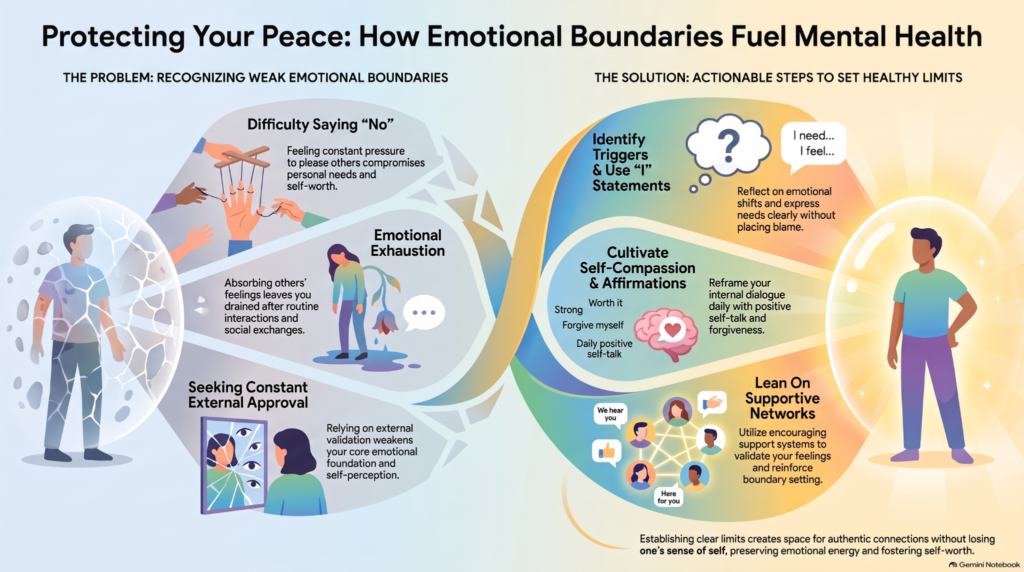
How can you tell if your emotional boundaries are weak? Recognizing weak boundaries is the first step toward building emotional resilience. Here are three signs to look out for:
- Difficulty Saying No: If you often feel pressured to please others, it’s a sign your boundary awareness may be lacking. Your needs deserve respect, too.
- Feeling Overwhelmed by Others’ Emotions: If you frequently absorb the feelings of those around you, it can drain your energy and skew your sense of self.
- Constantly Seeking Approval: When your self-worth relies on others’ validation, it weakens your emotional foundation.
How to Set Healthy Emotional Boundaries
When protecting your emotional well-being, you’re setting emotional boundaries. These include sharing your personal feelings and how other people’s feelings affect you. They can also refer to your beliefs, ideas, and values, sometimes called intellectual boundaries.
To set healthy emotional boundaries, you first need to recognize your emotional triggers and understand what affects you deeply.
Once you’re aware of these feelings, it’s important to communicate your needs clearly to others.
Recognize Your Emotional Triggers
Have you ever found yourself feeling overwhelmed by emotions that seem to come out of nowhere?
Recognizing your emotional triggers is essential for emotional awareness and setting healthy boundaries. By identifying what sparks these feelings, you empower yourself to respond rather than react.
Here are three steps to help you with trigger identification:
- Reflect on Past Experiences: Think about situations that have caused intense emotions. What do they’ve in common?
- Observe Your Reactions: Pay attention to when you feel emotional shifts. What circumstances or people were involved?
- Journal Your Feelings: Writing can help you connect the dots between your emotions and their triggers.
Understanding your triggers allows you to take control, fostering healthier emotional boundaries and enhancing your mental well-being. Practicing emotional self-preservation techniques, such as identifying personal limits, expressing your needs clearly, and stepping away from stressful situations, can strengthen your emotional awareness and enhance your mental well-being.
Communicate Your Needs Clearly
What happens when you don’t communicate your emotional needs? You might feel overwhelmed, unrecognized, or even resentful in your relationships.
It’s essential to engage in a needs assessment, identifying what you truly require for your emotional well-being. By practicing assertive communication, you’re not just expressing your needs; you’re empowering yourself.
Start by being clear about what you want and how you feel. Use “I” statements to convey your emotions without placing blame. For example, say, “I feel anxious when plans change suddenly,” rather than pointing fingers.

PRACTICAL STEPS TO BUILD A POSITIVE SELF-IMAGE FOR IMPROVED MENTAL HEALTH
One of the biggest hurdles my clients face when learning to communicate boundaries is the nagging guilt that they are somehow being difficult, rigid, or selfish. There is also frequent confusion about what an authentic boundary actually is. A boundary is never an ultimatum designed to police or manipulate another person’s behavior; it is a clear statement of your own limits and the actions you will take to protect your equilibrium. Saying, “You can’t act this way,” is control; saying, “If this conversation continues in this tone, I need to step away,” is boundary work rooted in self-preservation.
I often compare emotional limits to the discipline of salsa dancing. When two people share the dance floor, you cannot support your partner’s rhythm or navigate a fast turn if your own frame is soft, collapsed, or reactive to every bump. You must keep a firm core and clear physical boundaries to create mutual trust and movement without chaos. The exact same principle applies to emotional regulation and communication.
Assertive communication does not require conflict; it simply asks that you remain grounded in your own baseline rather than absorbing every shockwave around you. When you stop absorbing what isn’t yours, you reclaim the headspace required to thrive.
Maintaining professional boundaries between your work life and personal life can help you succeed. A healthy work-life balance also helps protect your mental health and can prevent burnout. A good example of a workplace boundary is clearly communicating your working hours in an email signature. This allows others to know when they can (and can’t) expect a reply. Setting clear expectations with your supervisor on prioritizing tasks is another example of creating a workplace boundary.
Building a positive self-image is essential for your mental health, and it starts with the way you talk to yourself.
By cultivating positive affirmations and practicing self-compassion, you can shift your mindset and embrace your true worth.
Let’s explore these practical steps together to help you foster a healthier relationship with yourself.
Cultivating Positive Affirmations
While it’s easy to underestimate the power of positive affirmations, incorporating them into your daily routine can greatly transform your self-image and overall mental health.
By fostering a positive mindset, you empower yourself to embrace your worth. Here are three simple steps to get started:
- Create a List: Write down affirmations that resonate with you, such as “I am enough” or “I deserve happiness.”
- Daily Practice: Set aside time each morning to recite these affirmations, allowing them to sink in and reshape your thoughts.
- Visual Reminders: Place notes around your space—on mirrors or your workspace—to reinforce these positive messages throughout the day.
Practicing Self-Compassion Techniques
Practicing self-compassion can profoundly impact your self-image and mental health, especially when you embrace it as a daily practice.
Start by engaging in kindness exercises; these simple acts can shift your perspective and foster a sense of warmth toward yourself. Whenever you face setbacks, remind yourself that mistakes are part of being human.
Incorporate self-forgiveness practices, allowing yourself to let go of harsh self-judgments. Write down what you appreciate about yourself or visualize a supportive friend offering you comfort.
By nurturing this inner dialogue, you cultivate resilience and self-acceptance. Incorporating a simple self care activity, such as journaling or practicing relaxation techniques, can help you manage stress and develop a more positive self-image.
With each step, you’ll find greater freedom and a more positive self-image waiting for you.
The Role of Support Systems in Maintaining Emotional Boundaries
Support systems play an essential role in helping you maintain healthy emotional boundaries, as they provide the encouragement and understanding needed to navigate complex feelings and relationships.
When you have strong support networks, you build emotional resilience, allowing you to protect your well-being more effectively.
Here are three ways support systems can help:
- Validation: They remind you that your feelings are valid and important, reinforcing your self-perception.
- Guidance: They offer insights and perspectives that help you identify when your boundaries are being tested, empowering you to take action.
- Encouragement: During tough times, they motivate you to assert your boundaries, reminding you that it’s okay to prioritize your mental health.
Embracing the support of those around you creates a safe space to explore your emotions and fosters your journey toward healthier relationships and self-awareness.

RELATED STUDIES ABOUT EMOTIONAL BOUNDARIES AND MENTAL HEALTH
In nurturing your emotional boundaries, you’re not just protecting yourself; you’re empowering your mental health. You’re creating space for self-respect, fostering healthier relationships, and building a positive self-image. Remember, setting boundaries isn’t selfish—it’s an essential step towards well-being. By prioritizing your emotional needs, you’re choosing self-care, choosing resilience, and choosing a brighter path forward. Embrace the journey, lean on your support systems, and watch as your mental health flourishes. You deserve it.
Understanding medical information and emotional support needs in mental health questions with large language models
This empirical study introduces the Multi-Needs and Context Recognition (MNCR) framework and the MHQ-MedEmo benchmark corpus to address the limitation of current Mental Health Question Answering (MHQA) systems, enabling large language models (LLMs) to jointly recognize medical informational needs, emotional support needs, and their discourse-grounded contextual foundations.
Study Overview & Conceptual Framework
- Clinical & Operational Motivation: Despite mental disorders affecting approximately 970 million people globally, severe shortages of psychiatric professionals persist. While MHQA systems offer automated support, existing models treat medical triage and emotional counseling as separate tasks. Real-world consumer queries frequently interweave clinical inquiries (e.g., pharmacotherapy guidance) with emotional distress (e.g., feelings of hopelessness), necessitating integrated, dual-mode understanding.
- Theoretical Foundations:
- Rhetorical Structure Theory (RST): Formulates user queries into central communicative goals (nuclei) and supporting elaborative or conditional spans (satellites), mapping patient requests and medical context into structured semantic units.
- Appraisal Theory of Clinical Empathy: Categorizes emotional expressions into direct Feelings (requiring emotional validation and empathy) versus evaluative Viewpoints (requiring cognitive reframing and reassurance).
- Task Architecture (Four Interrelated Subtasks):
- Medical Needs Recognition (MNR): Identifies explicit medical information requests across five clinical categories: General Medical Information (M-N-GMI), Etiology (M-N-ETI), Diagnosis (M-N-DIA), Treatment (M-N-TREAT), and Prognosis (M-N-PROG).
- Medical Needs-related Context Extraction (MNCE): Extracts supporting satellite clauses categorized as Elaboration (M-C-ELA), Background (M-C-BACK), or Condition (M-C-CON).
- Emotional Needs Recognition (ENR): Classifies emotional support needs as either expressions of feeling (E-N-FEEL) or evaluative viewpoint (E-N-VIEW).
- Emotional Needs-related Context Extraction (ENCE): Extracts causal satellite spans (E-C-CAUSE) identifying underlying psychological or circumstantial triggers.
The MHQ-MedEmo Benchmark Dataset
- Corpus Construction & Screening: Compiled from 2,139 real-world Chinese online consultations sourced from haodf.com and MedDialog. A semi-automated filtering pipeline curated 703 high-quality, initial, self-contained text queries containing at least one explicit emotional cue.
- Clinical Characteristics & Distribution:
- Contains 1,346 medical need instances (predominantly treatment at 61% and diagnosis at 21%) and 1,155 emotional need instances (56% feeling, 44% viewpoint).
- Queries average 254 Chinese characters, containing an average of 1.92 medical needs, 1.64 emotional needs, 3.68 medical context spans, and 1.65 emotional context spans.
- Crucially, 89.9% of queries present concurrent medical and emotional demands, demonstrating the empirical necessity of dual-mode understanding.
- Clinical entity normalization mapped queries across 16 ICD-10 categories, led by depressive episodes (77 cases), anxiety disorders (67), and non-organic insomnia (32). Fine-grained emotion analysis revealed fear and sadness as dominant affective categories.
- Annotation & Agreement: Annotated by four postgraduate psychiatry specialists using Label Studio with third-party adjudication. Inter-annotator agreement reached 80.17% for medical needs, 80.95% for medical context, 78.00% for emotional needs, and 85.45% for emotional causal context, with an author double-adjudication Cohen’s kappa of 0.83.
Experimental Setup & LLM Evaluations
- Model Cohort & Configurations: Evaluated across six base LLMs spanning dense and Mixture-of-Experts (MoE) architectures—GPT-4o (~1.8T params), DeepSeek-V3 (671B MoE / 37B active), DeepSeek-R1 (260B dense reasoning), Qwen3-235B-A22B (MoE / 22B active), Qwen2.5-Max (325B MoE / 22B active), and Qwen2.5-72B (dense)—alongside domain-fine-tuned variants of GPT-4o (via OpenAI SFT API) and Qwen2.5-72B (via QLoRA).
- Prompting & Evaluation Rigor: Deployed unified prompts embedding Chain-of-Thought (CoT) and few-shot examples. Evaluated via hierarchical entity matching, Kuhn-Munkres (Hungarian) span alignment, semantic similarity (cosine threshold > 0.5), token-level precision/recall/F1, and a strict Joint Exact-Match (JEM) metric requiring flawless multi-subtask output.
Primary Findings & Performance Metrics
- Efficacy of Domain Fine-Tuning:
- Fine-tuned dense models achieved superior end-to-end performance. GPT-4o-finetuning achieved the highest overall F1 score (0.699) and highest JEM, followed closely by DeepSeek-R1 base (F1 = 0.693) and Qwen2.5-72B-finetuning (F1 = 0.629).
- Fine-tuning produced marked gains on the most challenging subtask, Emotional Needs Recognition (ENR): GPT-4o-finetuning improved ENR F1 from 0.412 to 0.528, while Qwen2.5-72B-finetuning improved ENR F1 from 0.418 to 0.444.
- Subtask Disparities & Architectural Sensitivities:
- Medical vs. Emotional Performance Gap: Across all models, identifying medical needs (MNR F1 up to 0.790 in DeepSeek-V3) was substantially easier than recognizing emotional needs (ENR F1 peaked at 0.528 in GPT-4o-finetuned and 0.507 in Qwen3-235B base), reflecting the linguistic nuance and subjectivity of affective cues.
- MoE Routing Instability: Large MoE models exhibited inconsistent performance across subtasks. For example, DeepSeek-V3 attained the highest MNR F1 (0.790) but the lowest ENR F1 (0.385) among advanced models, while Qwen3-235B excelled at emotional cause extraction (ENCX F1 = 0.802) but lagged in MNR (F1 = 0.651). This variability suggests that sparse expert-routing mechanisms struggle to capture multi-intent queries.
- Context Extraction Strengths: Causal emotional context (ENCX / CAUSE) was identified reliably across models (F1 scores between 0.718 and 0.846).
- Joint vs. Separate Prompting:
- The unified Joint Prompt (JP) strategy outperformed Separate Prompting (SP) across all six base architectures, simultaneously increasing Joint Exact-Match accuracy (e.g., DeepSeek-R1 JEM rose from 0.262 to 0.433; GPT-4o JEM rose from 0.220 to 0.355) and substantially reducing inference latency (GPT-4o per-query latency dropped from 11.78 s to 6.60 s; DeepSeek-R1 dropped from 186.43 s to 122.84 s).
- Accuracy vs. Latency Trade-Offs:
- While DeepSeek-R1 achieved competitive un-tuned accuracy (F1 = 0.693), its reasoning chain incurred prohibitive latency (122.84 seconds per query).
- GPT-4o-finetuning delivered the best trade-off for real-time deployment, requiring only 8.64 seconds per query while achieving peak overall accuracy (F1 = 0.699). Qwen2.5-72B-finetuning represented the most effective open-weight alternative (18.96 seconds, F1 = 0.629).
Managerial & Clinical Implementation Implications
- Deployment Architecture: Clinical MHQA systems should deploy dense, parameter-efficient fine-tuned models rather than ultra-large uncalibrated MoE models, optimizing both token latency and semantic stability on multi-intent prompts.
- Data Curation Priorities: Organizations must deliberately curate and annotate underrepresented diagnostic categories (e.g., disease etiology and prognosis) and nuanced emotional expressions to mitigate current performance ceilings.
- Governance & Regulatory Alignment: Deployed conversational assistants informing mental health triage or care recommendations fall under high-risk AI classifications (e.g., the EU AI Act and FDA SaMD frameworks). Systems require operational guardrails, bias monitoring, role-based clinician-in-the-loop oversight, and strict audit logs to safeguard patient safety.
| REFERENCE: Chen Liu, William Yu Chung Wang, Gohar Khan, Understanding medical information and emotional support needs in mental health questions with large language models, Industrial Management & Data Systems, Volume 126, Issue 7, 2026, Pages 2205-2230, ISSN 0263-5577, https://doi.org/10.1108/IMDS-05-2025-0609. (https://www.sciencedirect.com/science/article/pii/S0263557726000758) |
Maternal Mental Health Literacy and Preschoolers’ Emotional Regulation Ability: A Chain Mediation of Depression and Democratic Parenting
This cross-sectional quantitative study investigates the transmission mechanisms through which maternal mental health literacy (MHL) influences preschoolers’ emotional regulation ability (ERA), testing a chain mediation model involving maternal depressive mood and democratic parenting style (DPS).
Study Overview & Conceptual Framework
- Theoretical Foundations: Grounded in Eisenberg’s model of parental emotion socialization, the study extends the framework upstream to incorporate cognitive resources. It formulates a four-stage processual sequence: “cognitive capital emotional state parenting behavior developmental outcomes”.
- Research Rationale: Prior literature on mental health literacy primarily emphasizes direct effects on an individual’s personal coping or help-seeking behavior. The authors challenge the assumption of “direct transformation of cognition into behavior,” hypothesizing that a mother’s cognitive literacy cannot directly alter a child’s emotional self-regulation without being filtered through the mother’s affective state and expressed via externalized parenting practices.
Methodology & Participants
- Sample & Data Collection: Recruited 544 mothers of preschool-aged children (aged 3–6 years; mean age = 4.76 ± 1.08 years; 51.84% boys, 48.16% girls) from 22 provinces across eastern, central, and western China via the online questionnaire platform Wenjuanxing between June and August 2024.
- Sociodemographics: Participants were primary caregivers. Most resided in urban or suburban settings (78.68%) and reported high educational attainment (63.06% held a bachelor’s degree, 25.00% held a master’s degree or above).
- Measurement Instruments:
- Mental Health Literacy: Evaluated via the Chinese version of the Multidimensional Mental Health Literacy Questionnaire (MMLQ; 22 items across knowledge, beliefs, and resource cognition; Cronbach’s = 0.76).
- Maternal Depressive Mood: Assessed via the Chinese Center for Epidemiological Survey Depression Scale (CES-D; 20 items on a 4-point scale; Cronbach’s = 0.74).
- Democratic Parenting Style: Measured using the DPS subscale of the Parenting Style Questionnaire (10 items on a 5-point Likert scale; Cronbach’s = 0.72).
- Child Emotion Regulation: Assessed using the 8-item “emotion regulation” dimension of the localized Emotion Regulation Checklist (ERC; Cronbach’s = 0.70).
- Analytical Strategy: Bivariate correlation, Harman’s single-factor test for common method bias (first factor explained 11.05% of variance, well below the 40% threshold), and path modeling using PROCESS Macro (Model 6) with 5,000 bootstrap resamples controlling for child age and gender.
Key Findings & Structural Path Analysis
- Absence of Direct Effect: Maternal MHL had no significant direct effect on preschoolers’ emotional regulation ability (=0.01, SE=0.01, p=0.24, 95% CI [-0.010, 0.240]). This rejected Hypothesis 1 and confirmed that cognitive literacy alone does not directly translate into developmental gains for the child.
- Direct Path Trajectories:
- Maternal MHL significantly negatively predicted maternal depression (=-0.02, SE=0.01, p<0.05) and positively predicted DPS (=0.02, SE=0.01, p<0.01).
- Maternal depression significantly suppressed DPS (=-0.40, SE=0.04, p<0.001) and directly impaired preschoolers’ ERA (=-0.24, SE=0.05, p<0.001).
- DPS directly and positively predicted preschoolers’ ERA (=0.18, SE=0.05, p<0.001).
- Sequential & Mediated Pathways (Total Indirect Effect = 0.011, 95% CI [0.003, 0.019]):
- Mediated via Maternal Depression: Significant indirect effect (=0.005, 95% CI [0.000, 0.010]), accounting for 22.73% of the total effect (supporting Hypothesis 2).
- Mediated via Democratic Parenting: Significant indirect effect (=0.004, 95% CI [0.001, 0.009]), accounting for 18.18% of the total effect (supporting Hypothesis 3).
- Chain Mediation Pathway (MHL Depression DPS ERA): Significant sequential indirect effect (=0.002, 95% CI [0.000, 0.003]), accounting for 9.09% of the total effect (supporting Hypothesis 4).
- Together, the three indirect paths accounted for 50.00% of the total effect model.
Theoretical & Practical Implications
- Depression as a “Psychological Filter”: Maternal depressive symptoms act as an affective barrier that obstructs the mobilization and execution of cognitive resources. Even when mothers possess high MHL, depressive affect limits their capacity to decode emotional cues and deploy warm, responsive parenting.
- Democratic Parenting as a Dynamic Behavioral Bridge: Reconceptualizes parenting style not as a fixed personality trait, but as an overt behavioral indicator of emotional and psychological resource integration that directly structures children’s regulatory capabilities.
- Intervention Architecture: Family-based interventions cannot rely solely on the didactic transfer of mental health information. Programs must integrate cognitive literacy with maternal affect-regulation skills, stress reduction, and experiential training in democratic parent-child communication.
Limitations
- Design Constraints: The cross-sectional design precludes definitive causal claims or verification of temporal precedence.
- Single-Informant Bias: All measures relied on maternal self-reports without multi-informant corroboration (e.g., teacher ratings or observational interaction tasks).
- Sample Homogeneity: Convenience sampling resulted in a sample predominantly composed of urban, highly educated mothers, with maternal sociodemographic covariates (e.g., income, maternal age, education) omitted from path modeling.
| REFERENCE: Jiaojiao He, Qing-en Yu, Yuwei Li, Jian Li, Maternal Mental Health Literacy and Preschoolers’ Emotional Regulation Ability: A Chain Mediation of Depression and Democratic Parenting, International Journal of Mental Health Promotion, Volume 28, Issue 2, 2026,, ISSN 1462-3730, https://doi.org/10.32604/ijmhp.2025.072905. (https://www.sciencedirect.com/science/article/pii/S1462373026000143) |
Emotional labor demands, stratification, and mental health pathways in Europe: Evidence from the European working conditions survey
This large-scale empirical study examines the distribution of emotional labor demands across occupations, genders, and employment arrangements in Europe, testing the mediational pathways linking emotional labor demands to mental health and the buffering role of job resources.
Study Overview & Conceptual Framework:
- Theoretical Foundations: Integrates Arlie Hochschild’s emotional labor theory with the Job Demands-Resources (JD-R) model and the challenge-hindrance stressor framework. The study distinguishes between emotional labor strategies (surface acting and deep acting) and “emotional labor demands”—defined as the frequency and intensity of situational workplace encounters requiring emotion management (e.g., hiding feelings, handling angry clients).
- Core Research Questions:
- How are emotional labor demands stratified across occupations, genders, and contractual arrangements in Europe?
- Do gender disparities in emotional labor persist within identical occupational categories?
- Through what mechanisms (perceived work stress, end-of-day exhaustion) do emotional labor demands associate with psychological well-being?
- Do workplace resources (job control, social support) or precarious employment moderate these health pathways?
Data Source & Operationalization:
- Dataset & Sample: Utilized data from the 6th wave of the European Working Conditions Survey (EWCS, 2015) conducted by Eurofound, encompassing 43,850 workers across 35 European countries (all 28 EU member states plus Norway, Switzerland, Albania, Montenegro, North Macedonia, Serbia, and Turkey). The 2015 wave was selected because it represents the most recent wave providing complete, unconfounded variable coverage across all 35 countries prior to the disruptions and questionnaire omissions of the COVID-19 pandemic wave.
- Emotional Labor Demands Index (ELI): Constructed a standardized 0–1 composite index from four survey items: hiding feelings (Q61o), handling angry clients/customers/patients (Q30g), facing emotionally disturbing situations (Q30h), and dealing directly with non-colleagues (Q30f). The ELI demonstrated acceptable internal consistency (Cronbach’s =0.65, mean inter-item r=0.33, single-factor variance explained = 35.2%), convergent validity with work stress (r=0.35,p<0.001), and discriminant validity against general self-rated health (r=-0.004).
- Health, Resource, & Moderator Metrics:
- Primary Outcome: The WHO-5 Well-Being Index (scored 0–100, where scores <50 indicate depression risk).
- Mediators: Global perceived work stress (single-item appraisal) and end-of-day exhaustion.
- Moderators: Job control (decision latitude across task order, methods, and speed; 0–1 scale), workplace social support (colleague and supervisor assistance; 1–5 scale), and precarious employment (operationalized primarily as a composite binary indicator of temporary/fixed-term contracts or small firm size <10 employees).
- Econometric Modeling: Employed ordinary least squares (OLS) regression models with robust HC3 standard errors, country fixed effects, ISCO-08 occupational dummies, NACE sectoral controls, and Baron–Kenny mediation decompositions using 1,000 bootstrap resamples.
Key Empirical Findings:
- Significant and Gendered Occupational Stratification:
- Overall ELI averaged 0.35 (SD = 0.24) with a right-skewed distribution. Service and sales workers faced the highest demands (M = 0.46), while agricultural workers reported the lowest (M = 0.18).
- Women reported significantly higher emotional labor demands overall (M = 0.39) than men (M = 0.32; difference = +0.07, Cohen’s d0.30,p<0.001).
- Controlled Within-Occupation Gap: Crucially, this gender disparity remained statistically significant after adjusting for 1-digit ISCO occupation fixed effects and age (=0.030,SE=0.002,p<0.001). This within-occupation gap accounted for 12.5% of an ELI standard deviation.
- Occupational Asymmetry: Women faced significantly higher demands than men in white-collar and service roles—including professionals (+0.087), technicians (+0.070), service/sales (+0.029), clerical staff (+0.028), and managers (+0.021). Conversely, men faced higher emotional demands in manual blue-collar roles, specifically machine operators (+0.087) and craft workers (+0.031), aligning with “masculine emotional labor” centered on suppressing vulnerability and projecting toughness.
- Full Mediation Through Work Stress:
- Total effect modeling showed that higher ELI scores significantly degraded subjective psychological well-being (c=-6.506,p<0.001). A 1 SD increase in ELI was associated with a 1.56 percentage point decline in WHO-5 scores.
- Emotional labor demands strongly predicted work stress (a=1.792,p<0.001), which in turn impaired well-being (b=-4.098,p<0.001).
- The indirect path through work stress fully accounted for the relationship (indirect effect =-7.345, bootstrap 95% CI [-7.737, -6.966], Sobel Z=-37.58,p<0.001), leaving an insignificant direct effect (c’=0.839,p=0.072). This pattern reflects statistical suppression/inconsistent mediation, confirming that perceived stress is the primary behavioral pathway linking emotional job demands to impaired mental health.
- Supplementary analyses identified end-of-day exhaustion as a second significant mediating pathway (indirect effect =-3.88,p<0.001).
- Distributional Inequality vs. Equal Vulnerability:
- Gender-stratified regressions revealed that the per-unit harmful effect of ELI on well-being was virtually identical between men (=-1.483,p<0.001) and women (=-1.434,p<0.001), with a non-significant interaction term (=0.203,p=0.339).
- The indirect stress pathway was likewise parallel (a=1.80 for men; a=1.79 for women).
- These results demonstrate that women’s greater occupational mental health burden stems from unequal structural exposure to emotional labor demands rather than differential psychological vulnerability.
- Moderation Dynamics (Buffering vs. Precarity):
- Social Support as the Dominant Buffer: The composite job resources index significantly attenuated the negative association between ELI and well-being (=0.52,p<0.001). However, this buffering was driven almost exclusively by social support from managers and colleagues (=0.85,p<0.001), whereas job control/autonomy alone failed to moderate the relationship (=0.05,p=0.649).
- Null Precarity Moderation: While precarious employment was independently associated with poorer baseline well-being, it did not significantly amplify the negative mental health impact of emotional labor demands across any operational specification (composite interaction =0.119,p=0.616; temporary contract =0.200,p=0.450; small firm =-0.262,p=0.479).
- Geographic Macro-Trends: Across Europe, mean ELI was highest in Mediterranean and Southeastern European nations (Albania, Greece, Cyprus; values ~0.40–0.45) and lowest in Northern European countries (Netherlands, Germany, Finland, Denmark; values ~0.30–0.35).
Theoretical & Organizational Implications:
- Rebalancing Emotional Demands: Because the gender gap persists within identical job codes and men and women exhibit equal per-unit vulnerability, individual-level resilience or coping workshops are insufficient. Organizations must pursue role redesign and formal recognition of “invisible” emotional caretaking tasks disproportionately assigned to women.
- Social Support Over Task Autonomy: In emotion-intensive jobs, discretion over task order or pacing cannot insulate workers from difficult interpersonal interactions. Interventions must focus on interpersonal relational resources—such as managerial validation, structured debriefing, and team-based peer support—to effectively buffer emotional strain.
- Recognition in Health Frameworks: The findings support recognizing emotional labor demands as a distinct psychosocial hazard within EU occupational health and safety directives, requiring routine organizational monitoring alongside ergonomic and physical stressors.
Methodological Limitations:
- Cross-Sectional Data: Precludes definitive causal inference and cannot rule out reverse causality (e.g., distressed workers perceiving work encounters as more emotionally demanding).
- Single-Item Stress Measurement: The global stress appraisal was measured via a single survey item, limiting psychometric granularity relative to multi-item diagnostic batteries.
- Demand Exposure vs. Internal Regulation: The ELI measures external exposure and situational demands rather than internal regulation strategies (surface versus deep acting).
| REFERENCE: Nikolaos Antonakakis, Emotional labor demands, stratification, and mental health pathways in Europe: Evidence from the European working conditions survey, Social Science & Medicine, Volume 399, 2026, 119202, ISSN 0277-9536, https://doi.org/10.1016/j.socscimed.2026.119202. (https://www.sciencedirect.com/science/article/pii/S0277953626002789) |
CONCLUSION
When you close the front door to your home after an exhausting day, you do not feel guilty for turning the lock. You recognize that your living space deserves sanctuary, shelter, and peace. Yet so many of us leave the inner doors of our mental and emotional life wide open, allowing demands, guilt trips, and unspoken expectations to walk in and out unchecked. True confidence does not mean developing an unshakeable exterior that can endure infinite pressure; it means knowing when to close the door and tend to your own garden before you offer fruit to anyone else.
As the research underscores, managing emotional demands and maintaining relational balance isn’t an abstract theory—it directly dictates our psychological well-being, stress levels, and emotional resilience. Setting boundaries will inevitably feel uncomfortable at first, especially if your sense of worth has long been tied to being universally agreeable.
But every time you say an honest “no,” you deliver a powerful vote of confidence to your self-image. You declare that your peace has value, your presence has dignity, and your well-being is non-negotiable. Embrace that boundary—it is the bedrock of living, leading, and connecting on your own terms.