
In my years working as a functional fitness coach and researcher in exercise science, I have lost count of how many clients walk into the gym carrying an invisible, crushing weight. They describe anxiety as an unpredictable mental ambush—a spiral of racing thoughts, cognitive fatigue, and tight chest walls that feels completely divorced from their control. But when we look at stress through a sports science lens, anxiety isn’t just an abstract psychological storm; it is a full-body, neurochemical event. Your nervous system gets locked into sympathetic overdrive, dumping stress hormones while paralyzing your natural recovery mechanisms.
When people ask me what the single best biohack for anxiety is, my answer is never a fancy supplement or an extreme protocol—it is intelligent, purposeful movement. I’ve watched clients break decades-long anxiety loops simply by establishing a consistent baseline of physical exertion. When you move your body, you actively force your physiology to rewrite its autonomic balance.
You’re clearing circulating cortisol, upregulating brain-derived neurotrophic factor, and re-establishing the neural pathways that signal safety to your brain. Movement gives your nervous system a productive outlet for the tension it’s harboring. If you’ve felt helpless against anxiety, understanding this biological connection is your first step toward taking the steering wheel back.
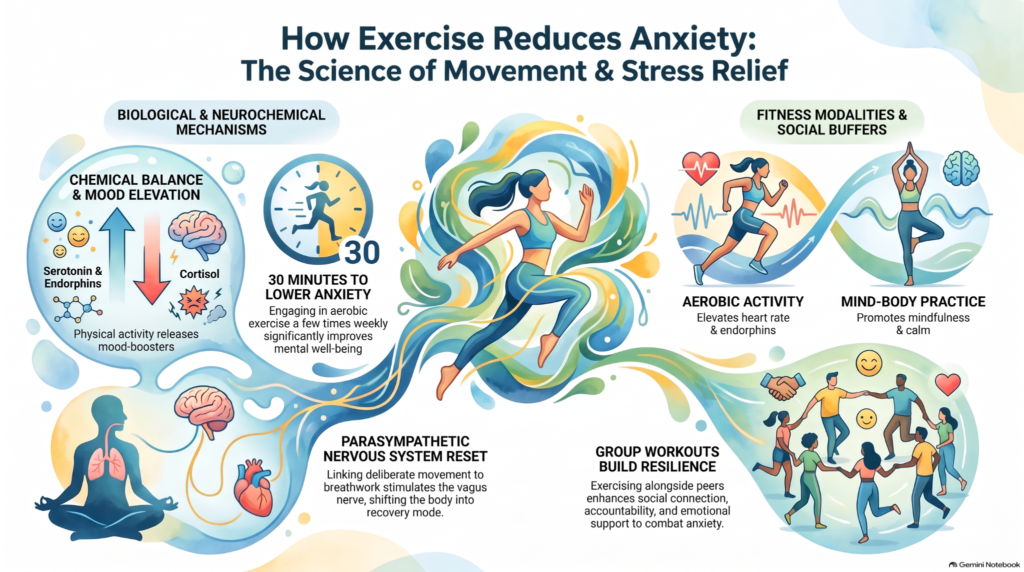
Regular physical activity greatly reduces anxiety by boosting your mood and overall well-being. Just 30 minutes of aerobic exercise a few times a week can trigger the release of endorphins and serotonin, which alleviate stress. Additionally, activities like yoga promote mindfulness, enhancing mental resilience. Group workouts amplify motivation through social interactions, creating a supportive environment for fitness. If you’re curious about how to effectively incorporate these elements into your life and achieve success, keep exploring the options available to you.
KEY TAKEAWAYS
- Regular aerobic exercise, such as running or cycling, significantly reduces anxiety by releasing endorphins and improving overall mood.
- Mind-body practices like yoga and tai chi promote relaxation and enhance mindfulness, effectively lowering anxiety and fostering emotional resilience.
- Social interaction during fitness activities boosts happiness and motivation, creating a supportive environment that aids in overcoming anxiety challenges.
- Setting specific fitness goals enhances focus and accountability, making it easier to maintain a routine that contributes to stress management and well-being.
- Short bursts of physical activity can provide immediate relief from anxiety symptoms, making even brief workouts beneficial for mental health.
UNDERSTANDING ANXIETY AND HOW FITNESS CAN HELP
When you understand anxiety, you can better appreciate how fitness plays an essential role in managing it. Anxiety triggers, like stress or overwhelming responsibilities, can hijack your sense of freedom.
But engaging in regular physical activity can help you regain control. Exercise boosts your mood by releasing endorphins, which are natural stress relievers. This isn’t just a theory; studies show that consistent workouts reduce anxiety symptoms considerably.
Finding your fitness motivation is key. Whether it’s a brisk walk, yoga, or hitting the gym, discovering an activity you enjoy makes it easier to stick with it.
As you incorporate fitness into your routine, you’ll notice improvements not just in your physical health but also in your mental well-being. You can transform anxiety from a heavy burden into a manageable part of your life, empowering you to embrace freedom and enjoy a more balanced existence.
The Science of Exercise in Relieving Anxiety
Exercise helps prevent and improve many health problems, including high blood pressure, diabetes and arthritis. Research on depression, anxiety and exercise shows that the mental health and physical benefits of exercise also can help mood get better and lessen anxiety.
Exercise isn’t just a way to stay fit; it’s a powerful tool in the fight against anxiety. When you engage in physical activity, your body releases neurotransmitters like serotonin and endorphins, which play a vital role in elevating your mood and reducing stress. These chemicals promote feelings of happiness and relaxation, helping to counteract anxiety.
Moreover, exercise helps maintain hormonal balance. Regular workouts can lower levels of cortisol, the stress hormone, while boosting levels of oxytocin, which enhances feelings of connection and well-being.
Research shows that even short bursts of activity can provide immediate relief from anxious feelings. You can choose activities you enjoy, whether it’s dancing, hiking, or yoga, to make it more enjoyable.
Types of Fitness and Their Effects on Stress
Exercise is not just about aerobic capacity and muscle size. Sure, exercise can improve your physical health and your physique, trim your waistline, improve your sex life, and even add years to your life. But that’s not what motivates most people to stay active.
When it comes to managing stress, different types of fitness can make a significant impact.
Aerobic exercises, like running or cycling, boost your mood by releasing endorphins, while mind-body practices such as yoga and tai chi help calm your mind and enhance mindfulness.
Understanding these benefits can empower you to choose the right fitness routine to effectively combat anxiety.
Aerobic Exercise Benefits
Exercise is also considered vital for maintaining mental fitness, and it can reduce stress. Studies show that it is very effective at reducing fatigue, improving alertness and concentration, and at enhancing overall cognitive function. This can be especially helpful when stress has depleted your energy or ability to concentrate.
Although life can often feel overwhelming, incorporating aerobic exercise into your routine can greatly reduce anxiety levels and boost your overall mood. Engaging in activities like running, swimming, or cycling not only elevates your heart rate but also enhances your cardiovascular health.
Research shows that just 30 minutes of aerobic activity a few times a week can lead to significant improvements in mental well-being. These exercises release endorphins, your body’s natural stress relievers, creating a sense of freedom and joy.
Plus, the rhythmic nature of aerobic activities can serve as a form of meditation, helping you clear your mind. By committing to regular aerobic exercise, you’re taking an empowering step towards managing stress and enhancing your quality of life.
Mind-Body Practices
While aerobic exercises are fantastic for boosting mood and reducing anxiety, mind-body practices offer unique advantages that can further enhance your mental well-being. Practices like yoga and tai chi focus on the connection between mind and body, promoting relaxation and mindfulness.
Here’s a quick comparison of their benefits:
| Mind-Body Practice | Key Benefits |
| Yoga | Increases flexibility, reduces stress, enhances focus |
| Tai Chi | Improves balance, promotes calmness, boosts energy levels |
Both yoga and tai chi can greatly decrease anxiety levels and improve your overall sense of well-being. By incorporating these practices into your routine, you can cultivate a deeper sense of peace and resilience against life’s stresses.
WHY WORKING OUT WITH OTHERS BOOSTS YOUR MOOD
Whenever I design training programs for athletes or volunteer with adaptive sports groups, my fundamental goal goes far beyond building visible muscle or boosting VO2 max—it’s about conditioning autonomic resilience. In the lab, we study the “Cross-Stressor Adaptation” hypothesis, which demonstrates that when you repeatedly subject your cardiovascular system to controlled physical stress, your body learns to handle non-physical, emotional stress with far greater efficiency. I see this play out on the gym floor every single week. When a client performs steady-state aerobic intervals or practices controlled nasal breathing through a demanding mobility flow, they aren’t just burning calories; they are actively training their heart rate variability and buffering their autonomic stress ceiling.
A lot of people make the mistake of thinking an anti-anxiety workout has to mean completely draining the tank with brutal high-intensity sessions. In reality, that can backfire and spike systemic inflammation if your baseline recovery is already depleted. The real magic happens when you pair deliberate, mindful mechanics—like rhythmic tempo work, outdoor trail hiking, or flow-state mobility—with proper breathwork.
By consciously linking breath to movement, you stimulate the vagus nerve and shift your body out of fight-or-flight into parasympathetic recovery. It turns a standard exercise session into a genuine neurological reset button.
Working out with others can greatly boost your mood by enhancing social interaction, which is proven to increase happiness levels.
When you exercise alongside friends or a group, the accountability factor helps you stick to your routine and stay motivated.
Plus, sharing fitness goals fosters a sense of connection, making the experience even more rewarding.
Social Interaction Enhances Happiness
When you engage in fitness activities with others, you’re not just improving your physical health; you’re also greatly boosting your mood and overall happiness.
Social interactions during workouts foster social bonding, providing emotional support that enhances your well-being. Here’s how working out with others can elevate your spirits:
- Shared experiences create lasting connections.
- Encouragement from peers helps you push through challenges.
- Laughter and fun make the workout enjoyable, reducing stress.
- Building friendships leads to a supportive community.
This camaraderie not only makes exercise more enjoyable but also reinforces a sense of belonging.
Accountability Boosts Consistency
Having a workout buddy can greatly enhance your commitment to fitness, as the element of accountability often makes it easier to stay consistent.
When you work out with others, you create a support system that encourages you to stick to your routine. Research shows that social interactions during exercise can uplift your mood, making the experience more enjoyable.
Incorporating consistency strategies, like scheduling workouts together, can further boost your motivation. You’re less likely to skip a session when someone’s counting on you.
Plus, sharing your fitness journey fosters a sense of connection, which can help alleviate anxiety.
Shared Goals Foster Connection
Exercising alongside others not only provides motivation but also cultivates a sense of belonging through shared goals.
When you work out in a group, you create shared experiences that can enhance your mood and reduce anxiety. This collective motivation fosters connections, making the process more enjoyable and fulfilling.
Consider these benefits of working out with others:
- Increased accountability: You’re less likely to skip a workout when others rely on you.
- Enhanced enjoyment: Group activities can be more fun, making fitness feel less like a chore.
- Supportive environment: Encouragement from others can push you to achieve your goals.
- Social connections: Building friendships improves your overall well-being, promoting a sense of community.
Embrace the freedom that comes with shared fitness experiences!
How Mindfulness in Exercise Enhances Mental Health
Mindfulness in exercise not only enhances your physical performance but also plays an essential role in boosting mental health. By focusing on mindful movement, you can cultivate a deeper connection between your body and mind, leading to improved mental clarity. Incorporating mindfulness into your fitness routine can make exercise a rewarding self care activity that helps reduce stress, improve emotional resilience, and support your overall mental well-being. This awareness during workouts helps you stay present, reducing stress and anxiety levels.
Research shows that engaging in mindful exercise, like yoga or tai chi, can greatly lower symptoms of anxiety and depression. When you concentrate on your breath and body sensations, you shift your focus away from daily worries, promoting a sense of calm and freedom.
The rhythmic nature of mindful movement allows you to release tension and foster emotional resilience. Incorporating mindfulness into your fitness routine not only empowers you physically but also nurtures your mental well-being, creating a holistic approach to stress management that can profoundly enhance your quality of life.
Incorporating Fitness Into Your Daily Life
Finding ways to weave fitness into your daily routine can greatly enhance both your physical health and mental well-being. By integrating exercise into your life, you can foster fitness habits that promote stress relief and improve your overall quality of life. Choosing balanced pre workout meals can also help fuel your exercise sessions, support energy levels, and make it easier to maintain a consistent fitness routine.
Here are some strategies to contemplate:
- Set specific goals: Define what you want to achieve, whether it’s weight loss or increased stamina.
- Create flexible workout schedules: Adapt your routines based on your availability, making it easier to maintain consistency.
- Incorporate exercise variety: Mix different physical activities—such as walking, cycling, or yoga—to keep your workouts engaging.
- Utilize time management techniques: Allocate dedicated time for physical activity, even if it’s just a quick session during breaks.
Embracing these lifestyle changes won’t only boost your motivation but also transform your daily routines into opportunities for well-being and fitness.
Success Stories: Fitness and Anxiety Relief
Many individuals have turned to fitness as a powerful tool for managing anxiety, and their stories highlight remarkable transformations. Personal testimonies reveal how regular exercise can shift perspectives and build resilience.
For instance, one individual shared how running became a sanctuary, providing clarity and a release from anxious thoughts. Another found solace in group classes, where the supportive community fostered a sense of belonging and strength.
These transformative journeys often involve trial and error, but the commitment to fitness opens a path to emotional freedom. Research supports these experiences, showing that physical activity releases endorphins, reduces stress hormones, and improves overall mood. Pairing regular exercise with balanced post workout meals can also support recovery and help you maintain a consistent fitness routine while managing stress.
As you explore your own fitness journey, consider how movement can be a catalyst for change. Whether it’s through yoga, weightlifting, or dance, embracing fitness not only empowers your body but also soothes your mind, paving the way to a more balanced and fulfilling life.
RELATED STUDIES ABOUT FITNESS REDUCES ANXIETY SCIENTIFIC EVIDENCE
Incorporating fitness into your daily routine can be a game changer for managing anxiety. The scientific evidence is crystal clear: exercise doesn’t just boost your mood; it can send stress packing like a freight train! By exploring different types of workouts and embracing mindfulness, you can transform your mental health. So why wait? Start moving today, and watch as your anxiety fades away, leaving you feeling lighter and more empowered than ever before.
Depression, anxiety, bipolar disorder and stress impact on fitness to drive: findings from a systematic integrative review
This systematic integrative review investigates the relationship between mood disorders (major depressive disorder, bipolar disorder), anxiety disorders, and occupational stress on fitness to drive, evaluating the divergence between clinical symptom remission and functional psychophysical capacity across general and professional driver populations.
Conceptual Framework & Rationale
- Public Health and Road Safety Context: Mental health conditions represent a leading contributor to global disease burden, affecting nearly 970 million individuals worldwide. Driving is a complex, high-demand task requiring seamless integration of executive functioning, psychomotor speed, sustained attention, emotional regulation, and risk perception.
- The Clinical Remission vs. Functional Driving Disconnect: While conventional clinical assessments equate symptomatic stability or euthymia with recovery, clinical remission does not guarantee the restoration of the cognitive-motor skills necessary for driving. Persistent cognitive deficits and pharmacological sedation frequently outlast visible affective symptoms, creating an unaddressed risk of motor vehicle collisions.
- Mobility vs. Safety Dilemma: Restricting driving privileges mitigates crash risk but often triggers adverse secondary psychosocial outcomes, including loss of independence, employment loss, increased depression, and social isolation. An evidence-based, objective evaluation framework is needed to balance road safety with personal mobility.
Methodology & Search Architecture
- Protocol & Standards: Conducted according to PRISMA guidelines and prospectively registered with PROSPERO (CRD420251023655).
- Information Sources & Eligibility: Systematically searched seven electronic databases (CINAHL, MEDLINE, ProQuest, PsycINFO, PubMed, Scopus, Web of Science) for peer-reviewed studies published in English between 2015 and 2025.
- Search Syntax Design: Group 1 (mental health diagnostic terms) was restricted to the title field to ensure primary clinical focus, while Group 2 (driving performance and fitness-to-drive terms) was searched across title, abstract, and keywords to maximize sensitivity.
- Eligibility Criteria (PECO Framework): Included licensed adult drivers (18 years) diagnosed with depressive disorders, bipolar disorders, or anxiety disorders (defined by DSM-5-TR or ICD criteria) with quantitative assessments of on-road driving, driving simulator performance, official driving records, or occupational driving outcomes.
- Study Yield: From 288 initial database records and 6 additional records identified through systematic cross-referencing and manual additions, 31 studies met the full inclusion criteria (17 focused on depression, 3 on clinical anxiety, 3 on bipolar disorder, and 8 on reactive/occupational anxiety in professional drivers).
- Quality Appraisal: Internal validity was evaluated using the National Heart, Lung, and Blood Institute (NHLBI) quality assessment tools (independent coding by two reviewers, inter-rater reliability Cohen’s =0.92). Studies were qualitatively categorized into good, fair, or poor methodological quality.
Key Findings by Clinical Condition & Context
- Major Depressive Disorder (MDD) and Driving Performance:
- Severity vs. Mild Symptoms: Mild depressive symptoms alone rarely predict on-road driving failure; instead, a clinical diagnosis of MDD is consistently linked to executive dysfunction, impaired hazard perception, and increased crash incidence.
- Naturalistic & On-Road Driving: Continuous naturalistic tracking of older drivers with MDD demonstrates elevated hard braking, high-speed cornering, and higher spatial entropy (erratic, unstructured travel patterns), reflecting deficits in divided attention and processing speed.
- Licensure in Youth: In young adults, mood disorders reduce the likelihood of obtaining a driver’s license by 30% and correlate with significantly higher crash rates, nighttime crashes (OR = 1.61), traffic violations, and license suspensions during the initial 48 months of driving.
- Simulator Parity in Remission: Outpatients with partially remitted depression under stable pharmacotherapy demonstrate simulator performance comparable to healthy controls, with social adaptation functioning as a stronger predictor of driving fitness than diagnostic category alone.
- Pharmacological Modulation and Antidepressant Effects:
- Discontinuation and Untreated Risk: Untreated active depression doubles motor vehicle crash risk (OR 1.90), whereas antidepressant pharmacotherapy is associated with a smaller risk increase (OR 1.40). Notably, abrupt discontinuation of antidepressant treatment triggers the highest crash incidence (IRR = 2.35).
- Sedating vs. Non-Sedating Agents: Sedating antidepressants (e.g., tricyclics like amitriptyline, and mirtazapine) acutely elevate the Standard Deviation of Lateral Position (SDLP) by approximately 3 cm—an impairment equivalent to a blood alcohol concentration of 0.8 mg/mL.
- Tolerance and Long-Term Stability: In on-road highway trials, driving impairment attenuates with sustained use: patients on stable sedating antidepressants for over three years perform identically to healthy controls, whereas short-term users (<3 years) exhibit marked SDLP elevation. Modern SSRIs, SNRIs, and intranasal esketamine demonstrate minimal or no adverse impact on on-road lane-keeping parameters.
- Anxiety Disorders:
- Age-Dependent Manifestations: In older drivers with generalized anxiety disorder (GAD), clinical anxiety degrades driving self-efficacy and traffic sign recognition, prompting avoidant behaviors. In younger adults, high trait anxiety impairs central executive efficiency, predicting frequent attentional lapses and memory failures at the wheel.
- Compensatory Mechanisms: Aligned with self-regulation theory, some anxious drivers adopt risk-compensatory adaptations—such as increasing following distances, driving slower, or avoiding complex highway environments—which can partially buffer against crash risk.
- Bipolar Disorder and Persistent Cognitive Deficits:
- Impairment in Euthymia: Bipolar disorder is associated with significant driving impairments, characterized by poor lane keeping, inadequate headway distance maintenance, and increased traffic sanctions.
- Failure of Remission to Restore Fitness: Deficits in sustained attention, cognitive flexibility (Wisconsin Card Sorting Test errors), and processing speed (Trail Making Tests A and B) persist during symptomatically remitted and euthymic phases. Sustained attention emerges as the primary neurocognitive predictor of safe vehicle headway maintenance.
- Pharmacological Nuances: Mood stabilizers such as lithium introduce minor psychomotor slowing on specific subtasks without significantly compromising global driving capability, demonstrating that cognitive dysfunction is driven primarily by underlying illness architecture rather than medication alone.
- Occupational Drivers and Reactive Work-Related Stress:
- Job Strain & Fatigue Cascades: In bus, taxi, and heavy-truck drivers, occupational stress predicts unsafe driving, traffic violations, and crash involvement through mediating pathways of severe fatigue, lack of physical recovery, and cognitive mind-wandering.
- Psychosocial and Personality Influences: High public self-consciousness and social anxiety increase dangerous maneuvers among professional drivers. High neuroticism and impulsivity correlate with elevated physiological stress biomarkers (salivary cortisol and -amylase), driving aggression, impaired hazard detection, and sensation-seeking.
- Organizational Buffers: Weekly driving hours strongly predict clinical depressive symptoms, whereas perceived organizational support and positive workplace social interactions mitigate stress and reduce traffic citations.
Methodological Limitations in the Literature
- Pervasiveness of Subjective Measures: The existing literature relies heavily on retrospective crash self-reports and cross-sectional survey designs, while objective real-world metrics (e.g., on-road telematics, naturalistic video recording, standardized SDLP tracking) remain underutilized.
- Confounder Control & Polypharmacy Deficits: Studies frequently fail to control for driving exposure (mileage), sleep apnea, or co-occurring substance misuse, and rarely document precise pharmacological dosages, plasma levels, or psychotropic polypharmacy regimens.
- Diagnostic Heterogeneity: Preclinical screening tools often substitute for formal psychiatric diagnoses, and studies rarely stratify participants across distinct illness phases (acute, remitted, chronic, treatment-resistant).
Practical and Regulatory Implications
- Shift to Multidimensional Functional Assessments: Medical fitness-to-drive evaluations must move beyond diagnostic categorization or subjective clinical impressions toward off-road neuropsychological test batteries (measuring sustained attention, executive control, and processing speed) combined with driving simulator challenges or telemetry.
- Targeted Monitoring During Treatment Transitions: Clinical risk protocols should concentrate monitoring on high-vulnerability periods: medication initiation, upward/downward dose titrations, and planned or unplanned drug discontinuation.
- Occupational Health Interventions: In professional transportation sectors, mitigating road risk requires systemic organizational reform: enforcing fatigue management policies, structuring mandatory recovery rest intervals, providing mental health screenings, and curbing prolonged driving shifts.
| REFERENCE: Cándida Castro, Daniel A. Salazar-Frías, María B. Sánchez-Barrera, Mario Trógolo, Antonia P. Pacheco-Unguetti, Depression, anxiety, bipolar disorder and stress impact on fitness to drive: findings from a systematic integrative review, Transportation Research Interdisciplinary Perspectives, Volume 39, 2026, 102200, ISSN 2590-1982, https://doi.org/10.1016/j.trip.2026.102200. (https://www.sciencedirect.com/science/article/pii/S2590198226003659) |
Reduced immune fitness is associated with poorer physical and mental health of Turkish community pharmacy visitors
This cross-sectional survey study investigates the sociodemographic, lifestyle, and health-related determinants associated with reduced self-reported immune fitness among adult community pharmacy visitors in Istanbul, Türkiye.
Conceptual Framework & Public Health Rationale
- Definition of Immune Fitness: Immune fitness is conceptualized as the body’s functional capacity to adapt to physical and health challenges (such as pathogenic infections) by activating an adequate, balanced immune response to maintain health or resolve disease.
- Public Health and Socioeconomic Burden: Temporary or chronic declines in immune fitness increase vulnerability to infections, acute illnesses, and non-communicable diseases. Beyond individual clinical morbidity, diminished immune fitness drives substantial workplace productivity loss through absenteeism and presenteeism (e.g., contributing over 10 billion euros in annual indirect costs in the Netherlands).
- Research Rationale: While previous studies have separately explored correlations between lifestyle factors (sleep, physical activity, nutrition, stress) and immune markers, direct comparative analyses contrasting individuals who report normal versus reduced immune fitness remain scarce. Furthermore, the interplay between educational attainment, socioeconomic status, and perceived immune function has received limited systematic inquiry.
Methodology & Survey Architecture
- Study Setting & Population: Conducted between December 16, 2024, and April 7, 2025, across community pharmacies in Istanbul, Türkiye. The analytical cohort comprised 450 adult pharmacy visitors aged 19 to 92 years (mean age: 39.515.6 years; 51.6% female).
- Recruitment & Ethics: Pharmacy visitors voluntarily completed an online 15-minute survey in the Turkish language without financial reimbursement. Ethical approval was granted by the Health Sciences Scientific Research Ethics Committee of Altinbas University (protocol code: 2024/31).
- Assessment Instrumentation:
- Perceived Immune Fitness, General Health, and Quality of Life: Evaluated using validated single-item 11-point scales ranging from 0 (very poor) to 10 (excellent). Participants were explicitly provided a standard definition of immune fitness to anchor subjective reporting.
- Physical & Sociodemographic Variables: Self-reported age, sex, height, weight (used to calculate BMI in kg/m2), education level (six tiers: primary, middle, high school, associate degree, undergraduate, and master/PhD), and binary confirmation of chronic disease history.
- Mood Profile: Single-item scales ranging from 0 (absent) to 10 (extreme) measuring stress, anxiety, depression, fatigue, loneliness, hostility, and happiness.
- Lifestyle & Sleep Metrics: The Healthy Diet Scale (HDS; 0% = completely unhealthy, 50% = mixed, 100% = completely healthy), average daily sleep duration (hours), single-item sleep quality (0 to 10 scale), and insomnia severity assessed via the 2-item Insomnia Severity Index (ISI-2; score 0 to 8).
- Statistical Analysis: Analyzed using SPSS (version 30). Group differences between participants reporting reduced versus normal immune fitness were evaluated using Mann-Whitney U tests for continuous variables and Chi-square tests for categorical distributions. Educational disparities and mood correlations were adjusted for multiplicity using Bonferroni corrections (p<0.008 and p<0.0071, respectively). A multivariable binary logistic regression model was constructed to identify independent predictors of reduced immune fitness.
Key Empirical Findings
- Prevalence of Reduced Immune Fitness: 38.9% (n=175) of the total sample reported experiencing reduced immune fitness.
- Sociodemographic & Clinical Disparities:
- Chronic Disease History: A striking 62.9% of participants with reduced immune fitness reported an underlying chronic disease, compared to only 22.9% in the normal immune fitness cohort (p<0.001). Absolute immune fitness ratings were significantly lower among individuals with a chronic disease (5.2 vs. 6.6, p<0.001).
- Age & Education Gradients: Individuals reporting reduced immune fitness were significantly older (44.116.9 vs. 36.514.0 years, p<0.001) and held lower levels of formal education (p<0.001). Participants with undergraduate or master/PhD degrees reported significantly higher mean immune fitness scores than those with primary school education (p<0.008).
- Absence of Sex Divergence: No statistically significant differences in immune fitness emerged between male and female respondents (p=0.708).
- Physical, Affective, and Lifestyle Correlates:
- General Health & Quality of Life: Participants with reduced immune fitness reported significantly lower general health (5.2 vs. 7.1, p<0.001) and quality of life (5.0 vs. 6.2, p<0.001). Immune fitness demonstrated strong, positive Spearman correlations with general health (=0.774,p<0.001) and quality of life (=0.417,p<0.001).
- Sleep & Circadian Markers: Reduced immune fitness was associated with shorter sleep duration (6.4 vs. 7.0hours, p<0.001), markedly poorer sleep quality (4.7 vs. 6.4, p<0.001), and higher insomnia severity (ISI-2: 5.1 vs. 3.8, p<0.001).
- Dietary Adherence: Participants with reduced immune fitness attained significantly lower scores on the Healthy Diet Scale (49.9% vs. 62.8%, p<0.001; positive correlation =0.453,p<0.001).
- Affective Distress: Significantly worse scores were documented across all negative mood dimensions: higher stress (6.1 vs. 5.2, p<0.001), anxiety (5.0 vs. 3.5, p<0.001), depression (3.2 vs. 2.7, p=0.005), and fatigue (7.0 vs. 5.1, p<0.001).
- Multivariable Logistic Regression Predictors:
- The regression model explained between 38.4% (Cox & Snell R2) and 51.7% (Nagelkerke R2) of the variance, correctly classifying 78.3% of cases (2(20)=189.991,p<0.001; Hosmer-Lemeshow p=0.382).
- Strongest Predictor: Having a chronic disease increased the odds of reduced immune fitness more than 3.5-fold (Odds Ratio [OR]=3.594, 95% CI: 1.880–6.872, p<0.001).
- Other Significant Independent Predictors:
- Greater fatigue (OR=1.381, 95% CI: 1.193–1.600, p<0.001).
- Greater anxiety (OR=1.188, 95% CI: 1.035–1.364, p=0.014).
- Older age (OR=1.027, 95% CI: 1.000–1.055, p=0.047).
- Less healthy daily diet (OR=0.972, 95% CI: 0.956–0.987, p<0.001).
- Lower BMI (OR=0.927, 95% CI: 0.867–0.991, p=0.027).
- Poorer sleep quality (OR=0.835, 95% CI: 0.717–0.972, p=0.020).
- Lower hostility (OR=0.816, 95% CI: 0.690–0.965, p=0.017).
- Variables that did not independently contribute to the multivariable model included sex, education level, sleep duration, stress, depression, loneliness, happiness, and quality of life.
Practical & Clinical Implications
- Pharmacy-Based Preventive Screening: Community pharmacies serve as low-threshold primary care access points where patients frequently seek symptomatic relief or dietary supplements. Integrating simple screening assessments of perceived immune fitness can aid clinical pharmacists in identifying at-risk individuals with unmanaged chronic illnesses, poor sleep hygiene, or elevated psychological distress.
- Lifestyle Interventions as Immunological Support: Given that modifiable lifestyle behaviors (specifically diet quality and sleep satisfaction) independently predicted immune status, clinical counseling should emphasize nutritional optimization and sleep hygiene alongside pharmacotherapy for chronic disease management.
- Targeting Health Literacy in Lower-Education Cohorts: The strong association between lower formal education and poorer perceived immune fitness highlights the need for public health and educational initiatives tailored to demographic groups with lower baseline health literacy.
Study Limitations
- Sampling & Selection Bias: The investigation utilized a cross-sectional convenience sample drawn exclusively from community pharmacies in a single metropolitan center (Istanbul), which may over-represent individuals seeking healthcare products or managing medical complaints compared to the general population.
- Subjective Self-Report Design: Assessments relied on subjective self-report questionnaires and retrospective single-item scales without confirmation through clinical medical records or objective laboratory biomarkers (e.g., circulating inflammatory cytokines, lymphocyte subsets, or antibody titers).
- Absence of Diagnostic Granularity: The survey captured chronic disease status as a general binary response without recording specific disease categories (e.g., autoimmune, cardiometabolic, oncological) or primary reasons for visiting the pharmacy.
- Cross-Sectional Architecture: The observational design precludes establishing directional causality between psychological distress, lifestyle behaviors, and immune decompensation.
| REFERENCE: Lucia Mosquera Macia, Emina Išerić, Nurgül Nefçi, Gökçe Çölkesenoğlu, Serel Ulusoy, Nilay Aksoy, Joris C. Verster, Reduced immune fitness is associated with poorer physical and mental health of Turkish community pharmacy visitors, Brain Behavior and Immunity Integrative, Volume 13, 2026, 100144, ISSN 2949-8341, https://doi.org/10.1016/j.bbii.2025.100144. (https://www.sciencedirect.com/science/article/pii/S294983412500042X) |
The moderating role of cardiorespiratory fitness in adolescents’ physiological and psychological responses to real-life academic stress
This quasi-experimental, within- and between-subject study evaluates whether cardiorespiratory fitness (CRF) moderates autonomic and psychological stress responses among adolescents facing an acute, real-life academic stressor (a high-stakes mathematics exam) compared to a standard classroom baseline.
Conceptual Framework & Rationale
- Adolescent Stress & Educational Pressures: Adolescence is a vulnerable neurodevelopmental period marked by heightened susceptibility to stress-related psychopathology. Within modern knowledge-based economies, academic performance—particularly high-stakes evaluations—constitutes a primary source of chronic distress, associated with depression, anxiety, somatic complaints, and sleep disruption. In the Swiss educational tracking system, performance in ninth-grade mathematics heavily determines admission into academic high schools (attended by only 23% of Swiss youth), creating an intense real-world evaluative stressor.
- The Cross-Stressor Adaptation (CSA) Hypothesis: The CSA framework posits that regular physical activity and higher CRF induce physiological adaptations within the hypothalamic-pituitary-adrenal (HPA) axis and the sympathoadrenal medullary (SAM) system. These neuroendocrine and autonomic adaptations are hypothesized to generalize to non-physical (cognitive and psychosocial) stressors, dampening physiological reactivity and mitigating negative affective responses.
- Research Gap: While the stress-buffering role of CRF has been documented in laboratory paradigms (such as the Trier Social Stress Test), laboratory stressors often lack personal relevance. Evidence regarding whether higher CRF buffers physiological and emotional reactivity during ecologically valid, real-life stressors in adolescent cohorts remains scarce.
- Core Objectives:
- Determine whether a real-life academic stressor (a graded mathematics exam) elicits significant autonomic and psychological stress reactions relative to a regular lesson baseline.
- Investigate whether estimated CRF moderates autonomic (heart rate [HR], heart rate variability [HRV]) and psychological (state anxiety, state affect) stress reactivity.
Methodology & Experimental Architecture
- Study Design: A quasi-experimental within-between interaction design conducted in a naturalistic school environment. Stress responses were evaluated across two natural curricular conditions: an acute stress condition (a high-stakes mathematics exam) and a baseline condition (a standard mathematics lesson held at the same time of day one week later).
- Participants & Sample Characteristics:
- Final analytical sample consisted of 79 ninth-grade students (Mage=14.190.79 years, range 13–16; 49.4% female, n=39; 50.6% male, n=40) recruited from eight classes of an academic A-track secondary school in northwestern Switzerland.
- Exclusion Criteria: Current physical illness, injuries precluding maximal exercise, missing sensor data, and intake of medications influencing cardiac autonomic function or listed on the WADA prohibited list.
- Assessment Protocol Across Five Contact Points:
- Contact 1 & 2: Study presentation, parental and participant informed consent, and distribution of socio-demographic and trait psychological questionnaires.
- Contact 3 (Stress Condition): Students donned continuous chest-belt ECG monitors during the first morning period. Psychological questionnaires were administered immediately before and after a 40–45 minute mathematics exam.
- Contact 4 (Baseline Condition): Exactly one week later on the same weekday, identical continuous ECG and pre/post psychological assessments were administered during a standard 40–45 minute mathematics lecture.
- Contact 5 (CRF Testing): Performed during a physical education class using the validated 20-meter shuttle run test (multistage progressive beep test). Performance was operationalized as total meters completed.
- Outcome Measures:
- Autonomic Function: Continuous RR-intervals recorded via Polar Vantage M monitors. Heart rate (HR) and spectral HRV were derived using Kubios HRV software (detrended via smoothness priors regularization and analyzed using Welch periodograms). Low-frequency power (LF: 0.04–0.15 Hz; ms2) was extracted across the 40–45 minute task segments as an index of autonomic activation.
- Psychological States: State affect was measured via the Multidimensional Mood Questionnaire (MDBF; 12 items spanning good-bad mood, alertness-tiredness, and calmness-restlessness on 5-point Likert scales). State anxiety was evaluated using a validated 6-item short form of the State-Trait Anxiety Inventory (sSTAI; 4-point scale).
- Potential Confounders: Assessed age, sex, nationality, language, socioeconomic status (Family Affluence Scale), body mass index (BMI), previous math grades, math self-concept (SDQII subscale), Children’s Test Anxiety Scale (CTAS), anticipated exam difficulty, and perceived exam preparedness.
- Statistical Analysis: Students were split into Low CRF and High CRF groups using sex-specific median splits on the 20-meter shuttle run (median for boys: 1,490 m / 74.5 laps; girls: 1,040 m / 52 laps). Repeated-measures ANOVAs (within-subject factor: Condition [Stress vs. Baseline]; between-subject factor: CRF [Low vs. High]) evaluated main effects and Condition CRF interaction effects. Effect sizes were quantified via partial eta-squared (p2).
Key Empirical Findings
- Validation of the Real-Life Stress Induction (Main Effect of Condition):
- The mathematics exam triggered marked autonomic and psychological stress responses across the full sample (p<0.001 for all primary metrics).
- Autonomic Activation: Mean HR was significantly higher during the exam than during the regular lesson (95.0912.83 vs. 86.179.70bpm; F=52.11,p<0.001,p2=0.401). Concurrently, HRV LF power declined significantly under stress (1,3111,006 vs. 1,8901,096ms2; F=42.07,p<0.001,p2=0.350).
- Psychological Distress: Compared to baseline, the exam elicited lower overall mood (3.62 vs. 4.09,p2=0.359), reduced alertness (3.28 vs. 3.46,p2=0.063), lower calmness (3.21 vs. 3.85,p2=0.570), and elevated state anxiety (13.65 vs. 10.28,p2=0.585).
- Group Comparisons During the Stress Condition:
- During the exam, students in the High CRF group demonstrated significantly higher HRV LF power (1,547.93 vs. 1,089.82ms2;F=4.26,p=0.042,p2=0.052) and a non-significant trend toward lower HR (92.42 vs. 97.55bpm;p=0.076) compared to the Low CRF group.
- High CRF students reported significantly more positive mood (3.82 vs. 3.44,p=0.022), higher alertness (3.47 vs. 3.11,p=0.025), greater calmness (3.36 vs. 3.08,p=0.049), and significantly lower state anxiety (12.55 vs. 14.65;F=8.24,p=0.006,p2=0.096) during the exam.
- Under baseline conditions, no significant group differences emerged across affective states, anxiety, HR, or HRV (p>0.20).
- Moderation Analysis (Condition CRF Interaction):
- Psychological Reactivity (Moderation Confirmed): Statistically significant Condition CRF interactions were established for mood (F=7.92,p=0.006,p2=0.093), alertness (F=12.16,p<0.001,p2=0.136), and state anxiety (F=4.92,p=0.030,p2=0.060). While both groups experienced emotional shifts, the escalation of anxiety and deterioration of positive affect was significantly blunted in high-fitness adolescents.
- Autonomic Reactivity (Moderation Not Supported): Condition CRF interaction effects were not statistically significant for HR (F=2.10,p=0.151,p2=0.027) or HRV LF power (F=0.67,p=0.414,p2=0.009). While fitter adolescents maintained higher baseline autonomic reserves and absolute HRV levels during stress, the magnitude of autonomic change from baseline to stress was parallel between groups.
- Confounder Control: Low and High CRF groups differed only in BMI (High CRF: 19.022.29; Low CRF: 20.613.36kg/m2;p=0.017). However, entering BMI as a covariate did not alter any outcome relationships, and it was dropped from the final models.
Theoretical & Practical Implications
- Real-World Validation of the CSA Hypothesis: The findings extend the Cross-Stressor Adaptation hypothesis to an ecologically valid academic setting, confirming that physical fitness is associated with attenuated psychological vulnerability when confronting authentic evaluative threats.
- Diathesis-Stress and Autonomic Reserves: Although the statistical interaction for autonomic reactivity was non-significant, higher baseline and task HRV in fitter adolescents indicates superior autonomic flexibility and physiological energy reserves. In a diathesis-stress framework, higher baseline vagal and autonomic tone may prevent adolescents from crossing a critical physiological threshold into debilitating distress.
- School Health and Educational Policy: Because academic stress contributes to adolescent mental health decline and school disengagement, school-based interventions that enhance CRF (through physical education, active recess, and sports participation) represent scalable public health strategies to foster academic resilience, reduce test anxiety, and support emotional regulation.
Limitations
- Single-School Convenience Sample: Participants were recruited from a single high-achieving Swiss academic track school, exhibiting baseline fitness levels corresponding to the 80th–90th international percentiles, which limits generalizability to less active, vocational, or clinical cohorts.
- Exam Standardization: The mathematics exams were designed by individual classroom teachers rather than through a standardized national test instrument, introducing potential class-to-class variability in difficulty and cognitive demand.
- Cross-Sectional Inference: Because CRF was measured observationally rather than manipulated via a randomized exercise training intervention, causal pathways between fitness gains and stress reactivity cannot be definitively established.
- Effort Variability in Field Testing: Although performance on the 20-meter shuttle run counted toward physical education grades, individual motivation and willingness to reach maximal exhaustion during field testing may have introduced minor measurement noise.
| REFERENCE: Markus Gerber, Damian Räber, Vera Nina Looser, Sebastian Ludyga, The moderating role of cardiorespiratory fitness in adolescents’ physiological and psychological responses to real-life academic stress, Psychology of Sport and Exercise, Volume 83, 2026, 103058, ISSN 1469-0292, https://doi.org/10.1016/j.psychsport.2025.103058. (https://www.sciencedirect.com/science/article/pii/S1469029225002572) |
CONCLUSION
When you zoom out from all the whitepapers and clinical trials, the absolute bedrock of managing anxiety through fitness comes down to one principle I constantly stress to my athletes: long-term adherence beats short-term intensity every single time. It is easy to feel inspired by the data, sprint into the gym for three days, get intensely sore, and then fall right back into the sedentary anxiety loop. True biological adaptation does not care about sporadic heroic efforts; it responds to steady, predictable input. Whether your daily dose of movement is a 30-minute brisk walk out in the morning light, a structured resistance training block, or an evening mobility circuit, that consistency sends a repeated biological signal that your nervous system can rely on.
I often remind people that exercise is only half of the performance equation—the other half is systemic recovery, proper nutrition, and quality sleep. If you want your workouts to protect you against anxiety, treat your recovery like a science.
Fuel your body with nutrient-dense meals, give yourself grace when your energy dips, and celebrate the small wins in how calm and focused you feel after moving. You don’t need to transform into an elite athlete overnight to experience the mental benefits of exercise. Start where you are, honor your body’s current capacity, and let movement do its quiet, powerful healing work.