

I still remember sitting at my desk a few years back, staring at an overflowing inbox while my shoulders felt like they were permanently fused to my ears. My brain was running on high-alert overdrive, completely trapped in that familiar fight-or-flight hum where every notification felt like an impending crisis. At that point, burnout wasn’t just a buzzword; it was a physical weight draining my energy and clouding my focus. When I finally decided to pack a bag and head into the mountains of northern Portugal, I wasn’t expecting a miracle cure.
But almost within twenty-four hours of breathing fresh, pine-scented air and disconnecting from my morning email avalanche, an unmistakable shift occurred. The persistent tension headache that had shadowed me for months simply vanished, and for the first time in ages, my breathing slowed down into an effortless, rhythmic flow.
As someone passionate about human behavior and mindfulness, that experience made me realize that getting away is far more than an indulgence or an aesthetic escape. It is a genuine, biologically wired reset switch. By stepping out of our habitual routines, we actively quiet the body’s internal alarm systems, allowing our stress hormones to settle so emotional clarity and resilience can finally take root.
Travel lowers stress hormones like cortisol and improves emotional well-being by immersing you in new experiences that promote mindfulness and relaxation. Anticipating a trip can boost your mood, while engaging with different cultures and environments sparks creativity and fosters genuine connections. Physical activities like hiking or lounging release endorphins, further counteracting stress. Exploring varied travel options, from wellness retreats to nature escapes, can enrich your journey. Discover more about the transformative power of travel and its effects on your stress levels.
KEY TAKEAWAYS
- Travel lowers cortisol levels, helping to reduce stress and promote a sense of relaxation and well-being.
- New experiences during travel stimulate endorphin release, counteracting negative stress responses.
- Anticipating a trip can enhance mood, creating positive emotional states before departure.
- Engaging in travel fosters meaningful connections, reducing anxiety and increasing feelings of belonging.
- Immersion in different cultures encourages mindfulness, promoting emotional growth and creative thinking.
HOW TRAVEL CAN ALLEVIATE STRESS: THE SCIENCE BEHIND IT
When you take a break from your daily routine and explore new environments, your body and mind can experience significant relief from stress. Engaging in travel allows you to immerse yourself in different cultures, which can serve as a powerful antidote to daily pressures.
This cultural immersion not only broadens your perspective but also fosters mindfulness practices, encouraging you to live in the moment. Research shows that stepping outside your comfort zone can enhance psychological resilience, making you more adaptable to stressors.
By discovering new sights, sounds, and flavors, you activate your senses, drawing your focus away from worries and fostering a sense of freedom. Additionally, travel often encourages you to disconnect from technology, promoting genuine human connections and reducing the mental clutter that contributes to stress.
Embracing these experiences can lead to a profound sense of well-being, allowing you to return home rejuvenated and ready to tackle life’s challenges.
How Travel Lowers Stress Hormones
Taking time from work to see new places releases the stress you’ve been holding onto. Relieving the tension and stress of your work life lets your mind relax and heal. Being under pressure at work not only stresses your mind and body, but also hurts your physical health.
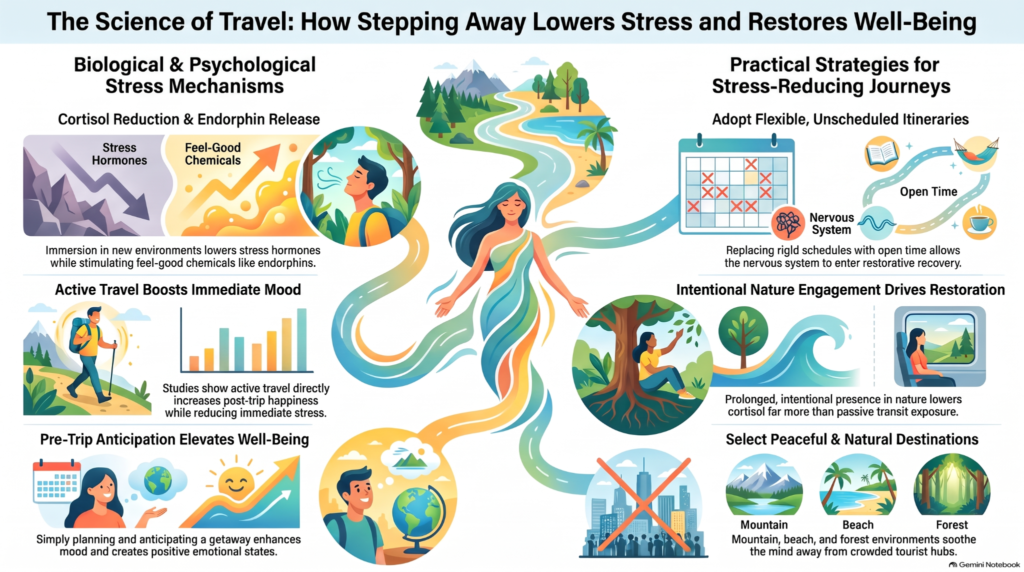
Traveling not only offers a break from routine but also plays an essential role in lowering stress hormones like cortisol. When you begin new travel experiences, your body responds positively by reducing the stress response.
Engaging in different activities and immersing yourself in new cultures helps distract your mind from daily pressures, allowing for natural stress reduction.
Research shows that the anticipation of a trip can elevate your mood even before you leave. As you explore new environments, your brain releases feel-good chemicals like endorphins, which counteract cortisol levels.
Whether it’s lounging on a beach or hiking through mountains, these experiences foster relaxation and joy.
The Emotional Benefits of Getting Away
Taking a break from your daily environment can considerably enhance your emotional well-being.
When you escape your routine, you open the door to experiences that promote emotional release and foster growth.
Here are some key emotional benefits of getting away:
- Reduced Anxiety: Stepping outside your comfort zone can diminish everyday stressors and lower anxiety levels.
- Increased Creativity: New surroundings stimulate your mind, allowing for fresh ideas and perspectives. Exploring unfamiliar places and engaging with different cultures highlights the cognitive benefits of travel, helping stimulate creativity, broaden perspectives, and encourage flexible thinking.
- Stronger Connections: Traveling often leads to meaningful interactions, strengthening your relationships with friends and family.
- Adventure Therapy: Engaging in activities like hiking or exploring new cultures provides a sense of adventure that invigorates your spirit.
Types of Travel for Stress Relief
Exploring various types of travel can greatly enhance stress relief, allowing you to find the perfect escape that suits your needs.
Wellness retreats offer a serene environment focused on rejuvenation, combining relaxation with holistic practices. If you crave excitement, adventure travel can invigorate your spirit through thrilling experiences, like hiking or zip-lining.
Cultural immersion lets you connect deeply with local traditions, enriching your perspective and fostering a sense of belonging. Solo travel empowers you to reflect and recharge, while group getaways provide camaraderie and shared joy.
Wellness tourism emphasizes self-care, allowing you to prioritize your mental health. Activities like mindful walking, journaling, or meditation during your trip can become a meaningful self care activity that supports relaxation and emotional well-being. Nature escapes immerse you in tranquil landscapes, promoting peace and mindfulness.
Finally, beach vacations offer soothing waves and sun-soaked relaxation, perfect for unwinding. By choosing the right type of travel, you can effectively lower stress hormones and boost your emotional well-being.
How Nature in Travel Boosts Your Well-Being
When you immerse yourself in nature during your travels, you’re not just enjoying beautiful scenery; you’re also tapping into a powerful source of mental and emotional well-being.
Nature therapy has been shown to considerably reduce stress and enhance your mood. Here’s how outdoor adventures can boost your well-being:
- Stress Reduction: Being in natural environments lowers cortisol levels, helping you feel more relaxed.
- Enhanced Mood: Exposure to greenery and fresh air can elevate your mood and combat feelings of anxiety and depression.
- Increased Creativity: Nature stimulates your mind, allowing for greater creativity and problem-solving skills.
- Improved Physical Health: Engaging in outdoor activities promotes physical fitness, which is linked to better mental health.

TIPS FOR PLANNING A STRESS-REDUCING TRIP
Finding real stress relief on the road didn’t happen for me until I broke one critical travel habit: over-scheduling. Early in my travel journeys, I treated vacations like productivity spreadsheets, mapping out every single hour from sunrise museum visits to late-night culinary tours. The result? I ended up just as hyper-vigilant and drained as I was in my home office. The breakthrough came during a trip along the coast of Oaxaca. Instead of obsessing over a rigid checklist, I decided to leave entire afternoons open with zero plans, simply letting the day unfold.
That meant wandering down quiet dirt paths, watching local surfers read the breaks, and sitting with an afternoon espresso without constantly checking the clock. That simple shift from rigid control to open curiosity made all the difference. When we stop trying to control every micro-variable of a trip, our nervous system finally drops its guard, downshifting from high-alert vigilance into restorative recovery.
Stepping onto unfamiliar terrain naturally forces us to be intensely present—whether negotiating a bumpy bus ride, trying a street food dish you can’t name, or navigating a trail. In those moments of gentle, flexible adventure, the constant worry about tomorrow fades away, creating the mental space our minds desperately need to replenish.
In today’s fast-paced world, stress and burnout have become increasingly common. Many people turn to travel as a powerful way to disconnect, recharge, and restore balance.Research consistently shows why travel is important for mental peace, helping the mind detach from stressors and regain emotional balance. But the benefits of travel go far beyond taking a simple break. A growing body of scientific research shows that travel helps reduce stress, lowers cortisol levels, improves brain function, restores emotional balance, and strengthens psychological resilience.
When planning a stress-reducing trip, choosing relaxing destinations is key to enhancing your well-being.
Opt for places that offer serene environments, like beaches or mountains, where you can unwind.
Additionally, flexible itineraries allow you to adapt your plans, ensuring you can fully enjoy each moment without feeling rushed.
Choose Relaxing Destinations
Choosing the right destination can make all the difference in planning a stress-reducing trip.
Opt for locations that promote relaxation and well-being. Here are some tips to help you choose:
- Beach retreats: The sound of waves and warm sand can soothe your mind and body.
- Mountain escapes: Fresh air and stunning views create a tranquil environment for reflection.
- Nature-focused destinations: Parks or forests offer a peaceful atmosphere to unwind and connect with nature.
- Quiet towns: Avoid crowded tourist spots; seek charming, less-traveled places for a more serene experience.
Plan Flexible Itineraries
While a well-structured itinerary can enhance your travel experience, allowing for flexibility is essential to minimizing stress.
Embrace flexible planning by leaving gaps in your schedule for spontaneous adventures or relaxation. This way, you can make itinerary adjustments based on your mood or new discoveries.
For instance, if you stumble upon a charming café or a local event, you won’t feel pressured to stick to a rigid plan. Research shows that flexible travel can boost your emotional well-being, as it allows for a greater sense of control and enjoyment. Understanding the psychology of vacation happiness shows how having the freedom to explore, relax, and enjoy unexpected experiences can make a trip more fulfilling and emotionally rewarding.
Real-Life Stories: Travel Transformations That Reduced Stress
To avoid the negative effects of chronic stress and burnout, we need time to replenish and return to our pre-stress level of functioning. This recovery process requires “switching off” from work by having periods of time when you are neither engaging in work-related activities, nor thinking about work. It is critical that you disconnect from time to time, in a way that fits your needs and preferences.
Travel often serves as a powerful antidote to stress, providing individuals with transformative experiences that rejuvenate the mind and spirit.
Many find that stepping outside their comfort zones leads to profound emotional shifts. Here are four real-life stories of travel transformations that reduced stress:
- Cultural Immersion: Lisa traveled to Italy, where engaging with local artisans allowed her to disconnect from daily pressures and embrace creativity.
- Adventure Therapy: Mark hiked the Appalachian Trail, discovering that physical challenges restored his mental clarity and resilience.
- Mindfulness Retreat: Sarah joined a yoga retreat in Bali, where meditation practices helped her cultivate inner peace.
- Family Bonding Trip: Tom took his family on a road trip across the country, strengthening connections and creating joyful memories that overshadowed stress.
These stories highlight how travel can be a catalyst for emotional healing and personal growth, revealing a sense of freedom and joy.

RELATED STUDIES ABOUT HOW TRAVEL LOWERS STRESS HORMONES
As you pack your bags and step into the world, remember that each journey can be a chapter in your story of well-being. Just like Odysseus, who sought adventure beyond the horizon, you too can discover new paths that rejuvenate your spirit. By lowering stress hormones and enhancing emotional health, travel invites you to rewrite your narrative. So, embrace the call of the open road; your next adventure awaits, ready to transform your life in ways you’ve yet to imagine.
Exposure to green and blue spaces during travel does not have immediate effect on subjective happiness and stress: evidence from a GPS survey in England
Conceptual Framework & Rationale
- Urbanization and the Daily Commuting Burden: Urban living is increasingly linked to chronic sedentary behavior, environmental stressors (noise, air pollution, heat islands), and directed psychological strain. Daily travel constitutes a ubiquitous routine of modern city life—averaging approximately one hour per day—where environmental conditions and travel modes directly shape immediate emotional well-being and ripple into broader life satisfaction.
- The “Residential Bias” in Environmental Well-Being Research: A vast body of literature demonstrates that residential access to natural amenities (urban green and blue spaces) fosters life satisfaction, lowers mental distress, and reduces salivary cortisol. However, prior studies have predominantly conceptualized environmental exposure as static and residential, leaving dynamic exposures encountered during active and motorized travel largely unexamined.
- Recall Bias vs. Geographic Ecological Momentary Assessment (GEMA): Conventional travel satisfaction research relies on retrospective, one-time questionnaires vulnerable to memory decay and peak-end heuristic distortion. GEMA addresses this limitation by integrating real-time smartphone GPS tracking with momentary experience-sampling prompts delivered in situ immediately following trip completion.
- Core Research Objectives:
- Investigate whether and to what extent momentary exposure to green and blue spaces during trips influences immediate post-trip happiness and stress levels.
- Evaluate the relative emotional impacts of micro-scale weather conditions (apparent temperature, visibility, rain) and transportation modes (active travel, public transit, personal car) within an urban commuter cohort.
Methodology & Empirical Architecture
- Empirical Setting & Participant Cohort:
- Conducted across three English cities: Leeds, Brighton and Hove, and Birmingham between October 2018 and April 2020.
- Recruited adult workers aged 18–64 years.
- Screening & Retention Criteria: Participants were required to log at least five days of continuous GPS tracking, complete 10 GEMA survey prompts, and provide complete sociodemographic profiles. From 1,017 initial participants, 411 were excluded, yielding a final analytical sample of 606 individuals (n=348 women, n=258 men).
- Trip Dataset: Encompassed 8,083 distinct trips with matched GEMA surveys completed within one hour post-travel (averaging 13.3 trips per individual), drawn from a broader pool of 21,349 total GEMA survey responses used to calibrate baseline emotional states.
- GPS Tracking & Dynamic Geofencing:
- Participants used a bespoke smartphone app that logged coordinates using a two-state rolling geofence system (50-meter threshold) to distinguish stationary phases from movement while preserving battery life.
- Stop points were defined by stationary periods >5 minutes within <75 meters. Agglomerative spatial clustering identified primary home locations, matching self-reported postal codes within 1 km in 81% of cases.
- Environmental & Meteorological Data Integration:
- Green & Blue Space Exposure: Calculated via the UK Centre for Ecology & Hydrology (UKCEH) 2019 Land Cover Map (derived from Sentinel-2 satellite imagery) using a 50-meter spatial buffer along each trip trajectory. Exposure was quantified as the proportion of trip buffer area covered by green (11 merged classes) or blue (2 merged classes) land cover, supplemented by cumulative duration dose metrics.
- Weather Attributes: Hourly meteorological data from the UK Met Office MIDAS network were assigned based on the station closest to each trip’s midpoint. Metrics included apparent temperature (AT; adjusted for humidity and wind speed via Steadman’s formula), horizontal visibility (meters), and rainfall presence (binary yes/no).
- Fuzzy Logic Travel Mode Classification:
- Inferred dominant transport modes without participant burden using a multi-variable trapezoidal fuzzy logic system (evaluating median speed, standard deviation of speed, and OSM proximity to bus and rail networks) across six categories (walk, run, bike, bus, train, car).
- Modes were aggregated into Active Transportation (walk, run, bike), Public Transit (bus, train), and Personal Car.
- Statistical Modeling Strategy:
- Dependent variables were momentary happiness and stress (7-point Likert scales), person-mean centered by subtracting each participant’s global mean across all trip and non-trip surveys to isolate relative within-person emotional shifts.
- Modeled using linear mixed-effects regressions with individual random intercepts to control for repeated within-subject clustering, adjusting for individual covariates (gender, age, city, distance from city center) and trip covariates (duration, day/night, weekday/weekend, destination type, social presence).
Key Empirical Findings
- Absence of Immediate Green and Blue Space Effects:
- Exposure to green space during trips exhibited no statistically significant immediate effect on either post-trip happiness (B=0.00,p=0.07) or stress levels (B=-0.00,p=0.07).
- Exposure to blue space similarly showed no significant relationship with happiness (B=0.87,p=0.60) or stress (B=-0.00,p=0.66).
- These neutral results remained identical when evaluated as cumulative duration-weighted exposure doses.
- The Emotional Advantage of Active Transportation:
- Compared to personal car travel (reference category), active transportation (walking, running, cycling) was significantly associated with higher immediate happiness (B=0.08,p<0.001) and lower immediate stress (B=-0.05,p=0.04).
- Public transit demonstrated no significant emotional divergence from personal car use (happiness: B=-0.03,p=0.61; stress: B=0.05,p=0.42), reflecting a neutral relative impact.
- Correlation checks confirmed that active travel occurred largely independently of green or blue corridors (weak negative correlation with greenspace, negligible correlation with bluespace), verifying that the emotional benefits of walking and cycling stem from active physical mobility rather than natural scenery.
- Meteorological Drivers of Commuter Affect:
- Apparent Temperature: Positively associated with happiness (B=0.01,p=0.01) and negatively associated with stress (B=-0.01,p=0.04), with warmer perceived temperatures elevating post-trip mood.
- Horizontal Visibility: Positively associated with happiness (B<0.001permeter/+0.03perkm,p=0.04) and negatively associated with stress (B=-0.03permeter/-0.04perkm,p=0.02), highlighting that clear navigation conditions alleviate travel-related cognitive strain.
- Precipitation: Traveling in rainy conditions had no statistically significant effect on either happiness (p=0.36) or stress (p=0.06).
- Temporal and Destination Correlates:
- Nighttime travel (relative to daytime) was associated with higher happiness (B=0.28,p<0.001) and lower stress (B=-0.25,p<0.001), reflecting a concentration of evening social and leisure pursuits.
- Weekend trips similarly predicted higher happiness (B=0.27,p<0.001) and lower stress (B=-0.33,p<0.001) relative to weekdays.
- Overall Explanatory Variance:
- Linear mixed-effects models yielded marginal R2 values of 0.030–0.032 (fixed effects) and conditional R2 values of 0.042–0.045 (fixed plus random effects).
- While environmental and modal predictors are statistically meaningful, they account for a small fraction ($<5\%$) of momentary affective variance, which remains heavily driven by unmeasured personal, genetic, social, and situational factors.
Theoretical & Urban Planning Implications
- Reconciling Acute Commuter Affect with Long-Term Restoration: The non-significant impact of green and blue spaces during travel does not contradict established environmental psychology frameworks (e.g., Attention Restoration Theory). Rather, it establishes a crucial boundary condition: passive, transient exposure during utilitarian travel does not generate the acute mood elevations or stress reductions seen with intentional, prolonged stays in parks or natural settings.
- Active Infrastructure as an Actionable Public Health Lever: Because active travel generates immediate, significant reductions in stress and gains in happiness, municipal investments in dedicated bike lanes, wide sidewalks, and pedestrianized corridors represent direct interventions for daily urban well-being.
- The Indirect Value of Street Greenery: While urban street vegetation may not provide an immediate post-trip happiness boost, literature indicates it lowers perceived noise, improves pedestrian safety, and encourages active travel choices—indirectly supporting long-term health outcomes.
- Designing for Environmental Legibility: The negative effect of poor visibility on stress underscores the importance of environmental legibility, open sightlines, and navigational clarity in urban transit corridor design to reduce commuter vulnerability.
Study Limitations
- Resolution of Satellite Land Cover: The UKCEH Sentinel-2 land cover classification uses an overhead 2D perspective that ignores vertical street-level vegetation (e.g., eye-level tree canopies and green walls), though previous research shows moderate correlation between satellite-derived buffers and human-perceived greenery.
- One-Hour Survey Response Window: Allowing up to 60 minutes for participants to respond to post-trip GEMA notifications created a trade-off: it maximized sample completion (retaining 8,083 trips) but introduced potential latency between travel termination and reported affect.
- Absence of Trip Origin Tracking: Due to technical and battery constraints, GEMA surveys were triggered only at trip termination, preventing the measurement of baseline emotional states immediately prior to trip departure.
- Subjective Affect Without Biosensing: The study captured self-reported psychological states on ordinal scales without concurrent ambulatory physiological biosensors (e.g., real-time heart rate variability, galvanic skin response, or salivary cortisol sampling).
| REFERENCE: Milad Malekzadeh, Darja Reuschke, Jed A. Long, Exposure to green and blue spaces during travel does not have immediate effect on subjective happiness and stress: evidence from a GPS survey in England, Travel Behaviour and Society, Volume 43, 2026, 101191, ISSN 2214-367X, https://doi.org/10.1016/j.tbs.2025.101191. (https://www.sciencedirect.com/science/article/pii/S2214367X25002091) |
Physiological markers of traffic-related stress during active travel
This review and conceptual framework paper synthesizes insights from transport engineering, stress physiology, and health psychology to evaluate the validity, limitations, and methodological challenges of utilizing wearable physiological sensors to measure active travelers’ (pedestrians and cyclists) perceptions of safety and comfort (PSC).
Conceptual Framework & Theoretical Rationale
- The Imperative for Perceptions of Safety and Comfort (PSC): Understanding PSC is essential for designing active travel networks, evaluating pedestrian and bicycle levels of service (LOS), and projecting mode shift. Unlike motorized transport analysis—which is dominated by operational efficiency and delay—active travel adoption is constrained primarily by fundamental personal safety and comfort concerns.
- Limitations of Self-Reported PSC: Traditional assessment tools (first-person post-ride surveys or third-person photo/video evaluations) suffer from severe limitations, including memory decay, social desirability bias, acquiescence, strategic reporting, low spatial/temporal resolution, and poor synchronization with micro-scale road design features.
- The Promise and Prematurity of Biosensing: To overcome subjective bias, researchers have increasingly deployed wearable biometric devices (electrodermal activity [EDA], heart rate [HR], heart rate variability [HRV], and skin temperature) to capture continuous, in situ psychological stress responses. However, the paper establishes that no physiological marker has yet been validated as a reliable measure of active traveler PSC under real-world, on-road conditions.
- An Integrated Transdisciplinary Framework (Figure 1): Grounded in Lazarus and Folkman’s transactional model, Epel et al.’s transdisciplinary stress model, and Blascovich’s biopsychosocial framework, the authors structure active travel stress across five interacting levels:
- Level 1 (Environmental & Travel Factors): External inputs comprising operating facility infrastructure (path width, slope, surface roughness), other road users (traffic speed, heavy-duty truck volume, proximity, passing maneuvers), weather (wind, temperature, rain), equipment, and trip constraints.
- Level 2 (Cognitive Appraisals):
- Primary Appraisal: Interprets incoming stimuli as positive/benign or potentially stressful (threat, challenge, or harm/loss).
- Secondary Appraisal: Evaluates environmental demands against personal coping capacity. If demands exceed resources, a threat appraisal is triggered (amplifying perceived crash risk and social evaluation anxiety); if resources match demands, a challenge appraisal occurs.
- Level 3 (Multidimensional Stress Responses): Tripartite activation encompassing cognitive-affective states (fear, frustration, vigilance, or flow), behavioral adaptations (gait changes, route diversion, speed reduction, slalom steering), and autonomic nervous system (ANS) activation.
- Level 4 (Physiological Outcomes & Biomarkers): Sympathetic Adrenal Medullary (SAM) axis and parasympathetic nervous system (PNS) modulation resulting in peripheral physiological shifts (sweat gland activation, peripheral vasoconstriction, tachycardia, and altered cardiac chronotropy).
- Level 5 (Subject-Level Moderators): Personal traits, travel habits, baseline fitness, prior trauma, demographics, and non-travel life stressors that condition every stage of appraisal and reactivity.
Critical Review of Existing Literature
- Corpus Characteristics: Analysis of 14 pioneering on-road active travel biosensing studies (11 cycling, 3 pedestrian) revealed a strong geographic bias, with 11 conducted in the Anglosphere or Western Europe.
- Predominant Physiological Markers & Sensor Placements:
- Electrodermal Activity (EDA): The most commonly utilized marker (wrist- or finger-worn devices like Empatica E4, Shimmer3, Bodymonitor Smartband) measuring skin conductance changes from eccrine sweat gland activation.
- Heart Rate (HR) and Heart Rate Variability (HRV): Assessed via chest straps (Polar RS800CX, BodyGuard II) or photoplethysmography (PPG), where sympathetic arousal elevates HR and reduces beat-to-beat variability (lowering high-frequency HRV power).
- Skin Temperature: Measured at the extremities to detect sympathetic vasoconstriction-induced cooling.
- Methodological Inconsistencies & Control Deficits:
- Existing studies report contradictory findings regarding whether infrastructure improvements (e.g., protected bike lanes vs. mixed traffic) produce statistically detectable physiological shifts.
- Most studies fail to measure or statistically control for essential confounding physical and environmental variables, drawing direct, unverified inferences between raw sensor spikes and perceived traffic fear.
Core Confounding Mechanisms & Threats to Validity
The paper demonstrates that inferring traffic-related fear or discomfort from ambulatory physiological markers is compromised by three major confounding pathways:
- Non-Traffic Factors Inducing Physiological Stress:
- Physical Exertion: Physical locomotion (pedaling, climbing hills, fast walking) directly activates the sympathetic nervous system, increasing HR, suppressing HRV, and triggering thermoregulatory sweating (EDA). Exertion functions simultaneously as a physical stressor, a behavioral stress response (e.g., sprinting to clear an intersection), and a direct physiological confound.
- Mental Workload & Cognitive Tasks: Navigating an unfamiliar route, reading signage, or managing vehicle balance demands executive attention and visual processing, evoking autonomic arousal independent of traffic danger.
- Social Evaluation: Pedestrians and cyclists are physically exposed in public spaces. Heightened arousal can stem from embarrassment, self-consciousness about fitness or attire, or passing crowds, rather than traffic hazard.
- Traffic Stimuli Evoking Non-PSC Stress Responses:
- Positive Arousal & “Flow” States: Stimuli appraised as challenges (such as descending a hill at speed, skillful slalom riding, or dynamic maneuvers) evoke high-arousal, positive-valence emotional states. These flow and excitement states trigger peripheral sympathetic signatures (elevated HR, suppressed HRV, skin conductance spikes) that are physiologically indistinguishable from negative traffic fear or anger.
- Traffic Delay vs. Collision Threat: Impedance at red lights or queue bottlenecks generates low-activation frustration or boredom, which alters autonomic tone without indicating perceived safety risks.
- Direct Environmental & Physical Interference Outside the Stress Pathway:
- Microclimate & Atmospheric Confounders: Ambient temperature, relative humidity, direct solar radiation, and wind directly manipulate skin conductivity, peripheral vasoconstriction, and heat dissipation independently of psychological affect. For instance, increased travel speed amplifies wind airflow, cooling the skin and drying sweat sensors.
- Motion Artifacts: Sensor movement, handlebar vibration, grip pressure variation, and loose strap contact introduce substantial mechanical noise into EDA and PPG signals during walking and cycling.
Practical Guidelines & Methodological Recommendations
To transition ambulatory biosensing from an exploratory exercise into a scientifically rigorous methodology, the authors formulate six foundational recommendations:
- 1. Standardize Conceptual Terminology: Discard the ambiguous catch-all term “stress”. Studies must rigorously distinguish between stressors (environmental/task stimuli), appraisals (threat vs. challenge), and stress responses (cognitive, behavioral, or physiological).
- 2. Implement Rigorous Covariate Control in Study Framing:
- Dynamic variables—specifically physical exertion, travel speed, road grade, ambient weather (temperature, humidity, wind), and concurrent cognitive demands—must be logged continuously via objective sensors (power meters, accelerometers, weather loggers) and incorporated as covariates into statistical models.
- Prompting participants to “ride at a comfortable pace” is insufficient to control for metabolic exertion and threatens ecological validity.
- 3. Restrict or Exercise Extreme Caution with Inter-Subject Comparisons:
- Peripheral autonomic reactivity varies widely across individuals based on age, sex, skin pigmentation, baseline cardiovascular fitness, and past psychological trauma. Absolute marker magnitudes cannot be compared across individuals.
- Researchers should adopt crossover (within-subject, repeated-measures) designs and establish standardized two-point reference conditions (e.g., baseline resting on a quiet sidewalk vs. high-stress cycling on a busy arterial) to normalize individual relative reactivity scales.
- 4. Combine Multi-Modal Biosignals:
- Relying on a single marker (such as EDA alone) is inadequate. Combining cardiovascular dynamics (HRV time- and frequency-domain metrics) with electrodermal indices and future mobile neuroimaging (e.g., ambulatory EEG) provides higher diagnostic resolution of autonomic balance.
- 5. Pair Biosignals with Real-Time Affective Ground-Truth:
- Physiological data must be synchronized with concurrent subjective validation—such as momentary verbal experience-sampling, eye-tracking, or video-prompted post-ride debriefs—to accurately disentangle emotional valence (fear vs. excitement) from autonomic activation.
- 6. Bridge Laboratory and Ambulatory Experiments: Controlled laboratory and virtual reality trials should be paired with field studies to calibrate how individual physiological markers respond to isolated physical exertion and vibration before attempting unconstrained on-road causal inferences.
| REFERENCE: Alexander Bigazzi, Fajar Ausri, Luke Peddie, Dillon Fitch, Eli Puterman, Physiological markers of traffic-related stress during active travel, Transportation Research Part F: Traffic Psychology and Behaviour, Volume 84, 2022, Pages 223-238, ISSN 1369-8478, https://doi.org/10.1016/j.trf.2021.12.003. (https://www.sciencedirect.com/science/article/pii/S1369847821002813) |
Hormonal, autonomic cardiac and mood states changes during an Antarctic expedition: From ship travel to camping in Snow Island
This prospective longitudinal field study evaluates the physiological and psychological acclimatization trajectories of tropical-native individuals exposed to contrasting phases of an Antarctic summer expedition—distinguishing the effects of naval confinement (low luminosity, warm indoor environment, sedentary routine) from field camping (extended natural photoperiod, sub-zero cold exposure, high physical exertion).
Conceptual Framework & Theoretical Rationale
- Antarctica as an Isolated, Confined, and Extreme (ICE) Space Analog: Antarctic research environments combine severe physical stressors—including cold temperatures, katabatic winds, high natural surface albedo, and altered light regimens—with social and logistical constraints (confinement, physical isolation, sensory deprivation). These environments serve as terrestrial analogs for human spaceflight missions.
- Contrasting Environmental Phases:
- Ship Travel Phase: Characterized by indoor confinement, sheltered thermal comfort, low daily physical activity, and predominantly artificial, low-luminosity lighting conditions (<600to800lx).
- Field Camping Phase: Characterized by natural Antarctic summer illumination (15.3 to 17.5 h daylight plus continuous twilight), persistent sub-zero to low temperatures (ambient mean $2^\circ\text{C}$ to $4.4^\circ\text{C}$), rugged terrain, and heavy physical labor.
- The “Polar Syndrome” & Neuroendocrine Pathways:
- Hypothalamic-Pituitary-Thyroid (HPT) Axis: Changes in luminosity and cold stress modulate thyroid-stimulating hormone (TSH) and thyroxine (T4). The “polar syndrome” is characterized by elevated TSH accompanied by blunted or declining peripheral thyroid hormones, which has been linked to metabolic alterations and mood disturbance.
- Hypothalamic-Pituitary-Adrenal (HPA) Axis & Melatonin: Disrupted photic cues and confinement stress alter the circadian secretion of melatonin and morning-to-evening cortisol dynamics.
- Sympathovagal Balance: Autonomic cardiovascular regulation reflects acclimatization demands, motion sickness, and environmental stress through heart rate variability (HRV).
- Core Research Objectives:
- Track hormonal responses (TSH, T4, melatonin, cortisol, free testosterone), cardiac autonomic control (HRV), and mood dimensions across a 50-day expedition.
- Disentangle the physiological signatures of indoor naval confinement from on-ice field camping in tropical-born expeditioners.
Methodology & Experimental Architecture
- Expedition Profile & Study Timeline:
- A 50-day deployment during the 2017 austral summer divided into:
- Ship Travel: 26 days on board the Brazilian Navy polar vessel Almirante Maximiano (H-41), crossing the Chilean channels and the Drake Passage (approx. 40-hour crossing).
- Field Camping: 24 days tent-camping on Snow Island, South Shetland Islands (6243’51.8”S,6112’33.1”W).
- A 50-day deployment during the 2017 austral summer divided into:
- Participant Cohort (N=10):
- 10 non-military Brazilian nationals (7 men, 3 women) born and residing in tropical regions.
- Baseline Profile: Mean age 4011 years (range 27–62); height 1708cm; body mass 81.723.0kg; body fat $27.5 \pm 8.6\%$. SF-36 General Health score was 7814, comparable to normative populations.
- Sampling Protocol & Measurement Timepoints:
- Evaluated at six distinct operational intervals: Days 2, 16, and 26 aboard ship; Days 4, 11, and 23 at camp.
- Biological Assays:
- Thyroid Hormones: TSH and total T4 measured in duplicate from dried blood spots on filter paper via time-resolved two-site fluoroimmunoassay (AutoDELFIA). The T4/TSH ratio was derived as an index of thyroid responsiveness.
- Salivary Steroids & Indoles: Saliva collected under resting conditions via passive drool. Cortisol (7:00 AM and 7:00 PM; electrochemiluminescence), free testosterone (7:00 AM and 7:00 PM; ELISA), and melatonin (10:00 PM to midnight; radioimmunoassay). Daily cortisol amplitude was calculated as AM-PM concentration.
- Urinary Biomarkers: 12-hour overnight urine collection (7:00 PM to 7:00 AM) at Days 4 and 23 of camping to assess aldosterone (radioimmunoassay) and total protein excretion (colorimetry).
- Cardiac Autonomic Monitoring: 20-minute resting RR recordings (Polar S810i) in a thermally sheltered tent/cabin. Kubios HRV software analyzed 5 artifact-free minutes, yielding time-domain metrics (RMSSD, NN50, pNN50) and frequency-domain spectral power (LF: 0.04–0.15 Hz; HF: 0.15–0.40 Hz; LF/HF ratio).
- Psychological Profiling: 24-item Brunel Mood Scale (BRUMS) evaluating anger, confusion, depression, fatigue, tension, and vigor (scores 0–16 per dimension).
- Physical Activity & Thermal Telemetry: Daily steps recorded via pedometers. Core body temperature tracked continuously in a subset using ingestible telemetric capsules (CorTemp).
- Statistical Analysis: One-way repeated-measures ANOVAs with Student-Newman-Keuls post-hoc tests and paired Student’s t-tests. Effect sizes were quantified using Cohen’s d (<0.2 trivial, 0.2–0.6 small, 0.6–1.2 moderate, 1.2 large).
Key Empirical Findings
- 1. Distinct Hormonal Divergence Across Phases:
- Thyroid Axis (HPT):
- Ship Travel: Blood TSH increased by $15.6\%$ by Day 16 (P=0.005,d=0.75) and remained elevated through Day 26 (P=0.004,d=0.79). Serum T4 declined between Day 16 and Day 26 (P=0.006,d=0.60). Consequently, the T4/TSH ratio steadily fell across the naval voyage (P=0.002,d=0.47), signaling emerging subclinical primary thyroid insensitivity.
- Field Camping: Entering the field reversed this pattern; TSH dropped by $26.5\%$ on Day 4 compared to pre-camp values (P<0.001,d=2.66) and remained depressed through Day 23 (P<0.001,d=1.83). Concurrently, T4 dropped by $34.1\%$ (P<0.001,d=1.70). However, the T4/TSH ratio stabilized, showing no significant difference relative to ship departure (P=0.12).
- Melatonin & Circadian Photic Regulation:
- Ship Travel: Nocturnal salivary melatonin increased markedly by $72.3\%$ from Day 2 to Day 26 (P=0.052,d=3.91), driven by low indoor ambient illuminance (7–660 lx).
- Field Camping: Despite continuous natural daylight and sleeping in uninsulated tents, nocturnal melatonin was stable throughout the camp period (P=0.378,d<0.20), showing no phase delay or suppression.
- Adrenocortical Stress (Cortisol):
- Ship Travel: Morning (7:00 AM) cortisol decreased by $37.1\%$ from Day 2 to Day 26 (P=0.048,d=0.93), blunting the diurnal cortisol amplitude (4,2912,6332,6202,069pg/mL,d=0.71).
- Field Camping: Morning cortisol increased by $72.1\%$ during field camping (moderate effect sizes: d=0.70 on Day 4; d=0.93 on Day 23 relative to pre-camp), expanding diurnal cortisol amplitude (4,8244,152pg/mL,d=0.67).
- Anabolic/Catabolic Balance (Testosterone & Ratio):
- Free testosterone showed no significant group-level changes in the morning or evening during ship or camp phases.
- The testosterone/cortisol ratio at 7:00 PM decreased moderately in the field (8.639.992.902.4110-2,d=0.79), indicating an evening shift toward a catabolic state.
- Thyroid Axis (HPT):
- 2. Cardiac Autonomic Plasticity & HRV Dynamics:
- Ship Confinement: Parasympathetic vagal tone exhibited a pronounced biphasic trajectory. RMSSD dropped by $47.8\%$ on Day 16 (24.25.716.95.4ms,P=0.03,d=1.31) along with a decline in HF power (266139ms2,P=0.04,d=1.01), driving a compensatory spike in the LF/HF ratio (1.53.6,P=0.03,d=1.15). By Day 26, these autonomic indices rebounded to baseline levels (RMSSD: 23.25.2ms; HF: 239ms2).
- Field Camping: Autonomic metrics remained stable across all 24 days. Resting HR (68.6–72.6bpm), RMSSD (21.8–25.4ms), and LF/HF ratio (1.4–1.7) showed no statistically significant deviations (P>0.20).
- 3. Mood State Profiles:
- Ship Travel: Depression scores increased significantly (0.71.21.62.2,P=0.01,d=0.51), accompanied by an increase in total negative mood dimensions (1.52.7,P=0.04,d=0.33) and a reduction in vigor (11.68.9,P=0.04,d=0.52).
- Field Camping: Confusion (2.31.0–1.3,P=0.01) and tension (4.52.4–2.5,P=0.001) dropped during the first 11 days, though tension rose back toward baseline by Day 23 (3.52.9).
- The Salutogenic Effect: Across all timepoints in both environments, subjective vigor scores (8.0–11.6) remained substantially higher than any negative mood score, demonstrating psychological resilience.
- 4. Renal & Fluid Balance:
- 12-hour urinary aldosterone excretion ($5.87 \pm 7.39 \rightarrow 3.85 \pm 3.51\ \mu\text{g/mL}, P = 0.29, d = 0.35$) and total protein excretion (6.064.125.422.45mg/mL,P=0.65,d=0.19) were unaffected, confirming preserved electrolyte and glomerular function.
Physiological & Practical Interpretations
- Mechanisms of Shipboard Endocrine Alterations: The concurrent elevation in TSH and drop in the T4/TSH ratio during ship travel mimic the early manifestations of the “polar T3 syndrome”. Because the ship interior was heated and comfortable, this response was not driven by cold thermogenesis; rather, it reflects diminished retinal photic input from low indoor ambient illuminance (under 600 lx). This dim lighting also drove the $72.3\%$ surge in nocturnal melatonin and blunted morning cortisol awakening responses.
- Autonomic Adaptation to Motion and Confinement: The transient mid-voyage drop in parasympathetic vagal tone (RMSSD and HF) coincided with navigating rough seas and acute motion sickness. The subsequent recovery by Day 26 demonstrates rapid baroreflex and autonomic re-calibration to ongoing confinement. This shipboard adaptation provided physiological cross-tolerance, preserving autonomic cardiac stability when participants entered the demanding field camp.
- Field Energy Demands and Thyroid Shift: Camping required hiking 6.2 km/day over snow and scree carrying 6–9 kg packs, generating moderate-to-high physical exertion (8,471 steps/day vs. 1,948 steps/day on board) in $2^\circ\text{C}$ air. Continuous telemetry confirmed core normothermia ($37.33 \pm 0.46^\circ\text{C}$), demonstrating effective thermoregulation. The sustained reduction in peripheral T4 in the field likely reflects accelerated peripheral conversion of T4 to metabolically active T3 to maintain metabolic heat production.
- Operational Guidelines for Polar Deployments:
- Vessel Lighting Management: Shipboard work areas and cabins should incorporate dynamic, high-intensity broad-spectrum blue-enriched lighting (>1,000lx) during day shifts to prevent photic-deprivation TSH elevation, melatonin phase shifts, and vigor decline.
- Nutritional & Metabolic Pacing in the Field: The combination of elevated morning cortisol and reduced evening testosterone/cortisol ratios indicates an elevated risk of muscle catabolism during demanding field work. Dietary rations should provide sufficient caloric and protein intake to preserve lean tissue during extended camping.
Study Limitations
- Sample Size & Heterogeneity: The cohort was restricted to 10 participants due to polar logistics; age varied from 27 to 62 years, and the small sub-sample of older males (n=2) displayed distinct androgen and melatonin responses that could not be evaluated via subgroup modeling.
- Absence of Direct Triiodothyronine (T3) Assays: Peripheral T3 and reverse T3 were not quantified, meaning enhanced T4-to-T3 deiodination during cold exposure is inferred from T4/TSH kinetics and established literature rather than measured directly.
- Sleep and Lighting Monitoring: Sleep architecture (actigraphy/polysomnography) and personal photic dosimeters were not deployed, precluding direct tracking of lux-hour exposure on individual circadian alignment.
| REFERENCE: Michele M. Moraes, Rúbio S. Bruzzi, Ygor A.T. Martins, Thiago T. Mendes, Chams B. Maluf, Roberto V.P. Ladeira, Cristian Núñez-Espinosa, Danusa D. Soares, Samuel P. Wanner, Rosa M.E. Arantes, Hormonal, autonomic cardiac and mood states changes during an Antarctic expedition: From ship travel to camping in Snow Island, Physiology & Behavior, Volume 224, 2020, 113069, ISSN 0031-9384, https://doi.org/10.1016/j.physbeh.2020.113069. (https://www.sciencedirect.com/science/article/pii/S0031938420303838) |
CONCLUSION
Whenever I return home from an intentional trip, I am struck by how travel shifts our entire mental baseline. The daily demands, tight work deadlines, and everyday responsibilities will always be there waiting, but stepping outside your usual environment completely changes how you carry them. When we give ourselves the grace to disconnect, explore unfamiliar cultures, and recharge in nature, we aren’t running away from reality; we are actively retraining our nervous systems to approach life with grounded resilience.
True well-being isn’t about escaping your life permanently—it’s about stepping back often enough to remember who you are underneath the daily noise. Every mindful journey offers a fresh vantage point, proving that when cortisol levels drop and emotional balance is restored, creativity and patience naturally resurface. As you think about your next getaway, look beyond just collecting photos or checking off landmarks.
Choose to travel with real intention, leave room in your schedule for spontaneous stillness, and prioritize your own restorative peace. The open road isn’t just an external journey across a map; it remains one of the most effective, accessible tools we have for personal healing and rediscovering lasting inner calm.