

Whenever I pack my bags for a long-distance trek or an immersive field study, I am reminded of how drastically our daily environments condition the way we perceive reality. In our ordinary routines, our brains operate largely on cognitive auto-pilot. We take the same transit routes, speak in habitual cadence to familiar colleagues, and predict almost every sensory input our environment delivers. While this cognitive conservation keeps daily fatigue at bay, it also gently dulls our curiosity and narrows our creative focus.
Throughout more than a decade of studying human behavior across different cultures, I have witnessed how physical displacement acts as an immediate psychological reset. Stepping onto an unfamiliar street or hiking along a remote mountain ridge disrupts those pre-established mental shortcuts. Suddenly, your brain is wide awake.
You are paying attention to the foreign pitch of street vendors’ voices, the unfamiliar scent of local markets, and the physical cues needed to find your way. Travel is not simply an indulgence or a scenic intermission from professional obligations; it is deliberate neural exercise. By stepping away from the predictable rhythms of home, we gift our minds the friction and novelty they desperately need to form new neural pathways, strengthen recall, and awaken dormant creative faculties.
Traveling offers you a unique opportunity to enhance your memory, creativity, and problem-solving skills. Immersing yourself in different cultures sparks curiosity and sharpens your recall through vivid experiences. Maneuvering through unfamiliar environments challenges your adaptability, boosting both resourcefulness and confidence. Unique encounters inspire your imagination and foster innovative thinking. Engaging with locals reveals diverse perspectives that deepen your understanding. As you explore these benefits, you’ll uncover even more ways travel can transform your cognitive abilities.
KEY TAKEAWAYS
- Immersive travel experiences enhance memory retention by creating vivid associations with local cultures and traditions.
- Exposure to novel environments stimulates creativity, encouraging new ideas and imaginative thought processes.
- Navigating unfamiliar situations during travel develops problem-solving skills, fostering adaptability and resourcefulness.
- Engaging with locals and trying new activities broadens perspectives, enhancing cognitive growth and innovation.
- Reflecting on travel experiences boosts self-awareness and reinforces memory, contributing to overall cognitive development.
THE SCIENCE BEHIND TRAVEL AND COGNITIVE GROWTH
When you immerse yourself in a new culture, your brain undergoes a remarkable transformation. This journey isn’t just about seeing new sights; it’s a chance to tap into the neuroplasticity benefits that travel experiences offer.
As you navigate unfamiliar environments, your brain rewires itself, forming new connections and pathways. You’ll find that learning a few local phrases or tasting exotic foods sparks curiosity and creativity.
Your senses awaken, and each interaction becomes a puzzle, enhancing your problem-solving skills. The challenges you face while adapting to different customs encourage flexibility in your thinking. The freedom of exploration releases your innate ability to adapt and innovate.
In this vibrant dance of learning, you’ll notice how travel cultivates a mindset that embraces change, fostering growth both personally and cognitively.
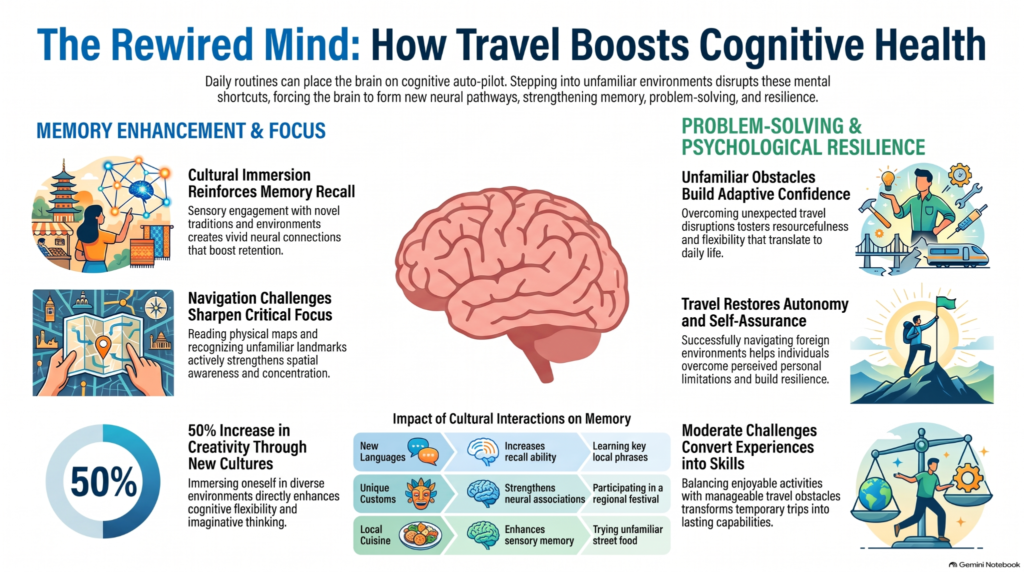
Boost Your Memory by Traveling
Travel is also linked to stress reduction and increased happiness, reducing the risk of burnout from work, family duties, and the monotony of routine. It can improve social connections with those who travel with us and provide new topics to discuss with friends and family upon returning. Meeting new people and forming relationships with those from different backgrounds broadens our understanding of the world and enhances our social well-being, reducing loneliness and improving mood.
Traveling opens the door to a world of new experiences that can sharpen your memory like never before.
When you immerse yourself in different cultures, every sight, sound, and taste reinforces your ability to recall details.
Plus, exploring unfamiliar places not only challenges your focus but also strengthens your cognitive skills, making every trip a powerful boost for your brain.
New Experiences Enhance Recall
Advancements in the travel industry have connected the world in ways humans have never seen before, allowing the average person to see places that previous generations may have only dreamed about. Travel offers a unique opportunity not only to take a break from regular routines, but also to experience new environments that challenge and excite us.
As you commence on new adventures, your brain craves the stimulation of unfamiliar sights, sounds, and experiences, which can considerably enhance your memory.
Engaging in diverse travel experiences ignites your curiosity and prompts your mind to form new connections. Each unique moment, from tasting exotic cuisine to wandering through vibrant markets, contributes to improved memory retention.
These fresh encounters challenge your cognitive processes, making you more adept at recalling details long after your journey ends. By immersing yourself in the unknown, you’re not just collecting memories; you’re training your brain to adapt and thrive.
Cultural Immersion Strengthens Memory
While exploring a new culture, you immerse yourself in a world rich with traditions, languages, and customs that not only captivate your senses but also bolster your memory. This cultural exposure ignites your brain, enhancing memory retention through vivid experiences. Engaging with locals, tasting unfamiliar foods, and learning new phrases creates mental connections that stick with you long after your journey ends.
| Experience | Memory Impact | Example |
| New languages | Increases recall ability | Learning a few phrases |
| Unique customs | Strengthens associations | Participating in a festival |
| Local cuisine | Enhances sensory memory | Trying street food |
| Cultural rituals | Boosts emotional ties | Joining a traditional dance |
Traveling deepens your understanding, turning fleeting moments into lasting memories. Understanding the psychology of vacation happiness helps explain how meaningful cultural experiences, new discoveries, and positive memories can enrich your travels and encourage a deeper appreciation of each destination.
Navigation Challenges Boost Focus
Maneuvering through unfamiliar streets and landscapes sharpens your focus in ways you mightn’t expect. When you face navigation challenges, you naturally hone your skills, leading to significant focus enhancement.
Here are some navigation strategies that can amplify your journey:
- Map Reading: Engaging with physical maps forces you to interpret symbols and scale, boosting spatial awareness.
- Landmark Recognition: Identifying key landmarks enhances your memory, making it easier to navigate back to familiar spots.
- Route Planning: Planning your route requires critical thinking, sharpening your problem-solving skills.
- Local Interaction: Asking locals for directions not only improves your communication skills but also deepens your travel experience.
Embrace these navigation challenges, and watch as your focus and cognitive abilities expand.

UNLEASH YOUR CREATIVITY THROUGH NEW EXPERIENCES
During one of my extended walking journeys across southern Spain, I found myself thoroughly lost in a labyrinth of whitewashed village streets without cellular service or a functioning digital map. At first, the familiar pang of travel anxiety flared up—that instinctive urge to control and predict every turn. Yet, as a psychologist, I recognized this exact moment as the fertile ground where mental flexibility takes root. I sat down on a stone step, pulled out my physical notebook, and sketched the landmarks I had passed: an archway draped in bougainvillea, an iron water fountain, a small bakery with blue shutters.
When you navigate an unexpected obstacle in a foreign place, you are forced to synthesize sensory details, ask for help across language barriers, and reframe obstacles as puzzles. That afternoon, finding my way back was not just a logistical success; it was an exercise in mindful problem-solving that restored my trust in my own intuition.
Over years of conducting field research, I have seen travelers discover an entirely new side of their intellect when things go off-script. Stripping away modern conveniences and confronting small, unfamiliar dilemmas abroad builds an adaptive confidence that permanent comfort simply cannot teach, directly elevating how creatively we approach hurdles back in our ordinary work lives.
The World Health Organisation (WHO) describes mental health as “a state of well-being in which an individual realises his or her own abilities, can cope with the normal stresses of life, can work productively and can make a contribution to his or her community.” Clearly, mental health is integral to having a fulfilling life.
Traveling opens up a world of fresh perspectives, inviting you to embrace novel environments that spark your imagination.
As you engage with diverse cultures, you’ll discover new ideas and ways of thinking that can ignite your creativity.
Each experience becomes a brushstroke on the canvas of your mind, encouraging you to paint with bolder colors.
Embrace Novel Environments
As you step into a new destination, the unfamiliar sights, sounds, and even scents ignite your senses, sparking a wave of creativity.
Embracing novel environments pushes you to adapt and think differently, enhancing your cognitive abilities.
Here are four ways to release your creativity through new experiences:
- Explore Uncharted Territories: Venture off the beaten path to discover hidden gems.
- Savor Local Flavors: Try unique cuisines that challenge your palate and inspire new ideas.
- Capture the Moment: Document your journey through photography or journaling to deepen your reflections. Taking time to photograph scenic views or journal about new experiences can be a rewarding self care activity that encourages mindfulness, strengthens memory, and supports emotional well-being.
- Engage Your Senses: Pay attention to the textures, colors, and rhythms around you, allowing them to influence your thoughts.
Each new experience enriches your mind, fostering environmental adaptation and revealing your creative potential.
Engage With Diverse Cultures
Stepping into a new culture is like opening a vibrant tapestry woven from countless threads of history, tradition, and human experience.
You immerse yourself in the sights, sounds, and flavors that spark your imagination and broaden your horizons. Each interaction becomes a cultural exchange, where you share stories and gain insights, enriching your perspective.
This dance of ideas fuels your creativity, igniting fresh thoughts and innovative solutions. Embracing diverse cultures nurtures global understanding, breaking down barriers and fostering empathy.
As you navigate different ways of life, you’ll discover that your mind expands, and your problem-solving skills sharpen.
Enhance Problem-Solving Skills Through Travel
When you immerse yourself in a new culture, unexpected challenges often arise, pushing you to think on your feet.
These moments are ripe for honing your problem-solving skills through travel brainstorming. You’ll discover that maneuvering through unfamiliar situations enhances your ability to adapt and find creative solutions.
Here are four ways travel sharpens your problem-solving techniques:
- Resourcefulness: You learn to make the most of limited resources, whether it’s finding food, transportation, or lodging.
- Flexibility: Adjusting plans on the fly teaches you to embrace uncertainty and pivot when things don’t go as expected.
- Perspective: Encountering diverse viewpoints helps you approach problems from various angles, broadening your thinking.
- Confidence: Successfully overcoming obstacles abroad boosts your self-assurance, empowering you to tackle challenges back home.
These experiences not only enrich your travels but also cultivate a mindset ready for any challenge life throws your way.
Why Cultural Immersion Makes You Smarter
Experiencing a new culture firsthand opens a gateway to a world of knowledge and understanding that can greatly boost your intelligence. When you immerse yourself in local traditions, languages, and customs, you engage in a vibrant cultural exchange that challenges your worldview.
This exposure fosters cognitive flexibility, allowing you to adapt your thinking and embrace new ideas with ease. As you navigate through unfamiliar environments, you sharpen your problem-solving skills and enhance your creativity.
You find yourself thinking outside the box, connecting seemingly unrelated concepts, and discovering innovative solutions to challenges. Each interaction, whether it’s sharing a meal or participating in local festivities, deepens your understanding of human experiences and perspectives.
Ultimately, cultural immersion isn’t just about seeing new places; it’s about expanding your mind and becoming smarter through rich, diverse experiences that ignite your passion for learning and exploration.
Overcoming Travel Challenges for Better Mental Resilience
Traveling often presents a unique set of challenges that, while intimidating, can greatly bolster your mental resilience. Facing these obstacles not only enhances your adaptability skills but also sharpens your problem-solving abilities.
Here are some effective coping strategies to help you manage travel anxiety and build mental fortitude:
- Prioritize Travel Preparation: Research your destination, plan your itinerary, and pack wisely to minimize stress. Packing a well-organized hiking travel backpack with water, snacks, and navigation essentials can help you prepare for outdoor adventures, minimize travel stress, and focus on enjoying new experiences.
- Practice Stress Management Techniques: Incorporate deep breathing or mindfulness exercises to maintain calm during unexpected situations.
- Embrace Flexibility: Accept that plans may change; adaptability is key to overcoming obstacles and enjoying the journey.
- Reflect on Experiences: After each trip, take time to analyze how you handled challenges, reinforcing your resilience building for future travels.
How to Maximize Cognitive Benefits While Traveling
While you explore new destinations, you can access a treasure trove of cognitive benefits that enhance your mental acuity and creativity. To truly maximize these benefits, embrace mindful planning and purposeful exploration. Consider these strategies:
| Strategy | Benefits |
| Engage with locals | Gain diverse perspectives and insights |
| Try new activities | Stimulate creativity and adaptability |
| Reflect daily | Enhance memory retention and self-awareness |
RELATED STUDIES ABOUT COGNITIVE BENEFITS OF TRAVEL
To sum up, traveling isn’t just an escape; it’s a catalyst for cognitive growth. In fact, studies show that engaging with new cultures can boost your creativity by 50%. So, as you explore unfamiliar landscapes and immerse yourself in diverse experiences, you’re not just collecting memories; you’re sharpening your mind and enhancing your problem-solving skills. Embrace the challenges of travel, and you’ll return home not just with stories, but with a richer, more agile brain.
From sustainable marketing to sustainable travel intention: Moral, experiential and cognitive pathways
This empirical investigation examines how destination-level sustainable marketing activities (SMA) shape tourists’ sustainable travel intentions (STI) by integrating moral, experiential, and cognitive psychological pathways within an emerging tourism market context (Vietnam).
Conceptual Framework & Theoretical Rationale
- Addressing the Attitude–Behavior and Rhetoric Gaps: Sustainable tourism research frequently relies on general attitudes, which empirical evidence shows weakly predict actual pro-environmental behavior. Furthermore, tourism studies often emphasize promotional rhetoric over the psychological mechanisms through which travelers internalize sustainability communications.
- Shift to Destination-Level, Visitor-Side Conceptualization: Prior empirical research on SMA has focused primarily on short-term event contexts (such as sports tourism) or treated sustainability as an objective supply-side destination attribute. This study re-conceptualizes SMA as a visitor-perceived, destination-wide communication construct.
- Theoretical Integration (NAM & OSL Theory):
- Norm Activation Model (NAM): Positions Personal Social Responsibility (PSR) as the moral pathway. Rather than functioning merely as informational persuasion, SMA acts as a moral trigger that activates tourists’ internalized obligations toward environmental and social welfare.
- Optimal Stimulation Level (OSL) Theory: Positions Perceived Novelty as the experiential pathway. Travelers pursue an optimal level of psychological arousal; innovative and distinctive sustainability practices disrupt routine travel habits and trigger curiosity and exploratory processing.
- Cognitive Capability: Integrates Sustainable Intelligence (SI)—defined as the cognitive capability to recognize, evaluate, and apply sustainability information to travel decisions (distinct from passive knowledge, general environmental attitudes, or perceived behavioral control).
- Core Research Hypotheses:
- Perceived SMA positively influences PSR (H1), perceived novelty (H2), and SI (H3).
- PSR positively influences SI (H4) and STI (H5).
- Perceived novelty positively influences SI (H6) and STI (H7).
- SI positively influences STI (H8).
- Perceived novelty moderates the relationship between SMA and SI (H9).
Methodology & Empirical Architecture
- Empirical Context: Vietnam, an emerging tourism destination characterized by rapid sector growth alongside structural policy-implementation gaps and uneven regional sustainability capacities.
- Sampling & Data Collection:
- Utilized a mixed-mode convenience sampling approach during late 2025 across offline locations (cafés and teashops in Hanoi and Ho Chi Minh City) and online travel communities.
- Target respondents were travelers with verified prior exposure to sustainable marketing practices at Vietnamese destinations.
- Data Quality & Screening: Out of 604 initial submissions (326 offline, 278 online), rigorous attention-check protocols—including a content-reversed item (NOT5) and a reverse-worded duplicate item (SI5)—resulted in the removal of 287 inattentive responses (92 offline [28.2%] and 195 online [70.1%]), yielding a final analytical sample of 317 valid respondents.
- Sample Demographics: 51.1% male, 48.9% female; 39.8% Generation Z, 43.2% Generation Y/Millennials, 17.0% Generation X; 52.7% holding bachelor’s degrees, 27.8% postgraduate qualifications; and 57.1% traveling 3–5 times annually.
- Construct Measurement & Validation:
- Scales adapted from validated literature: SMA (5 items), PSR (5 items), Perceived Novelty (6 items), SI (4 items), and STI (3 items) on 5-point Likert scales, refined via forward/back-translation and focus groups with tourism researchers.
- Analyzed using Partial Least Squares Structural Equation Modeling (PLS-SEM) in SmartPLS 4 (5,000 bootstrap resamples).
- Reliability & Validity: Outer loadings exceeded 0.70 (0.719–0.902); Cronbach’s (0.822–0.900) and Composite Reliability (0.882–0.925) confirmed internal consistency; Average Variance Extracted (AVE = 0.629–0.805) demonstrated convergent validity; and all Heterotrait-Monotrait ratios (HTMT) were <0.90, establishing discriminant validity.
- Inner VIFs ranged from 1.00 to 1.82, ruling out common method variance.
Key Empirical Findings
- Explanatory Power & Predictive Boundaries:
- The structural model accounted for 74.1% of the variance in Sustainable Travel Intentions (R2=0.741) and 42.4% of the variance in Sustainable Intelligence (R2=0.424), demonstrating strong in-sample explanatory capability.
- Conversely, SMA accounted for limited variance in Perceived Novelty (R2=0.021) and PSR (R2=0.031), indicating that marketing acts as an enabling trigger rather than a sole driver.
- PLSpredict Evaluation: Out-of-sample predictive performance was limited (Qpredict2 for SI was slightly negative at -0.002; STI was 0.005), confirming that sustainable intelligence operates primarily as an emergent, context-dependent explanatory mechanism rather than a stable, out-of-sample predictive trait.
- Direct Path Analysis (Hypothesis Testing):
- SMA Pathways: Perceived SMA exerted a significant positive direct effect on PSR (=0.176,p=0.002; H1 supported) and Perceived Novelty (=0.146,p=0.007; H2 supported).
- The Cognitive Disconnect: Perceived SMA showed no direct effect on Sustainable Intelligence (=-0.036,p=0.453,f2=0.002; H3 not supported). External marketing cues do not directly transmit cognitive capability without internal processing.
- Drivers of Sustainable Intelligence: Both PSR (=0.345,p<0.001,f2=0.125; H4 supported) and Perceived Novelty (=0.367,p<0.001,f2=0.144; H6 supported) strongly and positively predicted SI.
- Determinants of Sustainable Travel Intention:
- Sustainable Intelligence emerged as the strongest explanatory driver of STI (=0.390,p<0.001,f2=0.347; H8 supported).
- PSR directly and positively influenced STI (=0.375,p<0.001,f2=0.299; H5 supported).
- Perceived Novelty directly promoted STI (=0.245,p<0.001,f2=0.130; H7 supported).
- The Negative Moderation of Novelty (The Optimal Stimulation Boundary):
- The interaction between SMA and Perceived Novelty on Sustainable Intelligence was statistically significant but negative (=-0.121,p=0.007; H9 confirmed in the opposite direction).
- Conditional Simple Slope Analysis:
- At mean (=-0.036,p=0.453) and low (-1SD, =0.086,p=0.165) novelty levels, the effect of SMA on SI was non-significant.
- At high levels of perceived novelty (+1 SD), the relationship between SMA and SI became significantly negative (b = -0.157, t = 2.266, p = 0.023, 95% CI: -0.282, -0.009).
Theoretical & Practical Implications
- Dual Function and Boundary Conditions of Novelty: Perceived novelty serves a dual role in sustainable destination marketing. While it directly stimulates intrinsic curiosity, exploratory engagement, and travel intentions, excessive novelty induces cognitive overload. When experiential stimuli exceed optimal thresholds, tourists focus on sensory gratification and entertainment, diverting cognitive bandwidth away from reflective learning and attenuating the capacity of marketing messages to build sustainable intelligence.
- Indirect Internalization Over Direct Persuasion: One-way marketing assertions fail to build sustainable intelligence directly. Destination-level marketing works by activating moral duties (PSR) and providing moderate experiential curiosity (novelty), which collectively foster cognitive processing and intention formation.
- Actionable Recommendations for Destination Managers:
- Calibrate Novelty to Avoid Distraction: Avoid over-gamified or purely entertainment-driven gimmicks that distract visitors from ecological messaging. Every novel element must be anchored by a clear interpretive cue, a transparent sustainability purpose, and a simple behavioral directive.
- Shift from Passive Marketing to Experiential Co-Creation: In emerging destinations facing capacity constraints, destinations should pair communication with participatory ecotourism—such as community storytelling, guided wetland conservation tours, biodiversity tracking, and localized waste reduction workshops.
- Make Consequences Visible: Marketing narratives should highlight the tangible socio-economic and environmental impacts of tourist choices on local livelihoods, cultural preservation, and ecosystem restoration.
Methodological Limitations
- Cross-Sectional Architecture: The study design restricts definitive causal claims regarding the temporal evolution from marketing perception to cognitive and behavioral intention.
- Emerging Economy Context: Conducted exclusively in Vietnam, where rapid consumption-driven tourism and uneven local sustainability standards may heighten reliance on affective novelty over reflective learning.
- Self-Reported Intentions: Evaluated behavioral intentions rather than objective transactional, tracking, or observational trip choices.
- Screening Data Retention: Demographics of the 287 respondents who failed attention checks were not retained, preventing a formal statistical comparison between retained and excluded participants.
| REFERENCE: Bang Nguyen-Viet, Yen Thi Hoang Nguyen, The Chi Ngo, From sustainable marketing to sustainable travel intention: Moral, experiential and cognitive pathways, Acta Psychologica, Volume 267, 2026, 107100, ISSN 0001-6918, https://doi.org/10.1016/j.actpsy.2026.107100. (https://www.sciencedirect.com/science/article/pii/S0001691826009017) |
Experiences and attitudes of stroke survivors towards international travel health risks and benefits: A qualitative analysis
This qualitative empirical study evaluates the lived experiences, risk perceptions, logistical barriers, and perceived therapeutic health benefits of international leisure travel among community-dwelling stroke survivors participating in a structured multidisciplinary rehabilitation program in Ireland.
Conceptual Framework & Rationale
- Stroke Survivorship and the “Travel as Rehabilitation” Paradigm: Cardiovascular disease remains the primary contributor to mortality among adult international travelers, with stroke functioning as a major driver of chronic acquired disability worldwide. While advances in acute neurointerventions (thrombolysis, endovascular thrombectomy) and multidisciplinary stroke rehabilitation have substantially improved functional survival, many survivors live with chronic residual deficits—including hemiparesis, visual field cuts, dysphasia, fatigue, and affective dysregulation. Travel represents a meaningful, life-affirming personal goal that fosters psychosocial recovery, yet empirical evidence regarding post-stroke travel remains scarce.
- The Clinical Guidance & Information Deficit: Previous research indicates that professional stroke foundations and clinical associations consistently omit practical travel health advice from patient education materials. Consequently, stroke survivors must navigate complex pre-travel planning, aeromedical physiological risks, and foreign healthcare systems without structured evidence-based guidance.
- Core Research Objectives:
- Explore post-stroke travel patterns, anxieties, and risk perceptions surrounding overseas travel.
- Characterize pre-travel planning behaviors, support mechanisms, and barriers encountered in transportation and hospitality settings.
- Identify perceived physical, emotional, and psychological health benefits gained from international travel to inform travel medicine counseling protocols.
Methodology & Sample Architecture
- Setting & Patient Recruitment: Conducted at the Croí Heart and Stroke Centre (Galway, Ireland), home to the National Institute for Prevention and Cardiovascular Health (NIPC). Adult participants were recruited via purposive sampling from outpatient stroke support programs, specifically the Stroke Rebuild multidisciplinary rehabilitation initiative.
- Participant Cohort (N=12):
- Comprised 12 stroke survivors (5 males, 7 females) with a mean age of 627.5 years and an average latency of 4 years since their most recent stroke.
- All participants resided in the West of Ireland, shared households with family carers, and could mobilize independently at the time of the study.
- Disability Profile: Included chronic post-stroke fatigue (n=9), unilateral limb weakness (n=5), visual field loss (n=1), dysphasia (n=1), and coordination deficits (n=1).
- Post-Stroke Travel History: 10 participants had traveled internationally since their stroke (8 within Europe, 1 to North America, 1 to Africa); two participants had suffered an acute stroke while on vacation abroad (Greece and New Zealand); and two participants had avoided international travel post-stroke due to anticipated logistical hurdles.
- Data Collection & Phenomenological Interview Protocol:
- In-depth, semi-structured interviews (lasting 18–35 minutes) conducted remotely via Zoom.
- The interview guide was mapped to the International Society of Travel Medicine (ISTM) Body of Knowledge, covering travel patterns, pre-travel medical preparation, transportation and flights, accommodations, destination activities, medical devices/medications, and perceived barriers and benefits.
- Interviews were transcribed verbatim, with participant checks offered to confirm interpretive accuracy.
- Data Analysis & Reflexivity:
- Inductive thematic analysis was executed independently by two researchers using NVivo (v1.7.2), adhering to Braun and Clarke’s qualitative framework.
- An audit trail and reflexive journaling were maintained to manage investigator clinical and academic preconceptions. Data collection continued until thematic saturation was achieved.
Key Empirical Findings
Five overarching themes and fourteen subthemes emerged from the thematic synthesis:
- 1. Fear and Anxiety Towards Travel (Reiseangst):
- Fear of Stroke Recurrence & In-Flight Incidents: The dominant psychological hurdle was apprehension regarding a recurrent cerebrovascular event or in-flight thrombotic complication, causing some individuals to delay travel for years (up to 8 years in one case).
- Flight Duration Hesitancy: Survivors strongly favored short-haul flights (<2 hours within Europe) over long-haul journeys, viewing extended flights as an unmanageable medical gamble.
- Perceived Burden on Companions: Participants reported emotional distress and guilt driven by fear of becoming a physical or logistical burden to their travel companions.
- 2. Planning and Preparation for Travel:
- Total Absence of Professional Travel Medicine Engagement: None of the 12 participants attended a specialized pre-travel health clinic, and most were unaware that travel medicine services existed. Information was typically sought from unverified online sources.
- In-Flight Seating & Timing Strategies: Participants prioritized afternoon flights to accommodate morning lethargy and actively selected aisle seats adjacent to lavatories to manage mobility and urinary urgency.
- Medication & Legal Clearance Diligence: Travelers carried surplus medication supplies (e.g., an extra week’s supply), obtained medical summary letters from their physicians, and secured comprehensive travel insurance coverage with declared pre-existing conditions.
- Underutilization of Thrombosis Prophylaxis: Despite anxiety over circulatory complications, only a single participant utilized graduated compression stockings aboard aircraft.
- 3. Sources of Travel-Related Support:
- Family Dependency: Planning and logistics were heavily dependent on spouses or adult children.
- Airport Wheelchair and Special Assistance: Airport transfer assistance was universally praised as essential—particularly for managing terminal distances alongside chronic fatigue or navigating complex signage with hemianopia/visual field cuts.
- Security Screening Adaptations: Participants with implanted cardiac monitors (e.g., loop recorders) noted smooth transitions using manual pat-downs rather than full-body scanners.
- 4. Negative Travel Experiences & In-Destination Barriers:
- Post-Stroke Fatigue as the Primary Limiting Factor: Distinct from normal tiredness, post-stroke fatigue severely constrained daily activities, requiring travelers to maintain unhurried itineraries, incorporate mandatory afternoon naps, and avoid full-day bus tours.
- Unreliable Accommodation Information: Online accessibility descriptions frequently proved inaccurate (e.g., lack of functional elevators, high bathtubs), requiring direct telephone verification prior to booking.
- Recreational Avoidance: Participants deliberately avoided cold-water swimming, thermal spas, and saunas due to fears of inducing vascular shock or destabilizing blood pressure.
- 5. Perceived Benefits of Travel (Travel Therapy):
- Psychological Resilience & Restored Autonomy: Successfully completing an overseas trip acted as an affective turning point, restoring lost confidence, disproving perceived self-limitations, and providing a sense of “returning to normal”.
- Physical and Sensory Revitalization: Travelers reported subjective surges in vitality, elevated mood, and benefits from warm sunlight and outdoor environments.
Clinical & Travel Medicine Implications
- Bridging the Clinical Care Gap: A communication disconnect exists between acute neurology/stroke rehabilitation teams and travel health practitioners. Stroke associations and outpatient rehabilitation clinics must integrate basic travel health education into routine discharge planning.
- Pre-Travel Health Guidance Checklist for Stroke Survivors:
- Aeromedical Clearance: Reassure patients that in-flight strokes are rare ($0.03\%$ of in-flight emergencies). Advise against high-altitude destinations (>2,500m) for 90 days following transient ischemic attack (TIA) or stroke due to hypoxia-induced hemoconcentration.
- Hydration & Thrombosis Prevention: Instruct patients on frequent in-flight hydration, avoiding excessive alcohol/caffeine, and wearing correctly fitted graduated compression stockings. Those on diuretics for hypertension require tailored hydration plans to prevent dehydration, a recognized trigger for ischemic hemoconcentration.
- Fatigue Management Protocols: Recommend the “stepped travel” approach—starting with a brief, undemanding short-haul trip accompanied by a companion before attempting independent or long-haul travel. Advise booking afternoon flights, scheduling mid-day rests, and spacing out activities.
- Accessibility Arrangements: Proactively recommend early booking of airport special assistance (wheelchair/buggy transfers) to alleviate terminal walking fatigue and reduce anxiety.
- Insurance Verification: Counsel patients to contact insurers directly to ensure their policy explicitly covers recurrent cerebrovascular events.
Study Limitations
- Sample Composition & Selection Bias: The cohort was relatively small (N=12) and ethnically homogeneous (all White Irish residing in the West of Ireland).
- High Baseline Social Support: All participants cohabitated with supportive family carers and were able to mobilize independently, meaning findings may not fully represent stroke survivors living alone, those with severe cognitive or physical deficits, or non-travelers.
- Recall & Subjective Measurement: Reliance on retrospective self-reports introduces potential recall bias regarding pre-travel preparations and in-flight experiences.
| REFERENCE: Jennifer L. Jones, Harn Yeap, Rebecca Dorsett, Gerard T. Flaherty, Experiences and attitudes of stroke survivors towards international travel health risks and benefits: A qualitative analysis, Travel Medicine and Infectious Disease, Volume 70, 2026, 102962, ISSN 1477-8939, https://doi.org/10.1016/j.tmaid.2026.102962. (https://www.sciencedirect.com/science/article/pii/S1477893926000128) |
Children’s learning processes in family travel: A narrative review through a social cognitive lens
Conceptual Framework & Theoretical Rationale
- The Educational Shift in Family Tourism: While family travel was historically viewed primarily as a leisure escape from work-related fatigue, contemporary families increasingly treat travel as a vehicle for personal growth, cultural immersion, and informal learning. Modern parents frequently prioritize experiential education over mere relaxation.
- The “Black Box” of Informal Travel Learning: Although prior scholarship acknowledges that children acquire knowledge during holidays, research on informal travel learning remains fragmented and largely descriptive. Existing tourism studies often focus on isolated events, specific activities, or parental travel motivations, leaving unexamined the continuous psychological and behavioral mechanisms through which children actually learn across the travel lifecycle.
- Theoretical Grounding in Social Cognitive Theory (SCT): Rather than adopting traditional cognitive models (e.g., experiential learning theory or transformative learning theory) that treat learning as a cognitive reaction to environmental stimuli, the authors apply Albert Bandura’s Social Cognitive Theory (SCT). SCT conceptualizes learning through triadic reciprocal determinism—the dynamic, continuous interplay among:
- Environmental factors (social models, destination attributes, cultural norms, home/daily life environments).
- Behavioural factors (participation in fun versus challenging activities).
- Personal factors (emergent goals, self-efficacy, and perceived values).
- Core Research Objectives:
- Systematically identify and categorize the environmental, behavioral, and personal factors that shape children’s informal learning in family travel.
- Synthesize these fragmented elements into an SCT-informed integrative framework that bridges temporal travel stages (pre-travel, during-travel, post-travel) and spatial contexts (daily life vs. travel environment).
- Outline structural knowledge gaps and establish a child-centered future research agenda.
Methodology & Narrative Synthesis Architecture
- Systematic Literature Search Protocol:
- Followed PRISMA guidelines across six major academic databases: EBSCOhost, ScienceDirect, Scopus, Web of Science, ProQuest, and Sage.
- Employed a four-cluster keyword Boolean strategy combining terms for children (<18 years), learning, family, and travel/tourism, producing 360 search term combinations.
- Screening & Eligibility: Initial yield of 1,492 records was filtered to remove duplicates, non-peer-reviewed items, daily commuting/migration studies, and papers addressing travel motivation without examining learning experiences.
- A total of 38 peer-reviewed empirical and conceptual articles met all inclusion criteria (including 2 identified via backward citation tracking).
- Narrative Synthesis & Abductive Modeling:
- Utilized a four-step narrative synthesis method (groundwork, thematic coding, relational exploration, and robustness evaluation) designed to generate conceptual models from textual qualitative and quantitative data.
- Applied abductive reasoning to synthesize observed factors into an integrative SCT model.
- Corpus Profile & Methodological Imbalances (Table 2):
- Temporal Focus: 71.1% of studies examined exclusively during-travel experiences, while only 10.5% examined pre-travel preparation and 5.3% examined post-travel effects.
- Geographic Context: Asian contexts accounted for 44.7% of studies, Western contexts 28.9%, and cross-cultural comparisons 15.8%.
- Methodology: Qualitative designs dominated (68.4%), followed by quantitative (15.8%) and mixed methods (13.2%).
- Participant Perspective: Adult-centered perspectives predominated (42.1%), with whole-family approaches representing 26.3% and child-centered perspectives accounting for only 15.8%, revealing that children’s voices remain marginalized in family travel scholarship.
Key Synthesis Findings: Triadic Influencing Factors
1. Environmental Factors
- Family Travel Environment:
- Social Models: Children learn vicariously by observing social models. Parents deliver essential guidance, while non-family actors (local children, service workers, tour guides) foster global empathy, intercultural communication, and language acquisition. However, existing literature fails to compare the relative pedagogical efficacy of different social models.
- Tourist Destinations: Extant research treats destinations merely as static knowledge containers (e.g., zoos for biology, heritage sites for history). Only isolated studies evaluate broader destination attributes, such as how destination brand awareness motivates parental engagement and enhances children’s learning outcomes.
- Cultural Backgrounds: Cultural values dictate educational prioritization. Chinese and East Asian families emphasize knowledge acquisition, perspective broadening, and shared parental guidance, whereas Western/US families favor autonomy, physical skill development, and leisure enjoyment. Authoritarian and collectivist parenting in some Asian settings can also limit children’s pre-trip decision-making input.
- Daily Life Environment (Temporal Extension):
- Pre-Travel Phase: Lays foundational knowledge and academic curriculum reinforcement, yet remains under-researched regarding how it prepares children for on-site learning.
- Post-Travel Phase: Governs the consolidation of long-term outcomes through reflection. Outcomes span three tiers: sustained knowledge (retained facts), transferable skills (adaptability, problem-solving, social competence), and attitudinal/value shifts (higher education aspirations, lifelong curiosity). However, these outcomes are almost exclusively inferred from parental reports rather than tracked through objective longitudinal research.
2. Behavioural Factors
- Fun Activities & The “Sensory Trap”: Children view vacation learning as emotionally engaging and playful compared to rigid school curricula. However, when travel focuses solely on recreational hedonism, children often experience fragmented sensory stimulation without achieving reflective, deep learning.
- Challenging Activities & The Double-Edged Sword: Navigating unfamiliar landscapes, outdoor adventure, and unforeseen travel disruptions fosters resilience, critical thinking, and problem-solving. However, excessively difficult challenges can induce travel anxiety and insecurity, reducing self-efficacy and demotivating children from engaging further.
3. Personal Factors
- Unclear / Emergent Goals: Unlike formal schooling, children rarely begin family vacations with predefined educational goals. Instead, learning goals emerge dynamically through on-site participation, which fosters personal autonomy but complicates learning outcome evaluation.
- Self-Efficacy Neglect: Tourism scholarship routinely conflates self-efficacy with general “confidence,” treating it as a passive byproduct/outcome rather than an active internal mechanism that dictates perseverance through travel difficulties.
- Divergent Perceived Values: Children selectively participate in activities aligned with their personal interests and developmental stages. Small children rely on parent-led information, while adolescents seek specialized knowledge and peer relevance. Current literature overwhelmingly reflects parental value frameworks rather than what children themselves find meaningful.
The Proposed SCT-Informed Integrative Framework
To resolve the limitations of applying SCT—which was originally formulated for short-term learning in singular, controlled environments—to leisure travel, the authors construct an expanded spatio-temporal framework (Figure 2):
- Spatial Differentiation: Splits the environment into the Daily Life Environment (home, school, routines) and the Family Travel Environment (novel destinations, social models, cultural contexts).
- Temporal Continuity:
- Pre-Travel Phase: Daily life environmental factors interact with baseline personal traits to establish initial readiness and background competencies.
- During-Travel Phase: Travel environments interact with emergent personal factors (self-efficacy, values, interests) and behaviors (fun vs. challenging activities), producing short-term, context-specific learning outcomes.
- Post-Travel Phase: Return to daily life, where reflection and ongoing application convert immediate experiences into long-term, transferable learning outcomes (character development, worldview expansion, academic transfer).
Critical Research Agenda & Practical Implications
- Five Critical Future Research Directions:
- Contextual Comparisons: Evaluate how different social models (parents vs. peers vs. locals) and destination types affect learning, while empirically testing cultural variations in parenting and child autonomy.
- Identifying Learning Triggers: Investigate the motivational tipping points that transform shallow entertainment into deep, reflective learning.
- Directly Measuring Self-Efficacy: Shift self-efficacy from an unmeasured outcome to an active explanatory variable in travel psychology.
- Advancing a Child-Centered Agenda: Move beyond proxy parental reporting by employing participatory, child-centered qualitative and visual methodologies that respect children’s agency and developmental variations.
- Longitudinal Three-Phase Integration: Design multi-wave studies tracking children before departure, during the trip, and months after return to evaluate the durability and transferability of learning gains.
- Practical Recommendations for Parents & Tourism Providers:
- For Parents: Co-create pre-trip itineraries to build agency, balance fun activities with manageable challenges to protect self-efficacy, and establish post-trip reflective habits in daily life to consolidate transferable skills.
- For Tourism Designers & Destination Managers: Develop age-segmented edutainment programs that avoid passive lectures in favor of hands-on problem-solving, while engineering secure environments that allow children to explore unfamiliar cultures and environments safely.
Review Limitations
- Language and Source Boundaries: The narrative review included only peer-reviewed, English-language academic journal articles, omitting dissertations, book chapters, conference proceedings, and non-English publications that could provide richer cross-cultural insights.
| REFERENCE: Zhuxian (Zoey) Li, Charles Arcodia, Elaine Chiao Ling Yang, Truc H. Le, Children’s learning processes in family travel: A narrative review through a social cognitive lens, Tourism Management Perspectives, Volume 54, 2024, 101320, ISSN 2211-9736, https://doi.org/10.1016/j.tmp.2024.101320. (https://www.sciencedirect.com/science/article/pii/S221197362400103X) |
CONCLUSION
Whenever I return home from a research expedition, the true psychological work of travel begins. The physical souvenirs and digital photographs are pleasant mementos, but the lasting cognitive transformation happens when we sit down in quiet reflection and translate our sensory experiences into personal meaning. Throughout my fieldwork, I have made it a daily habit to journal at the close of every day—recording not merely what I saw, but how a particular conversation with an elder challenged my cultural assumptions, or how pushing through physical exhaustion on a high trail reshaped my sense of capability.
Travel in its purest form is an act of inner reconstruction. If we treat our trips merely as rapid checklists of tourist monuments, we fall into a sensory trap that overstimulates without genuinely enriching us. But when we approach novel landscapes with intentionality, humility, and mindful curiosity, we return home fundamentally altered.
The improved memory, flexible thinking, and grounded resilience we cultivate across foreign roads do not vanish when we unpack our luggage. They become enduring psychological assets that inform how we solve problems, connect with others, and navigate the daily complexities of our lives long after the journey concludes.