
We often treat personal development like a collection of data points books read, podcasts finished, or goals checked off. But from a neurological perspective, the moment you decide to take action, your brain often pushes back. This discomfort isn’t a sign that you’re failing; it’s actually the sound of your neural pathways meeting resistance as they try to form new connections. I’ve spent years exploring why we stay stuck in “learning mode” rather than “doing mode.” We consume self-help because it feels safe, but true transformation requires us to move through the vulnerability of being a beginner again.
In my own journey, moving from academic research into writing was a pivot that felt incredibly destabilizing. I had to learn that my identity wasn’t fixed in my past achievements. I believe that the books we choose to read should do more than just provide information; they should act as catalysts for identity-based growth.
When we shift our focus from “what” we want to achieve to “who” we are becoming, the actions we need to take start to feel less like chores and more like a natural extension of our new selves. Let’s look at these titles not as mere instructions, but as tools to help us stay grounded and human as we navigate our own unique trails of development.
If you’re looking for books that inspire you to take action, start with “Atomic Habits” by James Clear. It shows how tiny changes can lead to significant transformations. “The 7 Habits of Highly Effective People” by Stephen R. Covey will help you prioritize what truly matters in your life. Carol S. Dweck’s “Mindset” shifts your perspective on challenges. Brené Brown’s “Daring Greatly” encourages you to embrace vulnerability. Also, Eckhart Tolle’s “The Power of Now” teaches you to live fully in the present. Each book offers practical tools to ignite your journey, with even more insights waiting to be uncovered.
KEY TAKEAWAYS
- “Atomic Habits” teaches that small, consistent changes can lead to profound transformations, inspiring action toward personal goals.
- “Mindset” by Carol Dweck promotes a growth mindset, encouraging resilience and enthusiasm to tackle challenges and take initiative.
- “The 7 Habits of Highly Effective People” emphasizes proactive behavior and prioritizing values to align actions with personal missions, driving motivated action.
- Brené Brown’s “Daring Greatly” highlights the power of vulnerability and emotional intelligence, inspiring deeper connections and courageous actions in personal growth.
- “The Power of Now” encourages mindfulness and present living, empowering individuals to take conscious actions that enhance clarity and overall well-being.
“Atomic Habits” by James Clear
Self-help books provide the guidance and even the road map for accomplishing things we may dream of but lack the confidence to achieve. The best self-growth books are accessible, encouraging and feature a compelling story that pulls together the inspiring words.
“Atomic Habits” by James Clear is a powerful guide that transforms the way you think about change. It teaches you that small, incremental adjustments can lead to significant transformations in your life.
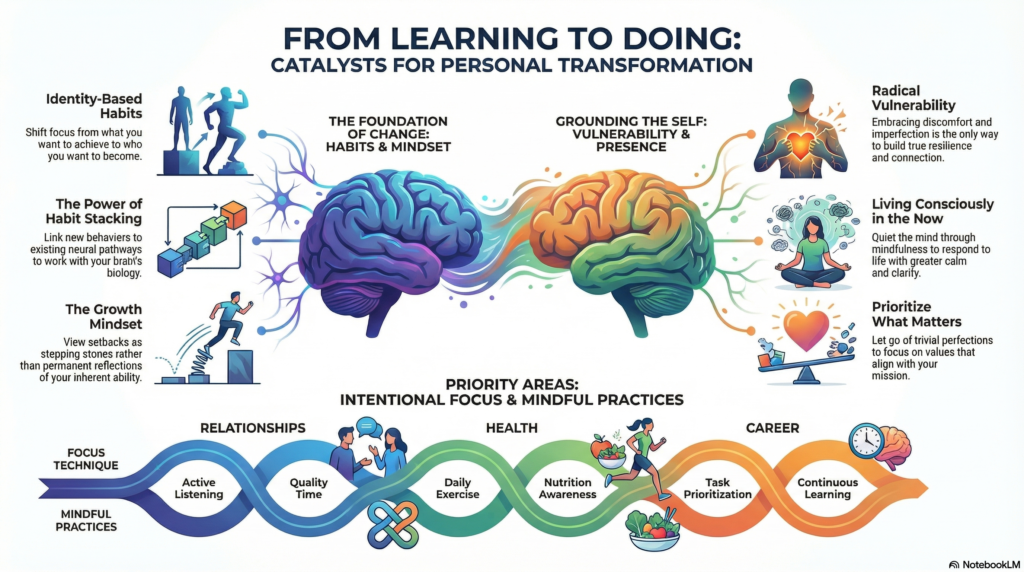
You’ll discover the concept of habit stacking, where you link a new habit to an existing one, making it easier to integrate positive changes into your routine. For instance, if you already enjoy your morning coffee, you might stack a new habit of journaling right after you finish your cup.
Clear emphasizes that true change begins with identity change. Instead of focusing solely on what you want to achieve, shift your mindset to who you want to become.
Ask yourself, “What would a healthy person do?” This simple shift can guide your actions toward your desired outcomes.
“The 7 Habits of Highly Effective People” by Stephen R. Covey
Personal Growth, also known as self-growth or personal development, is the method by which a person can improve for the better through the development of new behaviors, skills, habits, and attitudes. Through personal growth, one can create a positive impact on one’s career, emotional well-being, mindset, and life.
Releasing your potential starts with adopting the principles laid out in “The 7 Habits of Highly Effective People” by Stephen R. Covey. This book empowers you to cultivate a proactive mindset, encouraging you to take responsibility for your actions and choices.
By defining your personal mission, you align your daily activities with your core values, creating a foundation for personal leadership.
Covey’s synergy principles teach you the power of collaboration, showing how working with others can lead to win-win solutions that benefit everyone involved.
You’ll discover that effective time management is essential; prioritizing tasks based on importance rather than urgency allows for continuous improvement in all areas of your life.
As you implement these habits, you’ll notice a transformation in how you approach challenges. You’ll become more intentional, focused, and resilient.
Each step you take toward embodying these habits brings you closer to your goals, reminding you that personal growth is a journey.
Embrace this journey wholeheartedly, and watch how your life evolves as you apply these timeless principles.
Let Covey’s wisdom inspire you to take action and release your true potential!
“Mindset: The New Psychology of Success” by Carol S. Dweck
Personal development is a lifelong process. It is a way for people to assess their skills and qualities, consider their aims in life and set goals in order to realise and maximise their potential.
Cultivating a growth mindset can transform the way you approach challenges and opportunities, as Carol S. Dweck illustrates in her groundbreaking book. When you embrace the belief that your abilities can be developed through dedication and hard work, you open the door to resilience building. Instead of fearing failure, you’ll see it as a stepping stone on your journey to success.
Dweck emphasizes that adopting a growth mindset allows you to tackle obstacles with enthusiasm and persistence. You won’t shy away from difficult tasks; instead, you’ll lean into them, understanding that each effort contributes to your personal development. This shift in perspective empowers you to learn from criticism and setbacks, turning them into valuable lessons.
As you immerse yourself in “Mindset: The New Psychology of Success,” you’ll discover practical strategies to nurture this mindset. You’ll learn how to reframe your thoughts, embrace challenges, and celebrate your progress.
With each small victory, you’ll build the resilience needed to face life’s uncertainties. So, take that leap—embrace a growth mindset and watch how it propels you toward your dreams. You have the power to redefine what’s possible for yourself!
“Daring Greatly” by Brené Brown
When we dive into a book like Atomic Habits, we aren’t just looking for productivity hacks. We are looking for a way to lower the “extraneous load” on our brains. As someone who values the quiet of a morning yoga practice or a long hike, I know that big, sweeping changes rarely last. Neuroscience teaches us that our brains crave the efficiency of small, incremental adjustments. When you use techniques like “habit stacking,” you’re essentially hitchhiking a new behavior onto a neural pathway that is already strong and well-established. It’s a brilliant way to work with your biology instead of against it.
However, even the best habits won’t stick if we are operating from a “fixed” mindset. Carol Dweck’s work is essential here because it highlights how our internal narrative about failure can paralyze us. If you view a setback as a permanent reflection of your ability, your brain’s “threat” response will shut down your creative problem-solving.
In my writing for Self Care Engineer, I often talk about how emotional maturity involves sitting with that discomfort and reframing it as a “stepping stone” rather than a stop sign. It’s about building the resilience to be “imperfect” while we grow. Whether it’s through the mindfulness of The Power of Now or the radical vulnerability of Daring Greatly, the goal is to create a supportive internal environment where growth feels safe enough to happen.
In “Daring Greatly,” Brené Brown shows you the power of embracing vulnerability and courage as keys to living a fulfilling life.
By fostering genuine connections and overcoming your fear of failure, you release the potential for growth and authenticity.
It’s time to step into your greatness and transform how you engage with the world around you.
Embracing Vulnerability and Courage
Embracing vulnerability and courage can transform your life in ways you might never have imagined. Brené Brown’s insights encourage you to step outside your comfort zone and engage in vulnerability practices that foster growth. By opening up, you pave the way for genuine connections and courageous conversations.
Consider these key aspects as you initiate this journey:
- Authenticity: Being true to yourself invites others to do the same.
- Resilience: Embracing vulnerability strengthens your ability to bounce back from setbacks.
- Empathy: Sharing your struggles fosters understanding and compassion in your relationships.
- Growth: Stepping into discomfort is where real transformation happens.
When you choose to embrace vulnerability, you empower yourself to tackle challenges head-on. It’s not always easy, but each time you engage in courageous conversations, you build a stronger foundation for yourself and those around you.
Importance of Connection
How often do you pause to contemplate the true power of connection in your life? The relationships you build aren’t just social connections; they’re essential to your emotional well-being.
Brené Brown emphasizes that developing emotional intelligence is critical for fostering genuine connections. By practicing active listening and empathy development, you can deepen your relationships and create a supportive community around you.
Trust building is a cornerstone of any meaningful connection. Focus on enhancing your interpersonal skills to nurture these bonds.
When you engage with others authentically, you invite collaboration techniques that lead to shared growth and understanding. Networking strategies become more effective as you genuinely connect with those around you.
Overcoming Fear of Failure
Building strong connections lays the groundwork for tackling one of life’s biggest hurdles: the fear of failure.
Brené Brown’s “Daring Greatly” invites you to embrace vulnerability as a pathway to personal growth. It’s time to shift your mindset and transform limiting beliefs into stepping stones for success.
Consider these strategies for overcoming your fear of failure:
- Courage cultivation: Embrace the challenges that come your way and recognize them as opportunities to learn.
- Self-compassion: Treat yourself with kindness when things don’t go as planned. Acknowledge that failure is part of the journey.
- Risk assessment: Evaluate potential risks without letting them paralyze you. Focus on what you can control.
- Failure resilience: Build mental blocks that safeguard your confidence, encouraging you to bounce back stronger after setbacks.

“The Power of Now” by Eckhart Tolle
Diving into “The Power of Now” by Eckhart Tolle can transform your understanding of life and yourself. This book invites you to embrace the present moment, urging you to step away from the chaos of your thoughts and worries. By practicing mindfulness, you’ll discover how to quiet the mind and live fully in the now.
Tolle emphasizes that the present moment is where life truly unfolds. When you focus on the here and now, you’ll find clarity, peace, and a deeper connection to your true self. It’s not about ignoring your past or future; it’s about acknowledging them without letting them control your emotions.
Incorporating mindfulness practice into your daily routine can lead to profound changes. Start small—take a few minutes each day to breathe, observe your surroundings, and appreciate the present. As you cultivate this awareness, you’ll gain the ability to respond to life’s challenges with greater calm and resilience.
Ultimately, “The Power of Now” empowers you to take action by living consciously, reminding you that every moment holds the potential for growth and transformation. Embrace it; your journey begins now!
“You Are a Badass” by Jen Sincero
In “You Are a Badass,” Jen Sincero empowers you to recognize your inherent worth and potential, urging you to break free from self-doubt and embrace the life you truly desire.
Through her engaging and relatable style, she shares self-empowerment strategies that inspire you to take action and make meaningful changes.
Sincero offers practical applications to help you shift your mindset and elevate your life.
You’ll learn to:
- Identify and challenge limiting beliefs that hold you back.
- Cultivate self-love and confidence through daily affirmations.
- Set clear, actionable goals that align with your true passions.
- Surround yourself with supportive and positive influences.
“The Subtle Art of Not Giving a F*ck” by Mark Manson
In “The Subtle Art of Not Giving a F*ck,” Mark Manson challenges you to embrace life’s imperfections, self care activity and focus on what truly matters.
By letting go of the trivial, you can prioritize your values and lead a more fulfilling life.
It’s time to shift your perspective and start giving a f*ck about the right things!
Embracing Life’s Imperfections
Amidst life’s chaos and uncertainties, embracing imperfections becomes a powerful tool for personal growth. In “The Subtle Art of Not Giving a F*ck,” Mark Manson urges you to celebrate your flaws and recognize that everyone struggles.
By adopting self-acceptance practices, you can shift your mindset and start valuing authenticity over perfection. This shift isn’t just liberating; it empowers you to take meaningful action in your life.
Here are some key aspects of embracing life’s imperfections:
- Recognize your humanity: Remember, nobody’s perfect, and that’s okay.
- Celebrate your flaws: They contribute to your unique story and character.
- Let go of comparison: Focus on your journey instead of measuring against others.
- Practice gratitude: Appreciate your life as it is, imperfections and all.
Prioritizing What Matters Most
Embracing imperfections isn’t just about acceptance; it’s about making space for what truly matters in your life. When you prioritize what’s essential, you’ll find that time management becomes more effective, and goal setting feels more achievable. By practicing self-reflection, you’ll uncover your personal values, self care and learn to make intentional choices that align with them.
Consider this table as a guide to help you clarify your priorities:
| Priority Area | Focus Techniques | Mindful Living Practices |
| Relationships | Active Listening | Quality Time |
| Health | Daily Exercise Routine | Nutrition Awareness |
| Career | Task Prioritization | Continuous Learning |
| Personal Growth | Journaling | Meditation |
| Community Impact | Volunteer Work | Compassion Practices |

RELATED STUDIES ABOUT PERSONAL DEVELOPMENT
As you journey through these transformative books, imagine standing at the edge of a vast ocean, each wave a new opportunity to embrace change. These authors, like skilled navigators, guide you toward your true potential. With every page you turn, you’re not just reading; you’re planting seeds of action in the fertile ground of your mind. So, plunge in, ignite your passion, and let your personal growth unfold like a vibrant sunrise breaking through the darkness.
Growing Up in Transit: Personal Development and Resistance of Migrant Adolescents Traveling Through Mexico Unaccompanied
This study explores how unaccompanied migrant adolescents from Guatemala, Honduras, and El Salvador experience personal development, identity formation, and resilience while transiting through Mexico. It examines the challenges they face, including violence, exploitation, and lack of access to basic services, and highlights the ways in which they cope, resist, and envision their futures despite these adversities.
Methodology:
- 47 semi-structured interviews conducted in two migrant shelters in Mexico City and Guadalajara in 2021.
- Participants included 18 unaccompanied migrant adolescents (aged 14–19) and 29 professionals working in migration services (social workers, psychologists, child protection officers, etc.).
- Data analyzed using thematic analysis, focusing on identity, resilience, and structural challenges.
Key Findings:
- Migration as a Violent and Unstable Process:
- Migrant adolescents flee extreme violence, gang threats, poverty, and family abuse.
- Many experience gender-based violence, forced recruitment by gangs, and dangerous journeys (e.g., traveling on “La Bestia” cargo train).
- Long waiting times for asylum or family reunification create a sense of limbo and uncertainty.
- Identity Development is Restricted by Migration Context:
- The loss of stability and family separation makes identity formation difficult.
- Many adolescents prioritize sending remittances over personal growth, limiting their ability to dream beyond survival.
- However, some youth with legal status or support networks develop personal goals and aspirations (e.g., education, professional careers).
- Resilience and Resistance Strategies:
- Migrants use cultural narratives (e.g., faith, perseverance, and “salir adelante” – moving forward) to maintain hope.
- Peer support (friends made during migration) provides emotional strength and survival strategies.
- Some youth resist discrimination and exploitation, asserting their agency and self-worth despite systemic barriers.
- Structural Barriers and Discriminatory Migration Policies:
- Migration policies in Mexico and the U.S. prioritize containment and criminalization over protection.
- Lack of access to health, education, and work opportunities further marginalizes migrant youth.
- Professionals emphasize the need for better funding, legal protections, and integration programs for migrant adolescents.
Conclusions & Implications:
- Migration policies must recognize unaccompanied minors as individuals with agency and rights, rather than passive victims.
- Providing education, legal status, and stable environments can help migrant youth build a future beyond survival.
- Peer support networks and resilience mechanisms are critical and should be integrated into migrant aid programs.
- Addressing systemic discrimination and restrictive migration policies is essential to ensuring the well-being and development of migrant youth.
This study challenges the narrative that migration is only traumatic—it shows that, despite extreme hardships, migrant adolescents resist, grow, and envision futures for themselves when given opportunities and support.
| Reference: Susanna Corona Maioli, Delan Devakumar, Shoshana Berenzon Gorn, Rochelle A. Burgess, Growing up in transit. Personal development and resistance of migrant adolescents travelling through Mexico unaccompanied, Journal of Migration and Health, Volume 10, 2024, 100245, ISSN 2666-6235, https://doi.org/10.1016/j.jmh.2024.100245. (https://www.sciencedirect.com/science/article/pii/S2666623524000345) |
Discontinuity in Continuum: Transitions in Medical Education as a Milieu for Personal Development
This study explores key transition periods in medical education, such as moving from college to medical school and from pre-clinical to clinical training, as opportunities for personal and professional development. The authors argue that structured support during these transitions can enhance student success, reduce stress, and foster essential soft skills.
Key Concepts & Theoretical Framework:
- Cognitive Load Theory: Learning is affected by three types of cognitive load:
- Intrinsic Load (task complexity)
- Germane Load (meaningful learning processes)
- Extraneous Load (external factors that create unnecessary burden)
- Transition Model in Medical Education:
- Task readiness can reduce intrinsic load.
- Personal characteristics influence germane load (e.g., adaptability, resilience).
- Contextual factors (organizational support, mentoring) can ease extraneous load.
Key Findings & Recommendations:
- Soft Skills Are Crucial for Managing Transitions
- Soft skills like time management, stress management, critical thinking, and interpersonal relationships should be integrated into medical education.
- Training in patient communication, delivering bad news, professionalism, and empathy should be emphasized during the transition to clinical training.
- Interventions Should Target Multiple Levels
- Task-based training (e.g., early clinical exposure) can reduce stress and enhance preparedness.
- Mentorship and peer support can provide emotional and academic guidance.
- Institutional changes (e.g., structured transition programs) can reduce unnecessary burdens.
- Transitions Should Be Seen as Developmental Opportunities
- Instead of viewing transitions as stressful challenges, medical education should reframe them as opportunities for growth.
- Structured personal development programs before each major transition can help students build resilience and improve performance.
Conclusions & Implications:
- Medical schools should incorporate personal development programs focused on soft skills to help students navigate transitions successfully.
- Early preparation for clinical responsibilities can reduce the learning burden and improve patient care experiences.
- Future research should explore long-term impacts of structured transition programs on medical student well-being and performance.
| Reference: Mehran Ilaghi, Adel Soltanizadeh, Mahla Salajegheh, Discontinuity in continuum: Transitions in medical education as a milieu for personal development, Journal of Taibah University Medical Sciences, Volume 18, Issue 5, 2023, Pages 1087-1088, ISSN 1658-3612, https://doi.org/10.1016/j.jtumed.2023.03.007. (https://www.sciencedirect.com/science/article/pii/S1658361223000446) |
Professional and Personal Undergraduates’ Development in the Educational Process from the Perspective of Competency-Based Approach
This study examines the professional and personal development of undergraduate students through the competency-based approach (CBA) in higher education. It explores the role of moral development in shaping personal growth and its link to students’ academic performance and future professional success.
Methodology:
- Focus: Relationship between students’ professional skills, academic performance, and moral development.
- Participants: Undergraduate students at Astrakhan State University, Russia.
- Data Collection Methods:
- Observation and interviews with students.
- Analysis of academic records and practical task performance.
- Application of the “Friend-Adviser-2” moral choice test to assess moral development.
- Statistical analysis using Pearson’s correlation coefficient.
Key Findings:
- Competency-Based Education Enhances Professional Skills
- The Russian education system has adopted competency-based learning, leading to better professional skill acquisition.
- General cultural competencies (e.g., teamwork, communication, decision-making) support both personal and professional growth.
- Moral Development and Academic Performance Are Linked but Not Linearly
- Students with high moral development generally had strong professional skills.
- However, students with excellent academic performance (top grades) showed high variability in moral development, suggesting some prioritize competition over ethical considerations.
- Students with Balanced Personal and Professional Growth Were the Most Successful
- Those with both good academic results and strong moral development (upper-intermediate level) were the most well-rounded and successful in both personal and professional aspects.
- Students with mean performance had lower moral development, indicating a weaker sense of responsibility and discipline.
- Education Standards Lack Emphasis on Moral Development
- Current Russian federal education standards focus on technical skills but do not include clear requirements for moral and ethical development.
- Professors play a key role in fostering students’ moral and personal growth, but efforts are inconsistent.
Conclusions & Recommendations:
- Moral development should be integrated into higher education curricula, alongside professional competencies.
- Personal development training (e.g., self-discipline, ethical decision-making) should be included in undergraduate education.
- Universities should balance professional and personal development goals to ensure students become both competent specialists and responsible citizens.
- Further research is needed to refine educational strategies that bridge the gap between academic success and ethical maturity.
This study highlights that true professional success is not just about skills but also about ethical and personal integrity.
| Reference: Svetlana Agafonova, Natalia Bryukhova, Boris Kaigorodov, Professional and Personal Undergraduates’ Development in the Educational Process from the Perspective of Competency-Based Approach, Procedia – Social and Behavioral Sciences, Volume 214, 2015, Pages 479-486, ISSN 1877-0428, https://doi.org/10.1016/j.sbspro.2015.11.732. (https://www.sciencedirect.com/science/article/pii/S1877042815060875) |
CONCLUSION
As we wrap up this exploration, I want to remind you that personal growth is a lifelong process, not a destination we “reach” and then leave. It is very much like the plant-based cooking I enjoy experimenting with. It requires patience, the right ingredients, and an acceptance that things might get messy before they come together. The authors we’ve discussed are skilled navigators, but you are the one holding the compass. The “seeds of action” you plant today through these insights only grow if they are nurtured by consistent, daily choices that align with your core values.
In my experience, the most profound changes happen when we stop trying to “fix” ourselves and start trusting ourselves. Growth should feel grounded and personal. It’s not about performing for an audience or meeting a standard of perfection; it’s about the quiet satisfaction of realizing you are no longer the person you were a year ago.
Take these practical strategies whether it’s the time management principles from Covey or the self-empowerment from Sincero and adapt them to your own life’s rhythm. Remember that every moment you choose to live consciously and take action, you are redefining what is possible for yourself. Your journey doesn’t start when you finish the last page of a book; it begins the moment you decide to apply that first small insight to your real, human life.