
Living in the middle of a relentless urban rhythm, I see people treating their nervous systems like engines that can run at maximum speed without an oil change. In my years of facilitating mindfulness sessions and working with private yoga clients, the most common complaint I hear isn’t that people lack energy—it’s that they have lost the internal brake pedal. We live under constant cognitive friction: deadlines, notifications, and continuous sensory overload keep our sympathetic branch firing on all cylinders.
Many of us have internalized this state of hyper-vigilance so thoroughly that genuine stillness feels almost foreign, or even counter-intuitive.When I teach students about parasympathetic nervous system (PNS) activation, I always emphasize that relaxation is not a passive luxury or an indulgence you earn after completing a to-do list; it is a foundational, biological necessity.
Learning to intentionally trigger your “rest-and-digest” response is about re-establishing physiological safety in your own body. Whether through extended exhales, mindful pauses between tasks, or simple bodily stillness, tapping into the PNS gives your mind the spaciousness it needs to recover. It transforms your daily life from a frantic sprint into a sustainable, grounded rhythm.
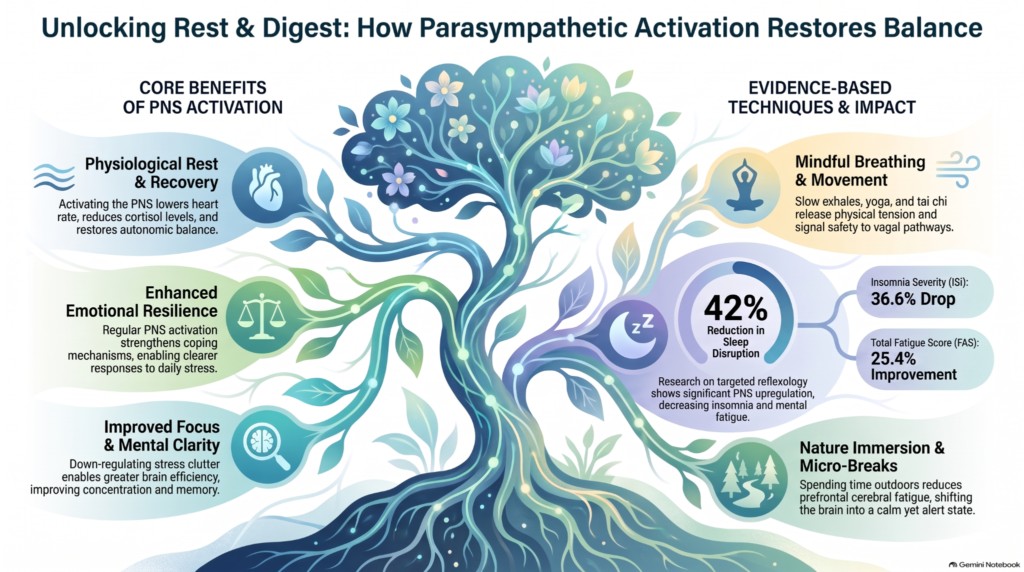
Activating your parasympathetic nervous system (PNS) is essential for boosting your mental and emotional wellness. When you engage in techniques like mindful breathing or gentle movement, you lower your stress levels and enhance your resilience. This process reduces anxiety and improves your emotional balance, allowing you to handle life’s challenges with clarity. By embracing practices that support your PNS, you can cultivate a more fulfilling and harmonious existence. Discover how to integrate these techniques into your daily life for better stability.
KEY TAKEAWAYS
- Activation of the PNS promotes relaxation, reducing anxiety and lowering cortisol levels for improved mental wellness.
- Engaging in mindful breathing and gentle movement enhances emotional resilience by fostering a sense of calm and balance.
- Nature immersion activates the PNS, contributing to emotional stability and a sense of belonging.
- Consistent PNS activation through daily practices strengthens coping mechanisms, enabling clearer responses to stress.
- Prioritizing relaxation and healthy habits supports overall well-being, enhancing mental and emotional health.
UNDERSTANDING THE PARASYMPATHETIC NERVOUS SYSTEM AND ITS ROLE
Your parasympathetic nervous system is a network of nerves that relaxes your body after periods of stress or danger. It also helps run life-sustaining processes, like digestion, during times when you feel safe and relaxed. The informal descriptions for this system include the rhymes “rest and digest” or “feed and breed.”
When you consider the complexities of your body’s response to stress, it’s essential to understand the role of the parasympathetic nervous system (PNS). The PNS is vital for maintaining autonomic balance, counteracting the fight-or-flight response triggered by stress. This system governs your nervous function, promoting relaxation and recovery after stressful events.
By activating the PNS, your body can lower heart rate, enhance digestion, and encourage a state of calmness. Understanding how the PNS operates can empower you to reclaim your sense of freedom and well-being.
It’s a reminder that you hold the key to your body’s responses. Rather than being at the mercy of stress, you can foster resilience and emotional stability. Embracing the PNS’s role allows you to navigate life’s challenges with greater ease, promoting a more balanced, harmonious existence.
This insight can inspire you to prioritize practices that enhance your parasympathetic function.
Effective Techniques to Activate Your Parasympathetic Nervous System for Stress Relief
To effectively manage stress and enhance your well-being, you can utilize several techniques that activate your parasympathetic nervous system (PNS). One powerful method is mindful breathing. By focusing on your breath, inhaling deeply through your nose and exhaling slowly through your mouth, you signal your body to relax. Research shows that this practice lowers heart rate and promotes a state of calmness.
Incorporating gentle movement, such as yoga or tai chi, can also stimulate your PNS. These activities encourage body awareness and help release physical tension, fostering emotional balance.
As you move, pay attention to how your body feels, allowing each motion to become a meditative experience.
How Activating Your PNS Helps You Relax and Manage Stress?
The parasympathetic nervous system controls the body’s ability to relax. It’s sometimes called the “rest and digest” state. It helps maintain daily functions like your resting heart rate, which is your heart rate while your body is at rest; your metabolism; and your resting bronchial constriction, which affects your breathing rate. It essentially keeps you in a relaxed state.
Activating your parasympathetic nervous system (PNS) offers powerful techniques that can greatly enhance your ability to relax and manage stress.
By engaging in practices like deep breathing or mindfulness, you tap into a state of calm that counters the effects of stress.
This not only promotes physical relaxation but also fosters mental clarity, allowing you to navigate challenges with greater ease.
PNS Activation Techniques
The PSNS helps your body relax and maintains some of your body’s functions, like digestion, heart rate, and breathing. It’s a network of small neurons and large nerves that run throughout your body and regulate these processes.
Many people underestimate the power of the parasympathetic nervous system (PNS) in promoting relaxation and reducing stress. To activate your PNS, try incorporating breathing exercises into your routine.
Mindful meditation and progressive relaxation techniques can also help ground you. Engaging in yoga practices and tai chi fosters a deep sense of calm, while nature walks connect you with the restorative power of the outdoors.
Visualization techniques can aid in creating mental tranquility, and sound therapy can enhance your relaxation experience. Don’t forget the aromatherapy benefits—essential oils can soothe your senses.
Finally, gratitude journaling can shift your mindset, reinforcing positive emotions. By integrating these techniques, you empower yourself to manage stress effectively and embrace a more relaxed lifestyle.
Benefits of Relaxation
Understanding the benefits of relaxation underscores the significance of the parasympathetic nervous system (PNS) in managing stress. When you activate your PNS through techniques like mindful breathing and nature immersion, you create a physiological shift that fosters tranquility.
This activation reduces cortisol levels, helping you counteract anxiety and enhance emotional resilience. Understanding the neuroscience of relaxation helps explain how activating the parasympathetic nervous system can reduce stress, promote calmness, and support emotional well-being. Engaging in mindful breathing calms your mind, allowing you to reconnect with your inner self, while immersion in nature promotes a sense of belonging and peace.
These practices not only support mental wellness but also empower you to navigate life’s challenges more effectively. By prioritizing relaxation, you reclaim your freedom from stress, paving the way for a more balanced, fulfilling life.
Embrace these benefits, and experience the profound impact on your well-being.
THE LINK BETWEEN PNS ACTIVITY AND EMOTIONAL RESILIENCE
In our community workshops on mindful breathing and progressive muscle relaxation, I frequently see people run into a frustrating hurdle: they try to force relaxation with sheer willpower. A student will lie down, attempt a measured breathing ratio, and immediately find their mind racing with internal commentary: “Is my heart rate dropping yet? Why am I not calm?” That very struggle keeps the sympathetic nervous system on high alert. I always remind them that our nervous systems don’t respond to intellectual demands or perfectionist expectations; they respond to sensory cues of safety.
When you practice shifting into parasympathetic dominance, the real breakthrough occurs when you drop the need to control the outcome. In my own daily routine, whether I’m holding a restorative yoga pose, tuning my guitar in quiet awareness, or consciously releasing muscular tension from my shoulders, the goal is not to eliminate thoughts. It is about letting the body lead the mind.
By using tactile and somatosensory tools—such as slow diaphragmatic breathing, unhurried physical stretches, and progressive releases—you signal to your vagal pathways that the perceived emergency has passed. Over time, this builds authentic emotional resilience, so when life delivers unavoidable pressure, your body remembers the physical path home to baseline calm.
When you engage the parasympathetic nervous system (PNS), you not only reduce stress but also enhance your emotional balance.
This activation strengthens your coping mechanisms, allowing you to navigate challenges with greater resilience.
Understanding this connection can empower you to cultivate a more stable emotional landscape.
PNS and Stress Reduction
As stressors in daily life accumulate, activating your parasympathetic nervous system (PNS) becomes essential for maintaining emotional resilience.
Engaging in effective stress management strategies allows you to tap into this calming system, promoting relaxation and reducing anxiety. Techniques like deep breathing, progressive muscle relaxation, and mindfulness meditation can greatly enhance PNS activity, helping you regain a sense of control.
Research shows that these relaxation techniques not only lower cortisol levels but also foster a greater capacity to cope with challenges. By prioritizing PNS activation, you create a foundation for emotional strength, enabling you to respond to stressors with clarity and composure.
Embracing these practices empowers you to navigate life’s ups and downs with a renewed sense of freedom and balance.
Emotional Balance Enhancement
Emotional balance hinges on the intricate interplay between your parasympathetic nervous system (PNS) and resilience.
By activating the PNS, you enhance your emotional stability and improve mood regulation. These benefits can also help you manage daily stress more effectively, making it easier to stay calm and maintain emotional balance during challenging situations. Here’s how this connection strengthens your emotional well-being:
- Stress Reduction: The PNS counters stress responses, helping you maintain calm during challenging situations.
- Improved Mood Regulation: Enhanced PNS activity supports neurotransmitter balance, promoting a more stable emotional state.
- Increased Resilience: A well-functioning PNS equips you with the tools to bounce back from emotional setbacks.
Coping Mechanism Strengthening
Understanding the relationship between parasympathetic nervous system (PNS) activity and your coping mechanisms can greatly enhance your emotional resilience.
When you engage in practices like mindful breathing and guided imagery, you stimulate your PNS, which promotes relaxation and reduces stress. This physiological response helps you manage difficult emotions more effectively.
Research shows that regular activation of the PNS can lead to improved emotional regulation, allowing you to respond to challenges with greater clarity and calmness.
By incorporating these techniques into your daily routine, you strengthen your ability to cope with life’s ups and downs.
Ultimately, fostering this connection empowers you to navigate emotional turbulence with confidence, enhancing your overall sense of freedom and well-being.
Benefits of PNS Relaxation for Mental Clarity and Focus
When you engage the parasympathetic nervous system (PNS), you’re not just promoting relaxation; you’re also enhancing your mental clarity and focus.
This calming state allows your mind to operate more efficiently, enabling you to tackle challenges with precision.
Here are three key benefits of PNS relaxation for your cognitive abilities:
- Improved Concentration: By reducing stress, your brain becomes less cluttered, allowing you to focus on tasks without distraction.
- Enhanced Memory Recall: A relaxed mind can better access stored information, making it easier to retrieve what you need when you need it.
- Creative Problem-Solving: With a tranquil state of mind, you’re more open to innovative ideas and solutions, fostering creativity.
How Your Daily Choices Affect the Parasympathetic Nervous System
Your daily choices play an essential role in shaping the health of your parasympathetic nervous system (PNS), influencing how effectively you can relax and rejuvenate.
Lifestyle choices like mindful eating can enhance your body’s ability to digest and absorb nutrients, directly impacting your PNS function. Incorporating regular physical activity helps reduce stress and promotes the release of endorphins, further supporting your nervous system.
Prioritizing sleep hygiene guarantees your body recovers, allowing your PNS to thrive. Effective stress management techniques, such as breathing exercises, can help you shift from a state of tension to relaxation.
Additionally, developing healthy hydration habits keeps your body functioning at its best, while exposure to nature can ground you, fostering peace.
Each choice you make contributes to a balanced PNS, enhancing your overall mental and emotional wellness. Embracing these practices empowers you to cultivate a life that supports your freedom and well-being.
Incorporating PNS Practices Into Your Daily Routine for Wellness
Integrating practices that support your parasympathetic nervous system (PNS) into your daily routine can greatly enhance your overall wellness.
By incorporating simple yet effective techniques, you can cultivate a sense of calm and balance in your life. Adding a simple self care activity, such as mindful breathing, taking a nature walk, or practicing progressive relaxation, to your daily routine can help reduce stress and support your mental and emotional wellness. Here are three practices to contemplate:
- Mindful Breathing: Spend a few minutes each day focusing on your breath. Inhale deeply through your nose, hold for a moment, and exhale slowly through your mouth. This practice reduces stress and promotes relaxation.
- Progressive Relaxation: Before bed, systematically tense and then relax each muscle group. Start from your toes and work your way up to your head. This technique can considerably alleviate tension and help you unwind.
- Nature Walks: Take regular walks in nature. Immersing yourself in natural surroundings not only calms your mind but also activates your PNS, enhancing your emotional resilience.
Embrace these practices and experience the freedom they bring to your mental wellness.
RELATED STUDIES ABOUT PARASYMPATHETIC NERVOUS SYSTEM RELAXATION
As you embrace the soothing waves of your parasympathetic nervous system, picture a serene forest, where each breath calms your racing thoughts. By weaving PNS practices into your daily life, you’re not just reducing stress; you’re nurturing your emotional resilience and mental clarity. Imagine the clarity of a still pond, reflecting your innermost thoughts without distortion. By prioritizing this relaxation, you cultivate a sanctuary within, fostering well-being that radiates into every facet of your life.
Effects of a programmed reflexology therapy on sleep quality, insomnia, and fatigue among individuals with poor sleep quality: evidence for autonomic nervous system modulation
This randomized crossover trial evaluates the comparative efficacy and physiological mechanisms of manual reflexology treatment (MRT) versus foot massage equipment (FEM) in modulating autonomic nervous system (ANS) activity, sleep architecture, insomnia severity, and fatigue among adults suffering from poor sleep quality.
Study Overview & Methodology:
- Research Objective & Clinical Rationale: Chronic sleep disturbance is closely linked to autonomic dysregulation, characterized by sustained sympathetic hyperarousal and reduced parasympathetic vagal tone. This study investigated whether a standardized, programmed foot reflexology protocol could improve subjective sleep metrics while providing objective electrophysiological evidence of ANS modulation, using an active mechanical comparator.
- Experimental Design: A randomized crossover trial with two 6-week intervention phases separated by a 3- to 4-week washout period to prevent carryover effects. Each participant received both interventions once weekly (30–40 minutes per session, containing approximately 32 minutes of active foot stimulation) and served as their own control.
- Participant Cohort: Enrolled 32 community-dwelling adults aged 40 to 80 years (mean age = 63.0 ± 8.9 years; 90.6% female; 71.8% retired or homemakers; 90.6% with tertiary education or higher). Inclusion required moderate-to-severe baseline sleep disruption, defined by a Pittsburgh Sleep Quality Index (PSQI) score greater than 10 (substantially above the conventional poor sleep cutoff of >5). Compliance was 100%, with no intervention-related adverse events.
- Intervention Protocols:
- Manual Reflexology Treatment (MRT): Administered by a certified therapist adhering to the Template for Intervention Description and Replication (TIDieR) checklist. It followed a standardized sequence: preparation/draping, initial relaxation (friction/oscillation), systematic five-technique reflex zone stimulation (pressing, kneading, pushing, scraping, acupressure) across toe, medial, dorsal, lateral, and plantar foot zones, focused sleep-support zones (brain, pituitary, frontal sinus, thyroid, solar plexus, kidneys, bladder), and terminal soothing relaxation.
- Foot Massage Equipment (FEM): Delivered via an electric commercial device (Model HY-703, HUEI YEH) operating in a 30-minute preset “fatigue relief mode” with medium-intensity pressure, mild heat, and automated mechanical rolling, squeezing, and vibration targeting plantar, medial, lateral, dorsal, and calf areas.
- Outcome Measures:
- Autonomic & Hemodynamic Biomarkers: Heart rate (HR), systolic/diastolic blood pressure (SBP/DBP), time-domain heart rate variability (SDNN, RMSSD, pNN50), and frequency-domain HRV (low-frequency [LF], high-frequency [HF], and LF/HF ratio) measured via the TFDA-approved ANSwatch-Wireless medical device at baseline and post-session during Weeks 1 and 6.
- Subjective Questionnaires: Administered pre- and post-intervention, assessing sleep quality across seven subdomains via the PSQI, insomnia symptoms via the Insomnia Severity Index (ISI), and physical/mental fatigue via the Fatigue Assessment Scale (FAS).
Subjective Sleep, Insomnia, & Fatigue Outcomes:
- Superior Sleep Quality Restoration: Manual reflexology induced an approximately 42% reduction in global PSQI scores (decreasing from 14.67 ± 3.1 to 8.5 ± 2.6, p < 0.05), alongside statistically significant within-condition improvements across all seven individual PSQI components. In between-condition comparisons, MRT was significantly superior to FEM in reducing global PSQI and specific subscales including subjective sleep quality, sleep latency, sleep duration, sleep efficiency, and daytime dysfunction. In contrast, FEM produced minor, non-significant shifts in global PSQI (13.23 ± 2.6 to 12.6 ± 1.5).
- Insomnia Severity Reduction: Baseline ISI scores reflected moderate clinical insomnia severity in both arms (>15). Following MRT, ISI scores decreased significantly by 36.6% (reaching subthreshold levels), demonstrating significantly greater efficacy than FEM at post-test (p < 0.05).
- Multidimensional Fatigue Relief: MRT produced a 25.4% drop in total FAS fatigue scores (26.72 ± 8.3 to 19.94 ± 3.6, p < 0.05), significantly outperforming FEM. Furthermore, while FEM only alleviated physical fatigue (15.38 to 12.46), MRT significantly reduced both physical fatigue (15.11 to 10.94) and mental fatigue subscores (11.61 to 9.00).
Autonomic Nervous System & Hemodynamic Modulation:
- Immediate Vagal Activation: From the initial session (Week 1), MRT prompted an acute reduction in resting heart rate (79.0 to 73.4 bpm) and sharp increases in cardiac vagal time-domain indices: SDNN increased from 32.3 to 48.1 ms, RMSSD from 26.6 to 41.6 ms, and pNN50 from 7.3% to 17.3% (all within-group ps < 0.05). The magnitude of HR reduction and SDNN elevation was significantly greater in MRT than in FEM.
- Spectral Shift Toward Parasympathetic Dominance: By Week 6, frequency-domain analysis revealed that MRT induced a significant reduction in LF power (56.2% to 52.8%) and a marked increase in HF power (33.8% to 47.2%), driving a significant decrease in the LF/HF ratio from 2.0 to 1.1 (p < 0.05). This shift confirms an alleviation of sympathetic dominance and robust upregulation of parasympathetic activity. FEM exhibited no significant frequency-domain shifts.
- Sustained Cumulative Neuroplastic Modulation: Baseline pre-session values measured prior to Week 6 were significantly higher than Week 1 pre-session baselines for SDNN (39.3 vs. 32.3 ms), RMSSD (37.2 vs. 26.6 ms), and pNN50 (17.3% vs. 7.3%). This establishes that weekly manual reflexology produces durable, cumulative autonomic adaptations rather than isolated, transient post-massage relaxation. Blood pressure remained normotensive throughout without adverse hypotensive episodes.
Clinical, Practical, & Methodological Implications:
- Active Human Touch vs. Mechanical Stimulation: The clear superiority of MRT over FEM indicates that generic mechanical vibration and compression are insufficient to alter central autonomic balance or alleviate mental fatigue. Targeted stimulation of specific somatosensory reflex zones coupled with dynamic, responsive human touch is essential for therapeutic engagement of vagal afferent pathways.
- Evidence-Based Non-Pharmacological Sleep Care: Programmed reflexology serves as an effective, non-invasive complementary therapy for middle-aged and older adults experiencing chronic sleep disturbances, offering a viable adjunct or alternative for individuals seeking to reduce dependence on sedative-hypnotic medications.
- Methodological Standardization: By implementing and documenting the protocol via the TIDieR framework, the authors resolve historical issues of poor intervention reproducibility in complementary medicine, providing a replicable clinical blueprint for hospitals, nursing homes, and integrative wellness centers.
- Limitations: The cohort was predominantly female (90.6%) and community-recruited, requiring validation in broader male cohorts and specialized clinical populations (e.g., diagnosed psychiatric insomnia, sleep apnea). Furthermore, sleep quality was captured using validated self-report indices rather than objective overnight polysomnography or actigraphy.
| REFERENCE: Shih-Pei Chen, Ming-Han Gao, Chun-Ching Huang, Wen-Ching Huang, Effects of a programmed reflexology therapy on sleep quality, insomnia, and fatigue among individuals with poor sleep quality: evidence for autonomic nervous system modulation, Complementary Therapies in Medicine, Volume 101, 2026, 103409, ISSN 0965-2299, https://doi.org/10.1016/j.ctim.2026.103409. (https://www.sciencedirect.com/science/article/pii/S0965229926000920) |
The role of the choroidal nervous system in central serous chorioretinopathy and associated diseases
This state-of-the-art review examines the functional and structural neurobiology of the choroidal nervous system, proposing that peripheral choroidal autonomic nervous system (ANS) dysregulation represents the unifying pathogenic driver linking pachychoroid remodeling, choroidal venous overload, neurogenic inflammation, and retinal pigment epithelium (RPE) decompensation in central serous chorioretinopathy (CSCR).
Study Overview & Conceptual Framework:
- Current Etiological Impasse: CSCR is traditionally defined as a component of the pachychoroid spectrum characterized by thickened choroid, hyperpermeability, dilated vortex veins (pachydrusen/pachyvessels), and serous retinal detachments. While mechanical hypotheses (e.g., rigid thick sclera, vortex vein outflow congestion, short axial length) and systemic triggers (psychological stress, exogenous glucocorticoids, hypertension, sleep apnea) are well documented, a unifying mechanistic link has remained elusive.
- The Proposed Neural Paradigm: The authors formulate a comprehensive neurovascular framework establishing that the choroid is not a passive vascular sponge, but an intensively innervated, neuro-immunologically regulated vascular bed. Primary or secondary choroidal neuropathy and autonomic baroregulatory failure directly cause venous engorgement, non-vascular smooth muscle dysfunction, neurogenic mast cell degranulation, and outer retinal breakdown.
Anatomy & Neurovascular Architecture of the Choroid:
- Vascular Hierarchy: Supplied by short posterior ciliary arteries (SPCAs, forming end-arterial segments without extensive collateral overlap) and long posterior ciliary arteries (LPCAs). The fenestrated choriocapillaris abuts Bruch’s membrane, which drains via collecting venules in Sattler’s layer into large vortex veins within Haller’s layer. Unlike retinal capillaries, choriocapillaris pericyte coverage is sparse, rendering vascular integrity heavily dependent on perivascular neural inputs.
- Arterial Pathway of Innervation: Challenging the historical dogma that ciliary nerves provide primary choroidal branches, modern anatomical tracings demonstrate that ciliary nerves pass through the suprachoroidal space with minimal branching (0% to 13% reduction in fibers). Instead, the dominant choroidal innervation travels directly along the adventitia of posterior ciliary arteries, branching inward alongside arterioles and veins.
- Autonomic & Sensory Triple-Innervation:
- Sympathetic Influx: Originates in the intermediolateral column of the thoracic cord, synapses in the superior cervical ganglion (SCG), and releases norepinephrine (NE) and neuropeptide Y (NPY) to drive alpha-adrenergic vasoconstriction.
- Parasympathetic Influx: Primarily originates from the superior salivatory nucleus (SSN) via the pterygopalatine ganglion (PPG), releasing acetylcholine (ACh), vasoactive intestinal peptide (VIP), and neuronal nitric oxide (NO) to mediate active vasodilation.
- Sensory Afferents: Trigeminal ganglion (ophthalmic V1 branch) fibers rich in calcitonin gene-related peptide (CGRP) and substance P (SP) closely appose choroidal vessels, macrophages, and mast cells.
- Intrinsic Choroidal Neurons (ICNs): Multiplexed local ganglion cells situated predominantly in the temporal subfoveal choroid and near vortex vein ampullae. ICNs co-express both autonomic (nNOS, VIP, NPY) and sensory (CGRP, SP) markers, express melanopsin (OPN4), and regulate non-vascular smooth muscle cells (NVSMCs) to modulate choroidal thickness and foveal blood flow autonomously.
Physiological Autoregulation & Experimental Neuropathology:
- Active Neural Baroregulation: Unlike retinal circulation (which relies on local myogenic autoregulation), choroidal blood flow (ChBF) is actively regulated by opposing autonomic reflexes. Under systemic hypotension, parasympathetic nitrergic signaling drives compensatory vasodilation. Under systemic hypertension, sympathetic vasoconstriction acts as a crucial protective brake against overperfusion.
- Consequences of Sympathetic Denervation: Experimental ablation of sympathetic tone (superior cervical ganglionectomy or carotid denervation in animals) leads to choroidal thickening, severe venous dilation, upregulation of VEGF/VEGFR-2, inflammatory microglial infiltration, loss of photoreceptors, and an elevated choroidal vascularity index (CVI)—precisely recapitulating the human pachychoroid phenotype.
- The Glucocorticoid–Mineralocorticoid Paradox: While glucocorticoids are traditionally thought of as anti-inflammatory mast cell stabilizers, systemic extraocular glucocorticoid exposure suppresses the central hypothalamic-pituitary-adrenal (HPA) axis, altering ocular corticoid ratios and driving excessive mineralocorticoid receptor (MR) pathway activation in the RPE-choroid.
- Animal Models of MR Neuropathy: Transgenic mice and rats overexpressing human MR (P1.hMR) and aldosterone-salt-treated rodents develop severe choroidal neuropathy—exhibiting ciliary nerve myelin disorganization, mitochondrial swelling, nerve vacuolization, mast cell activation, and choriocapillaris effacement.
- Neurogenic Inflammation & Retinal Detachment: Acute mast cell degranulation (triggered by sensory neuropeptides like CGRP during neurogenic stress) represents the sole animal model capable of producing rapid RPE barrier breakdown and acute serous subretinal fluid accumulation, providing a mechanistic link to migraine and allergic diatheses in CSCR.
Clinical Evidence of Local and Systemic Dysautonomia in CSCR:
- Local Ocular Autonomic Dysfunction:
- Pupillometry: Demonstrates blunted light-reflex constriction amplitude and accelerated redilation, reflecting reduced parasympathetic tone and elevated sympathetic outflow.
- Blunted Autonomic Reactivity: Dynamic stress testing (isometric handgrip test) demonstrates that while healthy subjects constrict choroidal vessels to stabilize perfusion, CSCR patients display paradoxical choriocapillaris hyperperfusion and failure to reduce CVI under elevated mean ocular perfusion pressure (MOPP).
- Corneal Confocal Neuropathy: In vivo corneal confocal microscopy (IVCM) reveals that 93% of chronic CSCR patients possess subbasal corneal nerve abnormalities (microneuromas, fiber tortuosity, and nerve rarefaction), serving as an accessible surrogate biomarker of shared ciliary nerve neurodegeneration.
- Systemic Dysautonomia Biomarkers:
- Heart Rate Variability (HRV): Consistently shows an elevated LF/HF ratio, indicating sympathetic dominance and blunted vagal reactivity that persists into disease remission as a trait-level phenotype.
- Blood Pressure Instability: 24-hour ambulatory blood pressure monitoring (ABPM) identifies marked daytime and nocturnal blood pressure variability and impaired circadian dipping.
- Stress Biomarkers: Patients with active CSCR show significantly elevated morning salivary alpha-amylase (sAA, an adrenergic marker) and flattened diurnal trajectories that correlate directly with choroidal thickness and choriocapillaris flow voids.
Translational, Clinical, & Therapeutic Implications:
- Re-evaluating Beta-Blockers: Systemic sympathetic predominance in CSCR coexists with peripheral adrenergic receptor downregulation/desensitization. Consequently, non-selective beta-blockers may paradoxically eliminate residual compensatory choroidal vasoconstriction or impair systemic baroregulation, explaining inconsistent results in clinical trials.
- Potential of Mineralocorticoid Receptor Antagonists (MRAs): MRAs (e.g., eplerenone, finerenone) stabilize mast cells, improve autonomic baroregulation, and normalize exercise-induced choroidal blood flow fluctuations, highlighting the need for randomized trials evaluating long-term neuroprotection.
- Diagnostic Multimodal Battery: Recommends moving beyond static OCT thickness to adopt dynamic autonomic testing—incorporating pupillometry, LSFG/dynamic OCTA under stress challenge, IVCM corneal nerve tracking, HRV, and 24-hour ABPM to phenotype patients into autonomic subcategories.
- Lifestyle & Risk Factor Management: Clinical management should address modifiable autonomic disruptors: screening and treating obstructive sleep apnea (which generates severe nocturnal hypoxemic sympathetic surges), managing circadian disruption and shift work, moderating exhaustive high-intensity overtraining, and integrating autonomic-stabilizing interventions like cardiac coherence or cognitive-behavioral therapy.
| REFERENCE: Bastien Leclercq, Giulia Gregori, Linxin Zhu, Lorenzo Mangoni, Nathalie Kubis, Dan Mejlachowicz, Min Zhao, J.L. Bourges, Luc Laurencena, Elodie Bousquet, Marco Lupidi, Francine Behar-Cohen, The role of the choroidal nervous system in central serous chorioretinopathy and associated diseases, Progress in Retinal and Eye Research, Volume 112, 2026, 101468, ISSN 1350-9462, https://doi.org/10.1016/j.preteyeres.2026.101468. (https://www.sciencedirect.com/science/article/pii/S1350946226000340) |
A systematic review of the impacts of nature exposure on the nervous system in children and youth: Implications for nature-based learning
This systematic review investigates the neurobiological impacts of nature exposure on the brain and peripheral nervous system in neurotypical children and youth under age 25, evaluating neurodevelopmental mechanisms and translating these findings into actionable principles for nature-based learning (NBL).
Study Overview & Methodology:
- Research Scope & Objectives: While the psychological and cognitive benefits of natural environments are documented in adults, neurobiological correlates across child and adolescent development remain poorly integrated. This review synthesizes empirical evidence examining the effects of nature on peripheral autonomic function, brain morphology, and functional brain dynamics in youth from primary school through university.
- Search Strategy & Inclusion Criteria: Conducted under PRISMA guidelines across the Children & Nature Network Research Library, APA PsycNet, Scopus, CINAHL, EMBASE, and Medline, supplemented by backward snowball sampling. Eligible studies investigated neurotypical populations with a mean sample age of 25 years or younger exposed to any form of nature (indoor plants, window views, digital greenery, or outdoor immersion) with objective measures of the central or peripheral nervous system.
- Included Evidence Base & Quality Assessment: Identified 26 empirical studies conducted across East Asia (Japan, China, Taiwan, Korea), Europe (Germany, Spain, the Netherlands, Italy), the United States, Singapore, and Australia. Methodological quality was appraised via a modified McMaster Critical Review Form (mean score = 11.19 out of 16). Nineteen studies evaluated university cohorts, six investigated elementary school students, and one examined high school students.
- Analytical Stratification: Beyond structural imaging, functional outcomes were analyzed across three distinct experimental conditions: exposure-only (passive rest), exposure paired with physical tasks (e.g., walking), and exposure paired with cognitive tasks. Theoretical interpretation was guided by Attention Restoration Theory (ART) and Stress Reduction Theory (SRT).
Key Neurobiological Findings Across Conditions:
- Structural Brain Morphology: Long-term residential greenness and early-life open green space exposure were significantly and positively associated with greater grey matter volume in the prefrontal cortex (PFC), specifically the right PFC and medial PFC, as well as the left premotor cortex and cerebellar white matter. Because the PFC supports working memory, decision-making, and goal-directed executive control, green exposure may provide a neurodevelopmental protective factor against psychiatric vulnerabilities and structural atrophy.
- Peripheral Nervous System (PNS) De-Stressing (Exposure-Only): Passive nature exposure consistently elicited marked autonomic down-regulation. Studies documented significant decreases in resting pulse and heart rate alongside elevated heart rate variability (HRV) high-frequency (HF) power (reflecting parasympathetic vagal activation) and reduced low-frequency-to-high-frequency (LF/HF) ratios (reflecting sympathetic dampening).
- The “Relaxed Yet Alert” Central State (Exposure-Only):
- Prefrontal Deactivation: Functional Near-Infrared Spectroscopy (fNIRS) and spectroscopy systematically demonstrated decreased oxygenated hemoglobin (oxy-Hb) and reduced metabolic activity across the PFC (right and left hemispheres) during passive nature viewing compared to urban or plant-free environments, indicating alleviated cerebral fatigue and reduced cognitive strain.
- Reduced Distress Network Coherence: EEG functional connectivity studies identified significantly reduced delta band coherence between the left insula and left subgenual anterior cingulate cortex (sgACC), signaling emotional regulation and decreased neural distress.
- Alertness Oscillations: Rather than inducing hypo-alert drowsiness, resting EEG spectral analyses showed increased beta power paired with decreased theta power during passive green exposure. This pattern reflects active top-down attentional modulation and internalized vigilance, preparing the brain for subsequent cognitive demands. Occipital alpha-theta oscillations also increased, signaling sensory recovery and visual processing efficiency.
- Neural Dynamics During Physical Tasks: Engaging in physical movement (such as trail walking) in green settings induced elevated neural metrics of relaxation and meditation compared to indoor or urban walking, accompanied by decreased PFC hemodynamic activity. These meditative neural profiles persisted even through subsequent acute experimental stressors (e.g., the Stroop task).
- Attentional Efficiency During Cognitive Tasks:
- Spectral Shifts: When children and youth engaged in cognitive challenges during or following nature exposure, brain activity increased, showing elevated alpha and theta oscillations during memory recall and directed attention tasks. This shift reflects enhanced inhibition of external distractors, deeper internal focus, and optimized cognitive resource allocation.
- Event-Related Potential (ERP) Efficiency: During Go/No-Go and Continuous Performance Tasks, participants tested in indoor classrooms exhibited significantly larger P3 and N1 wave amplitudes than those in outdoor nature settings. Higher P3/N1 amplitudes indoor indicate that students must expend substantially greater cognitive control and neural effort to achieve the same objective task performance, whereas nature exposure reduces the neural expenditure required for cognitive processing.
Theoretical & Methodological Considerations:
- Mechanism of Attention Restoration: The empirical divergence between passive states (decreased electrophysiological activity, increased beta power) and active task states (increased alpha/theta synchrony, reduced ERP resource cost) challenges the traditional assumption that nature functions solely as a passive, bottom-up sensory release. Instead, nature appears to provoke top-down restoration by first lowering baseline sensory and emotional burdens, thereby freeing attentional networks to allocate cognitive control more efficiently.
- The Equigenic Buffer & Socioeconomic Status (SES): Most reviewed literature failed to account for external confounding variables, notably SES and urban versus rural upbringing. Accounting for SES is critical because privileged families disproportionately reside in greener neighborhoods, while nature exposure produces larger relative health and developmental gains in disadvantaged youth—highlighting nature’s potential as an “equigenic” mechanism to mitigate socioeconomic achievement disparities.
- Experimental Limitations: The evidence base relies heavily on acute crossover designs, with a shortage of pre-registered randomized trials and power analyses. Furthermore, participant awareness of environmental hypotheses was rarely documented, leaving room for expectancy biases.
Implications for Nature-Based Learning & Educational Policy:
- Expanding NBL Beyond Primary Education: Nature-based learning programs are currently concentrated in pre-K and early primary education. However, because neurophysiological stress reduction and cognitive efficiency patterns were consistent across age brackets up to age 25, secondary schools and universities can leverage nature exposure to support executive function and academic stamina during critical stages of adolescent and young-adult brain maturation.
- Accessible, Low-Cost Cognitive Scaffolding: Integrating brief nature micro-breaks, classroom window views of vegetation, indoor living plants, or outdoor lesson delivery offers educators a low-cost, scalable strategy to induce a calm, alert mental state, potentially reducing reliance on costly behavioral programs or improving support for students experiencing attentional fatigue and ADHD symptoms.
| REFERENCE: Gabriela Quintela Do Carmo, Jean-Philippe Ayotte-Beaudet, Cathy Jordan, A systematic review of the impacts of nature exposure on the nervous system in children and youth: Implications for nature-based learning, Journal of Environmental Psychology, Volume 107, 2025, 102788, ISSN 0272-4944, https://doi.org/10.1016/j.jenvp.2025.102788. (https://www.sciencedirect.com/science/article/pii/S0272494425002713) |
CONCLUSION
Whenever I step away from city life and retreat into quiet mountain trails, the shift in my physiology is almost instantaneous. The sound of wind through the trees, the grounding sensation of unpaved earth, and the broad visual horizon naturally cue the nervous system to let down its guard. But the genuine secret to long-term vitality isn’t escaping to a remote forest whenever life becomes intense; it is learning to anchor that same steady, quiet clarity within your ordinary daily schedule.
Real wellness doesn’t require complex overhauls or hour-long regimens that add more pressure to an already crowded calendar. It thrives on small, consistent micro-rituals woven throughout your day: pausing for five deep, elongated exhales before answering an email, savoring a home-cooked, plant-based dinner without screens, or taking ten minutes before bed to systematically release built-up physical tension.
As clinical research continues to prove, these gentle, repetitive cues tone our vagal pathways and safeguard our mental and physical health against burnout. Give yourself permission to slow down, soften your grip on the day’s demands, and trust the innate intelligence of your body to restore its own equilibrium.