
For years, I treated self-care as an apology to my body rather than an intentional dialogue with it. Like many people navigating demanding creative work, I waited until exhaustion or creative burnout forced me to halt, mistaking an emergency afternoon off or an hour of silent retreat for actual personal development. What I failed to see was that wanting to evolve is entirely different from having an active architecture for change.
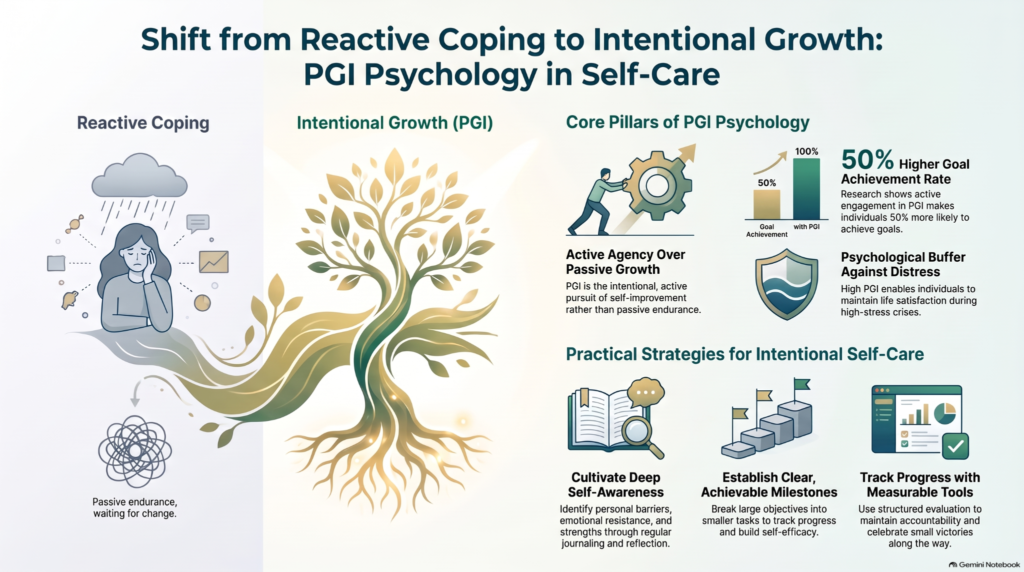
We often assume that growth is an organic by-product of aging or simply enduring difficult seasons. But passive endurance is not transformation; it is just weathering the storm. When I first encountered the framework of Personal Growth Initiative, it confronted me with an uncomfortable ethical truth: genuine well-being requires deliberate agency. You cannot merely wish for better emotional margins while remaining entirely reactive to your environment.
It demands that we step out of passive hoping and cultivate an honest, active interest in how we live each day. True care is not an escape from our routine; it is the conscious decision to examine our beliefs, plan our small disciplines, and take full responsibility for our internal condition. When self-care shifts from a reactive band-aid to an intentional practice of initiative, everything changes.
Personal Growth Initiative (PGI) Psychology boosts your self-care by enhancing self-awareness, emotional resilience, and goal-setting strategies. By fostering a proactive mindset, it empowers you to identify your strengths and needs, set clear and achievable goals, and track your progress effectively. This structured approach helps you embrace challenges and practice self-compassion, promoting a balanced lifestyle. If you’re ready to explore practical strategies and overcome common obstacles in your self-care journey, there’s much more to discover.
KEY TAKEAWAYS
- PGI Psychology fosters self-awareness, empowering individuals to identify their strengths and weaknesses for improved self-care practices.
- Goal setting within PGI provides a clear roadmap, enhancing motivation and enabling individuals to achieve meaningful objectives.
- Regular self-reflection encourages continuous personal evolution, allowing individuals to adapt and refine their self-care strategies over time.
- Measurement tools within PGI help track progress, promoting accountability and a sense of accomplishment in personal growth journeys.
- Embracing setbacks with self-compassion enhances resilience, supporting individuals in navigating challenges while maintaining focus on their self-care goals.
HOW PGI PSYCHOLOGY CAN TRANSFORM YOUR SELF-CARE ROUTINE
The Personal Growth Initiative Scale (PGIS) is a widely utilized psychometric instrument designed to assess an individual’s proactive engagement in the process of Personal Growth Initiative (PGI). It measures the intentional and active pursuit of self-change and self-improvement, differentiating between individuals who merely desire growth and those who actively plan and execute the steps necessary for goal attainment. The scale operationalizes PGI as a multifaceted psychological construct encompassing readiness, planning, and active behavior, providing a concise measure of an individual’s capacity to initiate and sustain personal development efforts.
When you embrace Personal Growth Initiative (PGI) psychology, you’re not just enhancing your self-care routine; you’re fundamentally reshaping how you approach your well-being.
By integrating self-reflection techniques into your daily practices, you reveal a deeper understanding of yourself. This isn’t about superficial wellness; it’s about fostering emotional awareness that allows you to identify your needs, strengths, and areas for growth.
As you engage in consistent self-reflection, you’ll notice patterns in your thoughts and feelings, empowering you to make informed choices. You’ll learn to recognize what truly nourishes your spirit, enabling you to curate a self-care routine that resonates with your authentic self.
PGI psychology encourages you to take ownership of your emotional landscape, fostering resilience and adaptability. In this way, your self-care evolves from routine to a dynamic process, ultimately guiding you toward a fulfilling and liberated life.
What Is Personal Growth Initiative (PGI) Psychology?
Personal Growth Initiative (PGI) psychology represents a proactive approach to self-improvement, emphasizing the importance of individual agency in personal development plans. By cultivating self-awareness development, you can empower yourself to set and achieve meaningful goals. This proactive mindset helps you take charge of your growth, transforming challenges into opportunities.
Here’s a quick overview of key PGI concepts:
| Concept | Description | Benefits |
| Self-Awareness | Understanding your strengths and weaknesses | Enhanced decision-making |
| Proactive Mindset | Taking initiative in personal development | Greater resilience to setbacks |
| Goal Orientation | Setting and pursuing meaningful objectives | Improved motivation and focus |
| Reflection | Evaluating experiences for growth opportunities | Continuous personal evolution |
Embracing PGI psychology allows you to foster your growth journey, guiding you toward a more fulfilling and liberated life.
How Goal Setting in PGI Enhances Self-Care
Setting clear goals in your personal development goals journey can greatly enhance your self-care practices.
When you outline achievable milestones, you not only create a roadmap for success but also build a sense of accomplishment that fosters emotional well-being.
This structured approach encourages consistent self-reflection and growth, helping you prioritize your mental and physical health.
Goal Clarity Promotes Self-Care
Goal clarity plays an essential role in enhancing self-care, as it helps you identify what truly matters in your life. When you set specific goals, you engage in goal visualization, creating a clear mental picture of your desired outcomes.
This practice not only strengthens your resolve but also fosters motivation enhancement, enabling you to prioritize self care activity that align with your aspirations. As you clarify your goals, you can discern which self-care practices resonate with your values, ensuring that your efforts are meaningful and fulfilling.
Ultimately, this clarity empowers you to make intentional choices, promoting a balanced lifestyle where self-care becomes a crucial part of your journey toward achieving personal freedom and growth.
Achievable Milestones Foster Growth
Achievable milestones greatly contribute to your growth by breaking down larger goals into manageable steps.
Milestone mapping allows you to visualize your path, making it easier to identify what you need to accomplish at each stage. This structured approach not only clarifies your objectives but also enhances your motivation.
As you achieve each milestone, you engage in growth tracking, observing your progress and celebrating small victories. This practice fosters a sense of accomplishment, reinforcing your commitment to self-care.
By focusing on attainable goals, you create an environment where freedom thrives, empowering you to pursue your aspirations without feeling overwhelmed.
Embrace this strategy, and watch your personal growth flourish as you navigate your journey with confidence and clarity.
How PGI Helps You Measure Progress?
Personal growth initiative (PGI), an individual’s active and intentional engagement in the growth process, was originally developed as a potentially useful construct in therapy. Although it has repeatedly been related to psychological well-being and distress, few studies have examined PGI in clinical samples.
As you commence your journey of personal growth, measuring your progress can feel intimidating; however, the Personal Growth Initiative (PGI) provides a structured framework that simplifies this process.
By utilizing PGI, you gain access to effective measurement tools that allow for clear progress tracking. These tools help you establish benchmarks, enabling you to visualize your achievements and recognize areas needing improvement.
For instance, you might set specific, measurable goals and regularly assess your progress against them. This not only fosters a sense of accountability but also encourages you to celebrate small victories along the way.
Research shows that tracking progress can enhance motivation and self-efficacy, which ultimately propels you toward your desired outcomes.
With PGI, you can embrace the freedom to shape your path while confidently measuring your growth, transforming what once felt overwhelming into an empowering experience of personal development.
PRACTICAL STRATEGIES AND COMMON CHALLENGES IN IMPLEMENTING PGI
When you begin breaking down self-care into concrete goals and honest self-assessment, you inevitably collide with your own resistance. In my early morning walks without the distraction of podcasts or music, I often notice where my thoughts try to escape. It is easy to draft lofty personal goals on paper, but it is far harder to sit quietly with the patterns that continually undermine them: the subtle resentment when boundaries are tested, the instinct to blame tight deadlines for neglecting physical health, or the habit of using self-improvement books as theoretical shields rather than living practices.
Taking personal initiative means giving up the silent convenience of playing the victim to circumstance. Acknowledging that our own neglect or poor boundaries created our exhaustion is painful, but that discomfort is where real growth roots itself.
PGI isn’t about ruthless productivity or punishing yourself into rigid compliance; it is about building discipline rooted in self-respect. When you view progress as small, traceable commitments—whether that means turning off your screen an hour before sleep or stepping away from an draining conversation—you remove the paralyzing pressure of dramatic transformation. Growth becomes less about grand gestures and more about steady, honest accountability repeated day after day.
While commencing on the journey of implementing Personal Growth Initiative (PGI) strategies, you may encounter both practical approaches and common challenges that shape your experience. To navigate this path effectively, consider these practical tips: set specific, measurable goals; establish a routine for self-reflection; and seek feedback from trusted sources. These actions can enhance your commitment and provide clarity.
However, be aware of common pitfalls, such as setting unrealistic expectations or neglecting self-care amid your growth efforts. Overextending yourself can lead to burnout, making it essential to balance ambition with well-being.
It’s vital to recognize that setbacks are part of the process; they don’t define your journey. By embracing flexibility and adapting your strategies, you can foster resilience.
Ultimately, understanding these practical strategies and potential challenges will empower you to cultivate your personal growth journey with confidence and grace.
How to Use PGI Techniques to Break Through Self-Care Obstacles?
Personal Growth Initiative (PGI) a multi-dimensional construct, conceptualised as a skill set that helps individuals to intentionally grow is considered an important construct throughout the life span. Coping with the challenges, transitions, experiences and stressors of life requires an active growth orientation. In previous empirical research, the construct has been measured by either the PGIS-I or PGIS-II, of which only the latter takes account of the theoretically established multi-dimensionality of the construct.
To break through self-care obstacles, start by identifying your personal barriers—those specific challenges that hold you back.
Once you’ve pinpointed these issues, set achievable goals that align with your values and capacities.
This focused approach not only fosters self-awareness but also enhances your motivation to prioritize self-care.
Identify Personal Barriers
How can you effectively identify personal barriers that hinder your self-care efforts? Start by enhancing your self-awareness. Reflect on your daily routines and pinpoint moments where you encounter self-awareness barriers.
Pay attention to your emotional resistance—recognizing feelings of guilt or anxiety can illuminate deeper issues. Journaling can also be a powerful tool; it allows you to track patterns in your thoughts and behaviors that may obstruct your self-care.
Consider discussing your experiences with trusted friends or a therapist, as their perspectives can reveal blind spots you might overlook. By actively engaging with your internal landscape, you can uncover these barriers, empowering you to navigate around them and embrace a more fulfilling self-care journey.
Set Achievable Goals
Setting achievable goals is essential for overcoming self-care obstacles, especially when you apply Personal Growth Initiative (PGI) techniques. Start by ensuring your goals align with your values and desires, creating a sense of purpose.
Break larger goals into smaller, manageable tasks, which not only makes them less intimidating but also enhances your motivation. Use success tracking to monitor your progress regularly; this helps you identify what’s working and what needs adjustment.
Celebrate small victories along the way, reinforcing your commitment to self-care. Remember, flexibility is key—if something isn’t working, reassess and realign your goals.
Creating a PGI Mindset for Lasting Growth
While many people aspire to grow personally, creating a Personal Growth Initiative (PGI) mindset is essential for transforming those aspirations into lasting change.
To foster this mindset, you need to embrace mindset shifts that cultivate a growth mindset. This involves recognizing that your abilities and intelligence can be developed through effort and learning. Research shows that when you adopt this perspective, you’re more likely to seek challenges and persist through obstacles.
Start by setting clear intentions and reflecting on your values. Acknowledge your progress and celebrate small victories to reinforce positive behaviors. Surround yourself with supportive individuals who encourage your growth journey.
Additionally, practice self-compassion; it helps you handle setbacks without losing motivation.

RELATED STUDIES ABOUT PERSONAL GROWTH INITIATIVE PSYCHOLOGY
Incorporating Personal Growth Initiative (PGI) psychology into your self-care routine can lead to significant changes in your life. Research shows that individuals who actively engage in PGI are 50% more likely to achieve their goals. By fostering a proactive mindset and using effective strategies, you can overcome obstacles and enhance your well-being. Embrace PGI techniques to not only measure your progress but also create sustainable habits that promote lasting personal growth and fulfillment.
Personal growth initiative moderates the mediating effect of COVID-19 preventive behaviors between fear of COVID-19 and satisfaction with life
This study examines a moderated mediation model investigating whether COVID-19 preventive behaviors mediate the relationship between fear of COVID-19 and satisfaction with life, and whether personal growth initiative (PGI) moderates these direct and indirect paths among university students in Pakistan.
Study Overview & Methodology:
- Participants & Setting: Surveyed 461 university students (52% male, 48% female; mean age 24.66 years; 75% single; 66% unemployed) across public and private universities in Islamabad, Rawalpindi, and Peshawar.
- Theoretical Grounding: Framed using Protection Motivation Theory (PMT), which posits that fear of a health threat motivates protective, risk-mitigating actions, and eudaimonic well-being theory, which conceptualizes PGI as active, intentional self-development.
- Instrumentation: Administered validated measures via an online survey, including the Fear of COVID-19 Scale (FCV-19S; alpha = 0.87), the Preventive Behaviors related to COVID-19 Scale (PBCV-19S; alpha = 0.82), the Personal Growth Initiative Scale (PGIS; alpha = 0.86), and the Satisfaction with Life Scale (SWLS; alpha = 0.91).
- Statistical Analysis: Conducted ordinary least squares regression and conditional process analysis using SPSS PROCESS macro Model 4 (simple mediation) and Model 15 (moderated mediation) with 5,000 bootstrap resamples to test conditional indirect effects.
Key Findings:
- Significant Mediation Mechanism: In the baseline mediation model, fear of COVID-19 positively predicted adherence to COVID-19 preventive behaviors (beta = 0.29, p < 0.001, explaining 8% of the variance). In turn, preventive behaviors positively predicted life satisfaction (beta = 0.13, p < 0.001). The indirect effect of fear on life satisfaction via preventive behaviors was positive and statistically significant (effect = 0.03, 95% CI [0.01, 0.05]).
- Significant Moderated Mediation: In the full moderated mediation model, the direct paths of fear of COVID-19 and preventive behaviors to life satisfaction were no longer significant on their own, whereas PGI was a strong positive predictor of life satisfaction (coeff = 0.53, p < 0.001). The model accounted for 48% of the total variance in satisfaction with life.
- Moderating Role of Personal Growth Initiative: PGI significantly moderated both the direct path from fear of COVID-19 to life satisfaction (coeff = 0.01, p < 0.05) and the path from preventive behaviors to life satisfaction (coeff = -0.02, p < 0.001), with the index of moderated mediation reaching significance (index = -0.01, 95% CI [-0.01, -0.00]).
- Conditional Thresholds: Simple slopes analysis revealed that the conditional effects occurred exclusively under high PGI (+1 SD), but were non-significant at moderate (mean) or low (-1 SD) levels. High PGI acted as a psychological buffer against the distress of fear while enabling individuals to translate health-protective compliance into improved subjective well-being.
Practical & Institutional Implications:
- Nurturing Self-Directed Growth: Universities and student affairs departments should implement positive psychology and character strengths workshops (e.g., goal-setting, proactivity, cognitive reframing) to build internal growth resources.
- Blended & Accessible Mental Health Delivery: Academic institutions should offer digital mental health interventions, such as Internet-based Cognitive Behavioral Therapy (I-CBT) hosted on accessible learning management systems (e.g., Moodle), to help students process crisis-related health anxieties and prevent distress from compromising academic performance.
- Contextual Compliance Messaging: Public health campaigns on campus should emphasize health-protective behaviors not merely through fear appeals, but by framing adherence as an intentional self-care habit that supports long-term goals and life satisfaction.
| REFERENCE: Zane Asher Green, Murat Yıldırım, Personal growth initiative moderates the mediating effect of COVID-19 preventive behaviors between fear of COVID-19 and satisfaction with life, Heliyon, Volume 8, Issue 6, 2022, e09729, ISSN 2405-8440, https://doi.org/10.1016/j.heliyon.2022.e09729. (https://www.sciencedirect.com/science/article/pii/S2405844022010179) |
Unsettling and rerooting psychological practice in schools: Part 2 – Decolonization and indigenization of school psychology as liberatory praxis
This conceptual and theoretical article proposes a liberatory praxis for school psychology, arguing that conventional diversity, equity, and inclusion (DEI) initiatives remain insufficient because they operate within colonial frameworks. The authors articulate how decolonization and Indigenization can be enacted in tandem to transform psychological and educational practice.
Conceptual Framework & Core Definitions:
- Beyond Conventional Diversity Initiatives: Argues that traditional equity frameworks fail to address systemic oppression because they center colonial assumptions. Decolonization and Indigenization are conceptualized not as metaphors or finite end goals, but as complementary, active processes:
- Decolonization: Described as an active, disruptive process of identifying, naming, and resisting historical and ongoing colonial violence, exploitation, and erasure.
- Indigenization: Described as a nurturing, relational process focused on re-establishing severed connections to Land, community, cultural identity, and Indigenous epistemologies.
- Definition of Liberatory Praxis: Grounded in the works of Paulo Freire, bell hooks, and Ignacio Martin-Baro, liberatory praxis is defined as a continuous cyclical loop of theory, action, and critical reflection aimed at dismantling oppressive structures to foster human flourishing and liberation.
Key Modes of Decolonization (Resistance):
- Resisting the Colonizer’s Right to Comfort: Challenging institutional avoidance of discomfort, such as policies or legislation that suppress discussions of racism and settler colonialism, and refusing to settle for superficial notions of educational harmony.
- Resisting Physical and Structural Violence: Intervening against school-based practices that criminalize marginalized youth, such as the disproportionate presence of police/school resource officers and the disciplinary pushout of Black and Indigenous students.
- Resisting Erasure: Defending against the systemic removal of Indigenous histories, symbols, and identities from curricula, school environments, and educational policy.
- Resisting Deficit Narratives: Rejecting pathologizing labels, medical-model categorization, and behavioral compliance agendas that treat minoritized students as disordered or lacking civility, and reorienting frameworks like Multi-Tiered Systems of Support (MTSS) toward system-level accountability.
Key Modes of Indigenization (Reclamation & Care):
- Strengthening Relationship to the Land: Moving beyond tokenistic Land acknowledgments to recognize Land as living, sovereign, and central to human health, resource access, and learning.
- Strengthening Connection to Relations: Honoring reciprocal relationships with natural ecosystems (water, air, native plants, animals) and rejecting extractive, capitalist logics of development.
- Re-Centering Indigenous Epistemologies: Embracing alternative knowledge-production methods, such as Two-Eyed Seeing (holding both Indigenous and Western worldviews simultaneously) and Indigenous storytelling, which treat knowledge as relational and whole rather than commodified.
- Strengthening Cultural Identity: Embedding traditional ceremonies, customs, languages, and governance styles within school structures without cultural appropriation.
- Strengthening Community & Kin Networks: Challenging individualistic, nuclear-family norms by honoring expansive, multi-generational kin networks and establishing community-centered educational spaces.
Five Enacted Pillars of Liberatory School Psychology:
- Advocating for Land Back: Integrating outdoor, nature-centered environments into psychoeducational assessments and school activities, ensuring student access to clean water and nutritious food, and supporting Indigenous Land reclamation and climate justice.
- Re-Centering Indigenous Ways of Knowing: Dismantling the overreliance on standardized, Eurocentric testing tools that disproportionately funnel minoritized youth into special education, and partnering with community Elders to guide evaluation and intervention.
- Uplifting Survivance and Indigenous Futures: Centering family and community networks as co-designers of learning rather than passive recipients of compliance notices, viewing youth through their inherent cultural brilliance rather than survival alone.
- Honoring Sovereignty: Acknowledging tribal and community self-governance, respecting family decision-making processes, and aligning school policies with local community governance.
- Engaging in Collective Relationality: Establishing school gardens with native plants, promoting ecological stewardship, and protecting school environments from commercial and environmental exploitation.
Practice & Training Implications:
- Centering Storytelling and Narrative Reflexivity: Illustrates praxis through a composite professional narrative of a South Asian school psychologist navigating everyday systemic resistance—such as discreet community emergency funds, meeting circle seating arrangements, conducting assessments outdoors, and confronting colleague bias.
- Collective Solidarity Over Individual Reform: Emphasizes that decolonial labor is not the sole burden of Indigenous clinicians; white school psychologists and non-Indigenous practitioners must take active responsibility for interrogating colonial habits and building authentic solidarity.
- Professional Ethics vs. Colonial Law: Reminds practitioners that when statutory regulations or school policies enforce discrimination or violate fundamental human rights, professional ethics mandate prioritizing human rights, child wellness, and collective liberation over institutional compliance.
| REFERENCE: Shereen C. Naser, Lisa N. Aguilar, Sujay V. Sabnis, Amanda L. Sullivan, Trae Brown, Bryanna Kinlicheene, Shafiq Nashashibi, Unsettling and rerooting psychological practice in schools: Part 2 – Decolonization and indigenization of school psychology as liberatory praxis, Journal of School Psychology, Volume 114, 2026, 101517, ISSN 0022-4405, https://doi.org/10.1016/j.jsp.2025.101517. (https://www.sciencedirect.com/science/article/pii/S0022440525000901) |
Learning Context and Undergraduate Students’ Needs for Autonomy and Competence, Achievement Motivation and Personal Growth Initiative
This theoretical and conceptual paper proposes a liberatory praxis for school psychology, arguing that standard diversity, equity, and inclusion (DEI) initiatives are insufficient because they continue to operate within colonial structures. The authors define decolonization and Indigenization and outline how they can be enacted together to transform education and psychological practice.
Theoretical Framework & Core Concepts:
- Limits of Standard Equity Work: Conventional DEI approaches fail to dismantle systemic oppression because they prioritize incremental reform while centering settler-colonial norms.
- Decolonization: Conceptualized as an active, future-oriented, and disruptive process of identifying, confronting, and resisting historical and ongoing colonial harms, violence, and institutional erasure.
- Indigenization: Described as a restorative, relational process focused on re-establishing severed connections to Land, community, cultural identity, and Indigenous ways of knowing.
- Liberatory Praxis: Grounded in the works of Paulo Freire, bell hooks, and Ignacio Martin-Baro, praxis is framed as an ongoing cycle of theory, action, and critical reflection aimed at dismantling oppressive structures to foster human flourishing and liberation.
Modes of Decolonization (Resistance):
- Resisting the Colonizer’s Right to Comfort: Confronting institutional avoidance of discomfort, including pushback against policies or legislation that restrict discussions of systemic racism, white supremacy, and colonial history.
- Resisting Physical and Structural Violence: Intervening against school practices that criminalize marginalized youth, such as the disproportionate deployment of school resource officers, police interventions, and harsh disciplinary pushout.
- Resisting Erasure: Defending against the systemic removal and suppression of Indigenous histories, symbols, languages, and cultures in school curricula and public spaces.
- Resisting Deficit Narratives: Rejecting medical-model deficit labeling and compliance agendas that categorize minoritized students as disordered or deficient, and shifting frameworks like Multi-Tiered Systems of Support (MTSS) toward structural and systemic accountability.
Modes of Indigenization (Reclamation & Care):
- Strengthening Relationship to the Land: Moving beyond tokenistic Land acknowledgments to honor Land as living and sovereign, recognizing its vital role in learning, well-being, and community health.
- Strengthening Connection to Relations: Fostering reciprocal, non-extractive relationships with the natural ecosystem (air, water, plants, animals) and challenging capitalist extraction logics.
- Re-Centering Indigenous Epistemologies: Reclaiming Indigenous knowledge-making methods, including Two-Eyed Seeing (integrating Indigenous and Western perspectives) and storytelling, which view knowledge as relational rather than a commodified product.
- Strengthening Cultural Identity: Integrating traditional cultural heritage, customs, languages, and governance styles into educational settings without co-optation or appropriation.
- Strengthening Community & Kin Networks: Moving beyond individualistic, nuclear-family frameworks to nurture extended kinship networks, collective care, and community-centered school spaces.
Pillars of Liberatory School Psychology in Action:
- Advocating for Land Back: Incorporating nature-based and outdoor environments into assessments and student interactions, ensuring access to clean water and nutritious food, and actively supporting Indigenous Land stewardship and climate justice initiatives.
- Re-Centering Indigenous Epistemologies: Addressing the overreliance on standardized, Eurocentric testing tools that drive racial disparities in special education placement, and collaborating with community Elders and knowledge bearers to guide student evaluations.
- Uplifting Survivance and Family Partnerships: Engaging families and kin networks as equal decision-makers and co-designers of learning rather than passive targets of compliance procedures.
- Honoring Sovereignty: Recognizing tribal self-governance and community self-determination, respecting cultural protocols, and aligning school policies with family and community decision-making structures.
- Engaging in Collective Relationality: Creating school gardens with native plants, promoting place-based ecological education, and protecting school grounds from commercial and environmental exploitation.
Narrative Illustration & Professional Implications:
- Illustrative Composite Story: Uses a narrative featuring a South Asian school psychologist to demonstrate daily acts of liberatory praxis, including discreet mutual-aid emergency funds, circular meeting arrangements that dismantle power hierarchies, conducting assessments outdoors under trees, and confronting colleague bias.
- Collective Responsibility & Solidarity: Emphasizes that decolonization is not solely the task of Indigenous practitioners; non-Indigenous and white school psychologists must engage in continuous critical self-reflection and active solidarity.
- Ethics Over Oppressive Mandates: Affirms that professional ethics and human rights must supersede institutional policies and legal mandates whenever rules uphold discrimination, exclusion, or colonial harm.
| REFERENCE: Valeria Negovan, Corina Bogdan, Learning Context and Undergraduate Students’ Needs for Autonomy and Competence, Achievement Motivation and Personal Growth Initiative, Procedia – Social and Behavioral Sciences, Volume 78, 2013, Pages 300-304, ISSN 1877-0428, https://doi.org/10.1016/j.sbspro.2013.04.299. (https://www.sciencedirect.com/science/article/pii/S1877042813008689) |
CONCLUSION
Looking back at the cycles of change in my own life, the shifts that actually held were never born out of sudden crises or frantic resolutions. They arrived through quiet, patient alignment between what I valued and how I spent my ordinary mornings. Too often, we approach personal growth like an emergency repair crew—scrambling to patch the roof only when the rain pours through, and abandoning the tools the moment the skies clear. But as the research on Personal Growth Initiative illustrates, our capacity to navigate uncertainty and stress is built long before the crisis arrives.
Character and well-being are built in the mundane spaces: in the willingness to evaluate where you stumbled without berating yourself, and in the quiet resolve to try again tomorrow with clearer focus. You do not need to overhaul your entire existence overnight; you only need to take deliberate ownership of your next step.
True personal growth is an ongoing inquiry—a steady, compassionate commitment to listening to who you are while responsibly authoring who you are becoming. When you invest in that process, self-care ceases to be a chore you check off and becomes the foundational way you live.