

When people hear the word “neuroplasticity,” they often imagine a miraculous switch that can be flipped overnight—a sudden epiphany that completely resets how we think, react, and feel. But in cognitive behavioral research, we look at the brain far less like a magic box and far more like an evolving architectural system. During my years researching cognitive reframing and emotional regulation in high-stress environments, I’ve found that true neural adaptation is quiet, patient, and deeply rooted in everyday micro-habits.
When you spend your mornings analyzing behavioral patterns and your evenings restoring fragile antique books, you start to notice a striking parallel. A weathered binding doesn’t realign itself in an instant; each fiber requires deliberate moisture, gentle pressure, and steady hands to adopt a new shape without breaking. Your neural architecture operates under the exact same principle. You cannot forcefully bend your mind through rigid expectations or overnight affirmations, as popular wellness narratives often claim.
Rewiring requires scaffolding. It asks you to slow down long enough to observe your internal friction points and provide the biological and psychological resources your nervous system actually needs to adapt. Mindset shifts don’t begin with forced positivity—they begin the moment you give your brain the space, rhythm, and evidence to feel capable of change.
Neuroplasticity allows your brain to adapt and grow through new experiences and challenges. By embracing a growth mindset, you can transform setbacks into growth opportunities, activating neuroplasticity and breaking limiting beliefs. Incorporating daily habits like quality sleep, lifelong learning, and physical exercise enhances cognitive resilience. Mindfulness and a balanced diet further support brain health, promoting neurogenesis and cognitive function. Exploring these science-backed self-care habits can reshape your mental landscape and enhance your overall well-being.
KEY TAKEAWAYS
- Embrace a growth mindset to view challenges as opportunities, fostering resilience and activating neuroplasticity through positive thinking and learning experiences.
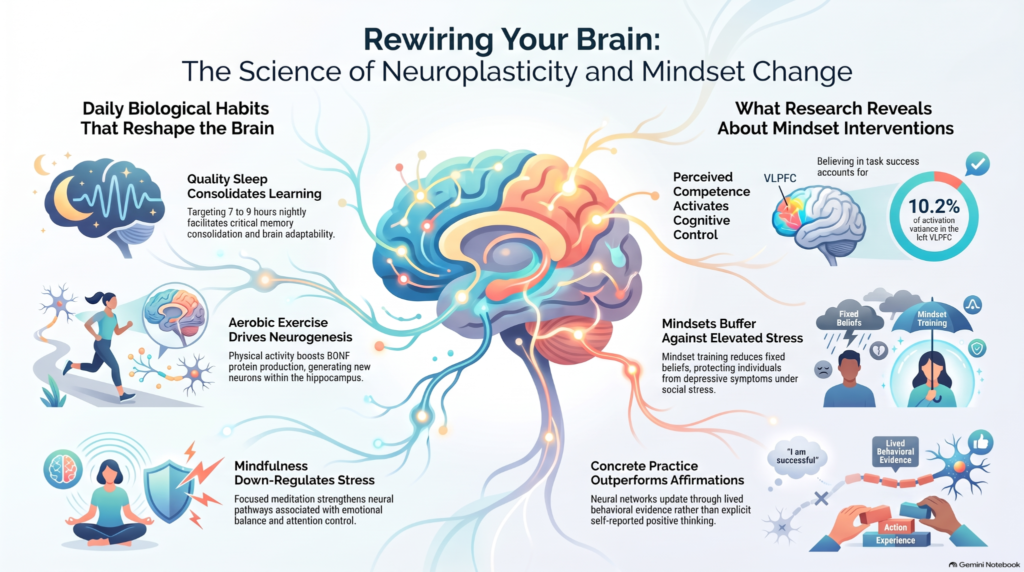
- Prioritize quality sleep, aiming for 7-9 hours, to enhance memory consolidation and cognitive flexibility, crucial for brain adaptation.
- Incorporate mindfulness and meditation practices to improve focus, reduce stress, and promote emotional resilience, facilitating better cognitive function.
- Engage in regular physical exercise to enhance blood flow to the brain, improve mood, and stimulate neurogenesis, particularly in the hippocampus.
- Maintain proper hydration and balanced meal timing to support cognitive performance, stabilize energy levels, and optimize overall brain health.
WHAT IS NEUROPLASTICITY AND WHY IT MATTERS?
Neuroplasticity refers to the brain’s ability to restructureTrusted Source or rewire itself when adapting to change. It can continue to develop throughout life in response to stimulation, environmental changes, and individual experiences.
Neuroplasticity, the brain’s remarkable ability to reorganize itself by forming new neural connections throughout life, plays a crucial role in how we learn, adapt, and recover from injury. This brain adaptability allows you to modify your thought patterns and behaviors, fostering cognitive flexibility.
When you engage in new experiences or challenge existing beliefs, your brain rewires itself to accommodate this growth. Research shows that stimulating activities—like learning a new language or practicing mindfulness—can enhance neural connectivity, making it easier to adapt to change.
This adaptability not only aids in overcoming obstacles but also empowers you to pursue personal freedom and resilience. By understanding neuroplasticity, you gain insight into how intentional practices can reshape your brain, enabling you to navigate life’s challenges with greater ease.
Embracing this knowledge can transform your approach to learning and development, leading to a more fulfilling life.
How Embracing a Growth Mindset Transforms Your Life
When you adopt a growth mindset, you fundamentally change how you approach challenges and setbacks. Instead of viewing these as insurmountable obstacles, you recognize them as growth opportunities that foster resilience and adaptability. Exploring quotes about mindset can also provide motivation and reinforce this positive approach.
Research indicates that individuals with a growth mindset are more likely to persist through difficulties, enhancing their problem-solving abilities and overall success.
This shift allows you to embrace mindset challenges, transforming failures into valuable lessons rather than sources of discouragement. As you cultivate this mindset, you activate neuroplasticity—your brain’s ability to reorganize itself—allowing you to forge new neural pathways associated with positive thinking and continuous learning.
This transformation empowers you to break free from limiting beliefs, encouraging a more fulfilling and liberated life. By consistently approaching life with a growth mindset, you not only enhance your cognitive flexibility but also release your potential to navigate and thrive in an ever-changing world.
Daily Habits to Boost Neuroplasticity
To enhance neuroplasticity in your daily life, integrating specific habits can lead to significant cognitive benefits. Here are three effective practices to take into account:
- Prioritize Sleep Quality**: Quality sleep is vital for brain health. Aim for 7-9 hours per night to facilitate memory consolidation and learning.
- Engage in Lifelong Learning**: Challenge your brain with new skills or knowledge. Whether it’s picking up a new language or taking up brain games, continuous learning stimulates neural connections.
- Foster Social Connections**: Strong relationships enhance cognitive resilience**. Spend time with friends, engage in meaningful conversations, and experience the joy of creative expression together.
Additionally, reflect on the journaling benefits for self-reflection, nature exposure for stress reduction, and a digital detox as a self care activity to minimize distractions.
Why Mindfulness and Meditation Are Key for Brain Rewiring
Mindfulness and meditation play an essential role in brain rewiring by enhancing your focus and attention.
Research shows that these practices greatly reduce stress and anxiety, fostering a more resilient emotional state.
Enhancing Focus And Attention
Although distractions are a common challenge in today’s fast-paced world, incorporating mindfulness and meditation into your daily routine can greatly enhance your focus and attention.
These practices encourage neuroplasticity, reshaping your brain for better concentration. Here are three focus techniques to contemplate:
- Mindful Breathing: Spend a few minutes each day focusing solely on your breath, which trains your mind to stay present.
- Body Scan: This technique helps increase awareness of your bodily sensations, improving your ability to concentrate on tasks.
- Guided Meditation: Using apps or online resources, guided sessions can provide structured attention training, making it easier to maintain focus in other areas of life.
Reducing Stress And Anxiety
While many people experience stress and anxiety as inevitable parts of life, engaging in mindfulness and meditation can fundamentally alter how your brain responds to these challenges.
Research shows that regular mindfulness practice enhances your brain’s ability to manage stress, promoting neuroplasticity. By focusing your attention and cultivating awareness, you can rewire neural pathways associated with stress management, allowing for more effective coping mechanisms.
Studies indicate that mindfulness meditation can notably reduce symptoms of anxiety, providing lasting anxiety relief. This practice fosters a tranquil mindset, enabling you to confront stressors with resilience.
Ultimately, integrating mindfulness and meditation into your routine not only reshapes your brain but empowers you to reclaim a sense of control and freedom in your life.
Promoting Emotional Well-Being
When you engage in mindfulness and meditation, you’re not just calming your mind; you’re actively reshaping your brain’s emotional landscape.
These practices promote emotional well-being by enhancing your emotional regulation and fostering a positive mindset. Here are three key benefits:
- Increased Self-Awareness: Mindfulness sharpens your ability to recognize emotions, empowering you to respond rather than react.
- Reduction of Negative Thought Patterns: Regular meditation helps you interrupt cycles of negativity, allowing room for positive affirmations.
- Stress Resilience: Engaging in these practices strengthens neural pathways associated with emotional balance, making you more resilient to stressors.

THE IMPACT OF PHYSICAL EXERCISE ON BRAIN RESILIENCE
In my coaching work with professionals, I frequently see a common stumbling block: people believe that repeating positive mantras will automatically rewrite years of ingrained self-doubt. They treat neuroplasticity like a motivational speech rather than a biological reality. But here is what the clinical data actually tells us: your brain does not update its internal models based on empty wishes; it updates based on visceral, lived evidence. Recent neuroimaging and behavioral trials remind us that simply understanding the concept of a growth mindset does not magically shift our automatic, implicit reactions. What genuinely activates our executive control networks—specifically regions like the ventrolateral prefrontal cortex—is perceived competence. You have to feel capable of working through the friction.
This is why self-care practices like structured journaling, focused breathing, and movement aren’t optional luxuries; they are the baseline conditions that stabilize your nervous system so learning can actually occur. When you take a solo walk or sit down for a five-minute thought audit, you aren’t ignoring your challenges.
You are down-regulating your threat response, allowing your prefrontal networks to step in, suppress obsolete default reactions, and lay down new neural pathways. You don’t out-think a limiting belief—you disconfirm it through steady, small-scale behavioral experiments.
Engaging in regular physical exercise greatly enhances your cognitive function and promotes neurogenesis.
Research shows that aerobic activities like running or cycling increase the production of brain-derived neurotrophic factor (BDNF), which supports the growth of new neurons.
Exercise Enhances Cognitive Function
As research increasingly shows, regular physical exercise plays an essential role in enhancing cognitive function and bolstering brain resilience. Developing the fitness mindset can also encourage consistency and a positive approach to physical activity.
Engaging actively in exercise not only supports brain health but also fosters mental clarity and emotional stability.
Here are three key benefits to reflect on:
- Increased Blood Flow: Exercise boosts circulation, delivering oxygen and nutrients to the brain, promoting cognitive enhancement.
- Neurotransmitter Release: Physical activity stimulates the release of endorphins and serotonin, which can improve mood and cognitive performance.
- Stress Reduction: Regular workouts reduce stress hormones, enhancing your ability to focus and think critically.
Neurogenesis Through Physical Activity
Neuroplasticity refers to the brain’s ability to change and adapt throughout life by modifying its structure, functions, or neural pathways.
Regular physical activity not only enhances cognitive function but also plays an essential role in neurogenesis, the process of generating new neurons in the brain.
Engaging in consistent exercise stimulates the release of brain-derived neurotrophic factor (BDNF), a protein vital for neuron growth and survival.
Research shows that aerobic exercises, like running or cycling, markedly increase neurogenesis benefits, particularly in the hippocampus—a region associated with memory and learning.
This process helps improve brain resilience, making you better equipped to handle stress and cognitive decline.
By incorporating physical activity into your routine, you’re not just maintaining your physical health; you’re actively reshaping your brain, paving the way for enhanced mental clarity and emotional well-being.
Embrace movement for a healthier mind!
Nutrition for Enhancing Neuroplasticity
Neuroplasticity is your brain’s ability to reorganize, remap its structure, functions, and connections in response to stimulus. Think of it this way: when you walk through a forest taking the same path every day, that path becomes more defined and easier to follow. Similarly, when you repeat certain thoughts or behaviors, you create well-worn pathways in your brain. The exciting part? You can always create new paths.
While your brain’s ability to adapt and reorganize itself—known as neuroplasticity—can be influenced by various factors, nutrition plays an essential role in optimizing this process.
To enhance neuroplasticity, focus on these key aspects of your diet:
- Nutrient Balance: Confirm you’re consuming a variety of brain foods, including fruits, vegetables, whole grains, and lean proteins to provide essential nutrients.
- Omega 3s Benefits: Incorporate omega-3 fatty acids, found in fish, flaxseeds, and walnuts, as they support synaptic plasticity and cognitive function.
- Antioxidant Sources: Include foods rich in antioxidants, like berries and dark chocolate, to reduce oxidative stress, which can negatively impact brain health.
Don’t forget the hydration effects and meal timing; both can influence your gut health and overall dietary patterns.
Practical Strategies to Overcome Limiting Beliefs
Additionally, practice visualization. Picture yourself succeeding and embodying the qualities you desire. This not only strengthens your resolve but also helps rewire your brain.
Surround yourself with supportive individuals who encourage growth and challenge your limiting beliefs.
Finally, set small, achievable goals. Each success reinforces your belief in your abilities, further diminishing the power of those negative thoughts.

RELATED STUDIES ABOUT NEUROPLASTICITY AND MINDSET CHANGE
In the grand tapestry of your mind, neuroplasticity serves as the loom, weaving new pathways and possibilities. By nurturing a growth mindset and embracing daily habits like mindfulness and exercise, you’re not just enhancing your brain’s resilience; you’re sculpting a masterpiece of self-improvement. Each choice you make is a stroke of the brush, transforming limiting beliefs into vibrant colors of potential. As you cultivate these science-backed habits, remember: the canvas of your brain is ever-evolving, waiting for your next creation.
Effects of teaching neuroplasticity on motivation, inhibitory control and task performance, and the role of mindset theory
OVERVIEW & OBJECTIVE
In counterintuitive learning domains such as mathematics (e.g., fraction comparison), students routinely make persistent errors due to intuitive heuristics—such as the “natural number bias,” where students assume 1/4 is larger than 1/3 simply because 4 is greater than 3. Overcoming this bias requires inhibitory control to actively suppress the intuitive automatism.
This study evaluated whether a brief pedagogical intervention explaining neuroplasticity (the concept that neural connections adapt and strengthen with effort, practice, and strategy) increases motivation, enhances the neural mobilization of inhibitory control, and improves behavioral task performance.
METHODOLOGY
- Participants: 44 French-speaking elementary school students aged 10–12 years (mean age: 11.4) from the Montreal area, Quebec, Canada. Participants were pre-selected for demonstrating interference on counterintuitive math problems and were randomized into an experimental group (n = 22) or an active control group (n = 22).
- Interventions:
- Experimental Group: Watched a 4-minute 33-second popularized educational video explaining neuroplasticity, the value of errors, effort/strategy use, and perceived competence. The video was viewed twice, separated by self-explanation summaries and followed by three comprehension questions.
- Control Group: Watched a video of identical duration, animation style, and pedagogical tone addressing climate change.
- Measures:
- Motivational Questionnaire: Completed pre- and post-intervention to assess four distinct dimensions: Perceived Skills Malleability, Perceived Control, Error Perception, and Perceived Competence.
- fMRI & Behavioral Testing: A 20-minute event-related functional magnetic resonance imaging (fMRI) session using a 3.0 T scanner while students completed an intuitive and counterintuitive fraction comparison task featuring trial-by-trial feedback.
KEY FINDINGS
- Significant Increases in Motivation:
- The experimental group exhibited statistically significant pre-to-post gains across general motivation (p = .002, d = 0.48), perceived control (p = .021, d = 0.47), error perception (p = .025, d = 0.43), and perceived competence (p = .003, d = 0.35). • Perceived skills malleability (the traditional core construct of growth mindset theory) did not change significantly (p = .184, d = 0.13), indicating that short interventions primarily influence peripheral motivational factors rather than foundational beliefs about skill malleability.
- Greater Neural Activation in Inhibitory Control Networks:
- During counterintuitive fraction trials, students taught neuroplasticity demonstrated significantly greater functional activation in the left ventrolateral prefrontal cortex (VLPFC, specifically the pars triangularis; p = .048, d = 0.56) and the right caudate nucleus compared to controls. • These regions are fundamentally responsible for the active mobilization of inhibitory control, interference suppression, and preparation for stopping automatisms.
- Perceived Competence as the Primary Neurological Predictor:
- In a multiple linear regression analyzing all four motivational constructs, change in perceived competence was the only variable significantly correlated with, and predictive of, activation in the left VLPFC (r = 0.32, R² = 0.102, p = .04). • This demonstrates that believing oneself capable of succeeding in a task directly accounts for roughly 10.2% of the variance in inhibitory brain activation.
- Lack of Behavioral Performance Differences:
- There were no statistically significant differences between the experimental and control groups regarding response latencies (p = .468) or task accuracy (p = .879).
- Both cohorts showed high baseline accuracy, suggesting a ceiling effect and indicating that while the brief intervention increased attentional and neural preparation, it was insufficient on its own to produce measurable performance leaps.
EDUCATIONAL & THEORETICAL IMPLICATIONS
- Re-evaluating Mindset Interventions: Rather than relying solely on the premise that teaching malleable intelligence directly shifts performance, positive educational outcomes appear to be mediated primarily by gains in perceived competence (self-efficacy).
- Neural Impact Without Immediate Behavioral Shifts: A single, low-cost 5-minute video can measurably activate key cognitive-control brain regions. Relying exclusively on immediate standardized test scores risks overlooking meaningful underlying neurocognitive mobilization.
- Practical Classroom Implementation: Teaching neuroplasticity and framing errors as necessary neural practice provides teachers with an inexpensive, scalable tool. To maximize benefits, educators should integrate targeted strategies and provide “optimal challenges” that allow students to directly experience success, thereby building the perceived competence required to mobilize cognitive control.
| REFERENCE: Jérémie Blanchette Sarrasin, Martin Riopel, Geneviève Allaire-Duquette, Sophie McMullin, Élisabeth Bélanger, Lorie-Marlène Brault Foisy, Steve Masson, Effects of teaching neuroplasticity on motivation, inhibitory control and task performance, and the role of mindset theory, Trends in Neuroscience and Education, Volume 40, 2025, 100257, ISSN 2211-9493, https://doi.org/10.1016/j.tine.2025.100257. (https://www.sciencedirect.com/science/article/pii/S2211949325000110) |
Is changing your mind enough? Growth mindset intervention fails to translate to implicit measures
OVERVIEW & CORE FINDING
Growth mindset interventions seek to cultivate learners’ beliefs that abilities can be developed through effort and practice. However, prior empirical research exhibits persistent inconsistencies regarding whether these interventions genuinely change student mindsets and improve achievement. Most studies rely on explicit, self-report questionnaires, which are vulnerable to social desirability bias and fail to capture implicit or unconscious cognitive structures.
Across two randomized experimental studies, the authors employed a multi-method evaluation framework to assess explicit self-reports alongside indirect scenario-based assessments and implicit reaction-time measures. The central finding demonstrates a clear translation gradient: the more indirect and implicit the measurement instrument, the weaker the intervention’s detectable effects. While the intervention successfully shifted self-reported ratings, it failed to alter implicit cognitive associations, situation-specific reflections, or downstream motivational indicators.
METHODOLOGY & INTERVENTION DESIGN
- Instructional Design: Both studies deployed a 30-minute, computer-based growth mindset intervention integrating four evidence-supported features: neuroplasticity instruction, attributional effort feedback during an adaptive dual n-back task, peer testimonials of overcoming academic struggle, and reflective writing exercises.
- Control Condition: An active control group matched the identical structural format, tasks, and reflections, but focused entirely on working memory rather than mindset or neuroplasticity.
- Study 1 Sample: 89 German university students (mean age: 24.0 years) evaluated in a laboratory across pretest, immediate posttest, and a 1-week follow-up. Implicit associations were measured via a Lexical Decision Task (LDT).
- Study 2 Sample: 50 participants (38 university students and 12 upper-track high school students; mean ages 21.89 and 17.00 years) tested online across three time points. Implicit associations were evaluated using a Single-Target Implicit Association Test (ST-IAT) focusing on self-related ability beliefs.
KEY FINDINGS
- Self-Reported Mindset (Explicit Level):
- In Study 1, self-reported growth mindset increased significantly from pretest to posttest (p < .001, eta_p² = .25), though the effect faded after one week (p = .21). Self-reported fixed mindset decreased significantly immediately (p < .001, eta_p² = .26) and remained lower at the 1-week follow-up (p = .019, eta_p² = .11).
- In Study 2, self-reported growth mindset showed no significant change. However, fixed mindset decreased significantly immediately after the intervention (p < .001, eta_p² = .41) and successfully buffered against an unfavorable increase in fixed beliefs observed over time in the control group (p = .007, eta_p² = .13).
- Scenario-Based Mindset (Indirect Situation-Specific Level):
- In Study 1, the intervention had no significant effect on participants’ written responses to failure scenarios (p = .480 for growth, p = .125 for fixed).
- In Study 2, the intervention yielded an isolated, delayed positive effect on scenario growth mindset at the 1-week follow-up (p < .001, eta_p² = .64), again primarily functioning as a protective buffer against declines observed in the control condition.
- Reaction-Time Measures (Implicit Level):
- The intervention produced no statistically significant changes in implicit cognitive associations in either study.
- Bayesian repeated-measures ANOVAs revealed strong to moderate evidence supporting the null hypothesis for both the Lexical Decision Task in Study 1 (BF_01 = 6.16) and the Single-Target Implicit Association Test in Study 2 (BF_01 = 3.07).
- Distal Motivational Indicators:
- The mindset intervention had no transfer effects on learning goal orientation, general self-efficacy, or academic self-concept across both studies (all interaction ps > .11).
CRITICAL IMPLICATIONS & RECOMMENDATIONS
- Self-Reports Reflect Manipulation Checks, Not Deep Belief Change: Positive shifts on traditional Likert questionnaires indicate that learners comprehended the instruction and responded according to social desirability, but do not signify deeper internalization.
- Independent Growth and Fixed Subscales: Growth and fixed mindsets do not operate along a single continuous spectrum. Interventions are more reliably effective at reducing fixed beliefs and preventing cynicism than at actively promoting new growth orientations.
- Direct Targeting of Downstream Motivation: General mindset training does not automatically elevate self-efficacy or mastery goals. Interventions seeking to influence specific motivational dimensions must explicitly target and scaffold those attributes directly.
- Adoption of Multi-Method Assessment: Educational research must move beyond isolated self-report scales to incorporate scenario-based and implicit behavioral paradigms when measuring intervention efficacy and long-term sustainability.
| REFERENCE: Helene Zeeb, Tino Endres, Manuel Becker, Steffen Weyreter, Stephan Lengsfeld, Alexander Renkl, Is changing your mind enough? Growth mindset intervention fails to translate to implicit measures, Learning and Motivation, Volume 94, 2026, 102279, ISSN 0023-9690, https://doi.org/10.1016/j.lmot.2026.102279. (https://www.sciencedirect.com/science/article/pii/S0023969026000391) |
Improving Mental Health in Adolescent Girls via a Randomized Trial of an Emotion Mindset Intervention
This study evaluates whether a single-session growth emotion mindset intervention (E-MIND) protects adolescent girls from depression and anxiety by reducing fixed emotion mindsets (FEMs), while identifying the timing, mechanisms, and context-specific conditions of these effects.
Study Design & Methodology:
- Randomized Controlled Trial: A community sample of 163 adolescent girls (mean age 15.68 years) was randomly assigned to either the self-administered online E-MIND intervention (n = 81) or an active control brain education lesson (n = 82) matched in format and length.
- Longitudinal Assessments: Participants reported on FEMs (Emotion Mindset Scale), depressive symptoms (Short Mood and Feelings Questionnaire), and anxiety symptoms (Revised Child Manifest Anxiety Scale) at baseline, post-intervention, a 2-month follow-up (FU2), and a 4-month follow-up (FU4). Baseline peer stress was assessed via an adapted inventory measuring stressor severity and frequency.
- Analytic Framework: Utilized conditional piecewise latent growth curve modeling to track within-person trajectories and estimate indirect effects, paired with multigroup moderated-mediation analyses across low (n = 87) and high (n = 76) peer stress groups.
Key Findings:
- Significant Reductions in Fixed Mindsets: Girls in the E-MIND group showed a significant decrease in FEMs from baseline to the 2-month follow-up (b = -0.32, p = .01, beta = -0.38), whereas the control group experienced no change. Supplemental analyses indicated that this outcome stemmed from the cumulative impact of immediate gains and their sustained maintenance over time.
- Indirect Protection Against Depressive Symptoms: Reductions in FEMs from baseline to FU2 significantly predicted a flatter depression trajectory from FU2 to FU4 (b = 0.41, p = .036, beta = 0.71), explaining 52% of the variance in the 4-month depression slope. By FU4, the control group exhibited significant increases in depressive symptoms, while the E-MIND group remained stable, yielding an overall indirect protective effect (95% CI [-0.34, -0.07]).
- Context-Specific Buffering Under High Peer Stress: Moderated-mediation analyses demonstrated that the protective effect of E-MIND was concentrated among girls facing high peer stress (indirect effect 95% CI [-0.47, -0.09]; non-significant for low-stress peers). At the 4-month follow-up, high-stress girls in the E-MIND group exhibited significantly lower depressive symptoms than high-stress controls (Cohen’s d = 0.34) and had depression levels comparable to low-stress controls (b = 0.15, p = .20).
- Null Effects on Anxiety Trajectories: E-MIND did not significantly predict changes in anxiety symptoms through FEM reductions (b = 1.40, p = .35, beta = 0.28; indirect effect 95% CI [-1.87, 2.23]), likely reflecting high baseline stability in adolescent anxiety or the need for a longer evaluation horizon.
Practical & Clinical Implications:
- Scalable, Low-Cost Prevention: Because E-MIND is a self-administered, single-session digital program, it provides an easily deployable, low-burden tool for schools and community youth programs to reach adolescents at scale.
- Targeted Intervention for Stressed Youth: The intervention functions as a “wise” psychological buffer, indicating that mindset training yields the greatest return when directed toward youth encountering elevated social and interpersonal stressors.
- Reinforcement & Environmental Affordances: While single-session lessons effectively initiate change, integrating booster exercises or environmental supports—such as training for parents and educators on emotion malleability—may help preserve and magnify long-term mental health benefits.
| REFERENCE: Karen D. Rudolph, Haley V. Skymba, Rebekah B. Clapham, Jillian Dodson, Megan Finnegan, Wendy Troop-Gordon, Wendy Heller, Improving Mental Health in Adolescent Girls via a Randomized Trial of an Emotion Mindset Intervention, Journal of Adolescent Health, Volume 78, Issue 3, 2026, Pages 402-409, ISSN 1054-139X, https://doi.org/10.1016/j.jadohealth.2025.10.023. (https://www.sciencedirect.com/science/article/pii/S1054139X2500504X) |
CONCLUSION
As we look at the growing body of neuroscience surrounding neuroplasticity, it’s easy to feel either overwhelmed by the responsibility or skeptical of the promises. But the takeaway from rigorous science is ultimately compassionate: your mind is neither permanently set in stone nor infinitely malleable at a whim. It is an adaptive, responsive living organ shaped by what you practice, fuel, and repeat daily.
As studies in adolescent and adult populations consistently show, developing malleability around your emotions and abilities serves as a protective buffer against stress, but it takes time to settle into your unconscious habits. I often remind my readers and clients that real mental resilience is built in the margins—over a slow morning cup of tea, during an intentional digital pause, or in the decision to view a momentary setback as diagnostic feedback rather than a personal verdict.
You do not need to overhaul your entire cognitive system before tomorrow morning. Focus simply on laying down one clean, steady behavioral brick today: prioritize your sleep, challenge one automatic negative assumption, or step away for a mindful breath. Your neural pathways will quietly handle the rest.