

Whenever modern conversations turn toward self-care, my thoughts often drift to the deliberate, quiet motions of a traditional tea ceremony. In those moments, nothing is rushed; every pour, every breath, and every touch of warm ceramic is a conscious choice to honor the present moment. For years in my holistic health and mindfulness work, I have noticed that people often view wellness as an extensive, exhausting checklist—an intimidating regimen that somehow causes more anxiety than it relieves. But authentic self-care psychology isn’t about striving for perfection; it is rooted in gentleness and everyday intentionality.
Sometimes, extending kindness to yourself begins with small, tangible anchors. I often talk about the power of thoughtful self-gifting—not out of superficial consumerism, but as a deliberate offering of compassion. It might be lighting a single sandalwood candle, investing in a handcrafted tea cup, or taking five minutes to mist a rare houseplant in the quiet morning light.
When we pair these quiet moments of personal reverence with outward acts of generosity toward others, something physiological begins to shift within us. Our nervous system softens, leaving behind chronic tension. As both ancient contemplative practices and modern clinical research remind us, taking time to honor yourself and extend kindness to those around you is the most direct, grounded pathway to calming an overactive nervous system and reclaiming genuine emotional harmony.
Self-care psychology and acts of kindness are essential for reducing cortisol levels, a hormone linked to stress and anxiety. Engaging in self-care enhances your emotional resilience, while practicing kindness not only uplifts your mood but also fosters connection within your community. By lowering cortisol, these strategies promote emotional balance and overall mental health. Embracing these habits can transform your well-being, leading to a more fulfilling life, and there’s more to discover about their combined benefits.
KEY TAKEAWAYS
- Self-care practices, such as mindful breathing and exercise, significantly lower cortisol levels, enhancing emotional balance and resilience.
- Acts of kindness activate the brain’s reward system, reducing stress hormones and promoting a sense of calm and well-being.
- Practicing self-compassion fosters emotional awareness, helping individuals manage anxiety and depression more effectively.
- Building a supportive community enhances emotional resilience by encouraging open communication and shared experiences, reducing feelings of isolation.
- Understanding cortisol’s effects enables the exploration of coping mechanisms, improving emotional regulation and overall mental health.
THE IMPORTANCE OF SELF-CARE PSYCHOLOGY FOR MENTAL HEALTH
Although many people underestimate its significance, self-care psychology plays an essential role in maintaining mental health. You may not realize how vital it’s to cultivate emotional awareness and employ self-compassion strategies. These practices can empower you to understand your feelings better and respond to them with kindness rather than criticism. Research shows that self-compassion can reduce anxiety and depression, fostering a healthier mindset.
By prioritizing self-care, you create a buffer against the stressors of life, allowing for greater emotional resilience. Implementing self-care routines can enhance your ability to recognize emotional triggers, leading to proactive rather than reactive responses. This heightened awareness not only improves your relationship with yourself but also impacts your relationships with others.
Ultimately, embracing self-care psychology frees you to live authentically, fostering a balanced emotional landscape that fuels personal growth and well-being.
The Role of Kindness in Emotional Well-Being
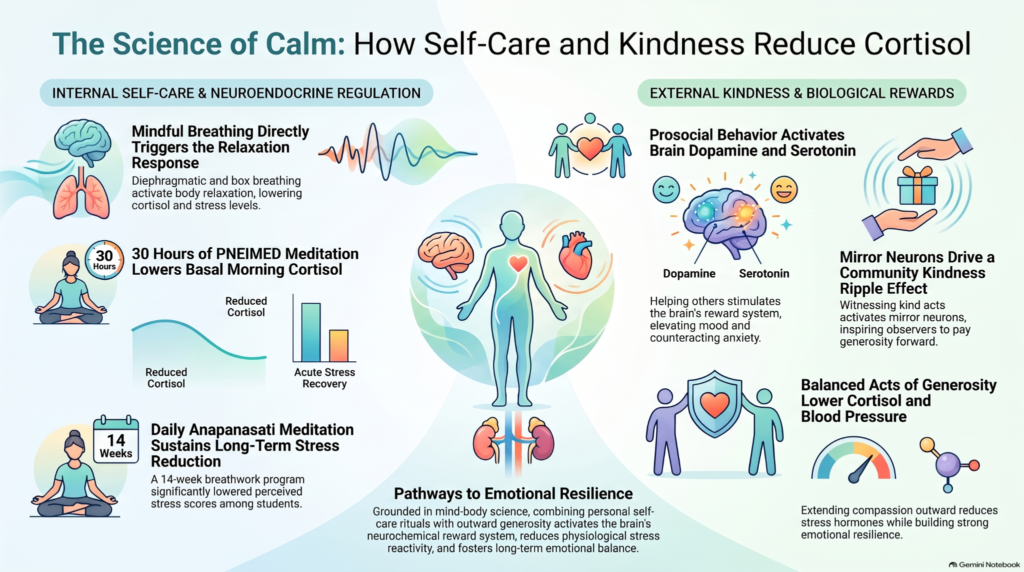
The positive effects of kindness are experienced in the brain of everyone who witnessed the act, improving their mood and making them significantly more likely to “pay it forward.” This means one good deed in a crowded area can create a domino effect and improve the day of dozens of people!
Kindness plays an essential role in enhancing your emotional well-being, serving as a powerful antidote to stress and negativity. Engaging in kindness interventions—whether through small acts of compassion or volunteering—creates emotional connections that can greatly uplift your mood.
Research shows that helping others activates the prosocial behavior brain reward system dopamine serotonin, which can contribute to feelings of pleasure, motivation, and emotional well-being while helping counteract stress and anxiety.
When you practice kindness, you not only improve others’ lives but also foster a sense of community and belonging for yourself. These emotional connections can buffer against stressors, leading to greater resilience.
Additionally, engaging in acts of kindness can reinforce positive self-identity and purpose, allowing you to break free from cycles of negativity. By prioritizing kindness in your daily life, you cultivate an environment where emotional well-being thrives, empowering you to embrace life’s challenges with greater ease and confidence.
How Cortisol Affects Your Mental Health
Emotional well-being can be greatly impacted by various physiological factors, one of which is cortisol, often referred to as the stress hormone. Elevated cortisol levels can lead to mental fatigue, complicating your stress response and emotional regulation. This imbalance can exacerbate anxiety management challenges and contribute to mood disorders. Understanding how cortisol affects your mental health allows you to explore effective coping mechanisms and prioritize stress relief.
| Effect of Cortisol | Mental Health Impact | Coping Strategies |
| Elevated levels | Increased anxiety | Mindfulness |
| Chronic exposure | Mood disorders | Physical activity |
| Fluctuating levels | Emotional instability | Social support |
| Reduced levels | Improved focus | Relaxation techniques |
Self-Care Practices to Lower Stress Hormones
To effectively lower stress hormones like cortisol, you can integrate mindful breathing techniques, physical activity, and gratitude journaling into your routine. Incorporating a simple self care activity, such as taking a short walk or practicing mindful breathing, can help you manage stress and enhance your overall emotional well-being.
Research shows that these practices not only reduce stress but also enhance your overall emotional well-being.
Mindful Breathing Techniques
Mindful breathing techniques offer a powerful way to lower stress hormones and promote emotional balance.
By engaging in deep breathing, you can activate your body’s relaxation response, leading to a decrease in cortisol levels.
Here are three effective practices to incorporate into your routine:
- Diaphragmatic Breathing: Place one hand on your chest and the other on your belly. Inhale deeply through your nose, allowing your belly to rise. Exhale slowly through your mouth.
- Box Breathing: Inhale for four counts, hold for four counts, exhale for four counts, and pause for four counts before repeating.
- Mindful Meditation: Focus on your breath, letting thoughts drift away. This practice enhances awareness and emotional resilience.
Embrace these techniques for a calmer, more balanced life.
Physical Activity Benefits
Physical activity serves as an essential tool for managing stress and enhancing overall well-being. Engaging in regular exercise not only boosts your mood but also greatly reduces cortisol levels, the hormone associated with stress.
Finding exercise motivation is key—try incorporating outdoor activities like hiking or biking, which connect you with nature and invigorate your spirit. Research shows that even short bursts of physical activity can lead to immediate emotional benefits, helping you feel more balanced and centered.
Gratitude Journaling Effects
While many self-care practices can help lower stress hormones, gratitude journaling stands out for its profound emotional benefits. By regularly reflecting on what you’re thankful for, you can actively reshape your mindset and reduce cortisol levels.
Here are three key gratitude benefits you’ll experience:
- Enhanced Emotional Resilience: Journaling helps you focus on positive experiences, making you more resilient to stress.
- Improved Mental Clarity: Writing down your thoughts fosters clarity, enabling you to process emotions more effectively.
- Stronger Relationships: Expressing gratitude can improve your connections with others, creating a supportive environment.
Incorporating these journaling techniques into your routine can lead to a more balanced emotional state, empowering you to embrace life’s challenges with a grateful heart.

HOW ACTS OF KINDNESS IMPROVE YOUR MOOD AND SUPPORT OTHERS
In my daily rituals and contemplative studies, I often observe how deeply our physiological states are entwined with our psychological focus. In mindfulness traditions, breathwork is revered as the vital bridge between consciousness and bodily calm; ancient scholars described breath and mind as riding the same horse. Modern endocrinology describes this exact phenomenon through the regulation of cortisol. When stress floods our system, the body tightens, entering a state of hypervigilance. Yet, as demonstrated in recent studies—such as research exploring targeted breathing, classical Anapanasati meditation, and intensive mind-body frameworks like PNEIMED—we possess the biological capacity to down-regulate that chemical alarm within our own tissues.
I see this harmony unfold regularly in simple daily living. Caring for a delicate fiddle-leaf fig or taking thirty mindful paces along a garden path does more than break up a busy workday; it acts as a conscious self-care activity that reassures our biology that we are safe. When we cultivate that inner spaciousness, our capacity to extend genuine kindness outward naturally expands.
Reaching out with a sincere compliment, sharing tea with a neighbor, or quietly helping a stranger isn’t an exhausting chore; it is an organic extension of a nourished self. This balance of internal presence and external generosity creates a tangible biological shift, buffering against daily wear and tear while steadying our emotional rhythm from the inside out.
Engaging in acts of kindness not only uplifts those around you but also provides a happiness boost from helping others behavioral science perspective, as research suggests that helping others can improve mood and promote a sense of connection and well-being. Research shows that kindness effects can lead to the release of endorphins, often referred to as the “helper’s high.”
When you perform a considerate act, whether it’s lending a hand or offering a compliment, your brain rewards you by boosting serotonin levels, which can trigger mood enhancement. This reciprocal nature of kindness creates a positive feedback loop; as you support others, you simultaneously foster a sense of belonging and connection.
Additionally, these interactions can alleviate feelings of isolation and stress, contributing to overall emotional well-being. By prioritizing kindness in your daily life, you cultivate resilience, not just for yourself but for your community.
Enhancing Emotional Resilience With Self-Care and Kindness
Kindness has been shown to increase self-esteem, empathy and compassion, and improve mood. It can decrease blood pressure and cortisol, a hormone directly correlated with stress levels. People who give of themselves in a balanced way also tend to be healthier and live longer.
To enhance your emotional resilience, it’s important to integrate self-care practices into your daily routine.
Research shows that engaging in acts of kindness not only boosts your mood but also strengthens your overall well-being.
Self-Care Practices Explained
Self-care practices play an essential role in enhancing emotional resilience, especially when you incorporate kindness towards yourself and others.
To cultivate this resilience, consider integrating the following self-awareness practices into your routine:
- Mindfulness Meditation: This helps you stay present, promoting emotional regulation by recognizing your feelings without judgment.
- Journaling: Writing down your thoughts fosters self-reflection, allowing you to process emotions and identify patterns in your behavior.
- Acts of Kindness: Engaging in small, kind gestures not only uplifts others but also boosts your mood, reinforcing positive emotional states.
Impact of Kindness on Well-Being
The beautiful thing about kindness is that it’s about the only thing in the world that doubles when shared. Neuroscientists used neuroimaging to show that ‘mirror neurons’ in the brain get fired up if you see someone shows emotion or a gesture, mimicking that feeling in the same areas of your own brain. Witnessing someone in pain activates the same parts of the brain as when we feel pain ourselves, just like you feel the urge to yawn when you notice someone else yawning. In conclusion, simply witnessing the kind act of another will motivate you to pay it forward.
Kindness has a profound impact on overall well-being, acting as a catalyst for emotional resilience. When you engage in compassion practices, you not only uplift others but also enhance your own mental health.
Research shows that acts of kindness can lower cortisol levels, reducing stress and promoting a sense of calm. These kindness benefits extend beyond the immediate moment; they create a ripple effect, cultivating a supportive community around you.
As you practice kindness, you’re also building your emotional toolkit, equipping yourself to handle life’s challenges more effectively. Ultimately, embracing kindness fosters a sense of connection and belonging, empowering you to navigate your journey with greater ease and joy.
Prioritize kindness and watch your well-being flourish.
Creating a Supportive Community for Change
Creating a supportive community for change is essential for fostering emotional balance and promoting self-care. When you engage with a network that values compassion and empathy, you’re more likely to thrive.
Community engagement plays a critical role in building resilience and emotional well-being. Here are three ways to cultivate that supportive environment:
- Encourage Open Communication: Foster spaces where sharing feelings and experiences is welcomed. This can help reduce feelings of isolation.
- Create Collaborative Opportunities: Organize group activities that promote kindness and collective growth, reinforcing the idea that you’re not alone in your journey.
- Establish Support Networks: Form connections with like-minded individuals who can provide guidance, encouragement, and accountability.

RELATED STUDIES ABOUT KINDNESS ACTS AND CORTISOL REDUCTION SCIENCE
You might think that self-care and kindness are just buzzwords, but the science backs their importance for emotional balance. Prioritizing these practices can lead to measurable reductions in cortisol, enhancing your mental health and overall resilience. Remember, even small acts of kindness can create ripples of positivity, not just for you, but for those around you. By embracing self-care and kindness, you’re not only nurturing yourself but also fostering a supportive community that thrives together.
Effect of Confucian-based acceptance and commitment therapy(C-ACT) on mental health and psychological flexibility improvement of college students: A randomized controlled trial
This randomized controlled trial (RCT) evaluates the efficacy of a culturally adapted, coach-supported Confucian-based Acceptance and Commitment Therapy (C-ACT) intervention compared with standard Mindfulness-based Acceptance and Commitment Therapy (M-ACT) in improving psychological flexibility and alleviating psychological distress among Chinese university students.
Study Overview & Conceptual Framework
- Clinical & Cultural Rationale: Chinese college students face mounting psychological distress stemming from academic competition, macroeconomic pressures, and employment insecurity. While third-wave cognitive behavioral therapies—specifically Acceptance and Commitment Therapy (ACT)—have demonstrated strong transdiagnostic efficacy, standard programs often suffer from high attrition in unguided online formats or low cultural resonance due to conceptual misalignment.
- Integration of Confucian Ethics with ACT Hexaflex: Grounded in the Theoretical Model of Confucian Self-Development (TMCS) and the historical self-cultivation framework of Qing Dynasty scholar-official Zeng Guofan, the study maps traditional Confucian practices directly onto the six core sub-processes of psychological flexibility (PF):
- Experiential Acceptance: Mapped to “abiding in reverence” (居敬) and “harboring in one’s heart” (心存), emphasizing non-reactive acceptance through disciplined conduct.
- Present Moment Awareness: Mapped to “abiding in stillness” (主静) and “feeling at ease” (心定), cultivated via tranquil sitting (静坐).
- Cognitive Defusion: Mapped to “personal cultivation / vigilance in solitude” (慎独) and achieving a relieved state (心安) through daily structured learning and calligraphy, separating external circumstances from mental events.
- Self-as-Context: Cultivated through routine bodily discipline (early rising, physical conditioning, avoiding nocturnal dissipation) to decouple the observing self from fleeting desires.
- Values: Mapped to “sincerity” (思诚) and single-minded focus (心专), explored via character cultivation (“nourishing vital energy” / 养气) and systematic monthly reflection.
- Committed Action: Mapped to “putting into practice” (践行) and the foundational doctrine of “unity of knowledge and action” (知行合一) through focused reading, historical study, and disciplined speech.
Methodology & Intervention Protocol
- Trial Design & Setting: A single-center, parallel-group randomized controlled trial conducted between September 2023 and February 2024 at a comprehensive university in Lanzhou, Western China. Assessments were administered at baseline (T1), immediate post-intervention (T2, 8 weeks), and 3-month follow-up (T3).
- Participants & Screening: Contacted 81 candidates; 76 met eligibility criteria and were randomized 1:1 via whole-cluster randomization into C-ACT (n=38) or M-ACT (n=38). Key inclusion criteria required being an enrolled university student, 18 years of age, without active psychosocial interventions, no prior ACT exposure, and having no formal religious affiliations (to prevent doctrinal dissonance).
- Baseline Cohort Profile: Mean age was 19.201.38 years; 44.7% female; 75.0% first-year undergraduates. No significant baseline differences emerged across demographics, academic tracks, birthplaces, baseline psychological flexibility, or psychological distress metrics (p>0.05).
- Intervention Format & Coaching Architecture: Both arms delivered an 8-week structured, face-to-face group program organized into small cohorts (8–10 students) led by two trained graduate-student coaches (drawn from applied psychology and social work) under senior clinical supervision. Participants completed weekly modules, daily reflective diaries, educational video modules, and reading guide assignments. While C-ACT integrated Confucian self-cultivation practices, M-ACT drew upon Buddhist ethical factors (compassion / Karuna, equanimity / Upekkha, empathetic joy / Mudita, loving-kindness / Metta) paired with body scans and sitting mindfulness meditation.
- Psychometric Instrumentation:
- Personalized Psychological Flexibility Index (PPFI): 15-item instrument assessing goal-referenced psychological flexibility across three subscales: Avoidance (reverse-scored), Acceptance, and Harnessing (=0.765).
- Depression Anxiety Stress Scales (DASS-21): 21-item global distress battery evaluating negative affect over the preceding week (=0.928).
- Analytical Modeling: Missing data (20 post-baseline dropouts) were addressed using fully conditional multiple imputation (20 imputations, 50 iterations). Primary effects were modeled via linear mixed models (LMM) with participant random effects, fixed effects of group, time, and group time interactions, supplemented by paired t-tests, within-group repeated-measures Cohen’s d, and one-sided between-group change comparisons.
Key Empirical Findings
- Broad Longitudinal Efficacy Across Both Modalities:
- Both C-ACT and M-ACT produced statistically significant improvements across the trial timeline (Time main effect p<0.001 for total PPFI, Avoidance, Acceptance, Harnessing, and total DASS, Stress, Anxiety, and Depression).
- Between baseline (T1) and 3-month follow-up (T3), both groups showed large within-group effect sizes for total psychological flexibility (C-ACT: d=0.70,p<0.001; M-ACT: d=0.97,p<0.001) and total distress reduction (C-ACT: d=0.75,p<0.01; M-ACT: d=0.71,p<0.001).
- Immediate Post-Intervention Contrast (T1 to T2):
- At immediate post-treatment, M-ACT produced a significantly larger increase in total psychological flexibility score gains relative to C-ACT (d=0.45,p<0.05; score increase 5.960.74 vs. 4.120.58).
- However, C-ACT demonstrated an immediate moderate within-group reduction in experiential avoidance (d=0.52,p<0.01), whereas M-ACT displayed early gains concentrated in acceptance (d=0.35,p<0.05) and total score (d=0.57,p<0.001).
- Selective Superiority of C-ACT on Harnessing at Long-Term Follow-Up (T2 to T3):
- Linear mixed model testing demonstrated a statistically significant group time interaction uniquely for the PPFI-Harnessing subscale (F=5.00,p<0.01).
- Between post-test (T2) and follow-up (T3), the C-ACT group continued to expand their capacity to convert negative affect into goal-directed motivation (Harnessing change: +2.140.40), whereas M-ACT plateaued (+0.770.39), yielding a statistically significant medium between-group effect size favoring C-ACT (d=0.57,p<0.05).
- Within-group effect sizes for C-ACT on psychological flexibility were notably higher during the follow-up phase (d=1.10,p<0.001) than during active treatment (d=0.22), whereas M-ACT exhibited comparable effects across both windows (d=0.57 then d=1.00), indicating strong post-intervention developmental persistence for Confucian-adapted techniques.
Theoretical & Practical Implications
- Mechanistic Synergy of Confucian Harnessing: The distinct advantage of C-ACT in the Harnessing dimension indicates that Confucian ethics provide an effective cultural schema for cognitive reframing. Rather than purely practicing detachment or non-judgmental awareness, Confucian principles view adversity, hardship, and emotional turbulence as essential raw materials for self-cultivation, thereby promoting proactive problem-solving and goal pursuit.
- Scalable Campus Delivery Model: Utilizing a collaborative coaching model—pairing graduate social work and applied psychology students as coaches under senior clinical supervision—provides a low-cost, scalable framework capable of addressing systemic staffing shortages within university mental health centers.
- Cultural Grounding in Psychological Interventions: The trial demonstrates that adapting Western third-wave behavioral therapies to indigenous philosophical traditions enhances longitudinal retention of regulatory skills without compromising the underlying therapeutic mechanisms of ACT.
Limitations & Research Considerations
- High Attrition Rate: The trial experienced substantial dropouts by the 3-month follow-up (20 participants total: 9 in C-ACT, 11 in M-ACT), reflecting the demanding weekly time commitment and heavy academic schedules of undergraduates.
- Demographic Homogeneity: The cohort was restricted to enrolled university students in Western China, limiting generalization to working youth, older demographics, or rural non-student populations.
- Potential Information Contamination: Because participants were recruited from a single university campus, cross-group communication between C-ACT and M-ACT participants could not be completely excluded.
- Reliance on Subjective Self-Reports: Outcomes were assessed entirely through self-report rating scales, highlighting the need for future trials to incorporate objective biomarkers (e.g., salivary cortisol, heart rate variability) and explore broader functional domains including academic retention, sleep architecture, and interpersonal relationship quality.
| REFERENCE: Yaping Zhou, Xiaochen Wen, Siyi Han, Yinan Li, Yue Lv, Qiushan Li, Effect of Confucian-based acceptance and commitment therapy(C-ACT) on mental health and psychological flexibility improvement of college students: A randomized controlled trial, Acta Psychologica, Volume 254, 2025, 104808, ISSN 0001-6918, https://doi.org/10.1016/j.actpsy.2025.104808. (https://www.sciencedirect.com/science/article/pii/S0001691825001210) |
Psychoneuroendocrinoimmunology-based meditation (PNEIMED) training reduces salivary cortisol under basal and stressful conditions in healthy university students: Results of a randomized controlled study
This randomized controlled trial investigates the efficacy of brief, intensive Psychoneuroendocrinoimmunology-based meditation (PNEIMED) training in modulating hypothalamic-pituitary-adrenal (HPA) axis activity—assessed via salivary cortisol—under both basal morning conditions and acute mental stress challenge in healthy, meditation-naïve university students.
Study Overview & Conceptual Framework
- Clinical & Physiological Rationale: Chronic activation and dysregulation of the HPA axis and sympathetic nervous system induce allostatic overload, contributing to mood disorders, cardiovascular disease, and metabolic disturbances. Salivary cortisol provides an established, non-invasive biomarker of adrenocortical reactivity and circadian tone. Although mind-body therapies have demonstrated positive effects on well-being and stress reduction, randomized controlled trials (RCTs) evaluating brief interventions with active control comparators and biological cortisol endpoints in healthy young cohorts remain scarce.
- The PNEIMED Method: Developed in Italy by Carosella and Bottaccioli, PNEIMED integrates modern scientific models of the mind-body-immune network with classical Mahayana Buddhist contemplative practices (specifically concentration [shamatha] and deep vision [vipassana]) and Assagioli’s psychosynthesis.
- Distinction from Mindfulness (MBSR): While standard Western mindfulness draws primarily from Theravada traditions and centers on non-judgmental acceptance of mental events, PNEIMED pairs contemplative practice with scientific didactic education regarding the neurobiology of stress, emotions, and systemic physiology. It utilizes specialized techniques—such as visualizing and releasing “emotional words” on an internal whiteboard—to foster emotional detachment, cognitive regulation, and ethical values of compassion and non-violence.
Methodology & Experimental Architecture
- Trial Design & Setting: A single-center, parallel-group randomized controlled trial adhering to the non-pharmacological extension of the CONSORT statement, conducted at the University of L’Aquila, Italy.
- Participants & Screening: From an initial pool of 130 assessed psychology undergraduates, 40 healthy, meditation-naïve 4th- and 5th-year students were enrolled. Rigorous exclusion criteria screened out active smokers, individuals with a body mass index (BMI) 25, current hormonal/oral contraceptive users, oral/dental pathologies, psychiatric conditions, and clinically significant distress on the Beck Depression Inventory-II (BDI-II >20), State-Trait Anxiety Inventory (STAI-Y2 >50), or Pittsburgh Sleep Quality Index (PSQI >5).
- Randomization & Demographics: Participants were randomized 1:1 via computerized random numbers into an intervention group (IG; n=20; 8 males, 12 females; mean age 25.24.07 years) or an active control group (CG; n=20; 6 males, 14 females; mean age 24.02.7 years). Baseline mood and sleep parameters were well-matched between groups (p>0.50).
- Intervention Protocols (Matched Duration):
- PNEIMED Intervention (IG): Delivered over 4 consecutive days (30 total hours) divided equally into 15 hours of didactic scientific education (mind-body medicine, epigenetics, stress neuroendocrinology, and lifestyle impacts) and 15 hours of guided meditation/relaxation (progressive body relaxation, geometric visualization, emotional word deconstruction, and deep open monitoring). Class sizes were capped at 20 participants.
- Active Control Group (CG): Attended 30 total hours of conventional academic lectures on health psychology and behavioral illness processes over the identical 4-day period in an adjacent university classroom, isolating the specific effect of meditation practice from didactic presence.
- Salivary Cortisol Sampling Protocol: Saliva was collected using Salivette tubes at four standardized time points both at baseline (pre-test) and four days later at post-test:
- Basal Morning (t0): Collected at home 30 minutes post-awakening.
- Pre-Stress Baseline (t1): 5 minutes prior to the laboratory stress task.
- Acute Stress Reactivity (t2): 10 minutes following the Subtraction Stress Task (SST).
- Stress Recovery (t3): 30 minutes following the SST.
- Cortisol concentrations were determined in triplicate via micro-ELISA.
- Statistical Modeling: Evaluated using mixed-model repeated-measures ANOVA (RM-ANOVA) with group as a between-subjects factor and condition (pre- vs. post-test) and time point (t0–t3) as within-subjects repeated factors, followed by Bonferroni post-hoc adjustments.
Key Empirical Findings
- Basal Diurnal Morning Cortisol Reduction:
- Between-Group Deflection: While baseline morning cortisol (t0) showed no significant difference between groups prior to training (9.426.0nmol/L in IG vs. 11.6412.1nmol/L in CG; F1,38=1.593,p=0.215), a statistically significant between-group divergence emerged post-intervention (F1,38=6.838,p=0.013). The PNEIMED group demonstrated lower morning levels (5.644.2nmol/L) than the control group (9.444.9nmol/L).
- Within-Group Attenuation: Within the PNEIMED group, basal morning cortisol declined significantly from pre-test to post-test (9.426.0 to 5.644.2nmol/L; F1,38=8.354,p=0.009; condition effect F=10.478,p=0.004). The control group showed no significant condition change (p=0.912).
- Reactivity and Recovery under Acute Mental Stress (SST):
- Stress Task Induction: The Subtraction Stress Task reliably elevated salivary cortisol across participants, confirming task validity.
- Accelerated Stress Recovery: Within the PNEIMED group, post-intervention cortisol concentrations during the recovery window (t3, 30 minutes post-SST) dropped significantly compared to their pre-intervention recovery levels (4.532.3 vs. 6.423.9nmol/L; F=5.326,p=0.032).
- Control Stability: The control group exhibited no significant changes across pre- and post-test stress evaluations at either peak reactivity (t2) or recovery (t3; pairwise comparison p>0.05).
Scientific & Practical Implications
- Rapid Neuroendocrine Plasticity: The results demonstrate that the HPA axis exhibits rapid functional regulation in healthy, meditation-naïve individuals following brief, intensive contemplative training (30 hours over 4 days).
- Active Control Rigor: Because the control cohort participated in matched-duration, high-level academic lectures on health and stress physiology, observed biological improvements cannot be attributed to general psychoeducation, instructional attention, or classroom social interaction alone. The inclusion of practical meditation techniques represents the active mechanism driving adrenocortical regulation.
- Preventive Health Utility: Down-regulating basal morning cortisol and accelerating physiological recovery following acute cognitive strain provides a biological buffer against allostatic load, supporting brief PNEIMED protocols as scalable stress-reduction interventions for student and occupational populations.
Methodological Limitations & Future Research
- Sample Size & Generalizability: The sample size (n=40) was small and restricted to psychology undergraduates at a single Italian university, limiting statistical power and requiring replication in broader demographic and clinical cohorts.
- Single-Day Basal Sampling: Morning cortisol was measured from a single post-waking sample (30 minutes) on one pre- and post-intervention day. Incorporating multi-day salivary assessments across consecutive days would better capture dynamic indices like the cortisol awakening response (CAR).
- Lack of Longitudinal Follow-Up: The final assessment occurred immediately following the 4-day intensive protocol, leaving the long-term durability and maintenance of neuroendocrine improvements unexamined.
| REFERENCE: Anna Giulia Bottaccioli, Francesco Bottaccioli, Antonia Carosella, Vincenza Cofini, Paola Muzi, Mauro Bologna, Psychoneuroendocrinoimmunology-based meditation (PNEIMED) training reduces salivary cortisol under basal and stressful conditions in healthy university students: Results of a randomized controlled study, EXPLORE, Volume 16, Issue 3, 2020, Pages 189-198, ISSN 1550-8307, https://doi.org/10.1016/j.explore.2019.10.006. (https://www.sciencedirect.com/science/article/pii/S1550830719305488) |
Aanapanasati Meditation and Stress Reduction Among Health Science University Students
This quasi-experimental empirical study evaluates the effectiveness of a 14-week Anapanasati Meditation Training Program (AMTP) on stress reduction, academic focus, physical relaxation, and interpersonal relationships among first-year dental students in Thailand.
Study Overview & Conceptual Framework
- Clinical & Educational Rationale: Healthcare science undergraduates face disproportionate levels of psychological stress driven by heavy curricular loads, clinical competencies, continuous examinations, and demanding time management pressures. Untreated chronic stress can impair working memory, learning engagement, and sleep quality, potentially contributing to somatic complaints, anxiety, and burnout.
- The Anapanasati Practice: Rooted in Buddhist contemplative traditions, Anapanasati meditation (AM)—derived from the Pali words anapana (inhalation and exhalation) and sati (mindfulness)—centers attention on the natural breath rhythm without force or control. The breath serves as an attentional anchor that settles the mind, cultivating tranquility (samatha) and concentration (samadhi). Within the cultural context of Thailand, AM represents a culturally familiar, accessible, and low-stigma approach to stress reduction and mental health promotion.
Methodology & Intervention Protocol
- Study Design & Setting: A single-arm, quasi-experimental prospective trial conducted at Thammasat University’s Faculty of Dentistry, Pathum Thani, Thailand, between August and December 2023 (analyzed through follow-up in early 2024).
- Participants & Screening: The target population comprised 50 first-year Thai dental students across regular (n=30) and bilingual (n=20) academic tracks. Thirty-one eligible volunteers aged 18 years displaying baseline moderate stress (Thai version of the Perceived Stress Scale [T-PSS-10] score between 1 and 26) were enrolled via a lottery system, excluding individuals diagnosed with major psychiatric disorders. A total of 28 participants completed the full intervention and follow-up protocol.
- Cohort Demographics: Mean age was 18.4 years; 67.9% were female (19/28); 60.7% were enrolled in the regular dental curriculum; 92.9% were dedicated solely to academic study without outside employment; and 60.7% resided in dormitories or rented accommodations.
- The AMTP Protocol:
- Structure: Required 60 minutes of daily practice divided into two complementary 30-minute components: walking meditation and sitting meditation.
- Walking Technique: Participants walked mindfully over a 5-to-10-meter course in a quiet environment, coordinating slow breathing with mental recitation of the mantra “Budho” while focusing attention on one of three anatomical centers (forehead, heart, or navel), concluding with a short loving-kindness (metta) prayer.
- Sitting Technique: Practiced in a relaxed, cross-legged posture with eyes lightly closed, tracking inhalation and exhalation alongside silent recitation of “Budho” to calm mental chatter, concluding with a recitation of the loving-kindness prayer.
- Workshops & Monitoring: Participants attended four in-person mini-workshops (Weeks 1, 4, 8, and 14) addressing stress mechanisms and practice techniques. Daily adherence was logged via Google Forms and the Line messaging application, supported by regular check-ins and a mandatory 10-minute video submission at Week 14 to verify technique fidelity.
- Assessment Time Points & Instruments:
- Evaluated using the validated 10-item Thai Perceived Stress Scale (T-PSS-10; 5-point Likert scale, Cronbach’s =0.76) at three intervals: Pre-intervention (baseline), Post-intervention (Week 14), and Long-Term Follow-up (Week 18; 4 weeks after program completion).
- End-of-program focus group discussions captured qualitative reflections regarding cognitive, emotional, and relational shifts.
- Statistical Analysis: Evaluated via repeated measures ANOVA, Cohen’s d effect sizes, and pairwise Bonferroni post-hoc tests (p<0.05).
Key Empirical Findings
- Quantitative Stress Reduction (T-PSS-10):
- Baseline perceived stress averaged 17.7 points. Following the 14-week AMTP intervention, mean stress scores declined significantly to 9.8 (p<0.001), with reductions sustained through the 18-week follow-up at 8.4 (p<0.001).
- Repeated-measures comparisons demonstrated large pairwise differences between baseline and post-test (t=0.79,p<0.001) as well as between post-test and follow-up (t=0.93,p<0.001).
- Item-Level & Effect Size Profiles:
- Between baseline and Week 14, eight out of ten T-PSS-10 items showed large stress reductions (d>0.80), led by item 1 (upset by unexpected events; d=1.33), item 8 (felt on top of things; d=1.31), and item 5 (felt things were going your way; d=1.20). Items 2 (inability to control important life events; d=0.65) and 10 (difficulties piling up; d=0.65) exhibited moderate effect sizes.
- By the 18-week follow-up, item 10 demonstrated further cumulative improvement (d=1.25), leaving only items 2 (d=0.68) and 7 (controlling irritations; d=0.90) at moderate effect levels, while the remaining items exhibited sustained, large effects (d up to 1.73 for item 1).
- Practice Habits & Behavioral Compliance:
- All 28 completers maintained consistent daily practice logs.
- 86% of participants (24/28) chose to meditate at night before sleeping, reporting that an uninterrupted environment helped relax the mind and improve sleep quality. The remaining 14% (4/28) meditated before dawn to establish calm focus for the upcoming day.
- Qualitative Thematic Insights:
- Enhanced Academic Focus & Cognitive Efficiency: Participants reported marked improvements in attentiveness, reduced distractibility during study periods, and fewer errors during examinations and laboratory tasks.
- Physical Relaxation & Sleep Quality: Participants described diminished muscle tension, interruption of intrusive/unnecessary thoughts, and restorative sleep.
- Improved Interpersonal Relationships & Emotional Self-Regulation: Practice promoted greater self-awareness, patience, and social empathy, fostering smoother interactions with peers and family members.
Educational & Public Health Implications
- Feasibility in Intensive Curricula: The high retention rate (28/31 completers; 90.3%) confirms that daily structured mindfulness breathing—particularly when combined with walking meditation—is manageable for first-year healthcare professional students when integrated into nighttime or morning routines.
- Preventive Mental Health Strategy: By lowering perceived stress and enhancing attentional control, institutionalizing Anapanasati meditation within healthcare science faculties can serve as an accessible, cost-effective intervention to prevent academic burnout and support student well-being.
Limitations & Future Research Directions
- Study Design Limitations: The quasi-experimental single-arm design lacked an active or passive randomized control group, meaning non-specific factors (e.g., passage of time, cohort familiarity, semester exam timing) cannot be fully ruled out.
- Sample Size & Specificity: The study was restricted to 28 first-year dental undergraduates at a single Thai university, limiting generalizability across different educational stages, diverse academic faculties, and non-Buddhist populations.
- Reliance on Self-Report: Stress assessments relied exclusively on the T-PSS-10 questionnaire. Future trials should implement randomized controlled designs across multiple institutions and incorporate objective physiological biomarkers (such as salivary cortisol, heart rate variability, or sleep polysomnography) alongside longitudinal academic performance metrics.
| REFERENCE: Ormanee Patarathipakorn, Kammal Kumar Pawa, Pasakorn Sritipsukho, Kunn Tansuhaj, Kornkarn Bhamarapravatana, Komsun Suwannarurk, Aanapanasati Meditation and Stress Reduction Among Health Science University Students, The Open Public Health Journal, Volume 18, 2025,, ISSN 1874-9445, https://doi.org/10.2174/0118749445380247250225075656. (https://www.sciencedirect.com/science/article/pii/S1874944525000310) |
CONCLUSION
True well-being is not a solitary summit to reach, but an interconnected, living ecosystem that flourishes with steady care. Just as a rare botanical cutting cannot thrive in hardened, neglected soil, our emotional resilience cannot survive under sustained criticism and neglect. When we close our day, the most transformative question we can ask ourselves isn’t how much we accomplished, but how gently we treated ourselves and those whose lives intersected with ours. Integrating small, tangible acts of self-compassion—whether resting with a notebook for evening reflection, gifting ourselves an hour of uninterrupted silence, or writing a brief poetic verse—is where true inner peace takes root.
The science surrounding cortisol reduction only validates what ancient contemplative teachers have known for centuries: kindness is an active medicine, not passive sentimentality. By softening your internal dialogue and allowing your compassion to spill outward into your community, you actively reshape your mental landscape.
Even on days when the world feels heavy and demanding, you can always return to the anchor of your natural breath, choose one small act of warmth for yourself, and pass that gentle light forward. As we step away from this reflection, consider what small ritual or gesture of kindness you will offer today—because in nurturing your own spirit, you quietly help heal the world around you.