
Throughout more than a decade researching mindful reward architecture and mental well-being, I have watched our culture develop an uneasy, almost adversarial relationship with our brain’s internal chemistry. We live in an era dominated by rapid notifications, infinite algorithmic feeds, and micro-bursts of artificial stimulation that flatten our sensory bandwidth. In response, modern wellness often prescribes harsh “dopamine detoxes” or treats natural pleasure pathways as vulnerabilities requiring discipline.
From a positive psychology perspective, this diagnostic lens is misguided. Dopamine is not an intrinsic flaw or a simple indulgence mechanism; it is the fundamental neurochemical engine of human curiosity, goal-directed action, and life engagement. When people ask me how to step out of chronic burnout and sensory numbness, my answer rarely starts with deprivation.
Instead, it begins with an intentional recalibration of where we direct our neural reward circuitry. Generosity and prosocial actions offer an elegant bridge here. When we turn our attention outward through genuine acts of giving, we step away from hollow, transient gratification and engage deep biological mechanisms designed for sustained connection. We are not designed to thrive in isolation; we are wired to experience profound biochemical replenishment when we share care, presence, and resources with others.
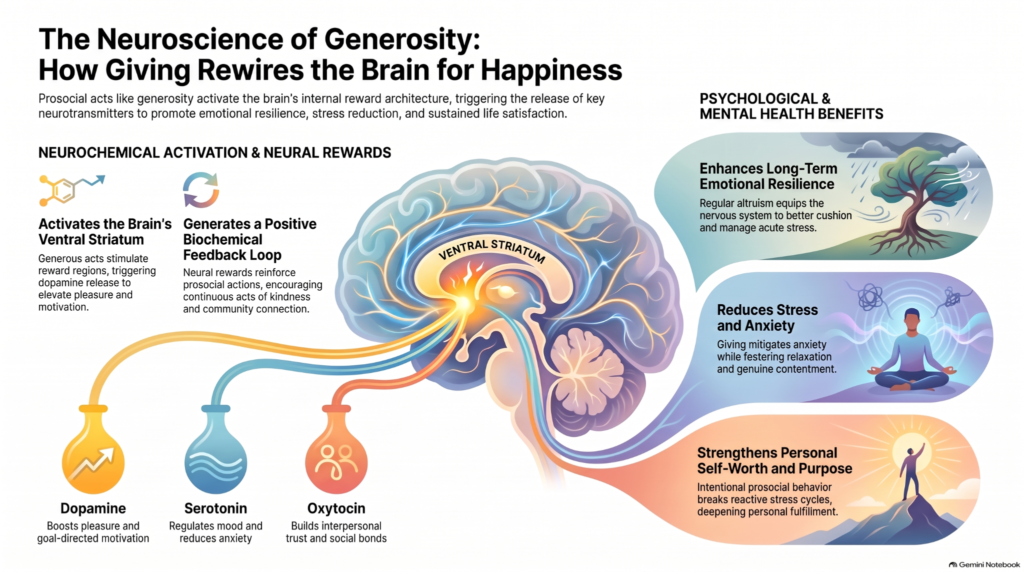
Prosocial behavior, like acts of generosity, activates your brain’s reward system, leading to increased levels of dopamine and serotonin. These neurotransmitters boost pleasure, regulate mood, and enhance emotional resilience, thereby elevating your happiness. Engaging in kindness not only fosters social connections but also creates a positive feedback loop that promotes mental well-being. Understanding the neural underpinnings of this effect reveals deeper insights into how you can cultivate happiness through generosity. Discover more about the broader implications and practices of this behavior.
KEY TAKEAWAYS
- Prosocial behaviors, like generosity, trigger the brain’s reward system, releasing dopamine and serotonin, enhancing feelings of happiness and motivation.
- Increased dopamine levels from acts of kindness create pleasure and reinforce the desire to engage in more prosocial actions.
- Serotonin release during generous acts helps regulate mood and anxiety, contributing to overall emotional well-being.
- Oxytocin, associated with generosity, fosters trust and strengthens social bonds, further enhancing happiness and community connections.
- Engaging in regular acts of kindness creates a positive feedback loop, boosting resilience and sustaining long-term happiness.
WHAT ARE PROSOCIAL BEHAVIORS AND WHY DO THEY MATTER?
Prosocial behaviors refer to “a broad category of acts that are defined by some significant segment of society and/or one’s social group as generally beneficial to other people” (Penner et al., 2005, p. 366). How prosocial behaviors arise is one of the fundamental questions of social life (Darwin, 2009). Prosocial behaviors, such as cooperation and altruism, are beneficial for group survival. However, these group advantageous behaviors come at a cost to the individual’s momentary reward (Wilson and Wilson, 2007). It remains unclear whether the intangible advantageous benefits of prosocial behaviors are integrative or segregated to the disadvantageous computations of tangible rewards for prosocial behaviors.
Prosocial behaviors, actions intended to benefit others, play an essential role in shaping social dynamics and individual well-being. These behaviors encompass a range of activities, including altruism, cooperation, and volunteering, reflecting various prosocial definitions.
By engaging in such actions, you not only foster community ties but also enhance your own emotional health. Research shows that prosocial behaviors lead to positive social impact, promoting trust and cooperation within groups.
When individuals contribute to the welfare of others, they often experience a sense of fulfillment and purpose, reinforcing social bonds. This connection can improve overall life satisfaction and well-being.
Moreover, the presence of prosocial actions in society can generate a ripple effect, inspiring others to act similarly, which amplifies community resilience.
Consequently, understanding and promoting prosocial behaviors is essential for both individual happiness and the collective health of society.
How Do Dopamine and Serotonin Make Us Happy?
Engaging in prosocial behaviors not only enhances connections with others but also triggers biochemical processes in your brain that contribute to feelings of happiness. Dopamine and serotonin, often referred to as happiness hormones, play vital roles in mood enhancement. When you engage in acts of kindness, your brain releases these neurotransmitters, fostering a sense of joy and well-being.
| Hormone | Effect on Happiness |
| Dopamine | Boosts pleasure and motivation |
| Serotonin | Regulates mood and anxiety |
| Both | Promote emotional resilience |
The Science of Generosity and Its Effects on the Brain
Social behaviors encompass a complex array of actions essential for survival, reproduction, offspring nurturing, and the overall well-being. These behaviors include any form of communication or interaction between two conspecifics and are observed across a wide range of organisms, from single-celled microorganisms to complex humans. Social need, similar to food and sleep, is maintained in a homeostasis. Chronic social deprivation (isolation) induces multisystem dysregulation in rodents, including metabolic dysfunction, affective disorders, cognitive impairment, and social behavior deficits. Clinical epidemiology further confirms social isolation as a risk factor for several human pathologies including diabetes, cancer, neuropsychiatric disorders, and cardiovascular disease in humans.
Research shows that acts of generosity can markedly influence neurotransmitter levels in your brain, particularly dopamine and oxytocin.
These changes not only enhance feelings of happiness but also contribute to improved mental well-being.
Understanding this relationship helps clarify how giving can be as beneficial for you as it’s for those you help.
Neurotransmitters and Generosity
While you may not realize it, the act of being generous triggers complex biochemical processes in your brain that can enhance your overall well-being. Neurotransmitter roles, particularly dopamine and serotonin, play an essential part in how generosity affects your mood and emotional state.
When you give, your brain releases these chemicals, creating feelings of joy and satisfaction.
- A surge of dopamine sparks a reward sensation.
- Serotonin stabilizes your mood, fostering contentment.
- Oxytocin builds trust and strengthens social bonds.
- Endorphins alleviate stress, promoting relaxation.
Understanding these connections reveals how generosity can lead to a more fulfilling life. Engaging in prosocial behavior not only benefits others but also enriches your own mental landscape, making generosity a meaningful self care activity that supports emotional well-being and strengthens social connections.
Impact on Mental Well-being
Generosity doesn’t just uplift those who receive; it also has profound effects on your mental well-being. Engaging in acts of kindness can notably enhance your mental wellness by stimulating the brain’s reward system. This activation increases dopamine and serotonin levels, which are essential for mood regulation. When you engage in acts of kindness, oxytocin release during altruistic behavior may help strengthen interpersonal trust, deepen social connections, and support emotional well-being.
Research shows that individuals practicing generosity demonstrate improved emotional resilience, allowing them to cope better with stress and adversity. By fostering a sense of connection and purpose, generous behaviors can lead to greater life satisfaction.
Furthermore, the positive feedback loop created by helping others can reinforce your own feelings of happiness. Fundamentally, embracing generosity not only benefits those around you but also cultivates a healthier, more resilient you.
HOW CAN GENEROSITY IMPROVE MENTAL HEALTH?
In examining how reward pathways operate in daily life, one of the most persistent misconceptions I encounter—both in clinical literature and everyday conversations—is the belief that dopamine represents the ultimate experience of enjoyment. In reality, dopamine drives the pursuit rather than the lingering satisfaction. It acts as an orienting signal that tells the mind, pay attention, explore this, pursue this. The genuine feeling of calm contentment, stability, and emotional presence requires downstream neurochemical partners: the mood-stabilizing effects of serotonin, the quiet security of oxytocin, and our internal soothing systems.
When we practice prosocial behavior, something extraordinary happens across these intersecting neural circuits. Far from a passive emotional state, extending kindness activates dynamic reward regions like the ventral striatum and mesolimbic pathways, transforming social connection into tangible emotional resilience. Interestingly, this process parallels what I observe in my work on healthy personal reward rituals: the value lies entirely in mindful intention.
When you give to someone else—or when you gift yourself an intentional pause, like quiet time with watercolors or an afternoon hiking in open air—you break the cycle of automatic, reactive living. You supply your nervous system with authentic, predictable positive reinforcement. This intentionality anchors your self-worth, deepens your capacity for empathy, and builds an internal emotional buffer capable of weathering acute stress.
When you engage in acts of generosity, you not only benefit others but also enhance your own mental health.
Generosity fosters self-esteem enhancement and strengthens social connections, creating a positive feedback loop.
Here’s how it can improve your mental well-being:
- Feelings of accomplishment: Helping others boosts your sense of purpose.
- Strengthened relationships: Acts of kindness foster trust and deepen bonds.
- Increased happiness: Generosity releases endorphins, elevating your mood.
- Reduced stress: Altruistic behavior can mitigate anxiety and promote relaxation.
How Generosity Boosts Our Brain’s Reward System
Engaging in generous acts triggers the brain’s reward system, leading to a cascade of neurochemical reactions that enhance feelings of pleasure and satisfaction.
When you practice generosity, studies show that brain activation occurs in areas associated with reward processing, such as the ventral striatum. This activation results in the release of dopamine, a neurotransmitter linked to feelings of happiness and motivation.
The generosity effects extend beyond immediate gratification; they can foster long-term emotional well-being by activating your brain’s self reward system, reinforcing positive behaviors and encouraging continued acts of kindness. As you give, the anticipation of positive feedback from others further fuels this reward system, reinforcing the behavior.
Empirical research indicates that individuals who engage in regular acts of kindness experience higher levels of overall happiness.
Consequently, understanding how generosity influences your brain’s reward system can empower you to incorporate more prosocial behavior into your life, ultimately leading to greater fulfillment and joy.
Practical Ways to Be Generous in Daily Life
The brain’s reward system is a network of structures that reinforce behaviors necessary for survival, such as eating, reproduction, and social interactions. Central to this system is the mesolimbic dopamine pathway, which includes the ventral tegmental area (VTA) and the nucleus accumbens. When an individual engages in a rewarding activity, the brain releases dopamine, creating a sense of pleasure and reinforcing the behavior to encourage repetition. This mechanism, designed for survival, is highly adaptable but can be exploited by artificial stimuli.
Although many people associate generosity with grand gestures, there are numerous practical ways to incorporate acts of kindness into your daily life.
Engaging in small, consistent actions can greatly enhance your well-being and foster a sense of community.
- Volunteer at local shelters: Share your time and skills to help those in need.
- Offer compliments to colleagues: A simple acknowledgment can brighten someone’s day.
- Pay for a stranger’s coffee: This random act can create a ripple effect of kindness.
- Help a neighbor with groceries: Building connections in your community enhances social bonds.
Long-Term Mental Health Benefits of Generosity
Generosity not only fosters social connections but also plays a significant role in enhancing long-term mental health. Research indicates that engaging in generous acts can lead to profound long-term effects on your emotional well-being. When you give to others, your brain releases neurotransmitters like dopamine and serotonin, which contribute to feelings of happiness and satisfaction.
Over time, these biochemical changes can bolster your emotional resilience, making you better equipped to handle life’s challenges.
Moreover, consistent acts of generosity can create a positive feedback loop. As you experience the mental health benefits, you’re likely to continue engaging in prosocial behaviors, further strengthening your emotional stability.
This cycle not only promotes a sense of purpose but also helps cultivate enduring connections with your community. Ultimately, generosity can serve as a powerful tool for enhancing your mental health and achieving lasting happiness.
RELATED STUDIES ABOUT PROSOCIAL BEHAVIOR BRAIN REWARD SYSTEM DOPAMINE SEROTONIN
In examining the connection between prosocial behavior and happiness, it becomes evident that generosity activates the brain’s reward system, particularly through dopamine and serotonin pathways. This activation not only fosters immediate feelings of joy but also contributes to long-term mental health benefits. Empirical evidence suggests that engaging in generous acts enhances well-being, reinforcing the theory that sharing and caring for others is intrinsically rewarding. Ultimately, embracing generosity can be a powerful catalyst for sustained happiness and improved mental health.
Variation in DNA methylation of the oxytocin gene is associated with prosocial, reward-related, decision-making
This pre-registered, double-blind, placebo-controlled empirical study examines the relationship between DNA methylation (DNAm) of the oxytocin gene (OXT), exogenous intranasal oxytocin administration, and multifaceted prosocial behaviors—specifically trusting behavior, generosity, and dispositional social traits—in healthy young adult males.
Study Overview & Conceptual Framework
- Theoretical Rationale: Central oxytocin (OXT) modulates social cognition, affiliation, and prosocial decision-making. However, human trials investigating exogenous intranasal OXT have generated highly heterogeneous findings, indicating that behavioral effects are constrained by individual biological baselines, context, and dosing.
- Epigenetic Focus on the OXT Gene: While prior epigenetic inquiries concentrated primarily on the oxytocin receptor gene (OXTR), endogenous OXT synthesis relies critically on the OXT structural gene. Because hypermethylation at promoter CpG islands generally mediates transcriptional silencing and chromatin compaction, elevated OXT promoter DNAm is hypothesized to suppress basal peptide synthesis capacity, leading to downstream decrements in prosocial behavior and altering responsiveness to exogenous peptide administration.
- Preregistered Hypotheses:
- Hypothesis 1a & 1b: Greater OXT DNAm negatively associates with self-reported dispositional trust (Inclusive Generalised Trust Scale [IGTS]) and dispositional social value orientation (SVO).
- Hypothesis 2a & 2b: Greater OXT DNAm negatively associates with task-based prosocial investments in a trust game (measuring interpersonal trust) and monetary allocations in a dictator game (measuring generosity).
- Hypothesis 2c & 2d: Exogenous intranasal OXT administration interacts with baseline OXT DNAm, producing greater behavioral facilitation in participants displaying higher DNAm (putatively lower endogenous baseline OXT).
Methodology & Experimental Architecture
- Participants & Screening: Recruited 234 healthy young men (aged 18–32 years) screened to exclude lifetime DSM-5 psychiatric/neurological disorders, psychotropic medication usage, or excessive substance consumption. After applying pre-registered compliance exclusions (recent substance/excessive nicotine use, mock-trustee pairings due to session no-shows, missing pyrosequencing data, and assay artifacts), the analyzed cohorts comprised:
- Dispositional traits: n=215.
- Trust game analyses: n=206 (96 OXT, 110 placebo).
- Dictator game analyses: n=205 (96 OXT, 109 placebo).
- Two-Stage Experimental Workflow:
- Session 1 (Online): Collected self-reported dispositional trust (IGTS), SVO (decomposed into prosocial vs. proself classifications), and subjective chronic nasal obstruction levels.
- Session 2 (Laboratory): Provided pre-treatment saliva samples for DNA isolation and pyrosequencing, self-administered nasal spray (24 IU Syntocinon vs. hypotonic saline placebo; 3 puffs per nostril), and completed behavioral economic tasks during the 30–90 minute post-administration peak window.
- Epigenetic Pyrosequencing: Quantified 5-methylcytosine (5-mC) across eight CpG sites within the OXT promoter region (GRCh37/hg19 chr20:3052,247 to chr20:3052,355) using bisulfite conversion (EZ-96 DNA Methylation-Gold Kit) and a PyroMark Q48 Autoprep system with validated calibration standards.
- Behavioral Economic Tasks:
- Trust Game: Participants acted as investors endowed with 12 Experimental Money Units (EMU), choosing to invest 0, 4, 8, or 12 EMU with a trustee; investments were tripled, and trustees could return any integer amount.
- Dictator Game: Participants allocated a €10 endowment between themselves and an anonymous, real off-site beneficiary.
- Statistical Modeling: Evaluated using Pearson correlations, Point-Biserial correlations, Spearman rank correlations (for ordinal trust investments), ordinal logistic regression (OLR), and linear regression with nasal obstruction scores as an administration covariate. Statistical tests were evaluated at =0.05 without multiple comparison corrections given the exploratory nature of the study.
Key Empirical Findings
- Selective Negative Association with Trust Game Investments:
- Spearman rank correlation identified statistically significant negative associations between OXT promoter DNAm and trust game investments across three adjacent cytosine-phosphate-guanine sites:
- CpG site 5 (chr20:3052,319): =-0.16,p=0.03.
- CpG site 6 (chr20:3052,334): =-0.15,p=0.04.
- CpG site 7 (chr20:3052,345): =-0.15,p=0.04.
- Trend-level negative associations emerged at CpG site 1 (=-0.13,p=0.07) and CpG site 4 (=-0.13,p=0.07), with participant-level mean CpG methylation correlating with trust at =-0.12,p=0.09.
- Spearman rank correlation identified statistically significant negative associations between OXT promoter DNAm and trust game investments across three adjacent cytosine-phosphate-guanine sites:
- Null Associations with Trait Propensities & Generosity:
- OXT DNAm was not significantly associated with dispositional trust (IGTS scores) or SVO classifications across any CpG site.
- Median-split comparisons revealed no significant differences in OXT DNAm between high- and low-trusting individuals.
- Dictator game allocations showed no significant negative associations with DNAm across any CpG locus, demonstrating that epigenetic variation did not influence unilateral generosity.
- Absence of Main or Moderating Effects of Exogenous OXT:
- Intranasal administration of 24 IU OXT produced no main effect on trust investments or dictator allocations compared to placebo.
- Ordinal logistic regression and linear regression revealed no significant interaction effects between treatment allocation (OXT vs. PLC) and OXT DNAm at any CpG locus on either task.
- While post-experimental guessing revealed partial unblinding (2=4.28,p=0.04 for trust; 2=5.94,p=0.01 for dictator), participant treatment beliefs did not significantly predict behavioral outcomes, ruling out expectancy or placebo artifacts.
- In Silico Transcription Factor Binding Analysis:
- Querying the JASPAR CORE database identified predicted binding sites overlapping CpG loci 5–7 for the zinc finger (ZNF) transcription factor family:
- ZNF460 at CpG site 5 (score 446, p=10-4).
- ZFX, ZNF135, and ZNF770 at CpG site 6 (scores 404–587, p10-4).
- ZNF454 at CpG site 7 (score 408, p=10-4).
- Querying the JASPAR CORE database identified predicted binding sites overlapping CpG loci 5–7 for the zinc finger (ZNF) transcription factor family:
Mechanistic Interpretations & Divergence
- Epigenetic Regulation Along the Oxytocinergic Axis: While prior work linked OXTR hypermethylation to social cognitive impairments and untrustworthiness sensitivity, this study provides the first evidence linking promoter methylation of the OXT ligand gene itself to social decision-making. Methylation at CpG loci 5–7 may influence chromatin accessibility and ZNF transcription factor binding, potentially altering endogenous synthesis.
- Domain-General Reward Processing vs. Pure Social Trust: The authors emphasize that the selective divergence between the trust game (significant association) and the dictator game (null association) may reflect domain-general reward sensitivity and approach motivation rather than trust per se. In the trust game, higher investments carry the expectation and probability of monetary multiplication and return, whereas the dictator game represents unilateral loss of personal payout. OXT is known to interface with mesocorticolimbic dopaminergic pathways regulating reward prediction error, reinforcement learning, and goal-directed approach.
- Peripheral vs. Central Biological Disconnect: Salivary OXT DNAm did not predict behavioral responsiveness to exogenous OXT. Because peripheral DNAm was not paired with direct measures of OXT messenger RNA transcription, CSF peptide concentrations, or receptor occupancy, peripheral DNAm serves as a correlational epigenetic biomarker rather than a validated index of central oxytocinergic tone.
Methodological Limitations & Future Directions
- Statistical Rigor & Correction Thresholds: The reported associations between CpG sites 5–7 and trust investments were modest (=-0.15 to -0.16) and would not survive formal adjustment for multiple comparisons, requiring confirmation in larger independent cohorts.
- Demographic Restrictions: The study was conducted exclusively in young, healthy males, precluding generalization to females—where oxytocinergic signaling interacts with estrogen fluctuations, menstrual phases, and oral contraceptives—or to aging populations.
- Delivery & Bioavailability: Reliance on conventional liquid nasal sprays involves variable central bioavailability, supporting the adoption of advanced delivery mechanisms (e.g., Breath Powered devices) and multi-dose testing to establish non-linear dose-response profiles.
| REFERENCE: Charlotte F. Kroll, Nicole K. Leibold, Claudia Vingerhoets, Gunter Kenis, Daniel L.A. van den Hove, Arno Riedl, Koen R.J. Schruers, Dennis Hernaus, Variation in DNA methylation of the oxytocin gene is associated with prosocial, reward-related, decision-making, Psychoneuroendocrinology, Volume 188, 2026, 107815, ISSN 0306-4530, https://doi.org/10.1016/j.psyneuen.2026.107815. (https://www.sciencedirect.com/science/article/pii/S0306453026000752) |
The endocannabinoid and paracannabinoid systems in natural reward processes: possible pharmacological targets?
This review synthesizes preclinical and clinical evidence examining the regulatory roles of the endocannabinoid system (ECS) and its paracannabinoid counterpart (predominantly N-acylethanolamines [NAEs]) across natural reward domains—feeding, reproductive behavior, and social interaction—evaluating their underlying neurobiology, circuit-level mechanisms, and therapeutic potential for metabolic and neuropsychiatric disorders.
Study Overview & Signaling Architecture
- The Endocannabinoid System (ECS): Comprises cannabinoid receptors (predominantly CB1 in the central nervous system and CB2 in peripheral and immune cells), endogenous lipid ligands derived from membrane polyunsaturated fatty acids—anandamide (AEA) and 2-arachidonoylglycerol (2-AG)—and their metabolic machinery. Unlike classical vesicular neurotransmitters, ECs are synthesized on demand in response to intracellular calcium influx and act as retrograde messengers that suppress presynaptic GABAergic or glutamatergic neurotransmission. AEA is primarily degraded by fatty acid amide hydrolase (FAAH), whereas 2-AG is hydrolyzed by monoacylglycerol lipase (MAGL).
- The Paracannabinoid System: Encompasses bioactive N-acylethanolamines structurally related to AEA—including oleoylethanolamide (OEA), palmitoylethanolamide (PEA), stearoylethanolamide (SEA), and docosahexaenoyl ethanolamide (DHEA)—as well as monoacylglycerol congeners. These molecules act independently of classical CB1/CB2 receptors, signaling instead via peroxisome proliferator-activated receptor-alpha (PPAR-), transient receptor potential vanilloid 1 (TRPV1), G-protein coupled receptor 55 (GPR55), and GPR119. Paracannabinoid signaling is terminated primarily by FAAH and N-acylethanolamine acid amidase (NAAA).
- Integrated Natural Reward Neurobiology: Food, sexual reproduction, and social bonding engage overlapping corticolimbic networks. Hedonic “liking” is governed by discrete hotspots in the nucleus accumbens (NAc) medial shell, ventral pallidum, and parabrachial nucleus, responsive to opioids and ECs. Incentive “wanting” is driven by mesocorticolimbic dopaminergic projections from the ventral tegmental area (VTA) to the NAc, medial prefrontal cortex (mPFC), and amygdala, tightly coordinated with hypothalamic homeostatic nuclei.
Role in Feeding Behavior & Metabolic Disorders
- Homeostatic & Hedonic Interplay:
- Hypothalamic Energy Balance: In the arcuate nucleus (ARC), CB1 activation presynaptically stimulates orexigenic NPY/AgRP neurons and inhibits anorexigenic POMC neurons, integrating peripheral hormonal inputs (leptin, ghrelin, insulin) with hypothalamic nuclei (lateral hypothalamus [LH], paraventricular nucleus [PVN], and dorsomedial hypothalamus).
- Mesolimbic Reinforcement: In the VTA and NAc, CB1 activation stimulates dopamine efflux and ERK signaling cascades, enhancing the incentive salience and “liking” of palatable food. Olfactory CB1 receptors on cortical glutamatergic terminals directly promote odor-driven hedonic eating.
- Enzymatic Tuning: Selective knockdown of NAPE-PLD in the VTA increases palatable food-seeking, operant responding, and NAc dopamine release, while protecting against diet-induced obesity via increased energy expenditure. Conversely, genetic FAAH deficiency (or human C385A variants) blunts leptin sensitivity and amplifies orexigenic drives via elevated baseline EC tone.
- Paracannabinoid Satiety Signaling (OEA, PEA, SEA):
- OEA Mechanisms: Synthesized in the small intestine in response to dietary fat, OEA acts as an anorexigenic satiety signal that extends inter-meal intervals via peripheral PPAR- activation. Peripherally administered OEA distributes rapidly to the brainstem (area postrema, solitary tract nucleus [NST]), hypothalamus, and hippocampus, independently of subdiaphragmatic vagal afferents. It recruits noradrenergic NST-to-PVN projections and activates hypothalamic oxytocinergic and histaminergic circuits, upregulating oxytocin release to suppress feeding. In the striatum, OEA restores deficient dopamine release in high-fat-diet models and dampens stress-induced dopaminergic hyperactivation in binge-eating paradigms.
- PEA & SEA: PEA reduces adiposity, improves hypothalamic leptin sensitivity in ovariectomized rodents, and remodels gut microbiota, while SEA suppresses short-term intake and downregulates hepatic stearoyl-CoA desaturase-1.
- Clinical & Pathological Implications:
- CB1 Antagonism: The first-generation central/peripheral CB1 antagonist rimonabant produced robust weight loss and binge-reduction but was withdrawn due to severe centrally mediated depression, anxiety, and suicidal ideation. Second-generation peripherally restricted neutral antagonists (AM6545) and inverse agonists (JD5037) successfully preserve metabolic benefits, improve glycemic control, and reduce palatable food intake without crossing the blood-brain barrier.
- Anorexia Nervosa (AN): In human AN, the normal meal-related rise in plasma 2-AG during hedonic eating and the rise of OEA/PEA during non-hedonic eating are blunted, persisting even after weight restoration. In activity-based anorexia (ABA) rodent models, 2-AG is acutely suppressed across feeding-regulatory regions, while AEA, OEA, and PEA exhibit delayed, widespread downregulation in the hippocampus and hypothalamus, driving persistent hypophagia and cognitive-emotional rigidity.
Role in Reproductive Behaviors
- Male Sexual Behavior (MSB):
- Preclinical cannabinoid administration demonstrates dose-dependent, biphasic actions. Low doses of AEA facilitate copulatory parameters via CB1 receptor activation, whereas high doses of AEA, 9-THC, or synthetic agonists (HU-210) inhibit sexual motivation and performance (prolonging mount, intromission, and ejaculation latencies) through sedation or TRPV1 engagement.
- In sexually sluggish or non-copulating male rats, acute AEA administration restores copulatory capacity for up to two weeks and enhances penile erection via neurogenic relaxation in the corpus cavernosum, indicating therapeutic utility for delayed ejaculation disorders.
- Female Sexual Behavior:
- Hypothalamic CB1 receptor density and AEA concentrations fluctuate across the estrous cycle, characterized by CB1 downregulation and concurrent AEA elevation during estrus (heat) under estradiol and progesterone priming.
- Cannabinoid receptor modulation yields variable responses: low doses of 9-THC or AEA enhance sexual motivation and lordosis duration in hormone-primed females, whereas high doses, synthetic agonists (CP55,940; HU-210), or acute vaporized cannabis diminish proceptive behaviors.
- Paracannabinoid Involvement: Female paced mating alters NAE levels across reward-related regions, with significant reductions of PEA, SEA, OEA, and DHEA in the striatum, midbrain, brainstem, and hippocampus during appetitive and consummatory phases.
Role in Social Interactions & Neuropsychiatric Impairment
- Affiliative Play & Social Reward:
- In adolescent rodents, elevating AEA tone via FAAH inhibition (URB597) selectively enhances social play behavior. This behavior involves a functional neuroanatomical dissociation: CB1 activation in the basolateral amygdala (BLA) mediates behavioral play expression, while CB1 signaling in the NAc mediates its motivational/reinforcing value.
- AEA-driven prosocial effects in the NAc are dependent on oxytocin signaling and dopamine D1/D2 receptor activation, and interact with the endogenous opioid system (requiring concurrent -opioid receptor activation in the NAc core).
- Developmental Vulnerability & Age-Dependent Divergence:
- While indirect ECS enhancement is pro-social, direct CB1 agonists and adolescent cannabinoid exposure disrupt social interaction and cognitive flexibility. Exposure during the vulnerable adolescent window alters mPFC synaptic connectivity, disrupts astrocytic lactate metabolism, and induces sex-dependent abolishment of endocannabinoid-mediated long-term depression (EC-LTD) in the female prelimbic cortex.
- Social Hierarchies & Maternal Bonding:
- Submissive mice exhibit elevated baseline levels of AEA and DHEA, while exogenous DHEA enhances dominance behaviors in aggressive/dominant mice. Genetic deletion of CB1 receptors impairs maternal behavior (pup retrieval, nursing) and reduces hippocampal oxytocin receptor and BDNF expression.
- Neurodevelopmental & Stress Models (ASD & CSDS):
- In human Autism Spectrum Disorder (ASD), clinical cohorts consistently display diminished circulating levels of AEA, OEA, and PEA.
- In valproic acid-induced and genetic (BTBR, Fmr1 knockout) rodent models of ASD, FAAH inhibitors (URB597, PF-3845) rescue social approach deficits via CB1-dependent mechanisms.
- Co-ultramicronized PEA plus luteolin, or PEA alone, reduces stereotypic behaviors, restores social preference, and normalizes hippocampal BDNF/CREB phosphorylation.
- In chronic social defeat stress (CSDS), systemic OEA reverses stress-induced social avoidance through histaminergic and hypothalamic oxytocinergic pathways, restoring PVN oxytocin expression.
Translational Roadmaps & Pharmacological Outlook
- Limitations of Direct Cannabinoid Agonists/Antagonists: Direct CB1 agonists pose significant risks of sedation, psychotropic effects, and cognitive disruption, while first-generation centrally active antagonists carry unacceptable psychiatric toxicity.
- Peripherally Restricted CB1 Antagonism: Second-generation peripheral CB1 neutral antagonists (AM6545) and inverse agonists (JD5037) hold strong translational promise for obesity, metabolic syndrome, and fatty liver disease by targeting peripheral metabolic organs and gut-brain signaling without neuropsychiatric liabilities.
- Enzyme Inhibition (FAAH & NAAA): Enhancing endogenous spatial-temporal lipid signaling via selective FAAH or NAAA inhibitors avoids receptor overstimulation, providing targeted therapeutic avenues for binge eating, withdrawal-induced anxiety, sexual dysfunctions, and social communication deficits in ASD.
- Direct Paracannabinoid Supplementation: Leveraging endogenous satiety mediators such as OEA (currently marketed as RiduZone) and PEA presents an established safety profile for metabolic regulation, neuroinflammation attenuation, and stress resilience.
| REFERENCE: Marzia Friuli, Barbara Eramo, Christian Sepe, Mitra Kiani, Paola Casolini, Anna Rita Zuena, The endocannabinoid and paracannabinoid systems in natural reward processes: possible pharmacological targets?, Physiology & Behavior, Volume 296, 2025, 114929, ISSN 0031-9384, https://doi.org/10.1016/j.physbeh.2025.114929. (https://www.sciencedirect.com/science/article/pii/S0031938425001301) |
Prosocial behaviors in rodents
This review synthesizes behavioral paradigms, contextual modulators, and neural circuits underlying prosocial behaviors in rodents, comparing actions driven by negative affective states (consolation, rescue, harm aversion) against positive affective states (reward provision).
Conceptual Framework & Theoretical Models
- Defining Rodent Prosociality: Prosocial behavior is defined broadly as actions benefiting another individual by improving their condition, regardless of lifetime direct fitness outcomes for the actor. Altruism is treated as a costly, other-regarding subset of prosociality with no expectation of self-benefit, while cooperation requires mutual coordinated benefit. In laboratory rodents, an action is operationalized as prosocial when it is learned, flexible, and goal-directed.
- Evolutionary Empathy Frameworks:
- Russian Doll Model (de Waal & Preston): Posits sequential, layered phylogenetic continuity built upon an ancient core Perception-Action Mechanism (PAM) driving motor mimicry and emotional contagion. Outer layers require advanced self-other distinction, emotion regulation, and cognitive complexity (empathic concern, consolation, targeted helping, perspective-taking).
- Three-Factor Combination Model (Yamamoto): Rejects strict linear dependence, proposing three interacting dimensions that evolved via convergent evolution: matching with others (emotional contagion), understanding of others (perspective-taking), and prosociality. Under this view, prosocial resource allocation (e.g., food-based prosocial choice) can operate independently of emotional state matching.
Behavioral Paradigms in Negative Affective States
- Consolation Paradigm (Allogrooming / Allolicking):
- Behavioral Dynamics: Measures increased affiliative social touch directed toward a conspecific experiencing acute distress (physical pain, fear conditioning, social defeat, or surgical trauma). Physical contact provides active stress buffering, normalizing post-stress corticosterone levels and reducing anxiety-like behavior in the demonstrator.
- Familiarity & Species Divergence: Monogamous prairie voles (Microtus ochrogaster) display strict familiarity-dependent consolation (selectively directed to mates, siblings, or familiar cagemates), whereas promiscuous meadow voles show no consolation. Rats and mice extend allogrooming to unfamiliar distressed partners, although familiarity and prior self-experience with the stressor amplify the response.
- Neural Mechanisms: Highly dependent on the anterior cingulate cortex (ACC). Oxytocin (OT) receptor signaling, GABAA, serotonin 5-HT1A, and dopamine D2 receptor activation within the ACC are necessary for consolation. Serotonergic projections from the dorsal raphe nucleus to the ACC (DRACC) regulate both consolation allogrooming and sociability. In mice, tachykinin-positive (Tac1+) GABAergic neurons projecting from the medial amygdala to the medial preoptic area (MeAMPOA), paraventricular thalamic nucleus (PVT) orexin-receptor neurons, and the central amygdala (CeA) coordinate consolation.
- Rescue Paradigm (Door-Opening / Lever-Pressing):
- Experimental Protocols: Assesses whether free rodents learn instrumental responses (opening a restrainer door or pressing a lever) to liberate a trapped conspecific or rescue a soaked partner from a water pool. Rescuing is selective for distressed partners (infrequently triggered by empty restrainers, toys, or dry cagemates).
- Empathy vs. Social Contact: Rats release trapped partners even into separate adjacent enclosures preventing social contact, and prioritize trapped partners over high-value food rewards (chocolate). However, seeking social contact provides an additional reinforcing component under progressive ratio schedules.
- Contextual & Physiological Constraints:
- Ingroup Bias: Adult male rats liberate familiar strains or unfamiliar strains they were cohoused with, but refuse unfamiliar outgroup strains. This ingroup selectivity is absent in adolescent rats, which rescue unselectively.
- Bystander Effect: The presence of passive (sedated) familiar bystanders inhibits helping in rats, whereas active non-sedated bystanders facilitate performance.
- Energy Deficits & Stress: High physiological stress (elevated corticosterone) or energy deficits (starvation, streptozotocin-induced diabetes, or chemogenetic activation of hypothalamic AgRP neurons) block the learning of rescue behavior.
- Neural Substrates: Engages a shared fronto-insular network. Specifically, ACC neurons projecting to the nucleus accumbens (ACCNAc) correlate with the release of ingroup members. Chemogenetic or pharmacological inactivation of the anterior insula (AI) impairs rescue by reducing the emotional salience of the trapped partner’s distress. Central OT signaling sustains rescue learning; Oxtr-/- prairie voles exhibit reduced door-opening and social affiliation.
- Harm Aversion Paradigm:
- Protocol & Individual Differences: Tests an animal’s willingness to forgo a preferred food lever or sucrose reward when that action delivers a concurrent electric foot shock to an adjacent conspecific. Harm aversion is marked by substantial individual variation: approximately half of tested rats switch to a non-shock lever or cease responding altogether, whereas others remain indifferent.
- Prior Experience & Cost-Benefit: Robust harm aversion requires prior direct experience with foot shock, indicating that emotional contagion and vicarious retrieval of personal aversive memories drive avoidance. Rats reduce pressing when the shock lever delivers twice, but not thrice, the sucrose pellets of the safe lever, confirming cost-benefit valuation.
- Neural Circuitry: Inactivation of the ACC (areas 24a and 24b) abolishes harm aversion, likely by reducing personal distress triggered by witnessing the victim’s shock. In mice, the functional pathway from the ACC to the mediodorsal thalamus (ACCMDL) is essential for harm avoidance.
Reward Provision in Positive Affective States
- Prosocial Choice Task (PCT):
- Paradigm Design: Adapted from primate literature into double-box and automated double T-maze setups. A focal decision-maker chooses between a prosocial option (delivering food rewards to both self and partner) versus a selfish option (delivering food to the focal animal only) at no additional cost or loss of reward to the actor.
- Social Dynamics & Hierarchy: Prosocial preferences range from 55% to 70% above chance. Choices are goal-directed and driven by the partner’s food-seeking attempts (nose-poking into reward ports) and ultrasonic vocalizations. Dominance status serves as a major driver: dominant rats and mice display higher prosocial preferences directed “down the hierarchy” toward subordinates, accompanied by behavioral attunement and coordinated movement before choices.
- Early-Life Programming: Infantile maternal separation impairs adolescent prosocial choice, an impairment reversed by post-weaning environmental enrichment or intranasal oxytocin administration. Conversely, environmental enrichment in non-stressed animals can diminish prosocial choice under high-effort schedules.
- Neural Architecture: Driven by reciprocal cortico-amygdala circuits. Bilateral lesions or chemogenetic inhibition of glutamatergic neurons in the basolateral amygdala (BLA) suppress prosocial choice preferences without impairing nonsocial reward learning. Inhibiting BLAPrL (prelimbic cortex) projections delays the acquisition of prosocial preferences, whereas inhibiting PrLBLA projections produces a shift toward selfish choices.
Synthesis & Future Research Directions
- Negative Valence Bias: The social neuroscience of rodent prosociality has focused disproportionately on distress, pain, and fear. Understanding how vicarious positive affective states (e.g., observing conspecific reward receipt, 50-kHz ultrasonic vocalizations) are encoded by mesolimbic dopamine circuits represents a critical research gap.
- Methodological Heterogeneity: Inconsistent findings regarding sex differences across paradigms (e.g., females showing heightened rescue in some setups but reduced prosocial choice or harm aversion in others) reflect non-standardized task configurations, varying shock intensities, and differential reward costs.
- Circuit Integration: The ACC functions as a shared central hub across consolation, rescue, and harm aversion, interfacing with subcortical targets (NAc, MDL) and the anterior insula. Establishing how these frontolimbic networks interface with amygdalar reward-valuation pathways will be essential to formulate a unified model of mammalian social decision-making.
| REFERENCE: Michael J.M. Gachomba, Joan Esteve-Agraz, Cristina Márquez, Prosocial behaviors in rodents, Neuroscience & Biobehavioral Reviews, Volume 163, 2024, 105776, ISSN 0149-7634, https://doi.org/10.1016/j.neubiorev.2024.105776. (https://www.sciencedirect.com/science/article/pii/S0149763424002458) |
CONCLUSION
Reflecting on the relationship between neurobiology and everyday human experience, true happiness rarely arrives through passive consumption or isolated self-preservation. It takes shape through active, repetitive rituals that affirm our social ties and validate our inherent worth. When we look closely at how the brain processes generosity, we discover that selflessness and sustainable self-care are complementary sides of the very same neurological coin. Both practices require stepping out of survival-driven scarcity and recognizing that our internal capacity for care can be actively cultivated.
When you deliberately incorporate prosocial behaviors into your routine—whether that means offering meaningful encouragement to a colleague, showing up for a neighbor, or carving out space to celebrate your own hard-won milestones—you fundamentally train your mind to associate effort with emotional safety and social cohesion. Over time, these small choices build structural resilience within your nervous system.
Generosity is far more than an abstract moral duty; it is an accessible, evidence-based psychological practice that enriches the giver just as profoundly as the receiver. By creating thoughtful, consistent cycles of giving and appreciation, you build a sustainable foundation for authentic joy, emotional balance, and lifelong mental health.