

When I look at a piece of clothing, I cannot help but see it through two distinct lenses: the eye of a fashion historian cataloging cultural evolution, and the practical instinct of a stylist standing beside someone in front of a fitting room mirror. Throughout history, dress has never been merely utilitarian. From the rigid sumptuary laws of the Renaissance—which dictated precisely who could wear velvet or crimson silk—to the subversive tailoring of 1940s zoot suits, attire has always operated as an immediate, silent dialect of authority, affiliation, and individuality.
Yet, working directly with clients has shown me that this historical weight isn’t just abstract theory; it unfolds on an intensely personal, daily level. I vividly recall a client who came to me convinced she lacked presence in executive meetings. The breakthrough did not come from an assertive public speaking workshop, but from re-evaluating the physical language of her wardrobe.
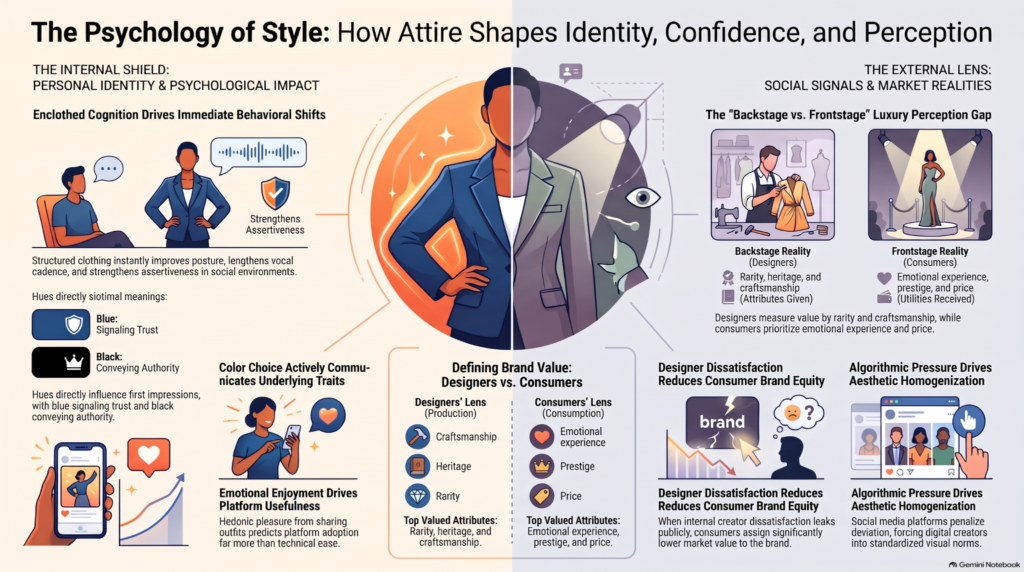
We swapped out shapeless, neutral layers that swallowed her frame for a structured jacket cut from structured wool, balanced with rich jewel tones that complemented her undertone. The physiological shift was instantaneous. Her shoulders eased back, her posture lengthened, and her vocal cadence grew noticeably calmer and more deliberate. Clothing carries an undeniable psychological resonance. It acts as both armor and an introduction, speaking long before we ever utter a single syllable.
Fashion profoundly influences your self-image and confidence. Your clothing choices can empower you or cause discomfort, impacting how you feel and behave. Attire shapes first impressions and communicates identity, values, and social status to others. By selecting outfits that resonate with your individuality, you enhance your self-worth and social interactions. Understanding these dynamics can lead to more authentic expressions of self. Explore how deeper insights into this relationship can elevate your personal style and social connections.
KEY TAKEAWAYS
- Clothing choices significantly shape self-perception, influencing confidence and how individuals perceive their social identity.
- Fashion acts as a non-verbal communication tool, conveying personal values and social status in various interactions.
- The right outfit can elevate mood and enhance assertiveness in social settings, boosting overall well-being.
- Awareness of color psychology and style dynamics helps navigate social environments and enhances first impressions.
- Unique fashion choices foster individuality and can create a sense of belonging or exclusion within peer groups.
HOW DOES FASHION INFLUENCE OUR SELF-IMAGE?
As you navigate through your daily life, the clothes you choose to wear can considerably shape how you perceive yourself. Your self-image perceptions are often influenced by fashion expectations, both from society and within yourself. Understanding clothing and identity development can help you recognize how your fashion choices reflect your personal values, shape your self-image, and influence the way you connect with others in different social settings.
When you put on an outfit that aligns with your values and personal style, you may feel empowered and authentic. Conversely, if you wear something that doesn’t resonate with you, it can lead to discomfort and self-doubt.
Fashion serves as a visual language, communicating your identity to the world. The choices you make can either reinforce or challenge societal norms, impacting your sense of belonging.
By consciously selecting attire that reflects your individuality, you defy restrictive fashion expectations. Ultimately, your clothing can either confine or liberate you, shaping your self-image and influencing how you navigate social interactions.
Embracing this connection between fashion and self-perception allows for a more liberated, authentic expression of who you are.
How Fashion Choices Boost Confidence
When you choose fashion that resonates with your personal style, it can greatly boost your confidence. This isn’t just about looking good; it’s about how you feel in your skin. Confidence boosters like a tailored jacket or your favorite pair of shoes can transform your mindset.
When you wear something that reflects who you are, you wield a sense of authenticity that empowers you in any setting. Understanding the science behind enclothed cognition can help explain why wearing clothes that align with your desired identity may strengthen your confidence, influence your behavior, and shape how you present yourself in social situations. Your personal style acts like a shield, allowing you to project your true self to the world. It communicates more than words ever could, instilling a sense of freedom and individuality.
The right outfit can elevate your mood, making you feel more capable and poised. Ultimately, embracing your unique fashion choices not only enhances your appearance but also reinforces your self-worth.
How Fashion Shapes Our Social Lives
The clothes we choose can impact our self-esteem and our overall mood for the day. The clothes that align with us for the day will make us more confident and secure. In contrast, if we feel like the attire, we chose doesn’t fit with the environment that we’re in, it can cause feelings of discomfort and lead to questioning whether or not we fit in.
Your choice of clothing can greatly influence how others perceive you, often shaping first impressions in social interactions.
The way you dress sends clear signals about your identity, values, and even your social status, impacting the connections you form.
Understanding this dynamic can empower you to navigate social landscapes more effectively, enhancing your interactions and relationships.
Fashion and First Impressions
The way you dress can greatly influence first impressions, shaping how others perceive your personality and intentions. Your attire impacts style perception, often leading to immediate judgments.
Consider these factors:
- Color choices: Bright colors can evoke energy, while muted tones may suggest sophistication.
- Fit and tailoring: Well-fitted clothes enhance your presence, conveying confidence.
- Accessories: Thoughtful accessories can reflect your interests and attention to detail.
- Context appropriateness: Dressing for the occasion shows that you understand social norms and expectations.
These elements work together, creating a powerful statement about who you are.
Clothing as Social Signals
Fashion serves as a powerful language, communicating social signals that extend beyond mere aesthetics. You might not realize it, but your clothing choices reflect deeper meanings tied to fashion symbolism and societal expectations. Each outfit can signal your identity, values, or even your mood, shaping how others perceive you.
| Clothing Norms | Fashion Symbolism |
| Casual wear for relaxation | Freedom and comfort |
| Business attire for professionalism | Authority and respect |
| Streetwear for rebellion | Individuality and expression |
Express Your Identity Through Fashion
While many people view clothing merely as a means of protection or comfort, it serves as a powerful canvas for self-expression and identity. Your fashion choices reflect not just personal expression but also the cultural significance of your background and beliefs. Embracing this can amplify your confidence and authenticity. Choosing outfits that reflect your personality and make you feel comfortable can turn getting dressed into a meaningful self care activity that boosts your confidence, supports emotional well-being, and encourages authentic self-expression.
Here are four ways to express your identity through fashion:
- Choose Colors That Resonate: Vibrant or muted hues can convey your mood and personality.
- Incorporate Cultural Elements: Infuse pieces that represent your heritage, celebrating diversity.
- Select Unique Accessories: Statement jewelry or bags can act as conversation starters, showcasing your individuality.
- Experiment with Styles: Mixing and matching different styles lets you redefine norms and express your evolving self.
NAVIGATING FASHION TRENDS FOR GROUP BELONGING
In my styling work and historical research, the tension between individual expression and collective belonging is where personal style truly comes alive. On one hand, dressing is an intimate creative act—much like an artist mixing pigments on a palette to capture an exact mood. On the other hand, humans are social creatures who intuitively lean into sartorial codes to signal kinship and status. In modern digital culture, this dynamic is amplified exponentially. Algorithms elevate lightning-fast aesthetic micro-trends, often reducing centuries of textile craft and silhouette evolution into fleeting, consumable tropes.
Whenever clients find themselves adrift in this relentless cycle, feeling pressured to adopt trends that betray their authentic shape or temperament, I always guide them back to classic foundation principles. We analyze line, proportion, tactile comfort, and historical lineage. When you invest in a trench coat, for instance, you are not merely participating in a seasonal street-style trend; you are donning an architectural garment refined by over a century of utilitarian tailoring, weatherproofing innovation, and cinematic sophistication.
Understanding the origin of what you wear transforms clothing from an exercise in anxious conformity into an empowering dialogue with history. It allows you to embrace shared aesthetic codes when you want to connect with your community, while giving you the discerning confidence to bypass the noise and remain anchored in what feels organically, timelessly yours.
Fashion is much more than just fabric; it is an expressive medium that allows people to convey identity, foster confidence, and navigate social dimensions of life. Color analysis—which helps people discover complementary colors for skin tone, eyes, and hair—can change mood and confidence. For example, dressing for body shape and using body shape as a dimension of body acceptance and healthy body image can allow one to identify as someone that is authentically themself, increasing confidence.
When you adopt fashion trends, you often align yourself with a particular group identity, consciously or unconsciously signaling your belonging.
This process is heavily influenced by your peers, whose choices can shape your own, creating a shared language that communicates social status and affiliation.
Understanding these dynamics can help you navigate the complex interplay between individual expression and group conformity in fashion.
Trends and Group Identity
As you navigate the ever-evolving landscape of trends, you might find that your choices in clothing often serve as a powerful means of expressing group identity.
Embracing trend adaptation signals your understanding of group dynamics, allowing you to connect with others who share similar aesthetic values.
Here are four key aspects to reflect on:
- Cohesion: Aligning with current trends fosters a sense of belonging.
- Expression: Your style reflects both individual and collective identities.
- Recognition: Wearing popular items can enhance social visibility within your group.
- Evolution: Adapting to new trends keeps your identity fresh, engaging, and relevant.
Peer Influence on Choices
Fashion choices often mirror the dynamics of peer influence, shaping not just personal style but also collective identity within social groups. Peer pressure often nudges you toward social conformity, pushing you to adopt styles that resonate with your fashion clique. This style imitation can solidify your role within influence networks, affecting group dynamics.
| Influence Type | Impact on Fashion Choices |
| Peer Pressure | Encourages conformity to trends |
| Style Imitation | Promotes shared aesthetics |
| Trendsetting Behaviors | Creates new group standards |
| Fashion Cliques | Defines collective identity |
| Social Dynamics | Affects individual expression |
Fashion as Social Language
Fashion can be defined as the way people use clothing, accessories, and style to express themselves and their individual personality. It is a cultural phenomenon that changes over time and is influenced by various factors such as social environment, trends, and personal taste.
Clothing serves as a powerful form of communication, allowing individuals to express their identities and navigate social landscapes. By understanding fashion semantics, you can enhance your cultural expression and foster connections with others.
To effectively navigate fashion trends for group belonging, consider the following:
- Identify Trends: Recognize current styles that resonate with your social circle.
- Adapt Personal Style: Integrate these trends while maintaining your unique identity.
- Observe Social Signals: Pay attention to how others react to your fashion choices.
- Engage in Dialogue: Use clothing as a talking point to connect through shared interests.
In this way, fashion becomes a social language, helping you articulate who you’re while fostering a sense of belonging in diverse communities.
The Psychology of Color and Style
When you step into a room, the colors and styles you choose can greatly impact how others perceive you and the emotions they experience. Color psychology reveals that hues evoke specific feelings, shaping your social identity. Your style evolution reflects personal growth, manifesting in the choices you make.
| Color | Emotion | Style Example |
| Red | Passion, Energy | Bold dress or suit |
| Blue | Trust, Calm | Tailored blazer |
| Yellow | Happiness, Optimism | Bright accessories |
| Green | Balance, Growth | Earthy tones |
| Black | Authority, Sophistication | Classic ensemble |
Understanding these dynamics helps you navigate social interactions. By strategically choosing colors and styles that resonate with your identity, you not only enhance your confidence but also influence how others engage with you. Embrace this power, and let your wardrobe speak for you.
Adapting Fashion for Different Social Settings
Your choice of attire can greatly impact your experience in various social environments, influencing not only how you feel but also how others perceive you.
Adapting your fashion for different settings requires an understanding of several factors:
- Event appropriateness: Know the dress code—whether it’s casual attire or formal wear—and dress accordingly.
- Cultural influences: Recognize how cultural nuances dictate style, allowing you to connect with diverse groups.
- Seasonal styles: Embrace seasonal trends to stay relevant and comfortable, enhancing your confidence.
- Personal comfort: Prioritize fashion adaptability and style versatility; when you feel good in your outfit, it radiates in your demeanor.

RELATED STUDIES ABOUT FASHION AND SOCIAL PERCEPTION
In the end, fashion is like a mirror reflecting your inner self, shaping how you see yourself and how others perceive you. It’s not just about clothing; it’s a powerful tool that can elevate your confidence and define your social identity. By consciously choosing what you wear, you navigate social dynamics and express who you are. Embracing this influence can lead to more authentic connections and a deeper understanding of yourself and those around you.
High-end fashion as a social phenomenon: Exploring the perceptions of designers and consumers
Conceptual Framework & Theoretical Rationale
- Social Construction of Luxury & High-End Brands: High-end fashion brands (spanning luxury and premium positioning) do not possess an objective, inherent reality. Grounded in Social Constructionist Theory (Berger & Luckmann, 1966), brand value is co-constructed within specific socio-cultural contexts through interactions between artists/creators, artworks, and audiences.
- The “Backstage” vs. “Frontstage” Perception Gap: The reality of high-end fashion is asymmetric across key actors:
- Designers (Backstage Reality): Exposed to the non-glamorous realities of sourcing, supply chain constraints, commercial pressures, mass production, and shifting brand legacy. Trained toward artistic perfectionism and self-criticism, designers evaluate products through the lens of attributes given (craftsmanship, materials, authentic heritage, rarity).
- Consumers (Frontstage Reality): Experience the polished brand image, prestige, status signaling, and service. Consumers evaluate luxury primarily through utilities received (emotional and hedonic experiences, personal indulgence, and social validation commanded by high prices).
- Core Research Objectives:
- Address the ongoing academic debate on whether luxury is objective or subjective by comparing the lived realities of high-end fashion designers against consumers.
- Compare emotional sentiment valence, cognitive definitions, and brand categorization between designers and consumers.
- Empirically test whether designers’ subjective realities (satisfaction vs. dissatisfaction/criticism) socially influence consumers’ brand value perceptions.
Methodology & Multi-Sample Empirical Design
The authors employed a mixed-method design comprising two studies and four distinct international samples across 16 established high-end fashion brands (12 luxury, 4 premium; operating for 20 years):
- Study 1: Designers’ Realities (N=16):
- Semi-structured in-depth interviews (1 to 1.5 hours via Zoom) with 16 professional high-end fashion designers working across 10 countries (Australia, Belgium, Brazil, France, Germany, India, Italy, Sweden, UK, USA).
- Participant Profile: 43.7% female; mean age 35.816.24 years; mean industry experience 8.873.89 years.
- Evaluated brand categorization (non-luxury, premium, luxury), open definitions of luxury, and qualitative sentiment.
- Study 2: Consumers’ Realities (Three Sub-Samples):
- Sample A (Qualitative Consumer Interviews; n=23): In-depth Zoom interviews with luxury/premium consumers across the UK, USA, Portugal, and Israel (52% female, mean age 40.52.8 years) exploring definitions of luxury.
- Sample B (Social Media Sentiment; n=145,986 clean tweets): Scraped 175,898 tweets via the Twitter/X API over one month referencing hashtags specific to the 16 target brands, resulting in 145,986 deduplicated, English-language tweets.
- Sample C (Online Quantitative Experiment; n=330): Survey of English-speaking consumers via Prolific (55.8% female, mean age 28.536.75 years; 45.2% recent luxury buyers). Tested brand classification, characteristic rankings, and an experimental between-subjects vignette manipulating designer satisfaction (confident/satisfied vs. critical/dissatisfied) on consumer brand value.
- Analytical Techniques:
- Text Sentiment Analysis: Applied the Valence Aware Dictionary and Sentiment Reasoner (VADER) lexicon across Study 1 interviews, Sample A interviews, and Sample B tweets.
- Cognitive Rankings & Classifications: Non-parametric Mann–Whitney U tests and Chi-square (2) tests.
- Attitudinal Experiment: Independent-samples t-tests and two-way ANOVA.
Key Empirical Findings
- 1. Emotional Exploration Phase (Sentiments & Satisfaction; H1a, H1b, P1):
- Designers vs. Interviewed Consumers (H1a): Designers exhibited significantly more negative sentiments (2.48% vs. 1.00%, t15 = 9.752, p < 0.001), more neutral expressions (82.38% vs. 76.23%, t15 = 4.753, p < 0.001), and fewer positive sentiments (15.16% vs. 22.76%, t15 = -6.384, p < 0.001) than consumers.
- Designers vs. Social Media Consumers (H1b): Replicating these findings against 145,986 tweets, designers expressed significantly more negative sentiments than Twitter users (2.48% vs. 1.31%, t15 = 7.671, p < 0.001) and fewer positive sentiments (15.16% vs. 20.44%, t15 = -4.431, p < 0.001).
- Qualitative Divergence (P1): Consumers reported high satisfaction (M=5.5/7, p<0.001 above neutral) rooted in personal pampering, external compliments, and high perceived quality. In contrast, designers voiced frustration with the commercialization of luxury, lamenting that modern luxury has shifted from atelier craftsmanship to “mass-produced hype,” celebrity culture, and factory production.
- 2. Cognitive Exploration Phase (Luxury Definitions & Classification; H2, H3):
- Defining Luxury Characteristics (H2):
- Designers (“What You Give”): Prioritized rarity and exclusivity (100% of designers; Mean Rank 279.50 vs. Consumers 168.36, Z=-5.14,p<0.001) and brand heritage (75% of designers; Mean Rank 242.75 vs. Consumers 170.14, Z=-3.43,p<0.001).
- Consumers (“What You Get”): Prioritized emotional experience (78.5% of consumers; Mean Rank 177.28 vs. Designers 95.56, Z=-4.33,p<0.001) and high price (56.1% of consumers; Mean Rank 176.98 vs. Designers 101.63, Z=-3.41,p<0.001).
- Shared Ground: Both groups equally valued quality craftsmanship (81.3% designers, 89.7% consumers; Mean Rank 159.56 vs. 174.18, Z=-1.07,p=0.286, non-significant).
- Brand Tier Devaluation by Designers (H3):
- 56% (9 of 16) of designers paused with hesitation before classifying their brand. Only 25% classified their brand at the official website/market tier, with 75% downgrading their brand’s classification (e.g., luxury classified as premium, or premium as non-luxury).
- In contrast, consumers classified 87.5% (14 of 16) of brands at or above official positioning.
- Across the 16 brands, designers assigned a significantly lower category tier than consumers in 62.5% of cases (2[2]=9.238,p<0.01). Industry experience had no correlation with downgrading (r=0.35,p=0.19).
- Defining Luxury Characteristics (H2):
- 3. Attitudinal Impact Phase (Social Construction of Value; H4):
- When exposed to an interview where a designer expressed dissatisfaction and doubt regarding the luxury delivered by their brand, consumers assigned a significantly lower brand value (M=4.971.42) compared to those exposed to a confident, satisfied designer (M=5.781.34, t[312]=5.125,p<0.001).
- This devaluation occurred equally among prior luxury buyers and non-buyers (interaction F[1,308]=0.495,p=0.482).
Theoretical & Strategic Implications
- Resolution of the Subjective vs. Objective Luxury Debate: The study demonstrates that luxury brand reality is fundamentally subjective. What constitutes luxury shifts depending on whether it is viewed from backstage production constraints or frontstage consumer consumption.
- Empirical Support for Social Constructionist Value: Brand equity does not exist in an isolated consumer vacuum. When backstage designer attitudes leak into public awareness, the social interaction directly alters consumer reality, reducing perceived brand value.
- Managerial Prescriptions for Luxury Brand Executives:
- Protect Backstage Alignment: In an era of increasing supply chain transparency and social media exposure, brand managers must treat designers as primary internal brand ambassadors. If designers feel that commercial pre-collections, cost-cutting, or factory outsourcing dilute the brand’s heritage, their dissatisfaction poses a direct reputational risk.
- Bridge the “Give vs. Get” Perception Divide: Marketing communications should emphasize frontstage emotional and prestige utilities to consumers, while internal management must preserve heritage, authentic rarity, and craftsmanship to maintain creative confidence among designers.
- Implement Co-Creation and Strategic Inclusion: Involve designers in executive brand positioning decisions so that creative outputs align with both artistic standards and commercial roadmaps.
Study Limitations
- Designers’ Sample Size & Disclosure Restraints: Due to strict non-disclosure agreements and the insular nature of luxury fashion, the designer sample was limited to 16 participants (though adequately powered for large effect sizes), precluding disclosure of specific brand names.
- Inclusion of Premium Brands: The sample incorporated four premium brands alongside twelve pure luxury brands; future research should distinguish whether backstage designer disillusionment differs across luxury versus premium tiers.
- Western Market Concentration: Data collection across consumers and brands centered predominantly on Western nations (USA, UK, Portugal, Israel), limiting generalizability to East Asian or Middle Eastern luxury markets where social status dynamics may diverge.
- Directionality of the Interaction: The experimental condition examined only the unidirectional impact of designer sentiment on consumers; the reverse effect (how consumer validation or critique alters designer self-perception) was not evaluated.
| REFERENCE: Yael Pedro, Enav Friedmann, Sandra Maria Correia Loureiro, High-end fashion as a social phenomenon: Exploring the perceptions of designers and consumers, Journal of Retailing and Consumer Services, Volume 79, 2024, 103877, ISSN 0969-6989, https://doi.org/10.1016/j.jretconser.2024.103877. (https://www.sciencedirect.com/science/article/pii/S0969698924001735) |
Philosophy of clothing. Fashion as a social vector: Unraveling the influence of digital times
This qualitative case study and netnography explores the socio-cultural, professional, and affective dynamics of Spanish women lifestyle influencers on Instagram, analyzing how they construct authentic personal brands, manage digital labor and platform algorithms, interact with peer communities, and navigate patriarchal pressures and hate speech.
Conceptual Framework & Theoretical Rationale
- The Rise of Digital Labor and Influencer Culture: The rapid proliferation of social networks—particularly Instagram—has transformed everyday domestic and lifestyle practices into professionalized digital labor. Women have emerged as primary agents in lifestyle influencer marketing, curating content across fashion, beauty, family, wellness, travel, and home decor.
- Platform Capitalism and Gendered Aesthetics: Grounded in theories of digital labor, platform capitalism, and fourth-wave digital feminism, the study examines how female lifestyle influencers navigate the tension between empowerment and hyper-commercialization. Influencers generate economic value through self-branding, commodifying their private lives, intimacy, and domesticity.
- The “Authenticity–Aesthetic” Paradox: While commercial brands require polished, aesthetically aspirational visuals, audiences demand relatable, unfiltered authenticity. Influencers must balance genuine self-expression against algorithmic demands that penalize deviation from standardized, highly stylized visual norms.
- Patriarchal Scrutiny and Online Toxicity: Female public figures in digital environments face disproportionate scrutiny regarding physical appearance, parenting choices, and lifestyle ethics, frequently encountering organized hate speech, digital harassment, and gender-based online violence.
- Core Research Objectives:
- Characterize the professionalization, everyday labor, and self-branding strategies of Spanish women lifestyle influencers.
- Examine how digital algorithms, aesthetics, and economic imperatives shape influencer content creation.
- Analyze relational dynamics within the creator ecosystem, including peer solidarity, mutual support, competition, and exposure to hate speech.
Methodology & Empirical Architecture
- Methodological Framework: A qualitative, mixed qualitative-digital design combining digital netnography (Kozinets, 2010; 2020), case study methodology, and autoethnography, developed from the doctoral research of one of the authors.
- Case Study Selection & Participant Profile:
- Centered on a focal case study of an established Spanish lifestyle influencer, supplemented by netnographic observation and in-depth qualitative interviews with 12 Spanish women lifestyle influencers.
- Participants held follower counts ranging from micro-influencers (10,000–50,000 followers) to macro-influencers (over 200,000 followers) across Spanish urban and regional contexts.
- Fieldwork spanned multi-year observation of Instagram posts, Reels, Stories, comments, and engagement analytics.
- Data Collection Protocols:
- Semi-Structured In-Depth Interviews: Conducted with influencers covering career trajectory, relationship with followers, monetization agreements with brands, algorithm adaptation, mental health, and harassment.
- Netnographic Observation: Systematic documentation of public feed posts, daily Stories, user commentary threads, and brand collaborations.
- Field Notes & Reflexive Journaling: Maintained to track researcher positionality, affective impressions, and evolving platform features.
- Data Analysis:
- Inductive and deductive thematic analysis (Braun & Clarke) supported by qualitative data analysis software.
- Emergent themes were categorized into core structural dimensions: identity construction, labor conditions, community engagement, algorithmic precarity, and online toxicity.
Key Empirical Findings
- 1. Professionalization and the Reality of Digital Labor:
- Invisibility of Behind-the-Scenes Work: Participants emphasized that external audiences perceive influencer work as effortless leisure. In reality, it involves demanding, multifaceted labor: photography, video editing, caption copywriting, lighting, community management, contract negotiation, invoice processing, and metric tracking.
- Boundary Blurring Between Private and Professional: The commodification of daily routines erodes boundaries between private intimacy and public display. Personal vacations, family dinners, and domestic spaces are continuously scouted and staged as commercial backdrops.
- 2. Algorithmic Precarity and Aesthetic Homogenization:
- Algorithmic Vassalage: Influencers experience platform algorithms as arbitrary and opaque. Constant algorithmic modifications to feed distribution create chronic anxiety regarding reach, impressions, and engagement drops.
- Pressure for Conformity: To maintain visibility, creators feel compelled to adopt trending audio tracks, follow rigid posting cadences, and adhere to homogenized visual aesthetics (e.g., minimalist neutral tones, specific pose geometries, curated domestic interiors), which directly constrains creative independence.
- 3. Authentic Connection and the Parasocial Bond:
- Curated Relatability: Influencers cultivate trust by deliberately interspersing high-glamour sponsored content with vulnerability—sharing personal insecurities, bad days, parenting fatigue, or health challenges.
- Community as Emotional Support: Direct messages (DMs) and comments foster intimate parasocial relationships, transforming follower bases into meaningful mutual-aid networks where women exchange parenting advice, mental health validation, and product recommendations.
- 4. Peer Communities: Solidarity vs. Competitive Envy:
- Collaborative Alliances: Influencers form informal support collectives (“pods” or engagement groups) to share pricing benchmarks, warn one another about predatory brand contracts, collaborate on cross-promotions, and provide mutual psychological support.
- Latent Rivalries: Despite outward solidarity, underlying tension persists regarding follower theft, copycat content, and competition for brand sponsorships within saturated niche segments.
- 5. Gendered Harassment, Hate Forums, and Mental Health Costs:
- Organized Digital Violence: Female influencers encounter intense, gendered toxicity. Harassment extends beyond isolated negative comments into organized hate campaigns hosted on specialized anonymous web forums and gossip boards (e.g., dedicated threads tracking influencers’ family lives, physical changes, and relationships).
- Patriarchal Policing: Female creators face disproportionate condemnation for deviations from traditional gender roles—such as being accused of maternal neglect for working, or being criticized for aging, weight fluctuations, and cosmetic procedures.
- Psychological Burnout: Continuous exposure to surveillance, hyper-criticism, and algorithmic instability induces substantial emotional exhaustion, imposter syndrome, and anxiety, prompting कई creators to seek therapy or schedule periodic digital detoxes.
Theoretical & Practical Implications
- Rethinking Influencer Work Through Feminist Political Economy: The study demonstrates that digital lifestyle creation is not mere self-absorbed leisure, but a form of contemporary, precarious gendered labor. It bridges domestic labor and commercial marketing, extracting surplus value from women’s emotional and aesthetic output in the platform economy.
- The Double Burden of Digital Visibility: While Instagram provides independent entrepreneurial pathways and financial autonomy outside traditional corporate gatekeepers, it subjects women to intensified forms of patriarchal surveillance, aesthetic standardization, and online violence.
- Operational Guidelines for Brands and Agencies:
- Ethical Campaign Planning: Brands should respect influencer creative autonomy rather than enforcing rigid, homogenized templates that erode creator authenticity and audience trust.
- Transparent Contracting & Fair Compensation: Agencies must establish clear deliverables, realistic revision cycles, and fair compensation rates that reflect behind-the-scenes administrative and production labor.
- Platform Responsibility & Moderation Reforms: Social media architectures need proactive moderation systems and stronger legal protections to curb coordinated cyber-harassment, stalker forums, and gender-based hate speech targeting female content creators.
Study Limitations
- Geographic & Cultural Scope: The investigation was conducted within Spain’s sociocultural and digital media context, meaning specific influencer-follower dynamics, regulatory structures, and brand marketing budgets may not fully reflect environments in Anglo-American, Latin American, or Asian markets.
- Platform Exclusivity: Analysis focused almost entirely on Instagram, leaving unaddressed how multi-platform presence across TikTok, YouTube, or podcasts alters digital labor routines, monetization structures, and toxicity exposure.
- Qualitative Sample Size: The cohort of 12 interviewed influencers, while providing rich, detailed phenomenological insight, does not permit quantitative generalization regarding income distributions or engagement analytics.
- Autoethnographic Reflexivity: Incorporating autoethnographic and close-case observations provides deep insider access, but inherently carries subjective interpretations that require continual methodological balancing.
| REFERENCE: Alfonso Vázquez-Atochero, Azahara Romero-Sanz, Philosophy of clothing. Fashion as a social vector: Unraveling the influence of digital times, Women’s Studies International Forum, Volume 109, 2025, 103063, ISSN 0277-5395, https://doi.org/10.1016/j.wsif.2025.103063. (https://www.sciencedirect.com/science/article/pii/S0277539525000123) |
Exploring the impact of social relationships and system experiences on consumers’ acceptance of social commerce in the fashion sector: an empirical study
Conceptual Framework & Theoretical Rationale
- Evolution of Social Commerce (S-Commerce) in Fashion Retailing: S-commerce blends traditional e-commerce transactions with social media networking, enabling two-way communication, peer recommendations, live streaming, and direct messaging between buyers and sellers. While s-commerce has been studied across tourism, food, and transportation, fashion retailing presents unique social dynamics driven by self-expression, peer conformity, aesthetic inspiration, and real-time social validation.
- Theoretical Integration (Extending TAM with Social Relationship Theory):
- Technology Acceptance Model (TAM): Employs foundational constructs—Perceived Ease of Use (PEOU), Perceived Usefulness (PU), and Intention to Use (ITU)—alongside hedonic Perceived Enjoyment (PE) and technical Perceived System Capability (CP) as core elements of the System Experience.
- Social Relationship Theory & Critical Mass: Posits that technology adoption within social spaces is guided by interpersonal dynamics. The authors integrate two social dimensions:
- Perceived Social Connectedness (SC): The subjective sense of belonging, bonding, and interpersonal affiliation experienced within social networks.
- Perceived Critical Mass (CM): The extent to which a consumer perceives that a substantial, influential threshold of friends, peers, and coworkers are actively using the platform, establishing social proof and transactional legitimacy.
- Core Research Objectives:
- Determine how social relationship factors (SC and CM) influence consumers’ evaluations of the system experience (PEOU, PE, CP, PU).
- Evaluate how system experience attributes translate into utilitarian evaluations (PU) and behavioral adoption intentions (ITU) for fashion s-commerce.
- Identify structural pathways that drive or constrain s-commerce adoption among fashion consumers, particularly within social-seller ecosystems (e.g., direct messaging, Instagram storefronts, Meesho).
Methodology & Empirical Architecture
- Context & Target Phenomenon: Examined s-commerce transactions within the Indian retail fashion landscape, focusing on platforms and micro-retailers utilizing direct messaging, social posts, live streams, and external links across platforms such as Instagram (56%), Facebook (25%), and WhatsApp (18%).
- Sampling & Data Cleaning Protocols:
- An online survey was administered to university students and educated consumers conversant in English, supported by procedural controls (expert cognitive pre-testing with marketing/language faculty, N=40 pilot test).
- Out of 628 initial submissions, 70 responses were removed based on screening criteria (completion speed <1.5 minutes, straightlining/extreme response bias), resulting in a final analytical sample of 558 valid respondents (88.8% effective response rate).
- Sample Demographics: 55% male, 45% female; 65% aged 21–25, 28% aged 26–30, 7% aged 31–35; diverse academic/professional backgrounds (management, engineering, arts, medicine, law). Shopping frequency was high: 48% shopped fortnightly, 32% monthly, and 16% weekly on social media.
- Construct Measurement & Psychometric Validation:
- Evaluated across seven latent constructs on 5-point Likert scales (1=stronglydisagree to 5=stronglyagree) adapted from validated sources (Cho & Son, 2019; Rauniar et al., 2014).
- Reliability: High internal consistency confirmed (Cronbach’s =0.818–0.949; Composite Reliability =0.890–0.958).
- Validity: Convergent validity established (AVE=0.697–0.866); discriminant validity verified via Fornell-Larcker criteria and Heterotrait-Monotrait ratios (all HTMT<0.85).
- Common Method Bias & Non-Response Bias: Harman’s single-factor test accounted for 35.76% of variance ($<50\%$ threshold); inner VIF values ranged between 1.41 and 3.41; paired-sample tests between early and late respondents confirmed no significant non-response bias.
- Analytical Modeling Strategy:
- Partial Least Squares Structural Equation Modeling (PLS-SEM) executed in SmartPLS 4 with 5,000 bootstrap subsamples.
- Model fit demonstrated an SRMR=0.036 (<0.10 benchmark) and an overall Tenenhaus Goodness of Fit (GoF=0.607), indicating large predictive power.
Key Empirical Findings
- Structural Explanatory Power (R2):
- The proposed structural model explained 64% of the variance in Perceived Usefulness (R2=0.64) and 62% of the variance in Intention to Use (R2=0.62).
- For intermediate system experience factors, the model explained 39% of variance in Perceived Enjoyment, 33% in Perceived Ease of Use, 30% in Perceived System Capability, and 8.8% in Perceived Critical Mass.
- Direct Path Coefficients & Hypothesis Testing (Table 6):
- Impact of Social Connectedness (SC):
- SC Perceived Enjoyment (H1b): Strong positive effect (=0.477,t=12.639,p<0.01).
- SC Perceived Ease of Use (H1a): Strong positive effect (=0.466,t=12.803,p<0.01).
- SC System Capability (H1c): Moderate positive effect (=0.320,t=6.186,p<0.01).
- SC Critical Mass (H1d): Moderate positive effect (=0.297,t=6.520,p<0.01).
- SC Perceived Usefulness (H1e): Not statistically supported (=0.048,t=1.162,p>0.05).
- Impact of Critical Mass (CM):
- CM System Capability (H2c): Positive effect (=0.353,t=6.273,p<0.01).
- CM Perceived Enjoyment (H2b): Positive effect (=0.288,t=6.737,p<0.01).
- CM Perceived Ease of Use (H2a): Positive effect (=0.224,t=5.265,p<0.01).
- CM Perceived Usefulness (H2d): Direct positive effect (=0.132,t=3.176,p<0.01).
- System Experience Drivers of Usefulness & Intention:
- Perceived Enjoyment Perceived Usefulness (H5): Represented the single strongest path in the model (=0.678,t=14.164,p<0.01).
- Perceived Usefulness Intention to Use (H4): Strongly predicted behavioral intention (=0.580,t=19.759,p<0.01).
- Perceived Ease of Use Perceived Usefulness (H3): Small but statistically significant positive effect (=0.082,t=2.027,p<0.05).
- System Capability Perceived Usefulness (H6): Not statistically supported (=-0.036,t=0.929,p>0.05).
- Impact of Social Connectedness (SC):
Theoretical & Strategic Interpretations
- The Indirect Nature of Social Connectedness: Social connectedness does not directly persuade fashion consumers of an s-commerce platform’s functional utility (H1e unsupported). Instead, social connectedness operates as a foundational psychological catalyst: feeling bonded to online peers enhances emotional enjoyment (=0.477) and reduces perceived cognitive effort (=0.466), which in turn drives evaluations of usefulness.
- The Primacy of Hedonic Value Over Functional Features: Perceived enjoyment exerted a dominant effect on perceived usefulness (=0.678), far surpassing ease of use (=0.082). In fashion s-commerce, shopping is inherently experiential, playful, and leisure-oriented; consumers perceive a platform as “useful” not because it functions like a sterile database, but because browsing, sharing outfits, and receiving compliments delivers positive affective gratification.
- The “System Capability” Disconnect: The failure of perceived system capability to predict usefulness (H6 unsupported) highlights an important boundary condition in modern e-commerce. Because standard technical features (e.g., photo uploads, text feeds, functional messaging) have become commoditized baseline expectations, consumers no longer derive perceived value from technical architecture alone. Social proof, peer community feedback, and entertainment value overshadow raw platform capabilities.
- Critical Mass as a Legitimizing Anchor: Perceived critical mass directly shapes both operational ease and perceived usefulness. When shoppers see friends and colleagues transacting through a social seller, it mitigates perceived transactional risk, establishes social validation, and transforms the platform into an active, credible marketplace.
Managerial & Retailing Implications
- Shift from Technical Features to Social Brand Communities: Fashion retailers and social sellers should de-emphasize technical specifications and prioritize cultivating engaged brand micro-communities. Emulating community-driven models (e.g., Sephora’s Beauty Insider community), brands should host virtual styling sessions, live styling try-on Q&As, and interactive voting polls.
- Embed Hedonic & Gamified Social Features: To maximize perceived enjoyment, s-commerce interfaces should integrate gamification (e.g., interactive style quizzes, loyalty badges, unlockable fashion challenges) and real-time social feedback tools (live emoji reactions, synchronized group shopping chats).
- Leverage User-Generated Journey Narratives for Social Proof: Because critical mass directly enhances perceived platform usability and legitimacy, fashion merchants should incentivize customer journey storytelling—encouraging buyers to post unboxing videos, outfit styling tips, and peer reviews that make the buying experience relatable and transparent to new prospective buyers.
Study Limitations & Future Directions
- Geographic & Demographic Concentration: The empirical sample was drawn predominantly from younger, tech-literate consumers (65% aged 21–25) residing in urban India, limiting generalizability to older demographics, rural consumers, or Western markets where s-commerce infrastructure and payment ecosystems (e.g., Apple Pay vs. UPI/Cash-on-Delivery) diverge.
- Cross-Sectional Architecture: The study collected single-timepoint perceptual data; longitudinal investigations are required to assess how user perceptions transition from initial trial into habitual repeat purchasing.
- Focus on Small/Micro-Retailer DM Transactions: Findings reflect social commerce centered around direct messaging, social seller networks, and visual storefronts, which may differ from fully integrated in-app checkout ecosystems (such as TikTok Shop or WeChat Mini Programs).
- Omission of Risk & Trust Dimensions: Although social relationships implicitly address credibility, future extensions could explicitly incorporate structural variables for perceived financial risk, counterfeit anxiety, and seller trust.
| REFERENCE: Sahil Singh Jasrotia, Alex Pak Ki Kwok, Surabhi Koul, Exploring the impact of social relationships and system experiences on consumers’ acceptance of social commerce in the fashion sector: an empirical study, International Journal of Information Management Data Insights, Volume 5, Issue 1, 2025, 100333, ISSN 2667-0968, https://doi.org/10.1016/j.jjimei.2025.100333. (https://www.sciencedirect.com/science/article/pii/S2667096825000151) |
CONCLUSION
Ultimately, fashion is far too meaningful to be relegated to mere surface vanity. It is an evolving, living archive of our collective culture, but more importantly, it is the daily medium through which we articulate our personal narrative to the world. Whether I am examining an antique hand-embroidered textile collected on my travels or helping someone build a cohesive, timeless capsule wardrobe, the overarching truth remains consistent: the most captivating style is never born from chasing every fleeting fad. It arises when our inner identity and outer aesthetic exist in total, harmonious dialogue.
When you dress with intention, respecting your body’s unique proportions and leaning into textures and colors that genuinely enliven your spirit, your attire stops being a social disguise or an exhausting demand for external validation. Instead, it becomes an authentic extension of who you are—a source of grounded, quiet confidence that carries you effortlessly through boardrooms, evening gatherings, and quiet neighborhood strolls alike.
Fashion gives us the rare opportunity to curate our own public exhibition every single morning. When approached with curiosity, historical perspective, and self-compassion, getting dressed ceases to be a chore and becomes what it was always meant to be: an empowering, creative celebration of personal identity.