

Having spent years reporting from the sidelines of international fashion weeks and watching micro-trends wash over street corners through my camera lens, I’ve noticed a persistent cultural myth: the idea that caring about what you wear is purely an exercise in vanity. But if you take a closer look at cultural semiotics and the rhythms of everyday life, clothing has never just been decorative textile; it functions as a second skin and an ongoing dialogue between your internal world and the outside environment.
Whenever I teach personal branding and wardrobe styling workshops, participants often confess to feelings of morning dread—standing paralyzed in front of a closet crammed with clothes, yet feeling completely ungrounded in their own bodies. We have all experienced the visceral difference between dragging our feet in tired, ill-fitting loungewear versus pulling on a piece that commands posture and clarity.
It isn’t magic or superficial posturing—it is cognitive science catching up with what human culture has intuitively practiced for centuries. When you understand enclothed cognition, getting dressed ceases to be a frantic chore before your first meeting and transforms into an accessible, grounded act of daily self-care. It’s about armoring yourself with intention before stepping out the front door.
Enclothed cognition shows how your clothing choices affect your mental state and emotional well-being. Studies reveal that specific outfits can enhance focus, confidence, and creativity. By consciously choosing clothes that resonate with your identity and intentions, you can boost your self-care practices. Mindful dressing strategies, like selecting uplifting colors and comfortable fabrics, can greatly impact your emotions. Understanding this connection empowers you to enhance your self-identity through fashion, and there’s much more to explore.
KEY TAKEAWAYS
- Enclothed cognition reveals how clothing choices can enhance self-perception and emotional well-being through intentional dressing aligned with personal identity.
- Research indicates specific attire, like lab coats, boosts cognitive performance and focus, illustrating clothing’s impact on mental processes.
- Mindful dressing strategies, such as selecting uplifting colors and comfortable fabrics, promote positive emotional states and improve self-esteem.
- Fashion serves as a powerful medium for self-expression, allowing individuals to communicate their identity and emotions through wardrobe choices.
- The wardrobe acts as a canvas for self-discovery, reflecting personal growth and contributing to overall psychological well-being and deeper self-awareness.
WHAT IS ENCLOTHED COGNITION AND WHY IT MATTERS?
Enclothed cognition is a psychological phenomenon where the clothing a person wears influences their thoughts, feelings, and behaviors. The term was coined by Hajo Adam and Adam D. Galinsky who exhibited the effects of clothing in a 2012 experiment that used white lab coats. They hypothesised that worn attire affects the wearer’s psychological processes due to the activation of abstract concepts through its symbolic meaning.
Enclothed cognition refers to the psychological phenomenon where the clothing you wear influences your mental processes and behaviors. This concept highlights the significant role of clothing symbolism and the psychological associations tied to different garments.
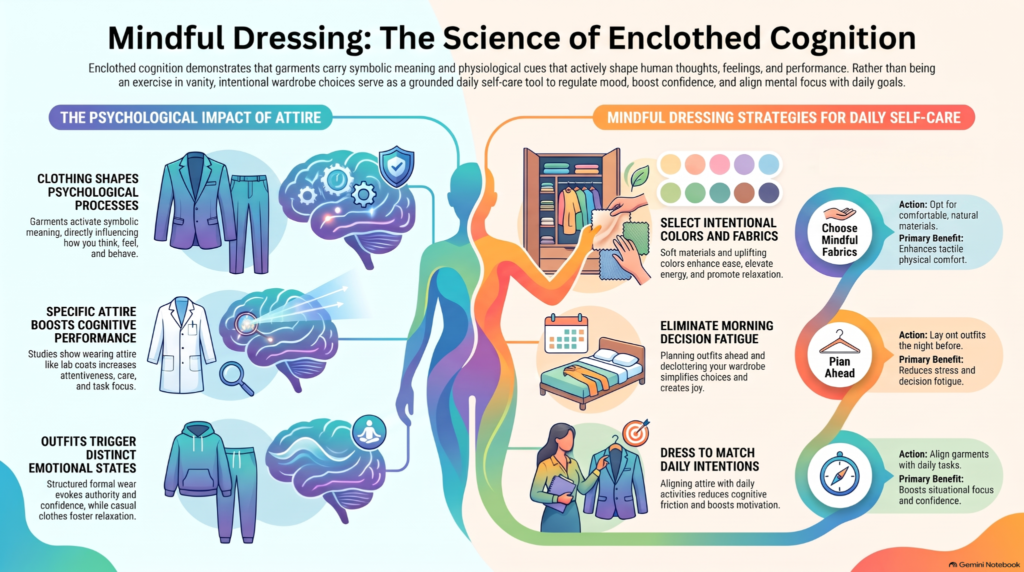
When you don specific outfits, you might unknowingly adopt the attitudes and traits those clothes represent. For instance, a tailored suit may evoke feelings of professionalism and confidence, while casual attire might foster relaxation and creativity.
Understanding enclothed cognition is essential, as it empowers you to make conscious clothing choices that align with your intentions and desired mindset. The clothes you choose to wear can serve as tools for self-expression, influencing not only how you perceive yourself but also how others perceive you.
The Science Behind Enclothed Cognition: Key Studies Explained
Psychologists Adam Galinsky and Hajo Adam from Northwestern University coined the term ‘enclothed cognition’ which basically describes the symbolic meaning of the clothes and the psychological processes that occur on wearing them. They have done two experiments based on wearing and seeing a specific category of clothes. The first one was an experiment with a lab coat on wearing. The found that when individuals wear a lab coat, they have more attentiveness and carefulness, and their performance improves as well. The findings of the study conclude that clothing has a symbolic meaning for a person. So, we should understand what we wear, as it has an influence on our performance.
Research into enclothed cognition reveals the psychological mechanisms that underpin how clothing affects our thoughts and behaviors. This concept aligns with the principles of embodied cognition, which emphasize how our physical experiences shape our mental processes.
Importantly, several key studies have demonstrated the profound psychological implications of what we wear:
- Participants performed better on cognitive tasks when dressed in lab coats, suggesting increased focus.
- Wearing formal attire led to greater abstract thinking compared to casual clothing, indicating a shift in mindset.
- Clothing that resonates with personal identity enhances self-esteem and confidence levels.
These findings illustrate that the clothes you choose can directly influence your cognitive abilities and emotional states.
The Impact of Enclothed Cognition on Emotions and Behavior
Clothing choices can considerably influence your emotional state and behavior, impacting how you interact with the world. The concept of enclothed cognition reveals that the attire you select acts as a powerful emotional trigger.
For instance, wearing formal clothing can enhance feelings of confidence and authority, prompting significant behavioral shifts in how you approach tasks and engage with others. Conversely, casual attire might evoke a relaxed mindset, affecting your motivation and focus.
You mightn’t realize it, but these subtle changes in your clothing can lead to profound effects on your emotions and actions. By understanding how your wardrobe influences your mood and behavior, you can make more intentional choices that align with your desired emotional state.
A well-considered outfit can serve as a catalyst for positive behavioral changes, allowing you to navigate social interactions and daily challenges with greater ease and authenticity.
How to Use Enclothed Cognition to Enhance Self-Care?
Enclothed cognition is a psychological phenomenon: it is the effects of clothing on your mental and emotional processes. Clothing can change how you think, feel, perceive, and understand yourself during situations and experiences.
When you consciously choose your attire, you can leverage the principles of enclothed cognition to enhance your self-care practices. By coordinating your outfits thoughtfully, you can greatly influence your mood and overall well-being.
Here are a few strategies to reflect on:
- Choose colors that uplift you: Bright or soft tones can evoke positive emotions and promote relaxation.
- Select fabrics that feel good: Comfortable materials can enhance your sense of ease, contributing to a more positive mindset.
- Dress for the occasion: Outfits aligned with your daily activities can boost confidence and motivation.
Emphasizing outfit coordination can lead to mood enhancement, allowing you to feel more empowered and in control of your day.
Everyday Strategies for Mindful Dressing
How can you cultivate a mindful approach to dressing each day? Start by selecting mindful fabrics that resonate with your values and comfort. Consider how your outfit influences your mood and productivity, empowering you to make intentional choices. Here are some strategies to help you dress mindfully:
| Strategy | Description | Benefits |
| Choose Mindful Fabrics | Opt for natural, sustainable materials. | Enhances comfort and awareness. |
| Plan Ahead | Lay out outfits the night before. | Reduces stress and decision fatigue. |
| Dress for Intent | Align your outfit with daily goals. | Boosts confidence and focus. |
| Declutter Your Wardrobe | Keep only what you love and wear. | Simplifies choices and promotes joy. |
HOW FASHION INFLUENCES YOUR SELF-IDENTITY AND CONFIDENCE

From behind my camera lens shooting street style in dynamic downtown spaces, I can spot the shift in a person’s gait from a block away depending entirely on how they carry what they’re wearing. A tailored shoulder doesn’t just change a silhouette; it physically realigns someone’s spine and changes how they occupy space. On my own workbench, when I spend weekends deconstructing thrifted blazers or modifying vintage denim, I’m constantly reminded of the tactile immediacy of clothing.
The weight of heavy canvas, the smooth breathability of crisp linen, or the grounding heft of a well-balanced jacket sends instant physiological cues back to our nervous system. When people hear about the classic lab coat experiment, it’s easy to write it off as an artificial laboratory quirk. But we see its everyday counterpart constantly in urban environments.
A client who swops an unstructured, fleece hoodie for a structured corduroy chore jacket or an oversized, sharp trench suddenly speaks with more deliberation and approaches collaborative meetings with tangible presence. Mindful dressing isn’t about adhering to rigid dress codes or chasing high-end designer tags; it’s about curating garments that trigger your intended mental frequency. When the physical sensations of your clothes match your personal ambitions, cognitive friction melts away.
Your clothing choices greatly shape your emotional state and self-perception.
The way you express yourself through fashion can enhance your confidence and alter how you view your identity.
Clothing’s Emotional Impact
Fashion wields a profound influence over self-identity and confidence, shaping how you perceive yourself and how others perceive you. The emotional resonance of your clothing choices can greatly impact your mood and self-expression.
- Color psychology plays an essential role in evoking specific feelings.
- Fabric texture can enhance comfort levels and influence your overall confidence.
- Attire symbolism carries cultural significance, affecting societal perception.
Through your personal narrative, the clothes you wear can enhance your identity expression and reflect who you are.
Style and Self-Perception
Clothing choices extend beyond mere aesthetics; understanding how fashion affects self perception can help you recognize how your personal style influences your body image, confidence, and the way you view yourself. Your personal style reflects not just your tastes but also influences your body image and self-confidence.
Fashion trends and cultural influences play significant roles in how you perceive yourself. By understanding wardrobe essentials and practicing effective outfit coordination, you can express your individuality and adapt to changing styles.
Color psychology affects emotions and perceptions, meaning the hues you choose can enhance your mood and impact how others see you.
As you navigate your style evolution, consider how your choices connect to fashion history, allowing you to create a narrative that resonates with your identity.
Ultimately, your clothing empowers you to embrace who you are.
Reflecting on Your Clothing Choices for Better Well-Being
Your clothing choices greatly impact your mental state and overall well-being.
By making mindful selections, you can enhance your self-expression and foster a positive psychological environment. Understanding clothes and mood psychology can help you make mindful wardrobe choices, as wearing soft, calming hues may promote relaxation while vibrant shades can elevate your energy and confidence.
Reflecting on what you wear allows you to align your wardrobe with your personal values and emotional needs.
Clothing’s Psychological Impact
While many people may not realize it, the garments you choose to wear can considerably influence your mood and behavior. Understanding clothing psychology reveals how different choices can affect your mental state.
For instance, consider the following:
- Color: Bright colors often uplift, while darker shades can evoke introspection.
- Fit: Well-fitting clothes can boost confidence, whereas ill-fitting garments might lead to discomfort.
- Garment Symbolism: Each piece carries meaning that can impact how you perceive yourself and how others perceive you.
Mindful Wardrobe Choices
The impact of clothing choices extends beyond mere aesthetics; it directly influences your mental and emotional well-being. By embracing mindful colors and intentional fabrics, you can curate a wardrobe that reflects your values and enhances your mood.
For instance, wearing soft, calming hues may promote relaxation, while vibrant shades can elevate your energy. Choosing natural, breathable materials not only supports comfort but also fosters a sense of connection to your surroundings. When you make conscious decisions about what you wear, you’re actively participating in your self-care routine, turning mindful dressing into a meaningful self care activity that supports your mindset, confidence, and overall well-being.
When you make conscious decisions about what you wear, you’re actively participating in your self-care routine. This awareness encourages a deeper understanding of how clothing impacts your mindset, allowing you to harness the psychological benefits of your wardrobe.
Prioritize choices that empower and uplift you, aligning your attire with your overall well-being.
Fashion and Self-Expression
Fashion serves as a powerful medium for self-expression, allowing individuals to communicate their identity and emotions through clothing choices. By reflecting on your personal style, you can cultivate a deeper understanding of yourself and enhance your well-being.
Consider these aspects of fashion:
- Your clothing can influence your mood and confidence.
- Choosing outfits that resonate with your values fosters authenticity.
- Experimenting with styles encourages creative expression.
Engaging with fashion in this way empowers you to embrace your uniqueness and articulate your inner self.
When you consciously select garments that align with your identity, you not only boost your self-esteem but also create a visual narrative that represents your journey.
Ultimately, your wardrobe becomes a canvas for self-discovery and well-being.
RELATED STUDIES ABOUT SCIENCE BEHIND ENCLOTHED COGNITION
Incorporating enclothed cognition into your self-care routine can dramatically influence your emotional state and behavior. You might think your clothing choices are trivial, but picture slipping into a tailored suit that enhances your confidence or donning a cozy sweater that wraps you in comfort. By intentionally selecting outfits that resonate with your identity and mood, you not only boost your self-esteem but also cultivate a deeper connection with yourself, ultimately fostering greater well-being.
Beyond self-care: Developing a climate survey for school psychology programs
This psychometric instrument development and validation study details the construction and initial exploratory factor analysis (EFA) of the Climate Assessment for Relationships and Equity in School Psychology (CARE-SP), a national, student-led assessment designed to evaluate graduate training program environments across interpersonal, institutional, and social justice dimensions.
Conceptual Framework & Rationale
- The Mental Health Crisis in Graduate Education: Graduate students in health service psychology (HSP) disciplines experience anxiety and depression symptoms at rates approximately six times higher than the general population. In school psychology specifically, rigorous academic, clinical, and research expectations routinely evolve into chronic stressors that heighten attrition during a severe, ongoing national practitioner shortage.
- Shortcomings of the Individualized “Self-Care” Paradigm: Graduate education has historically relied on a biomedical/medical-model approach to student distress, framing wellness as an individual responsibility to be resolved through personal self-care (e.g., exercise, mindfulness, leisure). The authors challenge this paradigm, arguing that individualized self-care acts merely as a transient palliative band-aid that obscures underlying institutional pathologies and systemic inequities.
- Ecological Systems Framing: Grounded in Bronfenbrenner’s ecological systems theory and K–12 school climate literature (e.g., Wang & Degol, National School Climate Council), the study re-conceptualizes graduate student well-being as an emergent property of nested environmental systems—spanning interpersonal dyadic interactions (microsystem), peer socialization, departmental dynamics, and overarching institutional structures (mesosystem).
- Disparities Experienced by Racially and Ethnically Minoritized (REM) Students: Black, Indigenous, and People of Color (BIPOC) graduate students report lower levels of belonging, heightened acculturative stress, and frequent racial microaggressions within school psychology training. Addressing these disparities requires moving beyond passive diversity statements toward actionable accountability, culturally responsive mentorship, and systemic climate measurement.
- Primary Study Aims:
- Develop a comprehensive, field-specific climate instrument tailored to school psychology graduate training programs across master’s, specialist, and doctoral levels.
- Uncover the latent factor structure of the newly developed CARE-SP via exploratory factor analysis.
- Establish baseline descriptive profiles across the emergent climate dimensions.
Methodology & Psychometric Architecture
- Researcher Positionality & Project Inception: The study was conceived organically within APA Division 16’s Student Affiliates in School Psychology (SASP) executive board and executed entirely by a six-member team of doctoral graduate students across four universities. The authors explicitly disclose their positionality (encompassing US-born, international, Asian American/Pacific Islander, Black, white, cisgender female, heterosexual, and queer identities) to contextualize subjective decision-making inherent in climate modeling.
- Survey Construction & Item Generation:
- An initial pool of over 120 candidate items was iteratively generated through extensive literature reviews of K–12 school climate measures (CSCI), higher education climate surveys (GPCS), and institutional tools.
- Following weekly consensus deliberations, the pool was refined to a 59-item pilot survey measuring five ecological tiers: self-experience (9 items), peer relations (10 items), faculty interactions (21 items), and program/institutional practices (19 items), presented on a 6-point Likert scale (0 = Strongly Disagree to 5 = Strongly Agree) with a “Not Applicable” option.
- Usability, cognitive validity, and completion feasibility (<30 minutes) were confirmed by a 12-member national student review board and external faculty advisors prior to national rollout.
- Participant Cohort & Administration:
- Disseminated nationally between January and May 2021 via student-led newsletters, APA Division 16 listservs, social media outlets, and direct outreach to NASP- and APA-listed program directors.
- A total of 606 graduate students initiated the survey; 451 completed demographic profiles, and 212 completed all climate items.
- Demographic Distribution (N=451): 62.4% cisgender women, 7.4% cisgender men, 2.3% gender non-conforming (25.8% undisclosed); 55.6% white, 8.1% Black/African American, 4.8% Multiracial, 3.7% AAPINA, and 9.1% Hispanic/Latine(x).
- Degree Tracks: 36.6% Specialist (EdS/CAGS), 27.3% PhD, 8.1% Master’s, 3.9% PsyD (23.9% undisclosed), with representation distributed across the South (22.9%), Midwest (22.3%), West (17.8%), and Northeast (11.8%).
- Analytical Modeling Strategy:
- Evaluated sampling adequacy via Kaiser-Meyer-Olkin (KMO=0.95, individual variable range 0.86–0.98) and Bartlett’s Test of Sphericity (2[1711]=11,530,p<0.001).
- Due to multivariate non-normality (multivariate skewness M=1055.12,p=0.00; kurtosis M=3685.32,p=0.00), the factor structure was estimated using Maximum Likelihood with Robust Standard Errors (MLR) and oblique Geomin rotation in Mplus Version 8.9.
- Missing data (~13% average item missingness) was addressed under Missing at Random (MAR) assumptions using Full Information Maximum Likelihood (FIML) across all 451 attempting respondents.
- Model extraction decisions weighed scree plot inspection, goodness-of-fit benchmarks (CFI0.90, TLI0.90, RMSEA<0.06, SRMR<0.08), and theoretical coherence. Items with cross-loadings 0.40 or primary loadings <0.40 were removed iteratively (14 items eliminated).
Key Empirical Findings
- Four-Factor Structural Solution:
- An optimal 45-item, four-factor solution was retained, balancing statistical fit (CFI=0.89,TLI=0.87,SRMR=0.034,RMSEA=0.059) and theoretical interpretability:
- Factor 1: Program Dynamics and Psychological Safety (30 items): =0.98,=0.98. Encompasses student-faculty relational depth, respect for autonomy, transparent expectations, exploitation vs. support, freedom from fear of retaliation, and responsiveness to student voice. Top loading items included:
- “Faculty in my program enjoy getting to know students to build genuine relationships” (=0.938).
- “Faculty in my program care about their students” (=0.916).
- “Faculty in my program are ‘on my side'” (=0.900).
- Factor 2: Diversity, Equity, and Inclusion (DEI; 7 items): =0.89,=0.89. Captures institutional commitment to social justice, recruiting and retaining diverse faculty and students, facilitating courageous conversations, and active accountability for microaggressions. Key items included:
- “My program builds a community dedicated to addressing issues of equity, inclusion, and diversity” (=0.661).
- “My program has a culture of openly facilitating courageous conversations to promote growth and reflection” (=0.628).
- Factor 3: Peer Social Supports (4 items): =0.88,=0.88. Reflects horizontal interpersonal safety, closeness, and mutual aid among student cohorts. Key items included:
- “I have peers in my program I trust and talk to when I have problems” (=0.878).
- “I feel close to other students” (=0.857).
- Factor 4: Resources (4 items): =0.81,=0.83. Focuses on physical infrastructure, study space adequacy, assessment kits, and hardware/printing resources. Key items included:
- “Communal spaces and classrooms are well-maintained” (=0.819).
- “My program provides adequate technical resources for students” (=0.765).
- Factor 1: Program Dynamics and Psychological Safety (30 items): =0.98,=0.98. Encompasses student-faculty relational depth, respect for autonomy, transparent expectations, exploitation vs. support, freedom from fear of retaliation, and responsiveness to student voice. Top loading items included:
- An optimal 45-item, four-factor solution was retained, balancing statistical fit (CFI=0.89,TLI=0.87,SRMR=0.034,RMSEA=0.059) and theoretical interpretability:
- Descriptive Factor Rankings:
- Peer Social Support was rated highest by graduate students (Mean =4.1, Variance =0.09), underscoring that student cohorts serve as the primary protective buffer during graduate training.
- Program Dynamics & Psychological Safety (Mean =3.5, Variance =0.12) and Resources (Mean =3.5, Variance =0.11) occupied intermediate tiers.
- Diversity, Equity, and Inclusion was rated lowest across all factors (Mean =3.1, Variance =0.16), with the lowest individual survey item being “My program recruits and retains faculty from diverse backgrounds” (Mean =2.671.58).
Practical & Systems-Level Implications
- Operationalizing Tier 1 Climate Screening: In alignment with multi-tiered systems of support (MTSS) common in K–12 schools, graduate programs should deploy the CARE-SP as an annual universal screener (“checking the temperature”) to diagnose environmental stressors before they cause student attrition.
- Decentering Student Labor in Antiracism: The pronounced deficits identified in Factor 2 (DEI) demonstrate that institutional statements have not translated into lived educational practice. Faculty must proactively lead antiracist efforts, model accountability when microaggressions occur, and dismantle the expectation that minoritized graduate students should educate their trainers on equity.
- Addressing Power Asymmetries & Retaliation Fears: Because items addressing fear of faculty retaliation (=0.687) and exploitation of student labor (=0.593) loaded heavily on psychological safety, programs must establish transparent communication, include voting student representatives on administrative committees, and build independent feedback loops to protect student anonymity.
- Decoupling Self-Care from Systemic Responsibility: Grounded in Audre Lorde’s conceptualization of self-preservation, the authors argue that training entities cannot mandate wellness while maintaining hostile or neglectful program climates. Structural reform of workloads, transparent policies, and psychological safety are required prerequisites for student well-being.
Psychometric Limitations & Future Directions
- Item Imbalance Across Factors: Factor 1 accounts for 30 of the 45 retained items, meaning global scale composites predominantly reflect faculty-student dynamics. Confirmatory factor analysis (CFA) in independent cohorts is needed to assess potential item redundancy and test bifactor structures.
- Mixed Item Valence: The scale integrated both positively and negatively worded items to minimize acquiescence bias, but this combination can introduce method artifacts and reduce internal consistency.
- Sociohistorical Context of Data Collection: Data collection occurred in early 2021 amid COVID-19 remote learning, national racial justice uprisings, and heightened sociopolitical volatility, which may have uniquely amplified student perceptions of institutional equity.
- Demographic Disaggregation Constraints: The sample size precluded disaggregating sub-analyses across intersecting minoritized identities (e.g., LGBTQ+, disability status, specific REM groups) without compromising anonymity, warranting targeted qualitative and mixed-methods follow-up studies.
| REFERENCE: Marie L. Tanaka, Tara Kulkarni, Miranda R. Zahn, Alexandria C. Robers, Heather Thompson, Kaitlyn M. Young, Beyond self-care: Developing a climate survey for school psychology programs, Journal of School Psychology, Volume 110, 2025, 101457, ISSN 0022-4405, https://doi.org/10.1016/j.jsp.2025.101457. (https://www.sciencedirect.com/science/article/pii/S0022440525000305) |
GET.HAPPY – Acceptance of an internet-based self-management positive psychology intervention for adult primary care patients with mild and moderate depression or dysthymia: A pilot study
This prospective, single-arm clinical pilot study evaluates the feasibility, user satisfaction, clinical symptom trajectories, and adverse/negative effects of GET.HAPPY, a 7-week internet-based, self-guided positive psychology intervention (PPI) delivered to primary care outpatients diagnosed with unipolar depression or dysthymia.
Conceptual Framework & Rationale
- The Depression Treatment Gap & Digital Delivery: Unipolar depression is a leading global cause of disability, yet a substantial proportion of patients do not receive evidence-based care due to stigma, appointment wait times, provider shortages, or a preference for self-management. Internet-delivered psychological interventions offer scalable, low-threshold support, historically demonstrating mild-to-moderate clinical efficacy.
- Beyond Cognitive Behavioral Therapy (CBT): The vast majority of evaluated digital depression interventions are grounded in CBT principles focused on restructuring maladaptive negative thoughts and behaviors. However, non-response rates highlight the absence of a universal solution, creating a need to evaluate alternative psychotherapeutic modalities.
- Positive Psychology Interventions (PPIs): In contrast to deficit-focused frameworks, positive psychology aims to foster psychological well-being, life satisfaction, character strengths, and positive affect. While brief, single-exercise online PPIs (OPPIs) have shown modest benefits in non-clinical populations, complex multi-week programs consisting entirely of sequential PPI exercises had not previously been evaluated within clinically depressed cohorts.
- The Overlooked Risk of Adverse & Negative Effects: Internet intervention literature rarely systematically measures therapy-induced negative effects or symptom deterioration. Because individuals with clinical depression experience fatigue, social withdrawal, anhedonia, and feelings of guilt, complex positive psychology exercises might place unrealistic demands on them or inadvertently induce feelings of failure and alienation.
- Core Research Objectives:
- Determine treatment acceptance and user satisfaction with a 7-week web-based happiness training program among adult outpatients with mild to moderate depression or dysthymia.
- Track changes in depressive symptom severity and health-related quality of life from baseline through a 3-month post-intervention follow-up.
- Systematically assess negative treatment effects and adverse clinical events.
Methodology & Trial Design
- Study Architecture: A single-arm prospective pilot trial conducted by the Depression Research Centre of the German Depression Foundation and Leipzig University (registered in the German Clinical Trials Register: DRKS00009301).
- Recruitment & Multi-Stage Screening:
- Recruited via German Depression Foundation media outreach, newsletters, and local general practitioner networks.
- Screening Protocol: Initial online questionnaire followed by structured diagnostic telephone interviews conducted by trained psychologists utilizing the Mini International Neuropsychiatric Interview (M.I.N.I. German v5.0.0).
- Inclusion & Exclusion Criteria:
- Inclusion: Age 18 years; past or present diagnosis of unipolar depression or dysthymia via M.I.N.I.; baseline Patient Health Questionnaire (PHQ-9) score >4 and <15 (confirming mild to moderate symptom severity); active outpatient status under regular physician or certified psychotherapist care; and reliable home internet access.
- Exclusion: Acute suicidality; substance/alcohol abuse or dependence within the preceding 6 months; psychotic disorders, bipolar disorder, obsessive-compulsive disorder, or borderline/antisocial personality disorders; acute medical illness requiring hospitalization; or concurrent participation in another clinical trial.
- Participant Cohort (N=81):
- Mean age: 45.611.2 years; 87.7% female; 72.8% employed; 96.3% accessed the internet daily.
- Clinical Profile: 13.6% met criteria for current major depressive episode, 16.0% for dysthymia, and 70.4% had a history of recurrent MDD with current residual mild-to-moderate symptoms (63.0% mild [PHQ-9 5–9], 37.0% moderate [PHQ-9 10–14]). Average age at first episode was 26.9 years, with a mean of 7.7 lifetime depressive episodes. Concomitant treatments included antidepressants in 71.6% and current/past psychotherapy in 92.6%.
- Intervention Architecture (“Glück kommt selten allein”):
- A 7-week, self-guided online program originally authored by German physician/entertainer Dr. Eckart von Hirschhausen, deployed on a secure web portal.
- Consisted of 7 sequential, weekly modules unlocked every Monday upon successful completion of the preceding module:
- Module 1: Mood check, identifying past obstacles, happiness journal.
- Module 2 (Interpersonal focus): Physical contact, identifying/meeting close friends (“Red light”), writing a gratitude letter.
- Module 3: Communicating wishes to others, random acts of kindness, chance decisions.
- Module 4: Mindful eating, savoring moments via photography, physical exercise.
- Module 5: Identifying signature strengths, deploying talents in new areas.
- Module 6: Gift giving, gratitude journaling, 10 minutes of daily silence.
- Module 7: Reviewing favorite exercises, becoming a “happiness ambassador”, self-rewarding.
- Assessment Framework & Measurement Points:
- Assessed at Baseline (T0), 3 weeks mid-treatment (T1, safety check), post-treatment at week 7 (T2), and 3-month follow-up (T3), supplemented by weekly post-module ratings and PHQ-9 safety monitoring.
- Primary Outcome (Satisfaction & Acceptance): Modified 8-item Client Satisfaction Questionnaire (CSQ-8 / ZUF-8; score range 8–32, =0.93) administered at T2, alongside custom module-level acceptability Likert items.
- Secondary Clinical Outcomes: Inventory of Depressive Symptomatology Self-Report (IDS-SR; 30 items, range 0–84, =0.90) and PHQ-9 (9 items, range 0–27, =0.85).
- Health-Related Quality of Life: Short Form-12 (SF-12), yielding Physical Component Summary (PCS) and Mental Component Summary (MCS) scores.
- Negative Effects & Adverse Events: Modified 18-item Inventory for the Assessment of Negative Effects of Psychotherapy (INEP) measuring treatment-attributed deterioration, dependency, and stigma, paired with clinician-rated adverse event reviews during telephone follow-ups.
- Statistical Modeling: Linear mixed-effects models specifying time as a fixed factor with autoregressive covariance structures evaluated changes across T0, T2, and T3 on Intention-to-Treat (ITT; N=81) and Per-Protocol (PP; 5 modules completed, n=47) bases. Multiple imputation (50 imputations) estimated within-subject effect sizes (d). Reliable change rates were computed via the Reliable Change Index (RCI).
Key Empirical Findings
- Program Adherence, Completion, & Attrition:
- 58.0% of participants (n=47) adhered to the protocol by completing 5 of the 7 modules.
- Total study attrition was 23.5% (21.0% dropped out during the 7-week active phase; 2.5% lost at 3-month follow-up). Reasons for premature discontinuation included lack of compliance (n=6), time constraints (n=4), somatic illness/injury (n=4), and prior program exposure (n=3).
- Primary Outcome: User Satisfaction & Program Acceptance:
- Mean CSQ-8 satisfaction score was 22.45.4 (95% CI: 21.0–23.7) in the ITT cohort and 23.34.8 (95% CI: 21.9–24.7) in the PP sample, indicating moderate acceptance (slightly below benchmarks established for depression-specific digital CBT programs).
- Highest Rated Element: Recommendation willingness (“Would you recommend our program to a friend?”, mean 3.10.9 out of 4).
- Lowest Rated Elements: Service congruence (“Did you get the kind of service you wanted?”, mean 2.60.8) and functional problem-solving efficacy (“Have the services you received helped you to deal more effectively with your problems?”, mean 2.60.7).
- Participants rated the program as coherent (3.60.6), interesting (3.50.8), easy to use (3.10.8), motivating (3.11.0), and feasible alongside daily routines (3.10.7).
- Module-Specific Acceptability Discrepancies:
- Across weekly evaluations, 81.0% of respondents considered module materials interesting and informative.
- Most Beneficial: Module 6 (Gratitude & Silence) had the highest acceptance and largest perceived improvements, with participants reporting that gift-giving and quiet reflection were approachable, manageable tasks.
- Most Disturbed & Challenging: Module 2 (Physical Contact, Friends, Gratitude Letter) was rated the most disturbing (13.2% flagging distress), least informative, and most likely to induce acute mood worsening.
- Secondary Symptom Trajectories & Clinical Improvements:
- IDS-SR Depressive Symptoms: Showed a significant main effect of time (F[2,74.61]=9.17,p<0.001). Scores declined significantly from baseline (28.18.3) to post-treatment (23.111.4; F[1,62.03]=25.45,p<0.001;d=0.60), with benefits sustained at 3-month follow-up (24.813.0,p=0.014;d=0.29). Positive reliable change occurred in 32.3% of participants at post-treatment and 31.1% at follow-up.
- PHQ-9 Scores: Exhibited significant reductions over time (F[2,125.00]=19.80,p<0.001), falling from baseline (9.63.4) to post-treatment (6.73.6; F[1,64.01]=79.05,p<0.001;d=0.90). Positive reliable change occurred in 22.6% at post-treatment and increased to 34.4% at 3-month follow-up.
- Quality of Life: SF-12 Mental Component Summary (MCS) improved significantly (F[2,132.77]=6.79,p<0.01) from baseline (33.68.0) to post-treatment (38.010.4;d=0.72) and remained elevated at follow-up (37.812.0;d=0.67). SF-12 Physical Component Summary (PCS) showed only a non-significant trend (p=0.062).
- Negative Treatment Effects & Adverse Events:
- Objective Deterioration: Reliable symptom deterioration at post-treatment was rare on the IDS-SR (1.6%) and absent on the PHQ-9 (0.0%). By the 3-month follow-up, 14.8% of participants demonstrated reliable symptom deterioration on both scales.
- Weekly Self-Attributed Mood: Across all intervention weeks, average subjective deterioration was 7.4%, but only 4.8% was attributed by participants to the online program itself.
- Adverse Events: Four adverse clinical events (all episodes of mood deterioration) were rated as “possibly related” to study participation (1 at post-treatment, 3 at follow-up).
- INEP Negative Effects:
- At post-treatment, 8.4% reported negative effects (2.2% attributed directly to the program, 6.2% to external life circumstances). At follow-up, total negative effects rose to 12.2% (1.7% program-attributed vs. 10.5% external).
- Perceived Invalidation: A prominent negative effect emerged on individual INEP items: 22.6% of participants at post-treatment and 21.3% at follow-up felt that “they or their problems were not taken seriously by the program”.
- Temporary Dependency: 8.1% reported feeling dependent on the online program’s content at post-treatment, which completely resolved (0.0%) by follow-up.
Clinical & Theoretical Interpretations
- The Expectation-Mismatch Dilemma in Clinical Populations: The finding that nearly a quarter of depressed participants felt invalidated highlights a core limitation of deploying generic wellness tools in psychiatric contexts. Because “Glück kommt selten allein” was originally designed for the general population to enhance everyday happiness rather than treat clinical mood disorders, its lighthearted tone clashed with the distress of clinical depression. Clinically depressed patients often perceive broad invitations to “be happy” as trivializing their suffering.
- Relational Overload and Depressive Avoidance: The negative reactions observed during Module 2 illustrate the risks of introducing demanding interpersonal tasks early in therapy. Depressed individuals experience social anhedonia, exhaustion, and fear of rejection. Requiring physical contact, direct reunions with friends, or gratitude letters early in the program can overwhelm compensatory reserves, causing distress. Conversely, solitary practices or lower-stakes prosocial acts (such as the gift-giving and quiet reflection in Module 6) proved far more tolerable and therapeutically effective.
- Adjunctive vs. Standalone Role: The moderate-to-large reductions in depressive symptoms (d=0.60–0.90) and improvements in mental well-being indicate that positive psychology strategies can serve as useful resource-oriented adjuncts. However, low ratings on problem-solving utility confirm that unguided PPIs are inadequate as standalone primary treatments for clinical depression.
Study Limitations
- Single-Arm Uncontrolled Design: The absence of a randomized control group (e.g., waitlist control, attention placebo, or active iCBT comparator) prevents definitively ruling out natural spontaneous remission, regression to the mean, or non-specific study-engagement effects.
- Sample Composition & Selection Bias: The cohort was predominantly female (87.7%), well-educated (97.5% completed vocational training or university degrees), and experienced with mental health care (71.6% taking antidepressants, 92.6% with prior psychotherapy). This limits generalizability to treatment-naive individuals, men, or populations with lower digital health literacy.
- Concomitant Clinical Interventions: All participants remained under active outpatient medical or psychotherapeutic care, meaning observed clinical improvements reflect adjunctive treatment effects rather than isolated program efficacy.
- Supervisory Guidance Artifacts: Routine telephone follow-ups conducted by study psychologists to monitor safety and adherence provided a degree of human contact that does not reflect real-world, unguided public web usage.
| REFERENCE: Frauke Görges, Caroline Oehler, Eckart von Hirschhausen, Ulrich Hegerl, Christine Rummel-Kluge, GET.HAPPY – Acceptance of an internet-based self-management positive psychology intervention for adult primary care patients with mild and moderate depression or dysthymia: A pilot study, Internet Interventions, Volume 12, 2018, Pages 26-35, ISSN 2214-7829, https://doi.org/10.1016/j.invent.2018.03.001. (https://www.sciencedirect.com/science/article/pii/S2214782917301148) |
A nurse-led perioperative intervention enhances self-care and supports long-term weight loss after bariatric surgery: a randomized controlled trial
This single-center, parallel-group randomized controlled trial evaluates the efficacy of NURLIFE—a structured, nurse-led perioperative case management intervention grounded in Orem’s Self-Care Deficit Nursing Theory—on preoperative and 12-month postoperative weight loss, multidimensional self-care behaviors, exercise self-efficacy, and social appearance anxiety among adults undergoing primary bariatric surgery in Portugal.
Conceptual Framework & Rationale
- The Behavioral Vulnerability Window in Bariatric Care: Bariatric metabolic surgery represents the most effective clinical intervention for severe obesity, inducing substantial initial weight loss and remission of cardiometabolic comorbidities (e.g., type 2 diabetes, hypertension, dyslipidemia). However, long-term surgical success requires profound, permanent behavioral adaptations—including strict adherence to staged post-surgical diets, micronutrient supplementation, regular physical activity, and symptom self-monitoring. Up to 20% to 30% of patients experience significant weight regain, suboptimal weight loss, and emotional distress over the long term due to difficulties sustaining these lifestyle changes.
- Theoretical Foundation (Orem’s Self-Care Deficit Theory): Self-care comprises three distinct behavioral processes: self-care maintenance (healthy lifestyle routines and treatment adherence), self-care monitoring (surveillance of signs and symptoms), and self-care management (active responses to symptoms or physical changes). Grounded in Dorothea Orem’s nursing model, nurse-led case management serves as a supportive-educative system designed to overcome patients’ self-care deficits by building long-term autonomy and self-efficacy.
- The “Guideline-to-Practice” Evidence Gap: While international guidelines recommend multidisciplinary follow-up, evidence regarding the specific contribution of specialized perioperative nurse case managers remains sparse, with existing literature largely restricted to observational or feasibility pilots lacking control groups.
- Core Research Objective: To evaluate whether a structured perioperative nurse case management program (NURLIFE) provides an incremental, additive benefit over standard surgical care in promoting pre- and postoperative weight reduction, strengthening self-care agency, and building exercise self-efficacy across a 12-month follow-up.
Methodology & Trial Design
- Study Setting & Population: Conducted between January 2024 and August 2025 at the Integrated Responsibility Center for Obesity and Metabolic Surgery (CRI.COM) of Hospital Espírito Santo de Évora (Unidade Local de Saúde do Alentejo Central), a public hospital in southern Portugal (Trial Registration: NCT06020105).
- Eligibility & Exclusion Criteria:
- Inclusion: Adults aged 18 years enrolled for primary bariatric surgery (sleeve gastrectomy or Roux-en-Y gastric bypass) who provided informed consent.
- Exclusion: Revisional/secondary bariatric procedures, severe intraoperative/early surgical complications, and active psychiatric or severe neurological disorders.
- Sample Size & Randomization:
- An a priori power calculation (G*Power) determined that 17 patients per arm were required to detect between-group differences at an alpha of 0.05 and power of 0.80 (1-). Accounting for an anticipated 15% attrition rate, 40 patients were enrolled.
- Participants were randomized 1:1 via a simple draw method into either the Intervention Group (IG, n=20) or Control Group (CG, n=20). Randomization was supervised by an independent researcher, though formal allocation concealment and blinding of participants/interventionists were not feasible given the nature of behavioral nursing care.
- Trial Arms & Intervention Architecture:
- Control Group (Standard Care): Received routine surgical, nutritional, and medical follow-up consultations provided by the surgical unit.
- Intervention Group (NURLIFE + Standard Care): Received standard care plus a personalized, multi-stage nurse case management pathway delivered by a clinical nurse specialist across the entire perioperative trajectory (initiating 2 months pre-surgery through 12 months post-surgery):
- Preoperative Phase (T0–T1; 2 months to 1 month pre-op): Biweekly consultations and phone calls focused on lifestyle modification, establishing a 5%–10% preoperative weight-loss goal, low-calorie diet education, smoking/alcohol cessation, continuous positive airway pressure (CPAP) and glucometer/blood pressure adherence, and stress reduction (diaphragmatic breathing).
- Intraoperative Phase (T2): Nursing coordination, person-centered safety, and early anxiety alleviation.
- Immediate Postoperative Phase (T3–T5; hospital discharge, 15 days, and 1 month post-op): Guidance on staged dietary textures (liquid pureed solid), eating ergonomics (small bites, slow chewing, solid/liquid separation), symptom monitoring (nausea, vomiting, surgical site pain, dehydration), and progressive ambulation.
- Long-Term Maintenance Phase (3, 6, and 12 months post-op): Reinforcement of high-protein intake, daily micronutrient supplementation (iron, vitamin B12, multivitamins), strength and aerobic exercise progression, and body image support.
- Outcome Measures & Evaluation Timepoints:
- Assessed across five milestones: A1 (Baseline, 2 months pre-op), A2 (Pre-surgery, 1 month pre-op), A3 (2 months post-op), A4 (6 months post-op), and A5 (12 months post-op).
- Anthropometrics: Body weight (kg), BMI (kg/m2), and percentage total weight loss (%TWL).
- Self-Care Behavior: Self-Care of Chronic Illness Inventory (SCII; subscales for Maintenance, Monitoring, Management, and Confidence; scored 0–100).
- Exercise Barriers & Confidence: Self-Efficacy for Exercise (SEE) Scale (9-item tool measuring belief in the ability to exercise despite barriers; scored 0–90).
- Appearance Anxiety: Social Appearance Anxiety Scale (SAAS; 16 items measuring fear of negative appearance evaluations; scored 16–80).
- Statistical Modeling:
- Longitudinal repeated-measures ANOVA (Mixed-Model ANOVA) evaluated group-by-time interaction effects across all five time points.
- Analysis of Covariance (ANCOVA) of pre-to-postoperative change scores (delta analysis: A1–A2 for preoperative change; A1–A5 for 12-month cumulative change) adjusting for baseline values.
Key Empirical Findings
- Baseline Homogeneity:
- The cohort had a mean age of 44.59.42 years in the IG and 48.611.32 years in the CG (p=0.238).
- Baseline body weight (118.99.82kg IG vs. 117.413.28kg CG, p=0.669) and baseline BMI (44.43.30 vs. 44.55.46kg/m2, p=0.941) were well balanced.
- High comorbidity prevalence was documented across both groups: 55% hypertension, 35% vs. 15% type 2 diabetes, and 45% vs. 20% dyslipidemia. No baseline differences emerged across SCII, SEE, or SAAS scores.
- Preoperative Weight Loss Discrepancy (A1–A2):
- The NURLIFE intervention induced substantial preoperative weight reduction: the IG lost 7.367.09kg, whereas the control group experienced a slight weight gain of -0.107.33kg (p=0.001,partial2=0.35, large effect size).
- This corresponded to a preoperative %TWL of $5.88 \pm 5.43\%$ in the intervention group versus $-0.62 \pm 6.58\%$ in the control group (p=0.049).
- Twelve-Month Cumulative Weight Loss (A1–A5):
- By 12 months post-surgery, the intervention group lost 50.8313.55kg compared to 42.3519.81kg in the control group—representing a statistically significant between-group delta difference of 8.48kg (p=0.033,partial2=0.18, 95% CI: -19.34 to 2.39).
- Final %TWL at 12 months was $42.29 \pm 8.87\%$ in the IG versus $34.97 \pm 14.30\%$ in the CG (p=0.049).
- Longitudinal vs. Delta Dynamics: In global repeated-measures ANOVA across all five time points, the overall between-group main effect on weight was marginally non-significant (p=0.061,partial2=0.089) due to the dominant physiological impact of surgery across both arms. However, delta change analysis confirmed that the intervention group’s preoperative advantage was maintained postoperatively without compensatory rebound.
- Evolution of Self-Care Behaviors (SCII):
- Preoperative Phase (A1–A2): NURLIFE produced immediate, significant improvements in active operational behaviors:
- SCII Monitoring: IG improved by +6.244.98 vs. +3.507.15 in CG (p=0.050,partial2=0.10).
- SCII Management: IG improved by +7.156.59 vs. +3.288.47 in CG (p=0.011,partial2=0.16).
- Postoperative Phase (A1–A5): At 12 months, active monitoring and management scores converged as standard clinical follow-up leveled out routine tracking. However, SCII Maintenance showed a sustained between-group advantage in the IG (+10.615.57 vs. +5.966.90 in CG, p=0.025,partial2=0.13).
- Self-Care Confidence: Showed no significant between-group divergence across time (p=0.886).
- Preoperative Phase (A1–A2): NURLIFE produced immediate, significant improvements in active operational behaviors:
- Exercise Self-Efficacy (SEE):
- NURLIFE generated significant, sustained gains in exercise self-efficacy across all phases.
- Preoperatively (A1–A2), SEE increased by +5.489.10 in the IG while declining by -0.6710.20 in the CG (p<0.001,partial2=0.27).
- At 12 months (A1–A5), the gap widened substantially: the IG gained +11.096.51 points, whereas the CG declined by -7.139.21 points (p<0.001,partial2=0.44, very large effect size).
- Social Appearance Anxiety (SAAS):
- SAAS scores decreased significantly over time within both groups following surgery-induced weight reduction (IG: 53.745.0; CG: 55.348.2,p<0.001).
- Between-group differences in change scores were not statistically significant (A1–A5: p=0.388), indicating that appearance-related social anxiety improved primarily as a function of surgical weight loss rather than the nursing intervention.
Clinical & Theoretical Interpretations
- The Additive “Parallel Trajectory” Effect: The study demonstrates that preoperative weight loss achieved through nurse-led coaching does not trigger a compensatory postoperative slowing of weight reduction. Instead, the initial ~7.4 kg advantage established prior to surgery ran parallel to surgical weight loss, resulting in an ~8.5 kg greater absolute weight loss at 12 months (42.3% vs. 35.0% TWL). This highlights how targeted behavioral coaching provides an incremental benefit alongside surgical anatomy modification.
- Temporal Phasing of Self-Care Competencies: The findings illustrate how different self-care dimensions evolve over time:
- Short-Term Monitoring and Management: Actively engaged preoperatively as patients track dietary intake, manage comorbidities, and prepare for surgery.
- Long-Term Maintenance: Emerges postoperatively as patients integrate and sustain permanent lifestyle routines into their daily lives.
- Exercise Self-Efficacy as a Buffer Against Weight Regain: While control participants showed erosion of exercise confidence over 12 months (falling by -7.1 points), the intervention group steadily expanded their confidence (+11.1 points). Because exercise is the single most critical behavioral predictor of long-term weight maintenance and prevention of late weight regain, this divergence suggests sustained metabolic and functional protection beyond the first postoperative year.
- Behavioral Specificity Over Emotional Traits: The selective impact of NURLIFE on self-care and exercise self-efficacy—without altering social appearance anxiety—supports the specificity of the behavioral intervention. NURLIFE targeted actionable self-management behaviors, whereas body image and social anxiety represent more stable psychological constructs driven by excess skin, societal stigma, and anatomical changes.
Practice & Health System Implications
- Embedding Nurse Case Managers Across the Bariatric Pathway: Specialized bariatric nurses should not be confined to immediate post-op wound care or inpatient discharge instructions. Integrating nurse case managers early in the preoperative evaluation window allows healthcare services to build self-management habits, optimize glycemic control, reduce hepatomegaly, and improve surgical outcomes.
- Standardizing Longitudinal Remote Touchpoints: Utilizing planned telephone consults, food and symptom diaries, and structured goal-setting provides a low-cost, scalable framework to maintain patient engagement between infrequent surgeon clinic visits.
- Developing Tailored Bariatric Self-Care Assessment Tools: The authors note that generic chronic illness instruments (such as the SCII) may not fully capture unique bariatric self-care demands (e.g., dumping syndrome mitigation, protein pacing, micro-supplementation), underscoring the need for bariatric-specific self-care scales.
Methodological Limitations
- Sample Size & Single-Center Setting: The sample size (N=40), while powered for primary weight outcomes, was relatively small and recruited from a single regional public hospital center in Portugal, which may limit generalizability to diverse international healthcare models.
- Absence of Allocation Concealment & Blinding: The draw-based randomization did not incorporate formal allocation concealment, and neither clinicians nor patients could be blinded to the nursing intervention, potentially introducing expectancy or social desirability bias on self-reported questionnaires.
- Self-Report Measurement of Secondary Endpoints: Physical activity self-efficacy and self-care processes were captured via self-report instruments rather than objective telemetry (e.g., wearable actigraphy/accelerometers) or biomarker assays (e.g., serum vitamin/micronutrient panels).
- Duration of Follow-up: Follow-up was restricted to 12 months post-surgery—a timeframe during which physiological surgical restriction and malabsorption are strongest. Longer-term trials (3–5 years) are needed to determine whether the NURLIFE intervention protects against late weight regain once physiological surgical effects plateau.
| REFERENCE: Cláudia Mendes, Manuel Carvalho, Catarina Martins, Maria Marques, Otília Zangão, João Gregório, A nurse-led perioperative intervention enhances self-care and supports long-term weight loss after bariatric surgery: a randomized controlled trial, International Journal of Nursing Studies Advances, Volume 11, 2026, 100633, ISSN 2666-142X, https://doi.org/10.1016/j.ijnsa.2026.100633. (https://www.sciencedirect.com/science/article/pii/S2666142X26001542) |
CONCLUSION
As our daily routines blur between remote setups, hybrid offices, and high-pressure social commitments, genuine self-care cannot remain confined to evening baths or expensive wellness retreats. It has to exist in the micro-decisions we make every single morning. Your wardrobe is an ongoing narrative of who you’ve been, who you are today, and who you are quietly preparing to become. Whenever I help people edit their closets, the goal is never to build an intimidating, sterile capsule wardrobe straight out of a showroom catalogue.
Instead, it’s about purging the garments that carry emotional baggage, outdated identities, or physical friction, leaving behind an environment that honors your peace of mind and self-worth. Cultivating enclothed cognition as a sustainable self-care ritual means giving yourself permission to dress for emotional support rather than external approval.
Some days that demands the protective boundary of an oversized knit; other days, it calls for bold, saturated hues or crisp tailoring that pulls you out of a psychological slump and sparks creativity. When you begin to view your clothing as a compassionate collaborator in your mental health rather than a superficial standard you must meet, getting dressed becomes one of the most empowering, deeply human creative acts in your day.