

Growing up, I spent endless afternoons watching how different fibers took to plant dyes, fascinated by the quiet alchemy of turning raw cloth into something that carried genuine presence. Yet, early in my career, I noticed a recurring tension that neither textile science nor trend forecasting could neatly resolve: people consistently feel detached from what they wear.
When we talk about wardrobe dilemmas, the struggle rarely centers on a lack of garments. Instead, it stems from the emotional weight of societal expectations, rigid gender norms, and the pressure to project an identity that feels foreign. I remember letting arbitrary social rules dictate my own choices—holding back from wearing functional, comfortable pieces or hesitating to mix utility with softness because I worried about how outside observers might interpret my intent.
The reality is that fashion is not merely an assemblage of cut-and-sewn fabrics; it functions as a second skin that negotiates our inner self with the outside world. When our clothing conflicts with our values, it drains mental energy. By viewing what we wear as an authentic grounding practice rather than an exercise in social performance, dressing shifts from an obligation into a meaningful expression of everyday care.
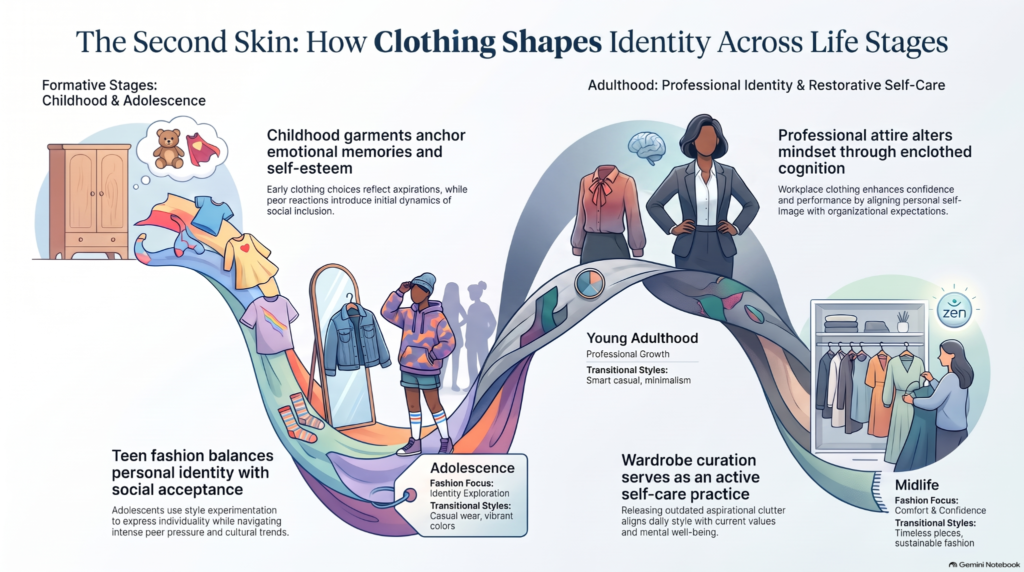
Clothing profoundly shapes your identity and emotional well-being across life stages. In childhood, it fosters self-expression and reflects social dynamics. As a teen, fashion becomes a canvas for individuality while maneuvering peer pressures. In young adulthood, your style solidifies, influencing personal and professional perceptions. Ultimately, understanding these connections enhances your self-care through fashion. Embracing this journey leads to evolving choices that authentically represent who you are and invite you to explore deeper insights into this transformative process.
KEY TAKEAWAYS
- Clothing serves as a fundamental medium for self-expression and identity formation throughout childhood, influencing emotional attachments and social interactions.
- Teen fashion is shaped by peer pressure and cultural trends, balancing individuality with the desire for social acceptance and self-discovery.
- Young adulthood focuses on personal branding and sustainable fashion, enhancing emotional connection and clarity in style choices.
- Professional attire impacts self-image and confidence, reflecting personal values while adhering to workplace standards and expectations.
- Fashion choices evolve across life stages, allowing individuals to redefine their identities and embrace new roles through their wardrobe selections.
THE PSYCHOLOGICAL IMPACT OF CHILDHOOD CLOTHING CHOICES ON IDENTITY
The psychology of fashion studies why people dress the way they do. Reflecting self-expression and identity, clothing choices are influenced by personality, cultural norms and social expectations. Factors like conformity, originality, and social status boost confidence and help people make conscious fashion choices that make them feel comfortable.
As children navigate the complexities of growing up, their clothing choices often serve as a powerful form of self-expression and identity formation. The garments they wear can become imbued with emotional attachment, representing childhood memories that shape their sense of self.
For instance, a favorite superhero t-shirt might symbolize bravery and aspiration, while a cozy sweater from a parent signifies love and security.
However, clothing choices also bring about social comparison, as children become aware of peers’ reactions. This awareness can foster feelings of both inclusion and exclusion, deeply influencing their self-esteem.
Parental influence plays a vital role, too; the way parents frame clothing as a form of identity can either empower or restrict.
Ultimately, understanding the psychological impact of these choices can help you recognize how clothing serves not just as fabric, but as a canvas for identity development in the formative years.
The Role of Teen Fashion in Shaping Self-Expression
Wearing fashion is a contemporary practice with profound economic, social and psychological implications for its consumers. This study investigates how fashion enthusiasts understand fashion and the social and psychological needs it satisfies. The data, analyzed through the lens of Grounded Theory, comes from 5 semi-structured interviews of women who identify as “Fashionistas”. The data revealed that Fashionistas use fashion to stabilise their individual and social identities by strengthening social bonds, boosting mood and comfort, and fitting in different social situations. Identity emerges from this study not as a monolithic structure but as a context-dependent entity with a constantly shifting balance.
Teen fashion plays an essential role in how you express your identity, reflecting not just personal taste but also the influences of peers and cultural trends.
As you navigate your style choices, you’re likely balancing the desire for individuality with the need for social acceptance.
Understanding these dynamics can illuminate how your clothing choices shape your sense of self during these formative years.
Fashion As Identity Expression
Fashion is far more than just clothing; it’s a form of self-expression, a reflection of our identity, and a means of communication. The psychology of fashion delves into the intricate relationship between what we wear and who we are. In this blog, we will explore how our clothing choices are a window into our minds, revealing our personalities, emotions, and cultural influences.
Fashion serves as a powerful medium for self-expression, especially during the transformative teenage years. As you navigate identity formation, your aesthetic choices reflect your personal narrative, influenced by cultural trends and generational shifts.
Each outfit becomes a canvas, allowing you to experiment with styles that resonate emotionally. This fashion evolution isn’t just about clothing; it’s a journey where you explore who you’re and who you wish to become.
The freedom to express individuality through fashion enables you to connect with peers and articulate your inner self. Embracing this phase of style experimentation helps shape your identity, serving as an essential tool for understanding your place in the world while celebrating the unique blend of influences that define you.
Peer Influence On Choices
Steering through the complex terrain of self-expression often means grappling with the influence of peers, especially in the domain of fashion. Peer pressure can serve as both a motivator and a constraint, shaping your choices through social conformity.
In the world of teen fashion, group dynamics play a vital role in identity formation, as you navigate what’s deemed culturally acceptable. This environment fosters style evolution, where you adapt trends to express your individuality while still feeling the weight of collective expectations.
Understanding the influence mechanisms at play allows you to embrace your unique voice amidst a sea of styles. Ultimately, recognizing these pressures empowers you to make conscious choices that reflect your true self.
Cultural Trends Impacting Style
As cultural trends ebb and flow, they greatly shape how you express yourself through clothing.
Teen fashion often reflects societal norms and cultural influences, allowing you to navigate identity politics and body image while embracing or rejecting traditional attire.
Globalization effects your style choices, merging diverse fashion histories and prompting discussions around cultural appropriation.
Media representation plays an essential role, showcasing varying ideals and sustainability trends that encourage you to reflect on ethical fashion.
As you curate your wardrobe, remember that your choices not only reflect your individuality but also contribute to broader conversations about identity and cultural appreciation.
Ultimately, your style becomes a powerful tool for self-expression, resonating with both personal beliefs and the evolving cultural landscape.
FINDING YOUR STYLE: CLOTHING AND IDENTITY IN YOUNG ADULTHOOD
During my doctoral fieldwork, I spent months evaluating the lifecycle of textiles, which fundamentally altered how I assess my personal closet. The hardest realization for most of us is not deciding what new pieces to buy, but confronting the clutter of the people we used to be. For years, my closet held aspirational garments—stiff, formal silhouettes and delicate sample fabrics that suited a hypothetical persona, while my daily reality involved active textile lab research, drafting tables, and commuting. Those unworn pieces did not just gather dust; they slowly degraded and exerted a persistent psychological weight every time I opened the wardrobe doors.
I had to shift my philosophy toward honest utility. Our wardrobes should serve our immediate everyday existence rather than an imaginary lifestyle. If you spend most of your waking hours in creative workshops, classrooms, or home studios, curating reliable, comfortable garments for those contexts is not a compromise—it is honoring your current phase of life.
Furthermore, adopting sustainable practices, such as choosing durable low-impact materials or curating timeless secondhand finds, brings clarity. It helps us reject fleeting cycles and treat getting dressed as a restorative personal routine that supports our ongoing work and growth.
In young adulthood, finding your style becomes a powerful form of personal expression that reflects your evolving identity.
As you navigate trends and experiment with different looks, you’re not just choosing clothes; you’re uncovering aspects of who you are.
This journey of self-discovery can shape how you present yourself to the world and influence your sense of belonging.
Personal Expression Through Fashion
Fashion serves as a powerful medium for personal expression, particularly during the transformative years of young adulthood. As you explore your identity, consider how color psychology influences your mood and self-presentation. Embracing sustainable fashion and vintage revival can deepen your emotional connection to clothing, allowing for style experimentation that reflects your unique journey. Personal branding becomes essential as you navigate gender expression and fashion accessibility. Organizing your wardrobe with seasonal trends in mind can enhance your overall style.
| Aspect | Impact on Identity | Tips for Expression |
| Color Psychology | Influences emotions | Choose colors that resonate |
| Sustainable Fashion | Ethical choices | Opt for eco-friendly brands |
| Vintage Revival | Nostalgic connections | Thrift shop for unique finds |
| Wardrobe Organization | Clarity in choices | Sort by occasion or color |
Trends and Self-Discovery
While traversing the complexities of young adulthood, discovering your personal style becomes an essential aspect of shaping your identity. Your style evolution is a journey of fashion experimentation and identity exploration, often influenced by cultural trends.
As you adapt to these trends, you may experience self-perception shifts that redefine how you view yourself. Clothing nostalgia can also play a role, prompting you to revisit styles that resonate with your past.
Embracing this fluidity in your wardrobe allows for authentic personal branding, reflecting who you’re and who you aspire to be. Ultimately, finding your style isn’t just about clothes; it’s about understanding your values and expressing your individuality in a world filled with possibilities.
The Role of Professional Attire in Shaping Adult Identity
When you step into a professional environment, the attire you choose can considerably influence how you perceive yourself and how others perceive you. This connection between clothing and self-image plays a significant role in shaping your professional identity. Understanding the science behind enclothed cognition helps explain how professional attire can influence your mindset, confidence, and behavior, shaping how you perceive yourself and approach your responsibilities.
Wearing professional attire often enhances your confidence, signaling to yourself and your colleagues that you’re serious about your role.
Moreover, your clothing choices can reflect your values and aspirations, allowing you to express individuality while still conforming to workplace standards. This balance between personal expression and professional expectations can create a sense of freedom, empowering you to navigate your career path authentically.
Recognizing the workplace influence of your attire is essential. Each outfit is a statement, intentionally or not, that can impact your interactions and opportunities.
The Psychological Effects of Clothing on Mental Health
The clothes you wear can greatly impact your mental health, as they often influence your mood and self-perception. When you prioritize clothing comfort and curate a wardrobe that aligns with your personal branding, you enhance your fashion confidence. Recognizing how fashion affects self perception is essential, as your clothing choices influence how you view yourself and present your identity to others.
Color psychology plays a significant role here; bold colors can energize you, while softer hues may bring a sense of calm. Your emotional attachment to certain pieces often reflects your journey and style evolution, shaping your self-image.
Societal norms can pressure you to conform, but embracing your unique style allows you to break free and express individuality. Brand identity also matters; the brands you choose can evoke feelings of belonging or empowerment.
Ultimately, your clothing choices aren’t merely about aesthetics; they serve as tools for emotional well-being, impacting how you navigate your world. Embrace this connection, and you’ll find clothing can be a powerful ally in your mental health journey.
Practical Self-Care Strategies Through Fashion Across Life Stages
Fashion can serve as a powerful self-care tool at various life stages, helping you navigate changes and express your evolving identity. To make the most of your fashion journey, consider setting realistic fashion budgets that allow for sustainable choices.
Building seasonal wardrobes can simplify daily decisions while elevating your body image through curated outfits that reflect who you are.
Explore vintage trends and thrift shopping for unique pieces that resonate with your personal story and promote eco-friendliness. Understanding color psychology can enhance your mood and confidence, so experiment with hues that uplift you.
Finally, refine your look with accessorizing techniques that add flair and individuality to your outfits. By embracing these practical strategies, you’ll not only express your identity but also turn fashion into a meaningful self care activity that nurtures your emotional well-being and boosts your confidence through every stage of life.
Embracing Change: How Fashion Choices Evolve Throughout Life
As you navigate different life stages, your fashion choices naturally evolve to reflect your changing identity and circumstances. You may find that transitional styles resonate with you, allowing you to express your individuality while adapting to new roles. Generational influences shape these choices, guiding you in how you perceive and adopt various trends.
| Life Stage | Fashion Focus | Transitional Styles |
| Adolescence | Identity Exploration | Casual wear, vibrant colors |
| Young Adulthood | Professional Growth | Smart casual, minimalism |
| Midlife | Comfort & Confidence | Timeless pieces, sustainable fashion |
Understanding these changes helps you embrace change rather than resist it. Each wardrobe shift signifies a new chapter, offering freedom to redefine who you are. By acknowledging your evolving tastes, you can create a personal style that aligns with your authentic self.
RELATED STUDIES ABOUT CLOTHING AND IDENTITY DEVELOPMENT
As you navigate the ever-changing tapestry of life, remember that your clothing choices are more than fabric—they’re threads woven into the fabric of your identity. Just as Dickens’ characters evolve, so too can your style reflect your growth and self-discovery. Embrace the art of self-care through fashion, recognizing how each garment can empower you, boost your mental health, and highlight your unique journey. Ultimately, your wardrobe can be a canvas for your evolving self, illustrating the story of who you are.
StyleVTON: A multi-pose virtual try-on with identity and clothing detail preservation
This computer vision and deep learning study introduces StyleVTON (Style Virtual Try-On Network), an end-to-end framework that addresses the dual challenge of transferring a target garment onto an individual while simultaneously altering their posture to an arbitrary target pose, overcoming the facial identity degradation and texture distortion typical of prior virtual try-on systems.
Conceptual Framework & Rationale
- Limitations of Single-Pose Virtual Try-On (VTON): Conventional 2D virtual try-on architectures (e.g., CP-VTON, ACGPN, VITON-HD) assume a static person image and focus exclusively on warping clothes to fit that original fixed posture. While preserving background pixels and non-target body parts simplifies image synthesis, it restricts consumers to static viewpoints and fails to simulate how clothing drapes dynamically across varied body postures.
- The Facial Degradation Trade-off in Multi-Pose Try-On: Emerging multi-pose try-on models (e.g., MG-VTON, FashionTryOn) attempt simultaneous garment transfer and posture re-targeting. However, their reliance on standard image-to-image translation networks causes severe facial feature blurring and loss of personal identity.
- Core Research Objective: To engineer a tripartite generative framework that can accept a trio of inputs—a candidate source image, a target garment image, and a target DensePose map—to synthesize a realistic try-on image in the desired posture while preserving fine garment textures, logos, and facial identity.
Methodology & Technical Architecture
The StyleVTON pipeline operates via three sequential, specialized modules:
- 1. Segmentation Module (Target Layout Prediction):
- Predicts an aligned four-channel segment map MWS (background, torso, left arm, right arm) representing the candidate in the target posture wearing the target garment.
- Takes the target clothing image C and target DensePose Dtrg as inputs. DensePose is utilized instead of standard 2D human parsing to provide robust 3D surface geometry that is invariant to the person’s original clothing.
- Implemented via a U-Net generator trained against a pix2pix conditional discriminator. Optimization combines pixel-wise cross-entropy loss with conditional GAN adversarial loss (LSM=Lentropy+LGAN).
- 2. Warping Module / Geometric Matching Module (GMM):
- Adapts the target clothing C to naturally deform and align within the generated torso boundaries Mt in two stages:
- Global Coarse Alignment: A Spatial Transformer Network (STN) takes C and predicted torso label Mt through a convolutional encoder to predict affine transformation parameters (rotation and scaling), yielding coarsely aligned garment Ca.
- Detailed Deformation: A U-Net refines Ca using concatenated channel inputs of Ca, an RGB pose skeleton S, and torso label Mt to produce final warped garment Cw. The authors demonstrate that utilizing skeleton S avoids color distortion artifacts induced if Dtrg is used directly.
- Loss Architecture (LGMM): Combines L1 pixel loss, VGG-19 perceptual loss (LVGG at layer 5), and adversarial training against two multi-scale discriminators to retain sharp garment logos, typography, and fabric textures.
- Adapts the target clothing C to naturally deform and align within the generated torso boundaries Mt in two stages:
- 3. Pose Transfer Module (StyleGAN-Modulated Synthesis):
- Unlike conventional pose-transfer networks that attempt to regenerate the entire body simultaneously, StyleVTON only transfers non-targeted body parts (head, trousers, limbs) to the target pose, keeping the torso region empty for final garment integration.
- Constituent Sub-Networks:
- Pose Feature Generator: Encodes target DensePose Dtrg into a 1616512 latent space Fpose.
- Coordinate Completion Model: Inpaints invisible UV-space coordinates by leveraging human body mirror-symmetry to transfer visible source appearance features to unseen target poses, generating appearance flow Mmap.
- Source Feature Generator: Extracts non-torso source body parts Intb, infills the torso with average arm skin color V to generate skin-conditioned source Iskn, and produces multiscale warped appearance features Fappi via a feature pyramid network (FPN).
- Affine Parameters Network: Translates appearance features into adaptive scaling () and shifting () modulation parameters within the StyleGAN synthesis blocks.
- Facial Preservation Loss (LPTM): Integrates a pre-trained SphereFace feature cosine loss (Lface) alongside L1, VGG, and StyleGAN discriminator losses (LPTM=L1+Lface+Lvgg+Ladv), directly penalizing deviations in facial identity.
- Final Image Composition: Generates the non-torso posed person Ih and performs element-wise addition with warped clothing Cw to produce the complete output image Ifinal.
Experimental Setup & Empirical Evaluation
- Datasets & Training Specifications:
- Training: Segmentation and Warping modules were trained on VITON-HD (11,647 training pairs, resized to 348512) for 45 and 50 epochs, respectively. Pose Transfer was trained on DeepFashion (101,967 pairs) using a pre-trained checkpoint fine-tuned over 10 epochs. Optimization used Adam with module-specific learning rates.
- Testing: Evaluated across three benchmark datasets:
- VITON-HD (n=2,032, unpaired setting without paired ground truth, assessed via pseudo-ground truth matching).
- FashionTryOn (n=7,516 image trios, paired ground-truth setting).
- MPV (n=52 trios, paired comparative benchmark).
- Evaluation Metrics: Structural Similarity Index (SSIM), Fréchet Inception Distance (FID), Inception Score (IS), and Learned Perceptual Image Patch Similarity (LPIPS).
- Quantitative Benchmark Comparisons:
- VITON-HD (Unpaired Setting):
- StyleVTON achieved an FID of 19.959, outperforming Wang et al. (42.208) and FashionTryOn (51.240) by over 22 points, while attaining superior perceptual quality (LPIPS=0.252) and Inception diversity (IS=2.907).
- FashionTryOn (Paired Setting):
- Outperformed competitors across all four metrics: SSIM of 0.759 (vs. 0.699 for FashionTryOn, 0.695 for Wang et al.), FID of 39.341 (vs. 53.911 and 44.306), IS of 3.331, and LPIPS of 0.131 (vs. 0.211 and 0.152).
- MPV Dataset:
- Achieved the highest structural accuracy (SSIM = 0.788 vs. 0.723 for Wang et al., 0.705 for MG-VTON, 0.563 for CP-VTON) and best perceptual similarity (LPIPS = 0.111 vs. 0.187 for Wang et al.).
- VITON-HD (Unpaired Setting):
- Ablation Study (Single vs. Dual Discriminators in Warping):
- Evaluating the GMM module under a paired VITON-HD setting confirmed that integrating two multi-scale discriminators dramatically reduced distribution divergence (FID dropped from 23.317 to 18.805) and improved perceptual sharpness (IS=5.111 vs. 4.786; LPIPS=0.0328 vs. 0.0353).
- Qualitative inspections verified that dual discriminators resolved blurry smudging across intricate brand logos, typography, and pocket patterns.
Technical Insights & Practical Implications
- Identity Preservation Without Re-Encoding Everything: Rather than forcing a single latent space to simultaneously synthesize novel clothing and preserve personal likeness, StyleVTON isolates the clothing-agnostic body parts. Relocating only the candidate’s actual head and lower body via SphereFace-regularized StyleGAN blocks avoids the facial distortion common in end-to-end multi-pose models.
- Decoupling Garment Deformation from Person Synthesis: Utilizing DensePose to guide initial segmentation while reserving a dedicated STN-plus-UNet pipeline for fabric warping ensures that complex fabric prints, structural collars, and hemlines conform to target limb positions before final image fusion.
- Commercial E-Commerce Utility: Allowing shoppers to visualize garments across dynamic, natural poses rather than rigid catalog stances provides a more realistic assessment of fit and drape, reducing return rates and enhancing consumer purchasing confidence.
Limitations & Failure Modes
- Segmentation Boundary Errors: In extreme postures, the U-Net segmentation module occasionally produces disjointed torso-arm boundaries or misinterprets long hair as upper clothing, creating unnatural empty gaps at the shoulders or artifacts near the hips. The authors trace this to DensePose’s lack of explicit separation between head/torso and torso/leg boundaries.
- Fine Text and Geometric Pattern Smudging: The warping module struggles with dense, high-frequency patterns (e.g., narrow stripes becoming crooked or overlapping) and small typography, where thin text can become illegible.
- Dataset Representation and Body Diversity Bias: Because available training datasets (VITON-HD and DeepFashion) feature predominantly slim, “average” body models, the network struggles when evaluating fuller-bodied or non-standard physiques, frequently rendering try-on images that erroneously depict candidates as slimmer than they are in reality.
- Upper-Garment Restriction: The current pipeline is evaluated strictly on upper garments (shirts, t-shirts, tops), requiring further architectural extensions and paired datasets to support full-body try-on (trousers, dresses, outerwear, and footwear).
| REFERENCE: Tasin Islam, Alina Miron, Xiaohui Liu, Yongmin Li, StyleVTON: A multi-pose virtual try-on with identity and clothing detail preservation, Neurocomputing, Volume 594, 2024, 127887, ISSN 0925-2312, https://doi.org/10.1016/j.neucom.2024.127887. (https://www.sciencedirect.com/science/article/pii/S0925231224006581) |
The consequence of possessions: Self-identity, extended self, psychological ownership and probabilities of purchase for pet’s fashion clothing
This empirical study evaluates how pet owner beliefs, self-identity concerning possessions, and psychological ownership interact to influence consumer extended self and purchase probabilities for pet fashion clothing using covariance-based structural equation modeling (CB-SEM).
Conceptual Framework & Theoretical Rationale
- Expansion of the Pet Economy and Anthropomorphic Consumption: The pet industry has experienced substantial commercial growth, with spending on pet accessories, luxury grooming, and fashion expanding rapidly. Pets are frequently treated as family members and social companions. In post-humanist and consumer culture frameworks, dog fashions challenge traditional human-animal boundaries, transforming human-animal emotional bonds into material consumer goods.
- Theoretical Integration (Belk’s Extended Self & Psychological Ownership):
- Extended Self Theory: Grounded in Russell Belk’s foundational conceptualization, consumers regard key possessions—knowingly or unknowingly—as parts of themselves. Because pets can reflect an owner’s personality, values, and lifestyle, they serve as symbolic extensions of the owner’s self-concept.
- Psychological Ownership & Control: Rooted in the need for control, efficacy, and personal attachment, psychological ownership (“the feeling that an object is mine”) connects possessions directly to self-perception.
- Beliefs and Self-Identity Concerning Possessions: Possessions help bridge the gap between actual and ideal self-identity. Beliefs regarding pets as possessions and family members guide consumer attitudes and provide the foundation for psychological ownership and self-extension.
- Core Research Objectives:
- Determine how pet owner beliefs and possession-based self-identity relate to psychological ownership and the extended self.
- Evaluate the direct and indirect impacts of these constructs on consumers’ purchase probabilities for pet fashion clothing.
- Test whether psychological ownership and the extended self mediate these behavioral relationships.
Methodology & Empirical Architecture
- Sampling & Recruitment:
- Conducted an online survey using an international professional market research firm across Australia, sampling respondents proportionally across states and territories (31% New South Wales, 28% Victoria, 21% Queensland, 9% South Australia, 5% Western Australia, 3% Tasmania, and 2% Australian Capital Territory).
- All 326 respondents owned at least one dog (with 33% also owning cats, 14% fish, 10% birds, and 43% other pets).
- Demographic Distribution: 51.2% female, 48.8% male; 73% urban, 26% rural; 62.6% married; with diverse age brackets (29.6% aged 56, 27.6% aged 46–55, 22.1% aged 36–45, 19.9% aged 26–35) and income ranges.
- Construct Measurement:
- Evaluated on 7-point Likert-type scales utilizing validated instruments:
- Probabilities of Purchase: Adapted from Bemmaor (1995) to assess purchase likelihood over standard binary purchase intentions.
- Self-Identity Concerning Possessions: Adapted from Sivadas and Machleit (1994).
- Beliefs on Pet Possessions: Derived from Belk (1996).
- Psychological Ownership: Adapted from Fuchs et al. (2010), Kirk et al. (2018), and Peck and Shu (2009).
- Extended Self: Adapted from Jyrinki and Leipämaa-Leskinen (2006).
- Evaluated on 7-point Likert-type scales utilizing validated instruments:
- Statistical Modeling & Quality Criteria:
- Analyzed via Covariance-Based Structural Equation Modeling (CB-SEM) in SPSS AMOS 28.
- Measurement Model Fit: Demonstrated good fit (2=280.527,df=121,2/df=2.318,RMSEA=0.064,GFI=0.91,CFI=0.96,TLI=0.95).
- Validity & Reliability: Confirmed convergent validity (all factor loadings >0.665, AVE>0.50, CR>0.70) and discriminant validity via Fornell-Larcker criteria and Heterotrait-Monotrait (HTMT) ratios below 0.85.
- Common Method Bias (CMB): Harman’s single-factor test accounted for $<50\%$ variance; full collinearity VIFs were 1.0; and a latent method factor model yielded a non-significant chi-square difference (2[1]=2.3<3.84), confirming CMB was not an issue.
- Mediation Analysis: Tested via bias-corrected bootstrapping with 5,000 resamples.
Key Empirical Findings
- Structural Path Model Estimates:
- The structural model achieved strong fit (2=1.058,df=1,p=0.304,RMSEA=0.013,CFI=1.00,GFI=0.99).
- Total variance explained (R2): 55% for psychological ownership/control, 80% for extended self, and 54% for purchase probabilities of pet clothing.
- Direct Path Coefficients:
- Beliefs Psychological Ownership (H1a): Positive and statistically significant (=0.671,p<0.001).
- Beliefs Extended Self (H1b): Positive and statistically significant (=0.267,p<0.001).
- Self-Identity Psychological Ownership (H2a): Positive and statistically significant (=0.112,p<0.01).
- Self-Identity Extended Self (H2b): Positive and statistically significant (=0.535,p<0.001).
- Psychological Ownership Extended Self (H4a): Positive and statistically significant (=0.247,p<0.001).
- Extended Self Purchase Intent/Probabilities (H3a): Exerted the strongest positive relationship in the entire model (=0.930,p<0.001).
- The Negative Direct Suppression Effect of Beliefs (H1c):
- In the direct path, pet owner beliefs in possessions showed a significant negative relationship with purchase probabilities (=-0.479,p<0.001).
- While owners who hold strong attachment beliefs view pets as deeply personal, baseline beliefs alone do not translate into fashion purchasing without the activating vehicle of the extended self.
- Mediation & Indirect Pathways:
- Extended Self Mediation (H3b): Extended self demonstrated a significant, suppressed partial mediation between beliefs and purchase probabilities (indirect effect: 0.403, 95% CI 0.32, 0.49), counterbalancing the negative direct path.
- Psychological Ownership Mediations (H4b & H4c): Psychological ownership significantly and partially mediated the relationship between self-identity and extended self (indirect effect: 0.028, 95% CI 0.005, 0.05) and between beliefs and extended self (indirect effect: 0.166, 95% CI 0.10, 0.24).
Theoretical & Practical Implications
- Pet Fashion as Self-Extension, Not Pet Utility: Purchasing pet clothing is driven primarily by the owner’s extended self rather than the objective physiological needs of the animal. Consumers buy pet apparel because the pet visually symbolizes and projects their own lifestyle, status, and aesthetic identity.
- Resolving the Belief Paradox: Strong emotional beliefs regarding pets as sentient family companions can induce resistance to treating them as frivolous mannequins. However, once a pet is incorporated into the consumer’s extended self, pet apparel is reframed as an expression of personal identity, driving high purchase probabilities.
- Retail & Marketing Strategy:
- Targeting the Extended Self Over Utilitarian Attributes: Marketing campaigns should emphasize identity consistency, personal style alignment, and social belonging rather than purely functional warmth or protection.
- Anthropomorphic Priming & Co-Branding: Retailers can prime human-like attributes and design coordinated owner-pet fashion lines to leverage psychological ownership and identity congruity.
- Focusing on Receptive Demographics: Marketing efforts should account for younger demographic segments who exhibit greater propensity for pet fashion consumption.
Methodological Limitations
- Purchase Probabilities vs. Actual Behavior: The study relied on subjective purchase probability scales rather than objective point-of-sale transactional receipts or scanner expenditure records.
- Cross-Sectional Architecture: The single-timepoint survey limits definitive causal assertions regarding how psychological ownership and self-extension evolve over a pet’s lifespan.
- Geographic & Cultural Boundaries: Conducted exclusively within Australia, an affluent Western market with high baseline companion animal ownership; relationships may vary significantly across collectivist cultures or regions with differing views on domestic animals.
- Canine Focus: All participants owned dogs, potentially limiting generalizability to feline or non-canine companion species.
| REFERENCE: Clare D’Souza, Vanessa Apaolaza, Patrick Hartmann, Ninh Nguyen, The consequence of possessions: Self-identity, extended self, psychological ownership and probabilities of purchase for pet’s fashion clothing, Journal of Retailing and Consumer Services, Volume 75, 2023, 103501, ISSN 0969-6989, https://doi.org/10.1016/j.jretconser.2023.103501. (https://www.sciencedirect.com/science/article/pii/S0969698923002485) |
How psychological and contextual barriers to environmentally sustainable consumption vary across domains: A comparative study of food, electronics, and clothing in Switzerland
This empirical investigation analyzes the prevalence of environmentally sustainable consumption behaviors during the acquisition phase and evaluates how perceived contextual constraints and psychological barriers (“Dragons of Inaction”) operate across three distinct consumption domains—food, portable consumer electronics, and clothing—using a nationally representative sample of Swiss residents.
Conceptual Framework & Rationale
- The Intention-Behavior Gap Across Domains: Despite widespread pro-environmental concern, consumers frequently fail to translate sustainable intentions into actual purchasing behaviors. While prior research has examined this intention-behavior gap either in the aggregate or within isolated product categories, comparative cross-domain investigations remain sparse.
- Consumption Domains as Distinct Decision Environments: Sustainable consumption is not a uniform individual trait; purchase decisions vary substantially across everyday domains:
- Food: Characterized by high purchase frequency, lower per-transaction costs, routine habituation, and deep social embedding (e.g., shared meals).
- Electronics: Characterized by infrequent multi-year replacement cycles (~3 years for smartphones), high financial investments, technical complexity, and low information transparency.
- Clothing: Characterized by regular purchase intervals, symbolic identity expression, and social status signaling.
- Dual-Lens Analytical Structure (Contextual vs. Psychological Barriers):
- Contextual Barriers: External constraints as subjectively represented by the consumer, including high prices, lack of trust in labels, limited availability, lack of time, and quality/trend perceptions.
- Psychological Barriers: Internal cognitive, motivational, and affective inhibitors operationalized via the Dragons of Inaction Psychological Barriers (DIPB) Scale across five core dimensions: change unnecessary, conflicting goals and aspirations, interpersonal relations, lacking knowledge, and tokenism.
- Core Research Objectives:
- Determine how engagement in environmentally sustainable acquisition behaviors varies across food, electronics, and clothing.
- Compare the prevalence of perceived contextual and psychological barriers across these three domains.
- Evaluate how psychological barriers relate to self-reported sustainable behaviors within each domain.
Methodology & Sample Architecture
- Data Source & Empirical Setting: Data were collected in October 2023 as part of Wave 3 of the Swiss Sustainable Consumption Observatory (SSCO). Switzerland represents an ideal setting due to high societal affluence and mature, well-developed markets where sustainable alternatives (e.g., organic foods, Fairphone, sustainable fashion brands) are readily accessible in mainstream retail channels.
- Sampling & Recruitment:
- Recruited via an ISO-certified market research panel using quota sampling to match the Swiss population across age (18–65 years), gender, and language regions (German, French, Italian).
- Final Analytical Cohort: 1,136 respondents after removing low-quality submissions (speeding <7 minutes, nonsensical open-ended text) and incomplete responses.
- Sample Demographics: Mean age 42.2113.0 years; 50.7% female; 43.3% tertiary education; 75.6% German-speaking, 20.4% French-speaking, and 4.0% Italian-speaking.
- Survey Design & Measurement Protocols:
- Self-Reported Acquisition Behaviors: Evaluated five acquisition behaviors per domain on 7-point Likert scales (1=veryunlikely to 7=verylikely).
- Contextual Barriers: Measured across all three domains via a multiple-choice format (“check all that apply”) assessing seven barriers: price, label trust, reluctance to give up habits, time constraints, lack of options, low quality, and not being trendy.
- Psychological Barriers: Assessed via a randomized between-subjects design where participants were allocated to evaluate the 22-item DIPB scale for a single domain: Food (n=378), Electronics (n=382), or Clothing (n=376).
- Statistical Modeling:
- Mixed-design ANOVAs with Tukey-adjusted post-hoc comparisons evaluated behavioral variations.
- Binomial probit regression models estimated marginal means and domain differences for contextual barriers.
- Confirmatory factor analysis (CFA with WLSMV estimator) and multigroup CFA established measurement invariance across domains for the DIPB scale ($\Delta\text{CFI} < 0.02, \Delta\text{RMSEA} < 0.018$).
- Multiple linear regression models identified domain-specific psychological predictors of sustainable behavior.
Key Empirical Findings
- Behavioral Prevalence Across Domains (RQ1):
- Across all categories, mean behavioral likelihood scored above the scale midpoint (>3.5), indicating generally positive attitudes toward sustainability.
- Food Dominated Sustainable Actions: Participants reported significantly higher engagement in food sustainability (e.g., buying sustainable food: M=4.84; reusable containers: M=4.99) compared to electronics (M=4.44,t=8.53,p<0.001) and clothing (M=4.43,t=8.91,p<0.001).
- Concrete vs. General Behaviors: Concrete, low-cost actions like “buying fewer products” (clothes: M=4.94; electronics: M=4.62) were adopted more readily than abstract actions like purchasing items made of recycled materials (electronics: M=3.78).
- Second-Hand Clothes Heterogeneity: Purchasing second-hand clothing showed the lowest average adoption (M=3.85) but the highest individual variance (SD=2.11), reflecting polar consumer attitudes regarding used apparel.
- Contextual Barrier Dynamics (RQ2):
- The Price Barrier: High price emerged as the primary contextual barrier across all domains, but was significantly higher for food (53.0%) than clothing (40.4%, z=6.01,p<0.001) and electronics (34.2%, z=9.05,p<0.001).
- Label Mistrust & Reluctance to Change: Lack of trust in sustainability labels was widespread (31.9% to 39.0%), and reluctance to give up preferred items was substantial (24.9% to 32.4%, peaking in food at 32.4%).
- Availability Constraints in Fashion: Lack of sustainable options was significantly more prevalent for clothing (17.0%) than electronics (10.4%, z=4.57,p<0.001). Quality ($<10\%$) and trend concerns ($<9\%$) were rarely cited as primary obstacles.
- Psychological Barrier Differences & Predictors (RQ3):
- Cross-Domain Differences: Two of five DIPB subscales differed significantly by domain:
- Interpersonal Relations: Significantly higher in food (M=2.94) than electronics (M=2.16) and clothing (M=2.25,p<0.001), reflecting social coordination demands around dining.
- Lacking Knowledge: Significantly lower in food (M=2.50) than electronics (M=3.16) and clothing (M=3.23,p<0.001), highlighting information deficits in non-food purchases.
- Predictive Explanatory Power:
- Food Model (R2=0.28): Psychological barriers strongly predicted behavior. Change unnecessary (t=-4.64,p<0.001) and conflicting goals (t=-2.21,p<0.05) negatively predicted sustainable food purchases. Counterintuitively, lacking knowledge (t=2.78,p<0.01) and tokenism (t=2.06,p<0.05) exhibited positive associations, as high awareness of personal knowledge deficits often co-occurs with active information seeking among motivated consumers.
- Clothing Model (R2=0.14): Conflicting goals (t=-4.87,p<0.001) and change unnecessary (t=-3.34,p<0.001) negatively predicted sustainable purchases, while interpersonal relations showed a positive association (t=4.99,p<0.001).
- Electronics Model (R2=0.07): Displayed the weakest relationship with psychological barriers, driven only by conflicting goals (t=-2.91,p<0.01) and interpersonal relations (t=4.90,p<0.001).
- Cross-Domain Differences: Two of five DIPB subscales differed significantly by domain:
Theoretical & Practical Implications
- Coexistence of High Barriers and High Action in Food: High adoption of sustainable food practices coexists with high perceived prices and interpersonal friction. Grounded in Social Practice Theory, food consumption involves routine, socially embedded practices where perceived price and social hurdles are ongoing, negotiated conditions rather than absolute stopping points.
- The Information Ambiguity of Consumer Electronics: Infrequent purchase cycles (~3 years) hinder habit formation and experiential learning in electronics. Lacking standardized, intuitive cues comparable to “organic” food labels, consumers default to conventional functional and financial criteria under decision uncertainty.
- Domain-Tailored Policy and Intervention Strategies: Universal, “one-size-fits-all” sustainability campaigns are ineffective. Interventions must be calibrated to specific domain dynamics:
- Food Interventions: Target market price structures (e.g., subsidies, reduced retail markups) and support social coordination around sustainable eating.
- Electronics Interventions: Implement mandatory, standardized sustainability labeling, repairability scoring, and extended warranty disclosures to overcome knowledge barriers and high perceived technical risk.
- Clothing Interventions: Expand sustainable retail availability and address second-hand apparel barriers—specifically by ensuring quality assurance and alleviating hygiene concerns.
Study Limitations
- Self-Reported Acquisition Focus: Evaluated self-reported behavioral likelihood at the acquisition stage rather than tracking objective transactions (e.g., scanner loyalty data) across the full product lifecycle (use, maintenance, and disposal).
- Measurement Asymmetry: Contextual barriers were operationalized via binary checklist items, whereas psychological barriers utilized continuous Likert scales, precluding direct comparative scaling.
- Geographic & Economic Specificity: Conducted entirely within Switzerland, an affluent market with advanced green retail infrastructures, which may constrain direct generalizability to emerging or less economically advantaged markets.
| REFERENCE: Swen J. Kühne, Yann Blumer, Sandor Czellar, Simona Haasova, Pascal Streule, Leïla Rahmani, Renate Schubert, Gregor Waller, How psychological and contextual barriers to environmentally sustainable consumption vary across domains: A comparative study of food, electronics, and clothing in Switzerland, Cleaner and Responsible Consumption, Volume 21, 2026, 100423, ISSN 2666-7843, https://doi.org/10.1016/j.clrc.2026.100423. (https://www.sciencedirect.com/science/article/pii/S2666784326000379) |
CONCLUSION
Reflecting on clothing and personal identity across different chapters of life underscores a central truth: personal evolution is rarely linear, and our wardrobes should never be treated as static monuments. Over the years, working with ethical makers and repairing well-worn garments has shown me that clothing endures changes in weave, form, and texture just as our bodies and identities naturally adapt to new stages of living. We often cling to rigid ideas of who we were supposed to become, allowing outdated silhouettes or aspirational purchases to fuel guilt.
True sustainable self-care begins when we grant ourselves permission to let go of pieces that no longer serve us. Every stitch, natural dye variation, and intentional layer should mirror our current values, physical comfort, and environmental awareness.
When you view your wardrobe as a living, circular ecosystem rather than a checklist of social conventions, the daily act of getting dressed becomes grounding. You are not dressing to satisfy an audience; you are honoring the body, mind, and values that carry you forward into your next chapter.