

Whenever I find myself in conversations about chronic stress, I notice how quickly people lean toward grand, sweeping overhauls. We tend to believe that resolving an overwhelming sense of mental fatigue requires completely rewiring our schedule, taking a week off to unplug entirely, or adopting an intense, rigid self-care regimen. But in my own practice and writing, I have consistently found that stress rarely operates on an all-or-nothing axis, and trying to “fix” it overnight often just adds another layer of pressure.
When your nervous system has been running on high alert for weeks or months, even the suggestion of adding more routines can feel exhausting. Real self-care in the context of chronic tension isn’t about self-optimization or adding more chores to your daily checklist. It starts with simple, non-judgmental observation.
Chronic stress typically creeps in quietly through subtle misalignments—a persistent gap between our natural rhythms and external expectations, sensory overload that we simply tolerate until we snap, or an internal narrative that convinces us everything is an emergency. Before reaching for drastic solutions, the most powerful shift begins by simply pausing long enough to notice the specific signals your body and mind are sending, without immediately judging yourself for feeling strained.
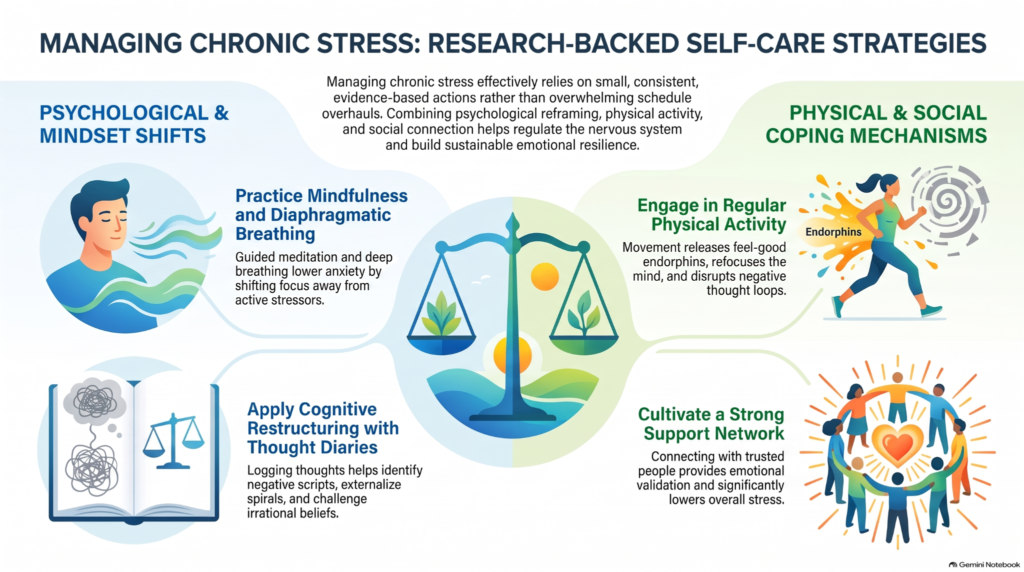
Chronic stress can feel overwhelming, but there are effective, research-backed strategies to help you manage it. Practicing mindfulness techniques, like breathing exercises and guided meditation, can reduce anxiety. Cognitive behavioral strategies help you identify negative thought patterns and replace them with balanced beliefs. Incorporating regular physical activity boosts mood and resilience. Additionally, building a supportive network strengthens your coping skills. Embracing these techniques can empower you to reclaim your peace and enhance your well-being—there’s more to explore about these strategies.
KEY TAKEAWAYS
- Incorporate mindfulness techniques, such as guided meditation and breathing exercises, to reduce anxiety and enhance emotional resilience.
- Utilize cognitive behavioral strategies to challenge negative thought patterns and replace them with balanced, rational beliefs.
- Engage in regular physical activity to boost mood, release endorphins, and promote overall well-being as a stress-relief method.
- Build a strong support network to provide emotional validation and share experiences, which can lower stress levels significantly.
- Maintain a thought diary to recognize triggers and patterns of anxiety, leading to more effective coping strategies over time.
UNDERSTANDING CHRONIC STRESS: WHAT CAUSES IT?
Stress might seem like a bad thing, but that’s not always the case. The stress response (fight or flight) is natural: It helps our bodies gear up for action—like avoiding an oncoming bus or meeting a tight deadline. When we feel threatened, our body releases hormones like adrenaline and cortisol that can boost mental clarity, tighten muscles, and accelerate the heart rate.
Although you mightn’t always recognize it, chronic stress can stem from various sources in your life. These chronic stressors, whether they’re work-related pressures, relationship conflicts, or financial woes, can accumulate over time, leading to overwhelming feelings.
Psychological triggers often exacerbate these stressors; perhaps a specific situation reminds you of past failures or instills fear of future challenges.
Identifying these triggers is essential for understanding your stress response. When you know what’s weighing you down, you can take steps to address it.
It’s not just about surviving day-to-day; it’s about reclaiming your freedom from the cycle of anxiety.
Mindfulness Techniques for Effective Stress Management
Stress management involves using various techniques and coping strategies to manage your overall stress levels, improve how you react to stressful things in your life, and build resilience.
When you practice mindfulness techniques, you can greatly reduce the impact of chronic stress on your life. These methods, like guided meditation and breathing exercises, help you cultivate awareness and presence, allowing you to break free from the cycle of stress.
Research shows that engaging in guided meditation can lower anxiety levels, enhancing your emotional resilience.
Breathing exercises, such as deep diaphragmatic breathing, ground you in the moment, offering a sense of control and calm. By focusing on your breath, you can shift your attention away from stressors, creating mental space for clarity.
Incorporating these mindfulness techniques into your daily routine empowers you to manage stress effectively. You’ll not only find relief but also develop a deeper understanding of your thoughts and emotions.
Cognitive Behavioral Strategies for Managing Stress
Cognitive behavioral strategies can be powerful tools for managing stress, as they help you identify and challenge negative thought patterns that contribute to your anxiety.
One effective method is cognitive restructuring, where you actively question irrational beliefs and replace them with more balanced thoughts. This process can empower you to reshape your perspective, allowing for a healthier emotional response to stressors.
Another valuable technique is maintaining thought diaries. By recording your thoughts and feelings during stressful moments, you can recognize patterns and triggers that escalate your anxiety. Over time, this awareness can lead to more effective coping strategies and a greater sense of control.
Ultimately, these strategies not only help you manage stress but also foster a mindset that embraces freedom from limiting beliefs.
How Physical Activity Relieves Stress
Physical activity can pump up your feel-good endorphins and other natural neural chemicals that boost your sense of well-being. Exercise also can refocus your mind on your body’s movements. This refocus can improve your mood and help the day’s irritations fade away. So go on a walk, take a jog, work in your garden, clean your house, bike, swim, weight train, vacuum or do anything else that gets you active.
Engaging in physical activity can be one of the most effective ways to combat stress, as it not only boosts your mood but also helps you regain a sense of control over your life. Research shows that exercise benefits extend beyond physical health; it releases endorphins, reducing anxiety and enhancing your overall well-being.
Movement therapy, whether through running, yoga, or dancing, allows you to express emotions and break the cycle of negative thoughts. These activities can also serve as a simple self care activity that supports emotional well-being and stress relief.
When you commit to regular physical activity, you create a routine that fosters discipline and empowerment. This shift in focus from stressors to your body’s capabilities can lead to a powerful transformation in how you handle challenges.
You’re not just burning calories; you’re nurturing resilience. So, consider integrating movement into your daily life. You’ll find that each step can lead you closer to a more balanced and fulfilling existence.

BUILDING RESILIENCE: EFFECTIVE COPING TECHNIQUES
For years, I’ve kept a daily thought journal—less of a traditional diary and more of a laboratory notebook where I record mindset experiments and track internal scripts. One of the most freeing patterns I began noticing early on was that my acute stress spikes were rarely caused by the workload itself. Instead, they stemmed from the silent, automatic commentary running behind the scenes: the subtle assumption that stepping away meant falling behind, or that taking a breath was a sign of falling short.
Cognitive reframing often sounds overly clinical or purely intellectual on paper, but in practice, it is fundamentally grounded and practical. When you write down an anxious spiral during a tense afternoon, you pull it out of your head and place it right in front of you. That small act of externalization creates a crucial pocket of breathing room. You start to see that a thought is merely a mental event, not an absolute truth or a command.
It gives you the space to ask: Is this catastrophic narrative serving me right now, or is it just the default static of an exhausted nervous system? By treating these recurring negative scripts as data points rather than personal failings, the emotional grip of the pressure begins to loosen. You stop fighting the current and start directing your mental clarity with intention.
Physical activity lays a solid foundation for resilience, but building effective coping techniques takes your stress management to the next level. To foster resilience, start by identifying your coping skills—those strategies that help you manage stress in healthy ways.
Mindfulness practices, such as meditation or deep breathing, can ground you in the present moment, easing anxiety and enhancing emotional clarity. Journaling also provides a powerful outlet; it helps you process thoughts and feelings, reinforcing your resilience building. These consistent practices can contribute to rewiring the brain for resilience by encouraging healthier responses to stress over time.
Consider re-framing negative thoughts into positive affirmations. This shift not only empowers you but also cultivates an optimistic mindset. Engaging in creative activities can further serve as a coping mechanism, allowing you to express emotions constructively.
Creating a Supportive Network: The Role of Social Connections
Having a strong support network can be a game changer when it comes to managing chronic stress. You don’t have to face life’s challenges alone; social support can provide you with the emotional validation you crave. Connecting with friends or family members who understand your struggles can create a safe space for you to express your feelings without judgment.
Research shows that people with supportive relationships experience lower stress levels and enhanced coping skills.
Building these connections isn’t just about having someone to vent to; it’s about fostering a sense of belonging and trust. When you share your experiences, you’re not only reinforcing your own emotional resilience but also creating a mutual support system.
Developing Your Personalized Stress Management Plan
While it might feel overwhelming to confront chronic stress, creating a personalized stress management plan can empower you to regain control over your life. Start by identifying your specific stress triggers—those situations or thoughts that create a sense of pressure. Next, consider personalized approaches that resonate with your lifestyle and preferences. Incorporating evidence based confidence habits can also help strengthen your sense of self-efficacy and make it easier to cope with stressful situations.
Here’s a table to help you organize your thoughts:
| Stress Trigger | Personalized Approach | Frequency |
| Work deadlines | Time-blocking sessions | Daily |
| Family responsibilities | Scheduled “me time” | Weekly |
| Financial concerns | Budgeting workshops | Monthly |
| Health issues | Regular exercise routines | 3-4 times a week |
| Social isolation | Join a community group | Bi-weekly |

RELATED STUDIES ABOUT SELF CARE FOR CHRONIC STRESS MANAGEMENT
In your quest to conquer chronic stress, it’s ironic how often we overlook the simplest solutions—like a walk in the park or a chat with a friend. While you might think the answer lies in grand gestures, it’s the small, consistent actions that truly pave the way for resilience. By combining mindfulness, physical activity, and social support, you’re not just managing stress; you’re crafting a life where stress takes a backseat. Remember, it’s the little things that often make the biggest difference.
Toward a standardized framework for chronic obstructive pulmonary disease self-care: An umbrella review
This umbrella review develops a standardized, patient-centered self-care framework for chronic obstructive pulmonary disease (COPD) by synthesizing evidence from clinical practice guidelines (CPGs) and systematic reviews, structured around the tripartite domains of maintenance, monitoring, and management.
Study Overview & Methodology:
- Two-Stage Best-Fit Synthesis: Stage 1 established a baseline framework by coding recommendations from five high-quality international COPD guidelines (including GOLD, NICE, and VA/DoD). Stage 2 expanded and refined the framework using evidence from systematic reviews to address gaps and incorporate patient-driven behaviors.
- Search Scope & Screening: Searched eight international databases from inception through April 20, 2026, screening 8,660 records. Fourteen systematic reviews met inclusion criteria, encompassing 584 primary studies (74.5% intervention trials, alongside qualitative and observational designs).
- Quality & Overlap Appraisal: Methodological quality was evaluated using the Joanna Briggs Institute (JBI) checklist and ROBIS tool, with 71.4% rated as high quality and low risk of bias. Primary study overlap across reviews was minimal (corrected covered area = 0.16%), eliminating duplication bias.
The Ten Core Self-Care Components:
- Self-Care Maintenance:
- Lifestyle Modification (High Certainty): Comprises smoking cessation (behavioral counseling combined with pharmacotherapy), regular individualized physical activity, self-practice of breathing techniques (such as pursed-lip breathing), avoidance of indoor/outdoor pollutants, and balanced nutritional intake.
- Psychological Coping and Social Support Engagement (Moderate Certainty): Encompasses emotional self-regulation to combat anxiety, depression, and fear of breathlessness, alongside peer or family network engagement to sustain daily routines.
- Preventive Vaccination Uptake (High Certainty in CPGs): Timely receipt of influenza, pneumococcal, and COVID-19 immunizations to reduce infection-triggered exacerbations.
- Self-Care Management:
- Adherence to Medication and Inhaler Technique (High Certainty): Correct and consistent use of inhaler devices, cognitive/dexterity adaptation, and routine technique reassessment.
- Management of Acute Exacerbations (High Certainty): Timely recognition of symptom deterioration (worsening dyspnea, sputum purulence, cough) paired with a personalized written action plan.
- Active Participation in Scheduled Follow-up (Moderate Certainty): Proactive attendance at routine clinic or telehealth appointments for treatment titration and functional review.
- Proactive Consultation for Unplanned Healthcare Issues (High Certainty, Emerging Component): Patient-initiated contact with clinicians via dedicated hotlines, messaging portals, or early appointments when acute warning signs persist for 48 hours.
- Self-Care Monitoring:
- Daily Monitoring and Tracking of Self-Symptoms (High Certainty, Emerging Component): Routine logging of breathlessness, sputum characteristics, activity tolerance, and vitals (e.g., pulse oximetry) to establish personal baselines and detect subclinical decline.
- Acquisition and Application of Health Literacy (High Certainty): Developing the practical capability to understand medical guidance, interpret symptom changes, and execute action plans.
- Self-Directed Access to Health Information and Resources (High Certainty, Emerging Component): Independent use of trustworthy patient guides, educational videos, and community resources to support informed decision-making.
Key Guideline–Review Misalignments:
- The Symptom Monitoring Deficit: Conventional CPGs focus heavily on maintenance and episodic management, leaving daily symptom tracking under-specified. This absence fosters reactive, symptom-delayed care where patients wait until severe breathlessness occurs before seeking help.
- The Vaccination Disconnect: While international guidelines prioritize vaccination as essential preventive maintenance, zero systematic reviews framed immunization as a discrete self-care behavior, reflecting a historical divide between clinician-led orders and patient-initiated action.
- Patient-Initiated Communication Gaps: Traditional guidelines rarely provide operational criteria for unscheduled, proactive consultations or self-directed information-seeking, both of which were strongly emphasized in recent literature as vital for autonomy.
Clinical & Health Policy Implications:
- Differentiated Implementation Models: Recommendations must match healthcare tiers: tertiary hospitals should emphasize discharge inhaler verification and exacerbation planning; community clinics should deliver smoking cessation, basic symptom diaries, and health literacy; and home settings require clear escalation thresholds via phone or telehealth.
- Low-Tech Inclusivity: While digital platforms and wearable apps provide continuous tracking, low-technology alternatives (paper symptom diaries, phone check-ins, visual cards) are essential to prevent health inequities among older adults and individuals with limited digital literacy.
- Standardized Outcome Measures: The authors recommend establishing a universal core outcome set for COPD self-care research—combining health-related quality of life, exacerbation frequency, hospital readmissions, and healthcare utilization—to improve evidence comparability across clinical trials.
| REFERENCE: Hongjuan Zhou, Doris Sau Fung Yu, Qing Zhao, Yulin Zhang, Charlie Hang Ip, Yi Nam Suen, Toward a standardized framework for chronic obstructive pulmonary disease self-care: An umbrella review, International Journal of Nursing Studies, Volume 184, 2026, 105679, ISSN 0020-7489, https://doi.org/10.1016/j.ijnurstu.2026.105679. (https://www.sciencedirect.com/science/article/pii/S0020748926003512) |
Understanding How a Digital Platform for Chronic Disease Management Can Enable and Limit Patient Self-Care: Qualitative Study
This qualitative study evaluates how a digital platform for chronic disease management—the Chronic Care Platform—both enables and constrains patient self-care behaviors and abilities, analyzing user experiences through the theoretical lens of Self-Care Theory.
Study Overview & Methodology:
- Research Context & Platform: Investigated a hospital-administered chronic disease management program in Canada for adult patients either recovering from cardiovascular events (post-discharge, 79%) or at elevated risk of cardiovascular disease (prevention, 21%). The web- and app-based platform provides health tracking, goal setting, educational resources, care plans, forum access, data sharing, and virtual health coaching.
- Sample & Data Collection: Conducted semi-structured interviews (in person and by phone) with 24 participants (15 men, 9 women) who had used the platform for at least one month, with 50% having utilized it for a year or longer.
- Theoretical & Analytical Framework: Applied template analysis (combining inductive coding with deductive categorization) using Self-Care Theory. The framework evaluated four domains of self-care ability (cognitive, psychosocial, physiological, sociocultural) and three core self-care behaviors (maintenance, monitoring, management).
Key Findings:
- Support for Core Self-Care Abilities:
- Cognitive Abilities: Educational articles, questionnaires, and personalized care plans helped patients feel informed and reminded them of lifestyle priorities. However, users noted frustration with repetitive, generic information and a lack of tailored, advanced guidance.
- Psychosocial Abilities: Automated congratulatory messages and tracking badges provided initial positive reinforcement and reassurance. Despite this, patients reported diminishing motivation over time because virtual points offered no tangible real-world value.
- Sociocultural Abilities: Features connecting patients to health coaches offered strong reassurance and safety. Conversely, peer discussion forums saw low engagement and lacked genuine social interaction, while attempts to share data with primary care physicians often failed because external providers were unwilling or unable to integrate platform outputs.
- Physiological Abilities Gap: The platform provided zero features or support targeting physical dexterity, functional movement levels, or motor skills needed to execute health behaviors.
- Support for Self-Care Behaviors:
- Self-Care Maintenance: Standardized exercise descriptions and wellness plans encouraged independent workouts and routine adjustments, though patients expressed a desire for more dynamic, proactive guidance.
- Self-Care Monitoring: The ability to visualize trends across blood pressure, weight, and activity logs gave patients valuable feedback that reinforced healthy habits. However, manual entry requirements caused data fatigue, and device syncing with third-party wearables presented recurring technical barriers.
- Self-Care Management Breakdown: While dashboards displayed longitudinal trends, the platform failed to provide normative interpretations (e.g., distinguishing normal fluctuations from dangerous clinical deterioration) or actionable instructions. Patients could not determine when to escalate care, and the system lacked automated clinical alert mechanisms to notify providers of abnormal metrics.
- Interdependent Feedback Loops: Positive self-care loops occurred when tracking data generated psychosocial reinforcement and productive discussions with health coaches. Conversely, missing management features disrupted these cycles: when metrics plateaued and patients could not determine clinical meaning, several stopped tracking altogether.
Design & Clinical Implications:
- Bridge the Self-Care Management Divide: Digital health platforms must evolve beyond passive data logging to incorporate algorithmic or normative feedback, clearly flagging out-of-range clinical trends and advising patients when to contact emergency services or their physicians.
- Integrate Movement Sensors: Incorporating interoperable movement and functional sensors can fill the gap in physiological self-care support, enabling individualized rehabilitation pacing and physical capacity assessments.
- Facilitate External Clinical Integration: Platform workflows need standard data export pathways compatible with external primary care electronic health records, preventing patient disillusionment when outside clinicians ignore their tracked metrics.
- Balance Automation with Human Support: Automated tools must be coupled with human guidance (such as nurse coaching) to satisfy patient needs for clinical validation while maintaining operational scalability.
| REFERENCE: Lysanne Lessard, Mark de Reuver, Kerri-Anne Mullen, Understanding How a Digital Platform for Chronic Disease Management Can Enable and Limit Patient Self-Care: Qualitative Study, Journal of Medical Internet Research, Volume 28, 2026,, ISSN 1438-8871, https://doi.org/10.2196/71875. (https://www.sciencedirect.com/science/article/pii/S1438887126004802) |
Parent–child interactions in the development of self-care among adolescents with chronic illness in Japan: A grounded theory approach
This study investigates how dynamic parent-child interactions shape the development of self-care among adolescents with chronic illnesses in Japan during their transition to adult-oriented health care.
Study Overview & Methodology:
- Research Design & Theoretical Framework: Used a qualitative grounded theory approach based on Strauss and Corbin’s methodology, sensitized by the Japanese Child Self-Care Nursing Theory. The COREQ checklist guided reporting.
- Participants & Setting: Recruited 11 adolescent-guardian pairs across two hospitals in Japan (a general hospital and a children’s specialty center). Adolescents were aged 16 to 24 years (mean age at onset 6–15 years) diagnosed with either type 1 diabetes (n = 6) or nephrotic syndrome (n = 5). Guardians included nine mothers and two fathers.
- Data Collection & Analysis: Conducted separate, semi-structured individual interviews (30–60 minutes each, in-person or online) with adolescents and parents to ensure uninhibited disclosure. Iterative coding and constant comparison were applied to map dyadic interactions until theoretical saturation was attained.
The Theoretical Interaction Model:
The study formulated an overarching model consisting of three sequential interactional stages and one stalled sub-process, depicted conceptually as interlocking gears where reciprocal behaviors and emotions continuously influence both parties:
- Process 1 (Parent-Led Self-Care):
- Parents are motivated by the desire to prevent their child’s life from being defined or ruined by disease. They perform primary clinical tasks and manage daily routines and environments on the youth’s behalf.
- Adolescents passively follow instructions and accept parental direction. Over time, parents observe their youth’s developmental growth and begin urging them to take initiative on tasks they can perform alone.
- Process 2 (Challenges & Experimentation Toward Autonomy):
- Adolescents actively assess what they can and cannot handle while navigating two competing developmental conflicts: striving to blend in with healthy peers (concealing symptoms, devices, or insulin pumps) and confronting the acute physical limitations and consequences of their condition.
- Parents shift away from direct execution, instead observing from a distance and attempting to explore their child’s thoughts. While parents attempt to empathize, they frequently struggle to fully understand the internal emotional conflicts and anxiety experienced by their teenagers.
- Sub-Process 2a (Disengaged Interaction Under Attribution):
- Occurs when dyads stall within Process 2 due to poor disease management or motivational friction.
- Parents attribute poor adherence entirely to a lack of effort or personal responsibility on the adolescent’s part (e.g., repeatedly questioning unmonitored blood glucose or missed medication).
- This unilateral attribution creates psychological distance, resentment, and disengaged communication, hindering the adolescent’s self-care progression.
- Process 3 (Realization of Self-Care Transition):
- Progression is unlocked when adolescents feel emotionally understood and supported by their parents, sparking feelings of gratitude.
- Observing their child’s efforts, parents acknowledge that the adolescent is doing their best and step back, recognizing their capability for independent management.
- Adolescents transition to performing former parental duties independently and ultimately integrate the illness into their personal identity, while parents actively seek broader adult support networks to facilitate their child’s full independence.
Clinical & Nursing Implications:
- Shift Unit of Care to the Parent-Child Subsystem: Transitional readiness cannot be judged solely by an adolescent’s individual cognitive knowledge or clinical skills; pediatric nursing interventions must assess the emotional alignment and communication patterns of the dyad as an interdependent unit.
- Prioritize Emotional Over Instrumental Support: Periods of poor adolescent adherence typically reflect social and emotional distress rather than ignorance of regimens. Healthcare teams should guide parents to provide validation and emotional empathy rather than repetitive reminders or information sharing, which often triggers disengagement.
- Support Parental Letting-Go: Clinicians must assist guardians in recognizing subtle self-care milestones, helping alleviate parental anxiety and facilitating the gradual transfer of clinical autonomy to the maturing adolescent.
| REFERENCE: Minae Fukui, Junko Honda, Chiemi Taru, Yushi Hirota, Hiroyuki Awano, Ikuko Miyawaki, Parent–child interactions in the development of self-care among adolescents with chronic illness in Japan: A grounded theory approach, Journal of Pediatric Nursing, Volume 87, 2026, Pages 460-467, ISSN 0882-5963, https://doi.org/10.1016/j.pedn.2026.02.002. (https://www.sciencedirect.com/science/article/pii/S0882596326000631) |
CONCLUSION
If you take only one thought away from this guide, let it be this: building resilience is not about hardening yourself against life or achieving an unbroken state of inner calm. Life will inevitably fluctuate, unexpected demands will arise, and your nervous system will occasionally shift into overdrive. The objective is never perfection; it is about reducing the time and emotional energy it takes you to notice when you’ve drifted into depletion and gently bringing yourself back to baseline.
During my early morning walks, as the sun begins to rise and the streets are quiet, I’m constantly reminded that real sustainable change mirrors the natural world: it happens through quiet, steady accumulation, not dramatic force. You don’t need to master every breathing method, overhaul your entire diet, or resolve every external conflict today.
Pick one small anchor that feels genuinely doable—whether that is drinking a full glass of water before looking at your phone, taking five deliberate breaths with a longer exhale before answering an email, or writing down an intrusive worry to inspect it calmly. Approach your well-being like an ongoing experiment. Give yourself permission to start small, observe what truly works for your mind, and let consistent, low-friction habits do the heavy lifting over time.