
Whenever someone tells me they want to “build unshakeable confidence,” my behavioral psychology radar immediately goes off. In mainstream wellness culture, confidence is often marketed like a switch you flip—or worse, a performance fueled entirely by reciting mirror affirmations until you magically feel bold. But human psychology doesn’t quite work on demand like that. I often think of a forum member named Janjump who shared how deeply isolated she felt: she kept a morning poster listing every single thing she wanted to change, reading it religiously just to get a fleeting burst of courage that fizzled out by noon.
That broke my heart, but it is also deeply relatable. When we try to force self-esteem from the top down—demanding that our brains simply “feel worthy”—the subconscious pushes right back with skepticism. Real, enduring confidence isn’t the absence of fear, nor is it an inflated ego. In applied psychology, we view it as self-efficacy: the quiet, grounded evidence that you can rely on yourself when things get uncomfortable.
True confidence isn’t built by pretending flaws don’t exist; it is cultivated through consistent micro-actions, emotional awareness, and sustainable behavioral feedback loops. Before we jump into changing the way you show up, we have to look gently at the mental models driving your self-perception in the first place.
Adopting evidence-based confidence habits can transform your self-esteem and spur personal growth. Start with positive affirmations to reshape your internal dialogue and challenge negative beliefs. Setting achievable goals can help you celebrate small victories and cultivate resilience. Mindfulness practices enhance emotional regulation, while strong social connections provide essential support in tough times. By embracing challenges and addressing limiting beliefs, you empower yourself to thrive. Explore these strategies further to release your full potential.
KEY TAKEAWAYS
- Regularly practice positive affirmations to reshape your internal dialogue and challenge negative self-beliefs, fostering a healthier self-image.
- Set achievable goals with clear, manageable steps to enhance self-esteem and celebrate small victories for personal growth.
- Engage in mindfulness practices to reduce negative self-talk, improve emotional regulation, and cultivate present moment awareness.
- Build and maintain strong social connections that provide emotional support, enhance confidence, and encourage personal resilience.
- Embrace self-compassion by treating yourself kindly, acknowledging flaws, and promoting understanding of shared human struggles to boost self-esteem.
HOW UNDERSTANDING SELF-ESTEEM CAN ENHANCE YOUR CONFIDENCE
Understanding self-esteem is essential because it directly influences your confidence levels.
When you grasp how self-esteem shapes your self-perception, you can initiate powerful shifts in your mindset. Recognizing that self-worth isn’t fixed, but rather fluid, allows you to engage in confidence-building practices that resonate with your values and aspirations.
Research shows that individuals with higher self-esteem tend to pursue challenging goals, leading to personal growth and resilience.
The Role of Positive Affirmations in Boosting Self-Esteem
Confidence is often defined as a feeling of assuredness or certainty in someone or something. Self-confidence is a belief in yourself and your abilities. You may feel confident that you’ll pass a course at your local community college, for example. When have confidence, you have no doubt that you’ll succeed.
Learning to be more confident involves using strategies such as positive self-talk, avoiding comparisons, and building relationships with positive, supportive people. Confidence is influenced by many factors, but building consistent daily habits can support positive self-perception. Self-compassion, setting achievable goals, and tackling new challenges can help build self-confidence through action.
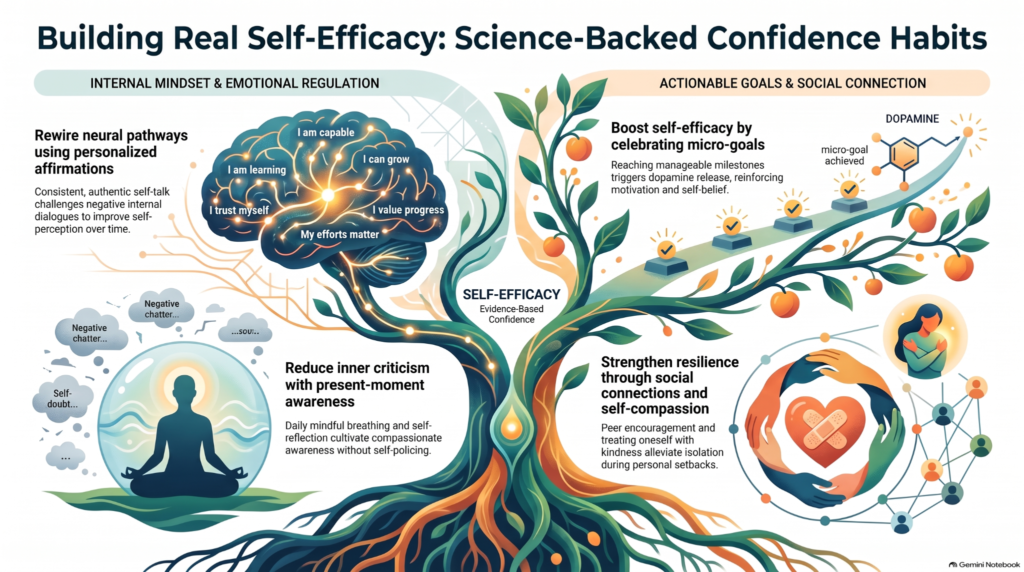
Positive affirmations can greatly influence your self-esteem by reshaping your internal dialogue.
Research shows that when you consistently engage with affirmations, you can actually alter neural pathways, leading to improved self-perception.
Science Behind Affirmations
While you mightn’t realize it, the words you tell yourself can greatly shape your self-esteem. Research shows that affirmation effectiveness hinges on the psychological impact they create. When you repeat positive affirmations, you actively challenge negative beliefs, reshaping your self-perception.
This process encourages neural pathways in your brain to reinforce a positive self-image, ultimately boosting your confidence. Understanding neuroplasticity and mindset change can help explain how repeated thoughts and behaviors may contribute to lasting changes in how you perceive yourself.
By embracing these statements, you cultivate a mindset that fosters personal growth and resilience. You empower yourself to break free from self-doubt and embrace your worth.
Crafting Effective Affirmations
Crafting effective affirmations requires a thoughtful approach, as the right words can profoundly impact your self-esteem.
Begin by utilizing affirmation techniques that resonate with you personally. Focus on positive language that speaks to your strengths and aspirations. For instance, instead of saying, “I won’t fail,” try, “I embrace challenges with confidence.” This shift not only reinforces a growth mindset but also promotes a more empowering self-narrative.
Research shows that consistently using affirmations can enhance your mood and foster resilience. Remember, authenticity is key; guarantee your affirmations reflect genuine beliefs you aspire to embody.
Daily Affirmation Practices
To effectively integrate daily affirmation practices into your routine, it’s essential to understand their profound impact on self-esteem.
Positive affirmations serve as powerful tools that can reshape your self-perception and foster personal growth. By consistently engaging in affirmation routines, you can rewire your mindset and promote a healthier self-image.
Here are four ways to enhance your daily mantras:
- Personalize Your Affirmations: Tailor them to resonate with your unique experiences and aspirations.
- Practice Consistency: Recite your affirmations at the same time each day for maximum impact.
- Visualize Success: Imagine achieving your goals while repeating your affirmations to reinforce belief.
- Reflect on Progress: Regularly assess how your affirmations influence your thoughts and actions.
How Setting Achievable Goals Boosts Self-Esteem and Personal Growth
Setting achievable goals can greatly enhance your self-esteem and foster personal growth. When you engage in goal setting, you create clear, manageable steps toward your aspirations. Each time you reach a personal milestone, you reinforce your belief in your abilities, which builds a positive self-image. This process isn’t just about the end result; it’s about celebrating small victories along the way.
Research shows that achieving these smaller goals can release dopamine, a neurotransmitter linked to feelings of satisfaction and motivation.
Moreover, setting realistic goals helps you avoid the frustration and disappointment that often accompany overly ambitious targets. By focusing on what’s attainable, you empower yourself to take action. This sense of autonomy and control over your life is essential for boosting self-esteem.
Embrace the journey of goal setting, and watch how each accomplishment propels you towards greater personal growth and confidence.

HOW MINDFULNESS PRACTICES CAN IMPROVE YOUR SELF-ESTEEM
I frequently see people trapped in an internal tug-of-war between two extremes: passive positive thinking and brute-force self-criticism. A Quora contributor captured this tension brilliantly, arguing that empty affirmations often feel like a superficial coping mechanism compared to real competence and facing intimidation head-on. From a behavioral standpoint, they have a solid point: the brain prioritizes lived experience over hollow words.
Yet, confronting our fears doesn’t mean we have to turn self-improvement into a battlefield of harsh self-demands. In my own work at Self Care Engineer, I love bridging that gap with what I call identity-aligned micro-mastery. You don’t need to conquer a mountain tomorrow to convince your nervous system that you are capable; you just need small, undeniable proof points. I was recently smiling at a Reddit user’s hack for social anxiety: approaching networking events and gatherings with the exact mindset of a kid on a playground asking someone to play.
That simple reframing works because it bypasses adult social posturing and taps into pure, open curiosity. Confidence flourishes when we lower the stakes, permit ourselves to be clumsy beginners, and allow connection and competence to evolve naturally through compassionate practice rather than exhausting self-policing.
Confidence is our representation of the way we want to be seen and how we want to see ourselves. Courage enables us to pursue the relationships and goals we desire. We need to dig in and find it inside of ourselves during this challenging time to be better. Science can help us get there.
Mindfulness practices can greatly enhance your self-esteem by helping you cultivate present moment awareness.
By reducing negative self-talk and improving emotional regulation, you create a more compassionate inner dialogue.
This shift not only fosters a positive self-image but also empowers you to respond to challenges with greater resilience.
Cultivating Present Moment Awareness
Practicing present moment awareness can greatly enhance your self-esteem by helping you connect with your thoughts and feelings without judgment.
By embracing mindful breathing and focusing on present awareness, you can cultivate a healthier self-image. Here are some effective strategies to get you started:
- Daily Mindful Breathing: Take five minutes each day to breathe deeply, focusing solely on your breath. This simple self care activity can help you stay present and develop greater awareness of your thoughts and feelings.
- Body Scan: Regularly check in with your body, noticing areas of tension and allowing them to relax.
- Gratitude Journaling: Write down three things you appreciate about yourself each day.
- Nature Walks: Spend time outdoors, paying attention to the sights and sounds around you to ground yourself.
These practices can empower your journey toward improved self-esteem and personal growth.
Reducing Negative Self-Talk
How often do you catch yourself engaging in negative self-talk? This internal dialogue can be damaging, undermining your self-esteem and personal growth.
Mindfulness practices offer a powerful way to combat this negativity. By incorporating self-reflection exercises, you can observe your thoughts without judgment, allowing you to challenge assumptions that fuel your inner critic.
When you notice negative patterns, ask yourself if these thoughts are based on facts or distorted perceptions. This process not only reduces self-doubt but also cultivates a sense of freedom from limiting beliefs.
Embracing mindfulness helps you shift your focus from harsh self-criticism to constructive self-awareness, ultimately fostering a healthier, more compassionate relationship with yourself.
Enhancing Emotional Regulation Skills
Negative self-talk often triggers a cascade of emotions that can feel overwhelming and difficult to manage.
Developing emotional regulation skills through mindfulness practices can enhance your self-esteem and emotional intelligence.
Here are four effective coping strategies:
- Mindful Breathing: Focus on your breath to anchor your thoughts and reduce anxiety.
- Body Scan: Tune into physical sensations, helping you understand emotional responses better.
- Journaling: Reflect on your thoughts and feelings, promoting self-awareness and clarity.
- Gratitude Practice: Regularly acknowledging what you’re thankful for can shift your mindset positively.
Incorporating these techniques fosters a greater sense of control over your emotions, empowering you to break free from negative patterns and enhance your personal growth journey.
Why a Growth Mindset Is Essential for Embracing Challenges
Embracing challenges becomes considerably easier when you adopt a growth mindset, as it allows you to view obstacles not as roadblocks but as opportunities for development.
Research shows that individuals with a growth mindset are more resilient and open to learning from failures. This process can support rewiring the brain for resilience by encouraging adaptive thinking and helping you respond more effectively to setbacks.
This perspective not only enhances your ability to tackle challenges but also fuels your self-esteem.
When you embrace challenges, you cultivate a sense of autonomy and confidence in your abilities. You start to recognize that effort and perseverance lead to improvement, which can transform your approach to personal and professional obstacles.
How Social Connections Boost Your Confidence
Building on the idea that a growth mindset helps you face challenges, it’s important to recognize how social connections can further enhance your confidence. Engaging with others provides essential social support that nurtures your self-esteem.
Here’s how strengthening your relationships can be beneficial:
- Peer Encouragement: Friends uplift you during tough times, reinforcing your belief in your abilities.
- Emotional Bonding: Sharing experiences with others fosters deeper connections, which can alleviate feelings of isolation.
- Community Involvement: Participating in group activities allows you to practice social skills, enhancing your confidence in various settings.
- Friendship Networks: A strong network can provide diverse perspectives and motivation, supporting personal growth.
How to Tackle Negative Self-Talk and Limiting Beliefs
While it might feel easier to succumb to negative self-talk and limiting beliefs, confronting these thoughts is essential for your self-esteem. Start by practicing cognitive restructuring—identify and challenge those harmful narratives. Ask yourself if they’re based on facts or just unfounded fears. This critical examination empowers you to rewrite your internal dialogue.
Incorporating self-compassion is equally important. Treat yourself with the kindness you’d offer a friend facing similar struggles.
Recognize that everyone has flaws and makes mistakes; this shared humanity fosters a sense of connection and understanding within yourself.
RELATED STUDIES ABOUT EVIDENCE BASED CONFIDENCE HABITS
Building self-esteem and fostering personal growth isn’t just wishful thinking; it’s a process backed by evidence. You might feel skeptical about the effectiveness of these habits, but remember that change takes time and consistency. By embracing positive affirmations, setting realistic goals, and nurturing social connections, you’ll gradually reshape your self-perception. Each small step you take builds a stronger foundation for confidence, proving that investing in yourself is always worthwhile. You’re capable of achieving lasting change.
Influence of students’ study habits, self-efficacy, digital literacy, and attitudes in curbing examination malpractices in computer-based examinations
This study investigates the relationships between undergraduate students’ study habits, general self-efficacy, digital literacy, attitudes toward computer-based testing (CBT), and attitudes toward examination malpractice in Nigerian universities.
Study Design & Methodology:
- Participants & Setting: Surveyed 2,577 undergraduate students across six federal, state, and private universities in Southwestern Nigeria (Ekiti and Ondo States) using a multistage sampling design.
- Instrumentation: Administered the Examination Malpractices and Computer-Based Testing Questionnaire (EMCBTQ), which incorporates adapted instruments measuring attitudes toward CBT examination malpractice (AEMC), attitudes toward CBT (ATCT), digital literacy (DL), general self-efficacy (GSE), and study habits (SH).
- Analytical Approach: Applied Partial Least Squares Structural Equation Modeling (PLS-SEM) via SmartPLS 4 to assess measurement reliability, convergent and discriminant validity, and structural path hypotheses.
Key Findings:
- Digital Literacy Increases Tolerance for Malpractice: Higher digital literacy was significantly associated with more favorable attitudes toward examination malpractice (beta = 0.135, t = 4.570, p < 0.001). Students with greater technical proficiency showed less fear of digital systems and greater awareness of how to exploit technological loopholes and online assistance during CBT.
- Study Habits Strongly Predict Integrity Dispositions: Study habits exerted the strongest direct positive effect on attitudes toward examination malpractice (beta = 0.623, t = 25.897, p < 0.001). In contrast, study habits showed an unexpected slight negative association with general self-efficacy (beta = -0.102, p = 0.002) and had no direct influence on attitudes toward CBT (beta = 0.044, p = 0.236).
- Technological Competence Fosters CBT Acceptance: Digital literacy positively influenced students’ attitudes toward CBT (beta = 0.184, t = 4.388, p < 0.001) and general self-efficacy (beta = 0.395, t = 12.506, p < 0.001).
- Self-Efficacy Shapes Testing Attitudes but Not Cheating Directly: General self-efficacy positively influenced attitudes toward CBT (beta = 0.103, t = 2.251, p = 0.024), but had no direct significant effect on attitudes toward examination malpractice (beta = 0.010, t = 0.331, p = 0.741).
- Attitudes Toward CBT Do Not Predict Malpractice: How students felt about CBT as an assessment method did not significantly affect their stance on examination malpractice (beta = -0.012, t = 0.489, p = 0.625), indicating that cheating behaviors are driven by deeper personal and academic factors rather than assessment modality perception.
- Model Explanatory Power: The structural model accounted for 45.6% of the variance in attitudes toward examination malpractice (R2 = 0.456, Q2 = 0.451), 14.2% in self-efficacy (R2 = 0.142), and 6.5% in attitudes toward CBT (R2 = 0.065).
Institutional & Policy Implications:
- Incorporate Digital Ethics into Curricula: Expanding digital literacy programs without ethical guidelines can increase cheating sophistication; institutions must integrate digital ethics, academic integrity modules, and responsible technology usage into undergraduate training.
- Address Systemic Security in CBT Infrastructure: Universities cannot rely solely on the CBT format to stop malpractice; institutions need to secure examination software against external device access, screen sharing, and local network tampering.
- Foster Academic Preparedness and Counseling: Academic counseling and structured study-habit interventions remain essential to build foundational subject mastery, helping reduce the pressure and motivation that drive students to seek shortcuts during examinations.
| REFERENCE: Oluwayemisi Damilola Akomolafe, Taiwo Olabode Kolawole, Kamorudeen Taiwo Sanni, Influence of students’ study habits, self-efficacy, digital literacy, and attitudes in curbing examination malpractices in computer-based examinations, Social Sciences & Humanities Open, Volume 14, 2026, 103242, ISSN 2590-2911, https://doi.org/10.1016/j.ssaho.2026.103242. (https://www.sciencedirect.com/science/article/pii/S2590291126008077) |
This study examines the efficacy of an integrated, school-embedded artificial intelligence (AI)-supported therapeutic program designed to promote healthy lifestyle habits among children with learning disabilities (LD).
Study Overview & Methodology:
- Research Design & Participants: Employed a quasi-experimental pre-test, post-test, and follow-up control group design involving 52 elementary students (aged 10–12 years; grades 4–6) diagnosed with learning disabilities in Riyadh, Saudi Arabia. Participants were assigned at the classroom level into an experimental group (n = 26) and a control group (n = 26).
- Intervention Framework: The experimental group received a 24-session therapeutic program delivered across 8 weeks (3 sessions weekly, 45–50 min per session) under structured educator mediation. The program integrated three commercial AI-supported tools:
- ChatGPT: Conversational AI for personalized natural language guidance, structured prompts, and motivational feedback.
- BIGGERFIVE Brave 2 (BW02): A wearable activity and sleep tracking smartwatch providing physiological and movement metrics (step counts, activity intensity, sleep duration) reviewed by educators to guide feedback.
- Elfie: A gamified health application utilizing points, badges, and reinforcement loops to motivate goal completion.
- Control Condition: The control group participated in standard school activities and general health instruction without specialized digital tools, behavioral scaffolding, or extra reinforcement.
- Outcome Measurement: Health behaviors were evaluated using the validated 40-item Healthy Habits Scale for Students with LD, measuring four primary domains (10 items each): physical activity, nutrition habits, sleep hygiene, and emotional regulation. Assessments occurred at baseline, post-intervention, and at a 4-week follow-up (experimental group only).
Key Findings:
- Baseline Equivalence: Independent-samples t-tests confirmed no statistically significant baseline differences between the experimental and control groups across age (p = 0.73), IQ (p = 0.82), or any healthy habit subscale (p > 0.47; Cohen’s d < 0.20).
- Marked Post-Intervention Improvements: Repeated-measures ANOVA and ANCOVA (controlling for pre-test scores) demonstrated statistically significant, large-magnitude intervention effects favoring the experimental group across all domains (p < 0.001, partial eta-squared = 0.75 to 0.82).
- Domain-Specific Gains (Experimental vs. Control Post-Test):
- Physical Activity: 36.20 +/- 4.40 vs. 28.45 +/- 3.30 (t = 7.12, p < 0.001, Cohen’s d = 1.97).
- Nutrition: 38.85 +/- 4.20 vs. 30.40 +/- 3.10 (t = 8.65, p < 0.001, Cohen’s d = 2.40).
- Sleep Hygiene: 39.44 +/- 4.30 vs. 31.28 +/- 3.20 (t = 7.92, p < 0.001, Cohen’s d = 2.19).
- Emotional Regulation: 37.75 +/- 4.10 vs. 29.95 +/- 3.00 (t = 8.11, p < 0.001, Cohen’s d = 2.25).
- Total Healthy Habits: 152.24 +/- 11.50 vs. 120.08 +/- 9.10 (t = 9.34, p < 0.001, Cohen’s d = 2.59).
- Within-Group Growth: Within the experimental cohort, total healthy habit scores improved from 117.54 +/- 9.20 at pre-test to 152.24 +/- 11.50 at post-test (t = 14.28, p < 0.001, Cohen’s d = 2.80).
- Maintenance of Behavioral Gains: Comparisons between post-test (152.24 +/- 11.50) and 4-week follow-up (151.73 +/- 11.20) in the experimental group showed no statistically significant attenuation (t = 0.81, p = 0.42, Cohen’s d = 0.16), confirming short-term behavioral retention.
Educational & Practical Implications:
- Scaffolding Executive Functioning: Children with LD face inherent self-regulatory and executive-function barriers (e.g., working memory deficits, difficulty delaying gratification) that undermine health routines. The multimodal combination of conversational prompts, continuous tracking, and gamified incentives offloads self-monitoring burdens and provides the external structure necessary to establish automated habits.
- Human-in-the-Loop Implementation: The program’s success relied heavily on educator oversight to interpret wearable metrics, moderate AI chatbot prompts, and scaffold digital interactions, highlighting that AI tools in special education serve as assistive pedagogical aids rather than autonomous replacements for educators.
- Methodological Caveats: The author notes that because the intervention was deployed as a bundled multi-tool program against a passive control, future studies using randomized designs, active control comparators, objective sensor endpoints, and disaggregated component testing are needed to isolate the specific causal impact of individual AI modules.
| REFERENCE: Ayman Abdullah Hazza Alamri, The effectiveness of an AI-based therapeutic program on health habits among students with learning disabilities, Acta Psychologica, Volume 268, 2026, 107266, ISSN 0001-6918, https://doi.org/10.1016/j.actpsy.2026.107266. (https://www.sciencedirect.com/science/article/pii/S000169182601067X) |
Higher education institutions students’ exercise habits and their self-reported oxidative-stress perception levels: A survey-based exploratory study
This study investigates the potential causal relationship between exercise habits and self-reported oxidative-stress perception levels among Chinese university students, addressing endogeneity biases through an instrumental variable (IV) approach.
Study Overview & Methodology:
- Participants & Sampling: Surveyed 1,868 undergraduate students (54.2% male, 45.8% female; mean age 20.8 years) from four diverse non-sports universities in a metropolitan area of China (effective response rate: 93.4%).
- Measurement Instruments: Exercise habits were measured using the 12-item Self-Report Habit Index (SRHI; Cronbach’s alpha = 0.973). Self-reported oxidative-stress perception was operationalized across three reverse-scored psychometric dimensions: the Fatigue Severity Scale-9 (FSS-9; fatigue-recovery dimension), the Subjective Vitality Scale-6 (SVS-6; physical vitality dimension), and the Exercise Self-Efficacy Scale-6 (ESES-6; exercise performance dimension).
- Econometric Identification Strategy: To resolve endogeneity stemming from omitted-variable bias and bidirectional reverse causality, the authors applied Two-Stage Least Squares (2SLS) alongside Ordinary Least Squares (OLS) regression. Identification relied on quasi-random campus housing allocations to construct a Comprehensive Accessibility Index (the weighted network walking distance from dormitories to multiple exercise facilities calculated via QGIS), supplemented by dormitory floor level as a secondary instrument. Models controlled for individual, socioeconomic, health, and institutional covariates.
Key Findings:
- Significant Instrumental Validity & Relevance: The first-stage regression confirmed that the Comprehensive Accessibility Index strongly predicted exercise habit intensity (beta = 8.45, p < 0.001) with a robust first-stage F-statistic of 127.2, well above the Stock-Yogo weak-instrument threshold. The Wu-Hausman test confirmed significant endogeneity across all three perception dimensions (p < 0.01), justifying the IV methodology.
- Ordinary Least Squares (OLS) Baselines: Standard OLS regression revealed modest, statistically significant negative associations between exercise habit intensity and all three dimensions: fatigue-recovery (beta = -0.021, p < 0.001), physical vitality (beta = -0.018, p < 0.001), and exercise performance (beta = -0.017, p < 0.001).
- 2SLS Causal Estimates & OLS Underestimation: In the 2SLS model, the mitigating impact of exercise habits increased in magnitude:
- Fatigue-Recovery Dimension: A 10-point increase in exercise habit intensity caused a significant 0.35-point reduction in perceived fatigue/recovery burden (beta = -0.035, p < 0.01).
- Physical Vitality Dimension: Produced a marginally significant reduction in perceived vitality loss (beta = -0.026, p < 0.05).
- Exercise Performance Dimension: Showed a negative but statistically non-significant effect (beta = -0.019, p = 0.089), likely attributable to lower measurement sensitivity.
- The larger 2SLS coefficients relative to OLS indicate that conventional regression underestimates the true protective benefits of consistent exercise due to attenuation bias and reverse causality.
- Robustness & Gender Heterogeneity: Sensitivity analyses (excluding outliers, evaluating non-linear specifications, and incorporating dormitory floor levels) affirmed model stability. Subsample analysis revealed stronger protective effects in male students (fatigue-recovery beta = -0.042, p < 0.01) than in female students (beta = -0.027, p > 0.05).
Policy & Campus Planning Implications:
- Built-Environment Interventions: Campus infrastructure directly shapes student health behaviors; optimizing the spatial distribution, physical proximity, and layout of recreational facilities can lower physical participation barriers and encourage routine exercise.
- Targeted Health Promotion: Because environmental convenience disproportionately benefits students with lower baseline exercise self-regulation, universities should combine physical education curriculum incentives with accessible sports venues to mitigate stress- and fatigue-related health burdens.
| REFERENCE: Binxin LI, Weibin KONG, Hao CHEN, Higher education institutions students’ exercise habits and their self-reported oxidative-stress perception levels: A survey-based exploratory study, Chinese Journal of Analytical Chemistry, Volume 54, Issue 6, 2026, 100675, ISSN 1872-2040, https://doi.org/10.1016/j.cjac.2025.100675. (https://www.sciencedirect.com/science/article/pii/S1872204025001847) |
CONCLUSION
If there is one behavioral principle I hope you take away from this exploration, it is that confidence is an outcome, not a prerequisite. We spend so much energy waiting for certainty or self-worth to show up before we finally raise our hand, reach out to an old acquaintance, or start that creative project we’ve been putting off. But neural pathways and self-narratives reorganize in response to movement, not passive contemplation. Every time you treat yourself with kindness after a misstep, set a boundary, or take one manageable step toward a personal milestone, you cast a behavioral vote for the person you are becoming.
Give yourself permission to treat your personal growth as an experiment rather than a high-stakes test. Cultivating self-esteem isn’t about reaching an imaginary finish line where you never doubt yourself again; it’s about knowing you have the emotional regulation and practical tools to hold space for doubt without letting it drive the vehicle.
Celebrate the small wins, lean on genuine social support, and stay endlessly curious about your own mind. When you build self-worth on compassionate daily actions instead of perfection, you create a foundation of confidence that genuinely lasts.