

When people consult me about cognitive fatigue, context switching, or chronic task friction, they usually anticipate a technical answer—a new time-blocking cadence, an environmental overhaul, or an automated intake funnel. Rarely do they expect me to prescribe deliberate stillness.
For years, I approached productivity strictly through systems architecture and cognitive psychology metrics. To me, attentional bandwidth was an engineering resource: you eliminate ambient latency, batch synchronous interruptions, and allocate processing power toward high-leverage problems. Yet across every team I consulted, an unmistakable failure mode emerged. Professionals were running optimized workflows on exhausted neural hardware. They possessed rigid schedules, but their mental bandwidth remained fragmented by anticipatory stress and continuous cognitive residue.
When I first introduced meditation into my own workflow, I treated it with skepticism. I tracked my baseline reaction times, task switching costs, and afternoon cognitive dips before and after short morning sessions. The data matched the internal shift: meditation is not passive escapism; it is targeted maintenance for our neural control loops. It down-regulates the sympathetic fight-or-flight loops that hijack the prefrontal cortex, effectively clearing operational memory. True productivity cannot exist without structured recovery, and stillness is the baseline condition for sustainable focus.
Meditation can greatly boost your task performance and mental clarity. By reducing stress and enhancing focus, it helps you overcome distractions and anxiety. Neuroscience shows that regular practice alters brainwave patterns, fostering creativity and emotional resilience. Mindfulness techniques sharpen your awareness and enable better decision-making. Ultimately, this self-care strategy empowers you to navigate daily challenges with ease and effectiveness, creating a balanced life. Discover how integrating meditation into your routine can transform your productivity.
KEY TAKEAWAYS
- Meditation reduces stress and distractions, enhancing overall task performance and mental clarity.
- Mindfulness techniques cultivate awareness, leading to improved emotional regulation and cognitive function.
- Regular meditation reshapes brainwave patterns, fostering creativity and focus necessary for effective task management.
- Short meditation sessions boost attention spans, empowering individuals to navigate daily challenges with ease.
- Integrating meditation into daily routines promotes a balanced work-life dynamic and enhances overall well-being.
HOW MEDITATION CAN SOLVE PRODUCTIVITY ISSUES
Stress reduction is one of the most common reasons people try meditation. Over time, physiological markers of stress, like increased cortisol and heart rate, can have wide-ranging impacts on everything from sleep to blood pressure.
While juggling numerous tasks can often feel overwhelming, incorporating meditation into your daily routine can considerably enhance your productivity. Many people face productivity barriers, such as stress and distraction, which hinder their ability to focus.
Studies show that specific meditation techniques, like mindfulness and focused attention, can greatly reduce these barriers. By creating a mental space, you cultivate clarity and enhance your cognitive functions.
When you take just a few minutes to meditate, you’re not merely pausing; you’re actively training your mind to return to the task at hand with renewed focus. This practice fosters a profound sense of freedom, allowing you to break free from the chains of overthinking and anxiety.
As you embrace these techniques, you’ll likely notice a shift in your ability to tackle tasks efficiently. Ultimately, meditation can serve as a powerful tool in overcoming challenges and revealing your full potential.
What Science Says About Meditation and Your Brain
As you explore the science of meditation, you’ll find compelling evidence that highlights its profound effects on the brain. Neuroscience findings reveal that meditation can greatly alter brainwave patterns, promoting a state of relaxation and heightened awareness.
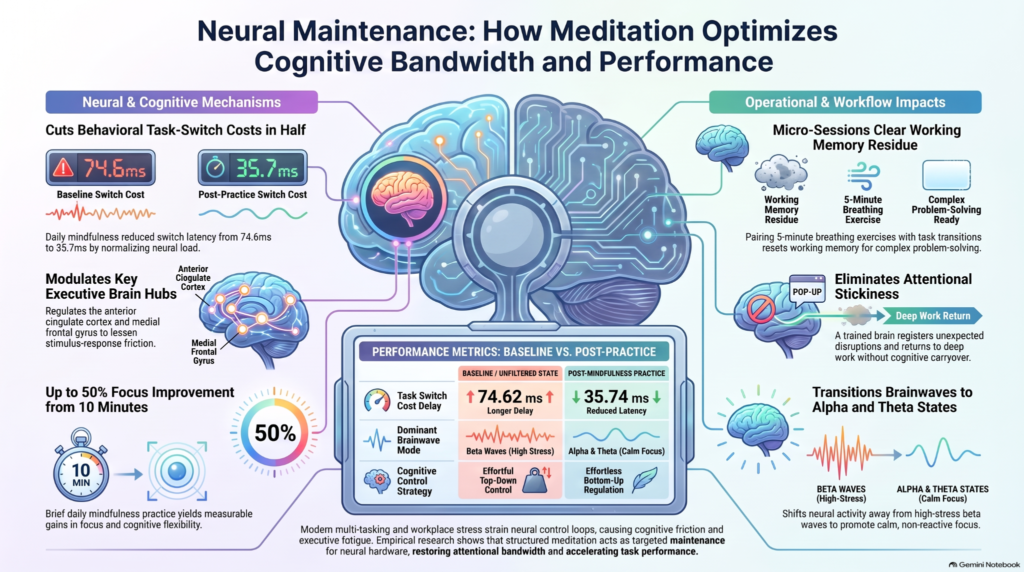
During meditation, you may notice shifts from beta waves—associated with active thinking—to alpha and theta waves, which encourage calmness and creativity. These changes not only enhance your mental clarity but also boost cognitive function over time.
Studies indicate that regular meditation can increase gray matter density in areas of the brain responsible for emotional regulation and memory. This suggests that meditation isn’t just a temporary escape; it actively reshapes your brain, allowing you to experience greater emotional resilience and improved focus.
Embracing this practice can be a powerful step towards releasing your potential, fostering a sense of freedom in both your mind and daily life.
Mindfulness: Reducing Stress and Enhancing Clarity
North Americans have adopted meditation and mindfulness because it can improve work performance, personal relationships, and health. In an average 9-to-5 work day, just 5 minutes of deep breathing, reflection, and tension release can work to decrease stress levels and increase overall productivity.
Practicing mindfulness can greatly reduce stress and enhance your mental clarity.
Research shows that techniques such as focused breathing and body scans not only calm your mind but also improve your ability to concentrate.
Benefits Of Mindfulness Practice
Mindfulness practice offers a powerful tool for reducing stress and enhancing mental clarity, particularly in our fast-paced lives.
When you engage in mindfulness, you’re not just taking a moment to breathe; you’re actively cultivating awareness of your thoughts and feelings. Research shows that these mindfulness benefits can lead to improved mental wellness, enabling you to navigate daily challenges with greater ease.
By focusing on the present, you can diminish anxiety and improve your cognitive function. This heightened state of awareness helps you make better decisions and enhances your overall performance.
Ultimately, embracing mindfulness allows you to reclaim your focus and foster a sense of freedom, creating space for clarity in both thought and action.
Techniques For Stress Reduction
Stress can feel overwhelming, but employing specific techniques can effectively reduce its grip on your life. Breathing techniques, like deep diaphragmatic breathing, can activate your body’s relaxation response, lowering heart rate and calming your mind. When you focus on your breath, you shift your attention away from stressors, promoting mental clarity.
Additionally, progressive relaxation helps you systematically tense and relax muscle groups, releasing physical tension and enhancing your overall sense of calm. By incorporating these strategies into your daily routine, you create a sanctuary within yourself, allowing for emotional freedom and resilience. This self care activity can help you manage stress and build long-term coping mechanisms.
Regular practice not only alleviates immediate stress but also builds long-term coping mechanisms, empowering you to face life’s challenges with greater ease and clarity.
Enhancing Focus Through Meditation
When life’s demands become overwhelming, enhancing your focus through meditation can be a powerful antidote. Mindful breathing is an essential element in this process, allowing you to center your thoughts and reduce distractions.
By practicing focus techniques like body scans or visualization, you train your mind to remain present, fostering greater mental clarity. Research shows that even short meditation sessions can greatly improve attention spans and cognitive performance, giving you the freedom to tackle tasks with renewed vigor.
As you cultivate this habit, you’ll notice a shift in how you respond to stress, allowing for a clearer, more focused approach to your daily challenges. Embracing these practices can lead to a more balanced, fulfilling life.

HOW MINDFULNESS FUELS CREATIVITY
In cognitive ergonomics, attention functions much like a CPU pipeline. Whenever an unexpected alert fires or you abruptly jump between asynchronous threads, your system pays a measurable switching penalty. What fascinates me as a researcher is how deliberate contemplative practice alters this architecture at a structural level.
Recent electrophysiological and neuroimaging data reveal that consistent mindfulness modulates executive hubs like the anterior cingulate cortex (ACC) and medial frontal gyrus. In controlled task-switching paradigms, practitioners demonstrate a marked reduction in behavioral switch costs—not because they force themselves to work faster under tension, but because their neural systems normalize the cognitive load of stimulus-response translations. You see a corresponding drop in attentional stickiness. In practical terms, when an urgent email derails your morning deep work block, a trained brain does not get cognitively snared by the disruption. It registers the event, resolves the immediate cue, and returns to baseline without carrying over task-depleting residue.
When designing high-output days for myself and remote teams, I use this mechanistic reality to build deliberate friction against reflexive multitasking. Pairing five minutes of focused breathing directly with key workflow transitions acts as an operational reset for your working memory. It preserves executive energy for when complex problem-solving truly demands it.
Advocates of mindfulness would have us believe that virtually every client and therapist would benefit from being more mindful. Among its theorized benefits are self-control, objectivity, affect tolerance, enhanced flexibility, equanimity, improved concentration and mental clarity, emotional intelligence and the ability to relate to others and one’s self with kindness, acceptance and compassion.
When you practice mindfulness, you sharpen your focus and enhance clarity, allowing your creative thoughts to flow more freely.
This mental clarity not only reduces stress but also builds resilience, empowering you to tackle challenges with a fresh perspective.
As you cultivate an open mindset, you’ll likely discover unconventional ideas that might’ve otherwise remained hidden.
Enhanced Focus and Clarity
Although creative blocks can feel insurmountable, practicing mindfulness can greatly enhance your focus and clarity, opening new pathways for creativity.
By integrating focus techniques like deep breathing and body scans, you can silence distractions that cloud your mind. Clarity exercises, such as visualizing your project or journaling your thoughts, help to refine your ideas and intentions.
Research shows that mindfulness increases cognitive flexibility, enabling you to see connections between seemingly unrelated concepts. This expanded perspective is essential for innovative thinking.
Embracing these practices not only fosters a deeper sense of presence but also empowers you to explore your creative potential without fear. Ultimately, mindfulness cultivates a fertile ground for inspiration, allowing your imagination to flourish.
Stress Reduction and Resilience
Mindfulness not only alleviates stress but also builds resilience, essential components for nurturing creativity. By practicing mindfulness, you engage in effective stress management techniques, allowing you to observe your thoughts and emotions without judgment. This can support sleep quality and workplace productivity by promoting emotional balance and reducing daily stress.
This awareness fosters emotional resilience, empowering you to bounce back from setbacks and challenges. Research shows that individuals who cultivate mindfulness can better regulate their emotions, leading to reduced anxiety and increased openness to new ideas.
When you’re less stressed and more resilient, your mind becomes a fertile ground for creativity to thrive. This shift in perspective enables you to explore unconventional solutions and express your thoughts freely, ultimately enhancing your creative potential.
Embracing mindfulness can transform your approach to both challenges and opportunities.
Unconventional Thinking and Ideas
As you cultivate mindfulness in your daily routine, you unfasten a powerful tool for fostering unconventional thinking and innovative ideas.
Research shows that mindfulness enhances cognitive flexibility, allowing your mind to wander freely during creative brainstorming sessions. This openness to new experiences leads to fresh perspectives and innovative insights, sparking creativity in ways you mightn’t have thought possible.
By embracing the present moment, you reduce mental clutter, enabling you to connect disparate ideas more easily. Mindfulness encourages you to explore unconventional paths, often leading to breakthroughs that challenge the status quo.
As you practice this self-care technique, you’ll find that your creativity flourishes, empowering you to express your unique vision and embrace the freedom of innovative thought.
How to Integrate Meditation Into Your Daily Routine
Integrating meditation into your daily routine can transform not just your mental state but also your overall well-being. Start by incorporating a brief session into your morning routine. Even five minutes of focused breathing can set a positive tone for the day, enhancing your mental clarity and reducing stress.
Research shows that morning meditation can boost focus, leading to improved task performance.
As your day winds down, consider an evening ritual that allows you to reflect and unwind. This could be a simple practice of gratitude or guided meditation to help you decompress and release the day’s tension.
Regularly engaging in these practices creates a sense of stability and freedom, empowering you to navigate daily challenges with greater ease.
Overcoming Challenges in Meditation for Better Productivity
Although many people recognize the benefits of meditation, overcoming common challenges can be essential for enhancing productivity. You might face meditation barriers like racing thoughts or environmental distractions, which can hinder your focus. Acknowledging these obstacles is the first step toward overcoming them.
Start by creating a designated meditation space free from interruptions, you can establish a routine that helps you increase productivity and enter a meditative state more easily. This can help you establish a routine, making it easier to enter a meditative state. If your mind wanders, gently redirect your focus back to your breath or a mantra.
Using techniques like mindfulness can also aid in overcoming distractions. Research indicates that regular practice enhances your ability to concentrate, ultimately improving task performance.
Success Stories: How Meditation Improved Work Performance
When you explore the transformative power of meditation in the workplace, you’ll find numerous success stories that highlight its positive impact on work performance.
Many individuals have shared meditation testimonials, illustrating how this practice fosters a healthier work-life balance.
Here are four compelling outcomes:
- Increased Focus: Employees report a sharper concentration, enabling them to tackle complex tasks more efficiently.
- Enhanced Creativity: Regular meditation encourages divergent thinking, leading to innovative solutions and ideas.
- Reduced Stress Levels: Practitioners experience lower stress, translating into a more harmonious work environment and improved team dynamics.
- Better Time Management: Mindfulness cultivated through meditation helps individuals prioritize tasks, allowing for more effective use of time.
These stories reflect how meditation can be a powerful tool for improving work performance, ultimately granting you the freedom to thrive professionally while maintaining personal well-being.

RELATED STUDIES ABOUT MEDITATION EFFECTS ON TASK PERFORMANCE
Incorporating meditation into your daily routine can greatly enhance your task performance and mental clarity. Research shows that just 10 minutes of mindfulness meditation can improve focus by up to 50%. This statistic highlights the tangible benefits of taking a brief pause to center your mind. By committing to this practice, you’re not only reducing stress but also revealing your full creative potential. Embrace meditation as a powerful tool for productivity, and watch how it transforms your work life.
App-based mindfulness meditation training enhances cognitive flexibility and modulates ACC and medial frontal gyrus activation during task switching in adolescent OCD
This randomized, interviewer-blind controlled study examines the behavioral and neurophysiological effects of an 8-week app-based mindfulness meditation intervention on cognitive flexibility in adolescents diagnosed with or suspected of having obsessive-compulsive disorder (OCD).
Study Overview & Methodology:
- Participants & Design: Recruited 76 adolescents aged 10 to 19 years from a university hospital department of child and adolescent psychiatry in Dresden, Germany. Following exclusions (due to behavioral outliers, EEG artifacts, or low app adherence), the final analyzed sample consisted of 53 adolescents (mean age = 15.4 years; 45.3% male). Participants were randomized to either a mindfulness meditation group or an active control group.
- Interventions: The mindfulness group used the mobile app “7Mind” (completing daily mindfulness exercises and bedtime sleep meditations). The active control group listened to audiobooks (“Harry Potter”) via the “Audible” app on a matched schedule of twice daily for eight weeks.
- Task-Switching Paradigm: Assessed cognitive flexibility before and after the 8-week intervention using a computerized task-switching experiment with 768 trials across cue-based and memory-based switching blocks (involving parity, magnitude, and font-size rules).
- Electrophysiological Analysis: Collected 60-channel EEG data and applied Residue Iteration Decomposition (RIDE) to isolate latency-variable single-trial signals into three distinct functional clusters: the S-cluster (stimulus evaluation), C-cluster (stimulus-response translation and decision-making), and R-cluster (motor response execution).
- Advanced Decoding & Source Localization: Utilized multivariate pattern analysis (MVPA) with support vector machines (SVM) and temporal generalization matrices to track condition discriminability (switch vs. repetition trials), followed by standardized low-resolution brain electromagnetic tomography (sLORETA) to identify underlying neural generators.
- Clinical Symptom Tracking: Measured OCD severity pre- and post-intervention using the Children’s Yale-Brown Obsessive Compulsive Scale (CY-BOCS).
Key Behavioral Findings:
- Significant Reduction in Switch Costs: The mindfulness group demonstrated a statistically significant reduction in behavioral switch costs (reaction time difference between switch and repetition trials) from baseline (74.62 ms) to post-intervention (35.74 ms, p = 0.002). In contrast, the active control group showed no change in switch costs (52.13 ms vs. 55.51 ms, p = 0.805).
- Driven by Faster Switch Responses: The improvement in the mindfulness group was specifically driven by accelerated reaction times on switch trials (decreasing from 869.36 ms to 777.30 ms, p = 0.004), whereas reaction times on repetition trials remained stable.
- Independence from Clinical Covariates: Reductions in switch costs remained robust and statistically significant after controlling for psychiatric comorbidities and psychotropic medication use.
- Global Task Impact: Switch cost reductions occurred equally across both cue-based and memory-based blocks, demonstrating domain-general enhancement in cognitive flexibility.
Neurophysiological & Decoding Results:
- Cluster-Specific Decoding: MVPA successfully decoded switch versus repetition trials in the S-cluster and C-cluster, while decoding performance in the motor R-cluster did not exceed chance levels.
- Selective Modulation in the C-Cluster: In the mindfulness group, classification performance in the intermediate C-cluster showed a significant decrease in decoding accuracy specifically within the 300 to 400 ms post-stimulus window following the intervention (p = 0.048). The control group showed no such modulation.
- Normalization of Neural Representations: Rather than indicating functional loss, the reduced decoding accuracy reflects a normalization process where neural activation patterns for demanding switch trials became more aligned with baseline repetition trials, indicating reduced cognitive load during stimulus-response translation.
- Frontal Localization: sLORETA source reconstruction traced this 300–400 ms C-cluster modulation to differential activation within the medial frontal gyrus (Brodmann Area 9) and the anterior cingulate cortex (ACC, Brodmann Area 32).
Clinical Symptom Observations:
- Equivalent CY-BOCS Reductions: Both the mindfulness and audiobook groups exhibited significant reductions in clinical OCD severity over time (CY-BOCS score decreasing from a mean of 16.25 to 12.54, p < 0.001).
- Absence of Group Interaction: There was no significant group-by-time interaction on the CY-BOCS, indicating that general clinical symptom relief was shared across both structured daily activities (or concurrent standard therapy), whereas neurocognitive flexibility improvements were exclusive to mindfulness training.
Clinical & Scientific Implications:
- Neurobiological Mechanistic Validation: Demonstrates that app-based mindfulness meditation directly targets frontal cognitive control hubs (ACC and medial frontal gyrus) that are chronically dysregulated in pediatric OCD, normalizing stimulus-response mapping during mental set switching.
- Scalable Adjunctive Digital Therapy: Because cognitive inflexibility underlies perseverative rituals and cognitive loops in OCD, brief digital mindfulness exercises serve as an accessible, cost-effective adjunctive tool to strengthen executive functioning alongside standard psychotherapy or pharmacotherapy.
| REFERENCE: Sarah Rempel, Maria McDonald, Veit Roessner, Christian Beste, Nicole Beyer, App-based mindfulness meditation training enhances cognitive flexibility and modulates ACC and medial frontal gyrus activation during task switching in adolescent OCD, NeuroImage: Reports, Volume 6, Issue 2, 2026, 100347, ISSN 2666-9560, https://doi.org/10.1016/j.ynirp.2026.100347. (https://www.sciencedirect.com/science/article/pii/S2666956026000309) |
Health effects of Sahaj Samadhi meditation: A scoping review of evidence across cognitive, neurophysiological and clinical domains
This scoping review synthesizes the empirical evidence on Sahaj Samadhi Meditation (SSM)—a mantra-based meditative practice—across cognitive, neurophysiological, psychological, and clinical domains, mapping existing findings and identifying methodological gaps for future research.
Study Overview & Methodology:
- Background & Practice Classification: Meditation modalities generally differ by attentional demand; while mindfulness emphasizes non-judgmental present-moment awareness, mantra-based traditions such as SSM are classified under automatic self-transcending meditation, using the silent repetition of an assigned sound or phrase to settle mental activity effortlessly rather than sustaining active cognitive control. SSM is taught by certified Art of Living Foundation instructors as a standalone technique or following pranayama in Sudarshan Kriya Yoga (SKY) programs.
- Review Framework & Search Scope: Conducted in accordance with PRISMA-ScR guidelines and the Joanna Briggs Institute (JBI) methodology, with prospective registration on the Open Science Framework. Searched PubMed, PsycINFO, Web of Science, Scopus, grey literature, and trial registries from inception to July 2026.
- Included Evidence Base: Eleven records met inclusion criteria: five experimental laboratory studies, one community cross-sectional survey, two clinical intervention trials, and three registered clinical trial protocols.
Cognitive & Neurophysiological Findings:
- Enhanced Automatic Sensory Processing: An event-related potential (ERP) study demonstrated significantly higher mismatch negativity (MMN) amplitudes in SSM practitioners compared to non-meditators during auditory oddball tasks. MMN amplitudes increased specifically following the SSM component rather than after breathing exercises, indicating enhanced preattentive sensory change detection that extends beyond general relaxation.
- Perceptual Stability & Top-Down Visual Control: Two fMRI studies utilizing color afterimage tasks demonstrated significantly longer afterimage durations among long-term SSM practitioners (>3 years) alongside heightened blood oxygen level-dependent (BOLD) activation in right inferior frontal and inferior occipital cortices, as well as broader attentional networks. This suggests strengthened top-down attentional modulation over primary visual sensory processing.
- Temporal Perception Expansion: A behavioral temporal bisection study revealed subjective time dilation among SSM practitioners under high attentional demand (p = 0.029 on difficult tasks), consistent with heightened attention to temporal processing.
- Cortical Oscillatory Profile: An EEG spectral analysis during SSM practice showed increased frontal theta coherence and greater theta power in frontal/frontocentral regions paired with decreased posterior-occipital theta activity and lower absolute alpha power. This oscillatory signature reflects an internally focused state of sustained attention and active inhibition of task-irrelevant, self-referential thought.
Clinical & Psychological Evidence:
- Chronic Pain and Depressive Comorbidity: A multicenter randomized controlled trial (RCT) in Canada evaluating a 12-week virtual SSM program against an active Health Enhancement Program (HEP) in adults with chronic pain and moderate depression found no statistically significant between-group difference on the PHQ-9. However, the SSM arm achieved statistically and clinically meaningful within-group depression reductions at 12 weeks (-3.97) and 24 weeks (-4.96) that exceeded the minimal clinically important difference.
- Adjunctive Support in Ophthalmic Disease: A feasibility trial in patients with mild-to-severe glaucoma demonstrated significant improvements in depressive symptoms (CES-D), sleep quality (PSQI), and anxiety (STAI) following SSM plus treatment-as-usual, with no adverse events. Physical glaucoma parameters (e.g., intraocular pressure, vision-related quality of life) were unchanged, indicating that SSM functions primarily as a psychological and quality-of-life adjunct rather than a disease-modifying therapy.
- Population Well-Being Survey: A cross-sectional survey of 1,099 adults who completed SKY/SSM courses linked personal practice adherence (beta = 0.60, p < 0.001) and follow-up attendance (beta = 0.41, p < 0.001) to higher perceived well-being and efficacy.
- Registered Protocols: Three ongoing Canadian protocols target late-life depression, treatment-resistant depression, and chronic pain with long-term opioid use (planned sample sizes ranging from 96 to 192), evaluating heart rate variability (HRV), HRSD-17, and PHQ-9 endpoints.
Critical Methodological Limitations & Evidence Gaps:
- Investigator Concentration: All five experimental neurocognitive studies originated from a single research group investigating long-term practitioners affiliated with the Art of Living Foundation, meaning independent replication is entirely absent.
- Past Trial Retraction: A previously published randomized trial evaluating SSM in late-life depression was formally retracted due to protocol deviations and selective outcome reporting, emphasizing the vulnerability of this early literature to bias.
- Confounding Component Interventions: Several studies examined SSM combined within multi-component programs (such as SKY breathing exercises), complicating efforts to isolate the specific effects of the mantra-based technique itself.
- Demographics & Follow-Up Constraints: Laboratory cohorts were limited to small samples (20–36 participants) of young, healthy experienced practitioners, while clinical intervention studies lacked follow-up beyond 24 weeks. No studies directly compared SSM to other active meditation modalities (e.g., mindfulness).
Implications for Research & Integrative Medicine:
- Low-Resource Scalability: Because SSM requires no specialized equipment, can be taught over brief periods, and has demonstrated feasibility in virtual formats, it holds potential utility as an accessible mental health adjunct in low-resource or remote settings.
- Research Priorities: Larger, pre-registered RCTs conducted by independent research teams are essential before SSM can be formally recommended for clinical guidelines or public health programs. Future trials must include diverse age cohorts (adolescents and older adults), active comparative arms, and longitudinal tracking to determine long-term habit retention and therapeutic durability.
| REFERENCE: Archana Balasubramaninan, Samya Varadarajan, Mathangi Damal Chandrasekar, Priyathersini Nagarajan, Health effects of Sahaj Samadhi meditation: A scoping review of evidence across cognitive, neurophysiological and clinical domains, Complementary Therapies in Medicine, Volume 101, 2026, 103414, ISSN 0965-2299, https://doi.org/10.1016/j.ctim.2026.103414. (https://www.sciencedirect.com/science/article/pii/S096522992600097X) |
Attention and meditative development: A review and synthesis of long-term meditators and outlook for the study of advanced meditation
This narrative review synthesizes behavioral and neurocognitive findings on attentional outcomes in long-term meditators (LTMs), integrating empirical evidence into a framework of meditative development and outlining an agenda for the study of advanced meditation.
Study Overview & Methodology:
- Scope & Benchmark Criteria: Evaluated behavioral performance-based studies of attention in long-term meditators, defining LTMs by an inclusive benchmark of at least 1,500 hours of lifetime meditation practice (equivalent to approximately one hour daily across five years). Studies measuring neuroimaging or electrophysiology were included when paired with behavioral tasks to provide convergent evidence.
- Attentional Models: Framed behavioral outcomes around Posner’s tripartite model of attention—executive attention, orienting, and alerting—alongside sustained attention as a dedicated fourth domain.
- Activity-Based Phenomenological Classification: Categorized meditative practices using Sparby & Sacchet’s activity-based classification system, differentiating receptive observing activities into “observe-and-focus” (concentrative/Samatha-like) and “observe-and-release” (open monitoring/Vipassana-like) styles, alongside active producing techniques.
- Theoretical Development: Integrated findings with Young’s multidimensional model of mindfulness (flexible concentration, sensory clarity, and equanimity) and Lutz’s neurophenomenological matrix (object-awareness, de-reification, and meta-awareness).
Key Findings Across Attentional Subsystems:
- Executive Attention & Conflict Monitoring: Long-term meditators consistently demonstrate enhanced executive attention control on flanker tasks and the Attentional Network Task (ANT), marked by smaller conflict-resolution difference scores and preserved executive function across aging. Trait mindfulness scores mediate this relationship, with some evidence of a dose-response effect linking cumulative practice hours to greater executive efficiency.
- Response Inhibition: Evidence indicates enhanced emotional response inhibition in LTMs, though findings for non-emotional motor inhibition tasks (e.g., Go/No-Go) remain mixed, with some trials showing no significant advantage over meditation-naïve controls.
- Attentional Orienting & Processing Bias: LTMs show faster reaction times during global-local orienting tasks. Habitual practice style modulates perceptual processing biases: observe-and-release practitioners exhibit greater efficiency in global processing, whereas observe-and-focus practitioners display localized processing advantages.
- Alerting & Alertness: Enduring trait elevations in baseline alertness among LTMs are limited; rather, pronounced alerting enhancements appear driven primarily by state-trait interactions following intensive residential retreat periods.
- Sustained Attention & Mind-Wandering: LTMs exhibit reduced frequency and depth of spontaneous mind-wandering during practice, accompanied by increased frontal midline theta power (reflecting cognitive control) and somatosensory alpha activity (reflecting suppression of distracting sensory input). Attention-based techniques, particularly observe-and-focus, consistently outperform emotion-based practices in stabilizing sustained vigilance.
- Attentional Blink Mitigation: Highly experienced LTMs demonstrate significant attenuation of the attentional blink—the temporal bottleneck where detection of a second rapid target (T2) fails within 500 ms of the first (T1). This reduction is most pronounced in practitioners engaging in observe-and-release meditation, driven by decreased cognitive resource capture (“attentional stickiness”) by T1, enabling rapid, non-fixated resource reallocation to T2.
Neurocognitive Dynamics & Meditative Development:
- Frontoparietal to Midline-Subcortical Shift: Beginner meditation relies heavily on effortful top-down executive recruitment supported by the dorsolateral prefrontal cortex (dlPFC) and frontoparietal control network (FPN). In contrast, long-term practitioners show a developmental shift toward effortless, bottom-up regulation, characterized by reduced prefrontal reliance and sustained activation in midline and subcortical hubs, including the anterior cingulate cortex (ACC), insula, and striatum.
- Network Coactivation: Advanced practice transitions FPN–Default Mode Network (DMN) interactions from initial competitive anticorrelation to cooperative coactivation, reflecting stable sustained attention without self-referential cognitive interference.
- Opponent-Process Dynamics: Meditative development depends on balancing complementary faculties: heightened concentration without equanimity risks emotional reactivity, whereas balanced development of sensory clarity, concentration, and non-reactive acceptance enables flexible cognitive control.
- Translating Traditional Contemplative Constructs: Traditional Buddhist mental factors (cetasikas) map directly onto neurocognitive attentional functions: vitakka (initial application) and manasikara (mental engagement) correspond to orienting and stimulus selection; sati (mindfulness) and viriya (effort) support sustained alertness; while vicara (sustained application) and ekaggata (one-pointedness) reflect concentrative absorption.
- Advanced Concentrative Absorption States (ACAM-J): Attaining advanced absorptive states (jhanas) requires resolving initial attentional instability and progressing into “access concentration”. The eight progressive jhanic states (four form-based, four formless) involve progressive reductions in discursive inner speech and sensory gating, culminating in non-dual awareness (consciousness-as-such).
Methodological Limitations & Future Research Directions:
- State-Trait Confounding: Over half of existing LTM studies fail to isolate transient post-meditation state inductions or retreat effects from genuine, long-term neuroplastic trait alterations.
- Lack of Dose-Response Linearity: Very few studies compare cohorts across stratified experience tiers (e.g., short-term vs. intermediate vs. long-term), and dose-response correlations between lifetime hours and behavioral gains are frequently weak or absent, raising questions about non-linear trajectories and potential plateaus.
- Recommended Factorial Designs: Future studies must employ time-by-technique-by-trait mixed factorial designs that incorporate meditation-naïve control groups, quantify lifetime practice hours and retreat frequency, and control for motivation, task incentives, and arousal.
- Phenomenological-Neurobiological Integration: Research should advance from general wellness evaluations to rigorous neurocomputational and neurophenomenological mapping of advanced meditation stages, leveraging objective biomarker tracking to characterize transitions into deep contemplative states.
| REFERENCE: Sebastian Ehmann, Idil Sezer, Arielle S. Keller, Isaac N. Treves, Matthew D. Sacchet, Attention and meditative development: A review and synthesis of long-term meditators and outlook for the study of advanced meditation, NeuroImage, Volume 323, 2025, 121602, ISSN 1053-8119, https://doi.org/10.1016/j.neuroimage.2025.121602. (https://www.sciencedirect.com/science/article/pii/S1053811925006056) |
CONCLUSION
If there is one principle I emphasize above all others at Self Care Engineer, it is that high performance must never come at the expense of cognitive sustainability. We operate in a work culture that celebrates relentless throughput while ignoring the biological costs of constant mental strain.
Meditation should not be treated as a competitive corporate productivity hack designed to squeeze another billable hour out of an already depleted schedule. Approaching mindfulness with an aggressive, goal-driven mindset defeats its core psychological function. Instead, consider daily practice as fundamental hygiene for your attentional ecosystem—a reliable mechanism to lower autonomic arousal, train non-reactive conflict monitoring, and give your executive networks time to recharge.
When I test these behavioral protocols in my daily life, between early-morning trail runs and focused writing sessions, the outcome is rarely a sudden surge in raw speed. Rather, it produces quiet cognitive composure. You make cleaner decisions, experience fewer moments of decision fatigue, and gain the mental spaciousness required to tackle demanding tasks without burning out. Do not overcomplicate the habit or demand immediate transformations. Give yourself five to ten minutes of daily stillness, respect your brain’s natural need for recovery, and let your workflow adjust around a calmer, more resilient center.