

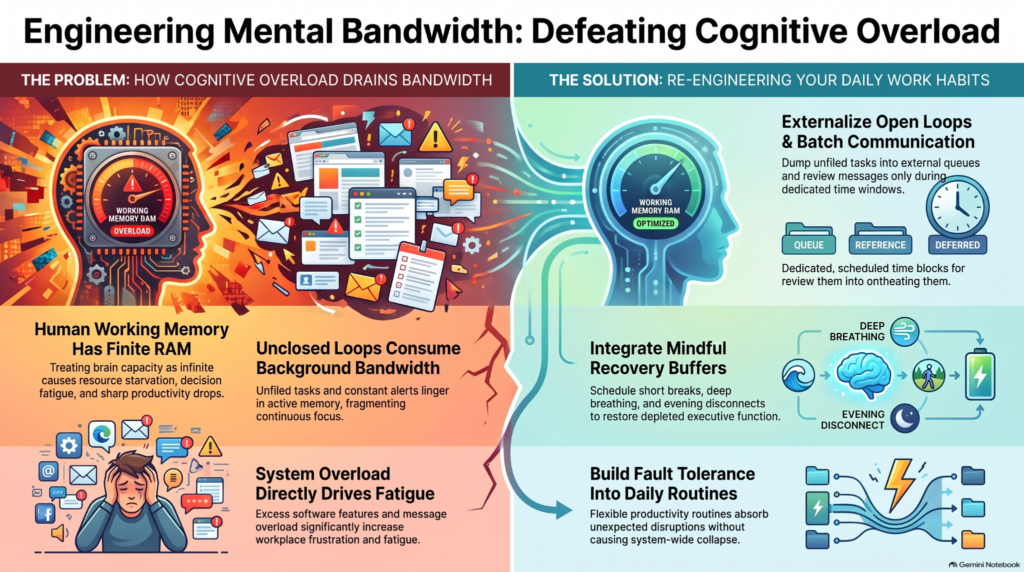
Whenever people talk to me about feeling unproductive, the conversation almost always begins with guilt. They assume their stalling output is a personal discipline failure—that if they just had more willpower, woke up an hour earlier, or pushed through the afternoon slump, everything would fall into place. But approaching daily work from an engineering perspective reveals an entirely different problem: the human brain is not a high-throughput processing unit designed for sustained, infinite multitasking. It is a delicate CPU with finite RAM.
When your working memory is flooded by fifty browser tabs, incoming Slack alerts, pending replies, and unresolved task lists, the system does not fail because you lack ambition; it fails due to resource starvation. I spent years trying to brute-force my way through digital noise, thinking sheer stamina would bridge the gap.
It never did. What truly transformed my workday was learning to treat cognitive load as a physical constraint rather than a motivational hurdle. Productivity is not about squeezing every drop of effort out of your day; it is about building clean, low-friction operating environments that reduce decision fatigue before it ever takes hold. By engineering intentional buffer periods and treating self-care as essential system maintenance, you stop fighting the machine and finally start working with it.
Reducing cognitive overload is key to maintaining productivity. When you prioritize self-care habits like mindful breaks and healthy routines, you create a more supportive environment for focus. Implementing mindset strategies, such as minimalism and gratitude, can help clear mental clutter. By being intentional about your workspace and incorporating practices that promote mental wellness, you can enhance clarity and efficiency. Discover more ways to effectively manage these aspects for even greater productivity.
KEY TAKEAWAYS
- Establish intentional morning rituals, like meditation, to enhance mental clarity and prepare for a productive day ahead.
- Implement decluttering strategies to simplify commitments and create a focused work environment that reduces cognitive load.
- Practice mindfulness techniques and breathing exercises throughout the day to ground yourself and alleviate stress and anxiety.
- Regularly reflect on your goals and progress to maintain motivation and ensure alignment with your evolving needs.
- Prioritize self-care activities, such as breaks and leisure, to recharge mental energy and prevent burnout, enhancing overall productivity.
UNDERSTANDING COGNITIVE OVERLOAD
Cognitive overload can feel overwhelming, as our brains struggle to process too much information at once. You might notice your mental capacity dwindling, leading to decision fatigue and reduced attention span.
When faced with information overload, your productivity barriers grow, making it harder to focus on tasks. The constant task switching drains your energy and increases mental fatigue, leaving you feeling stressed and unproductive.
To combat this, practice stress management techniques that promote cognitive flexibility. Simplifying your environment and prioritizing tasks can help reduce cognitive load.
By limiting distractions and breaking down complex information, you’ll enhance your ability to process what’s essential. Remember, it’s okay to take breaks and recharge.
Embracing these strategies not only empowers you to regain control but also fosters a sense of freedom in your work. So, take a step back, breathe, and recognize that managing your cognitive overload can lead to greater clarity and productivity.
The Importance of Self-Care for Boosting Productivity
Individuals with high cognitive loads may be less productive in the workplace. With increases in digital communications, overload and dependence on technology can lead to decreased productivity. In the post COVID remote workplace, workers may be involved in after hours work with more messaging and feedback via email. This is also associated with increased stress and anxiety of the workers.
Taking care of your mental health is essential for maintaining productivity.
By establishing healthy routines and setting effective boundaries, you can create a supportive environment that fosters focus and creativity.
Prioritizing self-care isn’t just a luxury; it’s a necessity for achieving your goals and avoiding burnout.
Prioritizing Mental Health
While many people rush through their daily tasks, neglecting their mental health, prioritizing self-care is essential for enhancing productivity.
When you focus on mental wellness, you create a foundation for greater emotional resilience. This resilience helps you navigate challenges with clarity and confidence, allowing you to maintain a balanced perspective.
By dedicating time to self-care practices—like mindfulness, exercise, or simply unplugging—you actively combat burnout and cognitive overload. This isn’t just about feeling good; it’s about fostering an environment where creativity and efficiency thrive. Incorporating regular exercise into your daily routine highlights the connection between exercise and workplace productivity, as physical activity can help improve focus, manage stress, and support overall well-being.
Remember, investing in your mental health isn’t a luxury; it’s a necessity for achieving true freedom in your personal and professional life.
Prioritize yourself, and watch your productivity soar.
Establishing Healthy Routines
Establishing healthy routines can greatly enhance your productivity, especially when you recognize that self-care is an essential component of your daily life.
Start with morning rituals to set a positive tone for the day, and embrace evening wind downs for better sleep quality. Incorporate weekly planning to keep your goals clear, using habit stacking to build momentum.
Implement reward systems to celebrate your progress and practice digital detox for mental clarity. Consistency tracking helps you stay accountable, while a flexibility allowance guarantees you’re adaptable to life’s changes.
Use environmental cues to remind you of your goals, and don’t forget to engage in goal reflection to assess your progress. Prioritize these habits for freedom and productivity.
Setting Boundaries Effectively
Setting boundaries effectively is essential for maintaining your well-being and enhancing productivity. When you communicate your personal limits clearly, you create space for yourself to thrive.
This isn’t just about saying “no” to others; it’s about saying “yes” to yourself. By establishing clear boundary communication, you empower yourself to prioritize what truly matters.
This freedom allows you to focus on tasks that align with your goals, reducing cognitive overload. Remember, it’s okay to step back and reassess your commitments. You’re not being selfish; you’re being strategic.
Mindset Strategies to Overcome Mental Clutter
Burnout describes a combination of physical, emotional, and mental exhaustion caused by a sustained period of stress or a sudden and critical stress event, such as a change in health, parenting, caregiving, or other life factors.
When mental clutter overwhelms you, adopting mindset strategies can make a significant difference.
Embracing minimalist thinking, practicing mindfulness techniques, and setting clear intentions can help clear your mind and focus your energy.
Embrace Minimalist Thinking
Although life often feels overwhelming with constant demands and distractions, embracing minimalist thinking can greatly help you overcome mental clutter.
By adopting a minimalist lifestyle, you create space for what truly matters, allowing you to focus on your priorities. Start by identifying areas in your life that feel chaotic and apply decluttering strategies. This might mean reducing your commitments or simplifying your environment—each small change can lead to a clearer mind.
Challenge the belief that more is better; instead, find freedom in less. As you strip away the unnecessary, you’ll notice your mental load lightening, granting you the clarity to pursue your passions.
Embrace minimalism, and reclaim your mental space for what enriches your life.

PRACTICE MINDFULNESS TECHNIQUES
From a workflow design standpoint, mental clutter rarely comes from the actual complexity of the work itself. Instead, it stems from what system architects call memory leaks—in productivity terms, “open loops.” An open loop is every half-baked decision, unfiled email, or unscheduled promise you allow to linger in active memory. Your subconscious burns vital energy tracking these unfinished threads in the background, leaving little processing bandwidth for creative, high-impact problem solving.
Whenever I notice my focus fracturing during mid-week sprints, I don’t overhaul my calendar or buy another fancy planning app; I run a diagnostic on my system friction. First, I execute a ruthless daily brain dump. If an item is not captured in a reliable external queue, the brain refuses to release it, causing persistent low-grade anxiety. Second, I dramatically limit input windows.
Checking messages continuously throughout the day forces the brain through relentless context-switching penalties, fragmenting your attention span into useless slivers. I treat input channels like batch processes: reviewed only at dedicated times, handled decisively, and closed. When you single-task deliberately and engineer automated boundaries around communication, you eliminate the constant micro-decisions that exhaust your executive function, giving your mind the uninterrupted space it needs to execute deep, satisfying work.
Mindfulness techniques can be a powerful ally in overcoming mental clutter and enhancing your overall well-being. Understanding the meditation effects on task performance can help explain how regular mindfulness practice improves concentration, reduces distractions, and supports better productivity. By incorporating mindfulness meditation into your daily routine, you create a sanctuary for your mind, allowing thoughts to pass without judgment. This practice fosters awareness, helping you identify distractions and reduce anxiety.
Pairing mindfulness meditation with breathing exercises can amplify these benefits; deep, intentional breaths ground you in the present moment, clearing away the noise of daily life. As you embrace these techniques, you’ll cultivate a sense of freedom, empowering yourself to navigate challenges with clarity.
Set Clear Intentions
Setting clear intentions can considerably reduce mental clutter and provide direction in your daily life. By engaging in intention setting, you’re not just drifting through your day; you’re consciously aligning your actions with your true goals. This clarity helps you focus on what truly matters, freeing you from distractions that drain your energy.
Consider each day as a blank canvas. Define what you want to achieve, whether it’s completing a project or nurturing your wellbeing.
Regularly revisit and adjust your intentions to guarantee they align with your evolving goals. This practice empowers you, allowing freedom from overwhelm and confusion.
Ultimately, clear intentions serve as your compass, guiding you toward a more fulfilling and productive life.
Daily Self-Care Practices for Enhanced Focus
When you’re juggling multiple tasks and demands, incorporating daily self-care practices can greatly enhance your focus. Start your day with intentional morning rituals, like meditation or light exercise, to center your mind. These practices prime your brain for productivity, allowing you to tackle challenges with clarity.
Throughout the day, take brief breaks to recharge—step outside, stretch, or enjoy a quick mindfulness exercise. These moments can reduce cognitive overload and keep your mental energy flowing. Engaging in a self care activity, such as taking a short walk or practicing mindfulness, can further restore your focus and improve your productivity.
As the day winds down, establish an evening unwind routine. Disconnect from screens, read a book, or engage in a calming hobby. This not only signals your brain that it’s time to relax but also helps you reflect on the day’s achievements.
Designing an Effective Workspace for Focus
Although you might not realize it, the environment where you work considerably impacts your ability to focus. A well-designed workspace can greatly enhance your productivity and mental clarity. Consider implementing ergonomic furniture to support your body and reduce strain. Additionally, employing declutter strategies can create a more inviting atmosphere, allowing your mind to breathe.
Here’s a simple guide to help you design your workspace:
| Element | Tips |
| Ergonomic Chair | Choose one that supports your lower back. |
| Desk Height | Confirm it’s at elbow height for comfort. |
| Lighting | Use natural light whenever possible. |
| Personal Items | Limit to a few meaningful pieces. |
| Digital Declutter | Organize your desktop and files weekly. |
How to Stay Present and Mindful?
Staying present and mindful can transform your daily experiences, allowing you to fully engage with the moment rather than getting lost in distractions. One effective technique is mindful breathing. By focusing on your breath, you anchor yourself to the present moment. Take a few deep breaths, inhaling slowly through your nose and exhaling through your mouth. This simple practice can create a sense of calm and clarity, helping you push aside overwhelming thoughts.
Additionally, try to incorporate short mindful breaks into your day. Pause for a moment to observe your surroundings, notice the sounds, or feel the texture of an object. These small acts can ground you, promoting awareness and reducing cognitive overload.
Building a Sustainable Routine for Long-Term Success
Cognitive load refers to the mental resources used by the brain to learn something new or complete a task. This is a normal process — but when the available resources are insufficient to process information and make decisions effectively, it becomes cognitive overload (or mental overload).
Creating a sustainable routine can feel overwhelming, especially when life’s demands pull you in different directions. However, by focusing on sustainable habits, you can cultivate a routine that supports your long-term success without restricting your freedom.
Start small—integrate one or two new habits that resonate with your goals. This could be a morning meditation or a weekly planning session.
Embrace routine flexibility; life is unpredictable. Allow yourself the space to adapt and shift your routine when necessary. This flexibility not only keeps you engaged but also prevents burnout.
Regularly reflect on your habits to guarantee they align with your evolving needs and aspirations.

RELATED STUDIES ABOUT COGNITIVE OVERLOAD PRODUCTIVITY DECLINE
By embracing effective self-care habits and mindset strategies, you can conquer cognitive overload and release productivity like never before. Remember, it’s not just about working harder; it’s about working smarter. Prioritize your well-being and create a sustainable routine that nurtures your focus and creativity. As you integrate these practices into your life, you’ll find clarity amidst the chaos, transforming your daily grind into a fulfilling journey. Stay present, and watch your productivity soar to astonishing heights!
Deciphering the underlying repercussions of cognitive overload on university students’ fatigue, frustration and academic productivity: Implementation of stimulus–organism–response model
This empirical study examines how three distinct dimensions of mobile social networking service (SNS) cognitive overload—information, social, and system function overload—impair university students’ academic productivity through the mediating mechanisms of mobile SNS fatigue and frustration, utilizing the Stimulus-Organism-Response (SOR) framework.
Study Overview & Methodology:
- Theoretical Framework: Grounded in environmental psychology’s SOR paradigm, treating cognitive overload dimensions as external environmental stimuli (S), mobile SNS fatigue and frustration as internal organismic psychological states (O), and academic productivity as the behavioral response (R). It additionally integrates person-environment fit theory, self-determination theory, and cognitive load theory.
- Participants & Setting: Surveyed 660 Chinese university students recruited via the Sojump platform who regularly used mobile social media platforms (predominantly WeChat and Weibo). The sample comprised 52.9% female and 47.1% male respondents; 84.2% were aged 18 to 25 years. The vast majority were highly experienced users: 94.7% had used mobile social media for four or more years, and 67.6% reported daily usage exceeding four hours.
- Instrumentation: Administered 5-point Likert scales adapted from validated measures and refined via a rigorous forward- and back-translation procedure:
- Information Overload and System Function Overload: Adapted from Xiao et al..
- Social Overload: Adapted from Cao and Sun.
- Mobile SNS Fatigue: Adapted from Swiatek et al..
- Frustration: Adapted from Dai et al..
- Academic Productivity: Adapted from Whelan et al..
- Analytical Approach: Employed a two-step analytical procedure consisting of Confirmatory Factor Analysis (CFA) using SPSS 26 and Structural Equation Modeling (SEM) via AMOS 24, alongside Harman’s single-factor test to rule out common method variance and bootstrap resampling to test indirect mediation paths. The structural model demonstrated satisfactory goodness of fit (chi-square/df = 2.762, RMSEA = 0.061, RMR = 0.053, GFI = 0.939, AGFI = 0.941, NFI = 0.926, IFI = 0.945, TLI = 0.921, CFI = 0.932).
Key Structural Findings:
- Predictors of Mobile SNS Fatigue:
- System function overload exerted the strongest positive effect on mobile SNS fatigue (path coefficient = 0.523, p < 0.001).
- Information overload significantly increased fatigue (path coefficient = 0.289, p < 0.001).
- Social overload significantly increased fatigue (path coefficient = 0.176, p < 0.001).
- Predictors of Frustration:
- System function overload was the primary driver of user frustration (path coefficient = 0.502, p < 0.001).
- Information overload significantly exacerbated frustration (path coefficient = 0.356, p < 0.001).
- Social overload significantly exacerbated frustration (path coefficient = 0.310, p < 0.001).
- Affective Interrelationship: Frustration exerted a significant positive direct effect on mobile SNS fatigue (path coefficient = 0.161, p < 0.001), corroborating ego depletion principles where emotional strain accelerates mental exhaustion.
- Direct Detriments to Academic Productivity: Both internal organismic states significantly impaired students’ academic productivity, with frustration exerting a slightly stronger adverse direct effect (path coefficient = -0.415, p < 0.001) than mobile SNS fatigue (path coefficient = -0.339, p = 0.011).
Mediation Mechanisms:
- Mediating Role of Mobile SNS Fatigue: Bootstrap analysis confirmed that fatigue significantly mediated the effects on academic productivity from information overload (beta = 0.121, p < 0.05, 95% CI [0.061, 0.220]), social overload (beta = 0.067, p < 0.05, 95% CI [0.038, 0.133]), and system function overload (beta = 0.035, p < 0.05, 95% CI [0.022, 0.163]).
- Mediating Role of Frustration: Frustration likewise significantly mediated the relationships between academic productivity and information overload (beta = 0.139, p < 0.05, 95% CI [0.062, 0.205]), social overload (beta = 0.048, p < 0.05, 95% CI [0.001, 0.123]), and system function overload (beta = 0.055, p < 0.05, 95% CI [0.001, 0.116]).
Practical, Pedagogical, & Design Implications:
- User-Centered Platform Engineering: Service providers and developers must address “function fatigue” by minimizing unnecessary feature proliferation, simplifying interface navigation, reducing feature redundancy, and offering customizable notification controls to protect finite human cognitive processing capacities.
- Curricular Digital Literacy Initiatives: Higher education institutions should embed digital wellness training into academic curricula, educating students on information curation, task-switching costs, time allocation, and deliberate filtering of non-essential feeds.
- Mental Health & Counseling Strategies: University counseling centers should design targeted interventions (e.g., mindfulness-based stress reduction and psychoeducational workshops on technogenic exhaustion) to help students manage digital frustration and decouple social media obligations from academic routines.
| REFERENCE: Hua Pang, Xiaoyi Jin, Wanting Zhang, Deciphering the underlying repercussions of cognitive overload on university students’ fatigue, frustration and academic productivity: Implementation of stimulus–organism–response model, Acta Psychologica, Volume 260, 2025, 105469, ISSN 0001-6918, https://doi.org/10.1016/j.actpsy.2025.105469. (https://www.sciencedirect.com/science/article/pii/S0001691825007826) |
Digital fatigue era: Rethinking the future of productivity
This conceptual short communication examines digital fatigue as a structural economic concern rather than a purely individual psychological strain, formulating an interdisciplinary framework linking digital intensification to challenges in long-term productivity sustainability.
Study Overview & Theoretical Framework:
- The Economic Blind Spot: Digitalization is widely recognized as a driver of economic efficiency and innovation, yet economic discourse has largely overlooked the cognitive consequences of prolonged digital engagement. While disciplines like psychology, neuroscience, organizational studies, human-computer interaction (HCI), and media studies investigate cognitive overload, technostress, and attention extraction, they predominantly frame fatigue as an individual or firm-level behavioral issue. Mainstream economics continues to treat labor as quantifiable hours or skills while assuming human cognitive capacity is infinitely elastic or stable.
- Conceptual Scope & Synthesis: Synthesizes literature across economics, cognitive psychology, neuroscience, organizational studies, and HCI to theorize cognitive capacity as a finite, depletable economic resource subject to diminishing returns under excessive digital load.
- Core Definition of Digital Fatigue: Conceptualized as a cumulative state of cognitive and emotional exhaustion arising from sustained interaction with digitally intensive socio-technical systems, characterized by diminished attentional capacity, mental overload, decision fatigue, and compromised cognitive recovery.
- The Structural Pathway: Proposes a sequential conceptual framework where digital intensification (always-on connectivity, platform dependence, information overload, algorithmic acceleration) leads to cognitive overload and attentional fragmentation, which drive decision fatigue and reduced cognitive recovery, culminating in digital fatigue and threatening long-term productivity sustainability.
Mechanisms Linking Digital Fatigue to Productivity Drag:
- Degradation of Cognitive Immersion: Knowledge-based work depends heavily on deep cognitive engagement, working memory, and sustained attention for complex problem solving and innovation. Frequent digital interruptions (emails, alerts, multitasking) impose measurable cognitive switching costs, requiring attentional disengagement and mental recalibration that break cognitive flow and elevate error rates.
- Temporal Compression and the Illusion of Efficiency: Digital technologies accelerate communication cycles and shorten response windows, transforming latency—historically a protective cognitive buffer—into perceived inefficiency. This constant availability fosters continuous cognitive vigilance, where high-frequency communication creates a superficial appearance of productivity while eroding the deep cognitive processing necessary for quality output.
- Impairment of Decision-Making Efficiency: Persistent digital engagement accelerates the depletion of finite executive resources (decision fatigue). Depleted decision-makers display diminished analytical depth, lower tolerance for ambiguity, increased risk aversion, and greater reliance on cognitive heuristics, default choices, or impulsive judgments. At the consumer level, this manifests as choice deferral, decision avoidance, or impulsive purchasing.
- Erosion of Cognitive Recovery Cycles: Drawing on labor economics and cognitive neuroscience, sustained mental performance relies on alternating intervals of effort and recovery. Continuous connectivity and intrusive digital alerts collapse boundaries between work and non-work life, sustaining cognitive activation during leisure and preventing attentional replenishment.
Policy, Organizational, & Research Implications:
- Redefining Cognitive Sustainability: Productivity sustainability requires maintaining output over the long term while actively preserving the underlying human cognitive architecture upon which economic performance depends. Cognitive recovery must be treated as a critical economic variable rather than a discretionary lifestyle choice.
- Organizational Interventions: Employers should implement structured digital well-being practices, including notification management protocols, protected blocks of uninterrupted time for deep focus, and strict institutional boundaries that support cognitive detachment outside working hours.
- Macro-Level Digital Governance: Policymakers evaluating digital transformation initiatives should assess not only technological speed and capital investment, but also the cognitive conditions and regulatory guardrails (such as right-to-disconnect standards) required to safeguard human capital.
- Future Empirical Agenda: Calls for operationalizing digital fatigue through standardized measurement indicators (technostress scales, cognitive load, attentional stability, recovery metrics), conducting longitudinal studies across diverse industries, and investigating the cognitive sustainability impacts of emerging generative AI and algorithmic management systems.
| REFERENCE: Chumki Handique, Alok Ranjan Dutta, Digital fatigue era: Rethinking the future of productivity, Social Sciences & Humanities Open, Volume 14, 2026, 103193, ISSN 2590-2911, https://doi.org/10.1016/j.ssaho.2026.103193. (https://www.sciencedirect.com/science/article/pii/S2590291126007588) |
A profession of silent struggle: Associations among distributive justice, work overload, work-related depressive symptoms, and teachers’ self-reported job performance
This mixed-methods study examines the relationships among distributive justice, work overload, work-related depressive symptoms, managerial support, and self-reported job performance among secondary school teachers in Penang, Malaysia.
Study Overview & Methodology:
- Research Design & Theoretical Framework: Conducted a sequential explanatory mixed-methods investigation combining a cross-sectional quantitative survey (Phase I) with semi-structured qualitative interviews (Phase II). The study is grounded in the Job Demands-Resources (JD-R) model, the Effort-Reward Imbalance (ERI) model, Social Exchange Theory, and Cognitive Dissonance Theory.
- Quantitative Sample & Setting (Phase I): Surveyed 381 public secondary school teachers in Penang, Malaysia, using convenience sampling across 100 schools (recruitment conducted December 2023 to February 2024). The sample was 53.8% female, 42.1% aged 26–30 years, 86.0% held at least a bachelor’s degree, and the majority had 1–5 years of teaching experience.
- Survey Instrumentation: Administered validated 5-point Likert scales: Distributive Justice (4 items; alpha = 0.812), Work Overload (8 items; alpha = 0.869), Work-Related Depressive Symptoms (adapted from Joseph et al., capturing occupational distress rather than clinical diagnostic criteria; alpha = 0.896), Managerial Support (adapted from Ko et al.; alpha = 0.766), and Job Performance (7 items from Lopez-Cabarcos et al.; alpha = 0.869).
- Statistical Analysis: Evaluated measurement and structural models via Partial Least Squares Structural Equation Modeling (PLS-SEM) using SmartPLS 4 with 5,000 bootstrap resamples. Assessed mediation using indirect effect bootstrapping and moderation via the product indicator approach.
- Qualitative Phase (Phase II): Conducted semi-structured interviews (30–60 minutes) with 10 experienced Malaysian school heads (6 male, 4 female; 50% with 10+ years in leadership). Transcripts were analyzed using MAXQDA 2024 to generate first- and second-order thematic structures and word frequency patterns.
Key Quantitative Findings:
- Direct Path Relationships:
- Work overload strongly and positively predicted work-related depressive symptoms (beta = 0.669, t = 13.390, p < 0.001).
- Distributive justice demonstrated a statistically significant positive direct association with work-related depressive symptoms in the multivariate model (beta = 0.157, t = 2.887, p = 0.004).
- Both distributive justice (beta = 0.219, t = 5.236, p < 0.001) and work overload (beta = 0.464, t = 10.086, p < 0.001) were positively associated with self-reported job performance.
- Work-related depressive symptoms positively related to self-reported job performance (beta = 0.266, t = 5.053, p < 0.001).
- Direct association of managerial support on job performance was statistically non-significant (beta = 0.007, t = 0.298, p = 0.766).
- Mediation Effects:
- Work-related depressive symptoms significantly mediated the pathway between distributive justice and job performance (beta = 0.042, t = 2.351, 95% CI [0.010, 0.079], p = 0.019).
- Work-related depressive symptoms significantly mediated the relationship between work overload and job performance (beta = 0.178, t = 4.988, 95% CI [0.111, 0.252], p < 0.001). Because direct and indirect associations shared the same directional sign, these reflect complementary indirect associations.
- Moderation by Managerial Support:
- Managerial support significantly moderated the relationship between distributive justice and job performance (beta = 0.128, t = 3.484, p = 0.001).
- Managerial support significantly moderated the relationship between work overload and job performance (beta = 0.121, t = 2.805, p = 0.005). Slope plots confirmed that higher managerial support steepened positive performance slopes, functioning as a vital social buffer.
- Model Fit & Predictive Power: The structural model explained 44% of the variance in job performance (R2 = 0.44) and 38% in work-related depressive symptoms (R2 = 0.38), with an SRMR of 0.061 indicating acceptable model fit.
Key Qualitative Findings (Phase II):
- Contributing Factors to Teacher Depression: School heads identified dual layers of contributing stressors:
- Personal Factors: Compromised psychological well-being, severe work-life imbalance, low self-esteem, and chronic feelings of inadequacy.
- Institutional & Climate Factors: Toxic or unsupportive school culture, micromanagement, lack of decision-making autonomy, and inadequate institutional support structures.
- Depression-Performance Nexus: Interviewees reported that persistent workplace distress directly degrades teaching efficiency, classroom instructional strategies, and pedagogical approaches, which subsequently hinders student academic achievement, student behavior, and broader educational quality while increasing teacher turnover.
Practical & Institutional Implications:
- Transparent Distributive Justice Systems: Educational administrators should establish clear, merit-based, and transparent criteria for resource allocation, scheduling, and incentive distribution, while providing accessible grievance procedures and involving teachers in operational decision-making.
- Systematic Workload Mitigation: School leaders must conduct formal workload audits to streamline non-instructional administrative burdens, redistribute duty rosters equitably, and protect instructional focus to prevent psychological burnout.
- Leadership Training in Managerial Support: School heads and supervisors should undergo targeted training in empathetic communication, constructive feedback, and mentorship to serve as effective protective buffers against occupational strain.
- Methodological Considerations: The cross-sectional, single-source design limits causal inference; self-reported depressive measures capture occupational distress rather than formal clinical diagnoses; and sampling was restricted to government secondary schools in Penang, warranting future longitudinal and multi-regional evaluations.
| REFERENCE: Jamshed Khalid, Muhammad Umair Ashraf, Nordian Mohd Nordin, Muhammad Rashid Hafeez, Chuanmin Mi, A profession of silent struggle: Associations among distributive justice, work overload, work-related depressive symptoms, and teachers’ self-reported job performance, Acta Psychologica, Volume 269, 2026, 107508, ISSN 0001-6918, https://doi.org/10.1016/j.actpsy.2026.107508. (https://www.sciencedirect.com/science/article/pii/S0001691826013090) |
CONCLUSION
The single biggest design flaw I see in conventional productivity advice is the obsession with rigid perfection. People draft intricate hour-by-hour schedules, stick to them for three flawless days, encounter an unexpected fire drill, and watch the entire architecture collapse in frustration. But good engineering has never been about designing systems that only function under ideal conditions; it is about building fault tolerance. A genuinely effective productivity routine must have slack built into its joints. It must accommodate bad days, unexpected interruptions, and natural energy dips without derailing your momentum.
Accepting that there is no final “done” state is the most liberating shift you can make. The horizon will always generate new tasks, fresh inputs, and shifting priorities. The objective is not to empty the incoming queue permanently, but to maintain a steady, sustainable equilibrium where your tools serve you rather than dictate your life.
When you integrate consistent self-care, physical resets, and deliberate disconnection into your architecture, you protect your core hardware from chronic burnout. True productivity isn’t defined by manic bursts of speed followed by weeks of cognitive exhaustion. It is built through quiet, reliable, and adaptable systems that keep you clear-headed, grounded, and consistently moving forward for years to come.