

When we discuss self-care in mainstream culture, the conversation almost inevitably gravitates toward consumer products and boutique wellness routines—things like adaptogenic supplements, boutique fitness memberships, artisanal bath salts, and high-priced digital detox retreats. But as someone whose background bridges nutritional science and cognitive psychology, I find this commercialized version of self-care deeply incomplete. Wellness is not merely a collection of personal lifestyle indulgences; it is directly shaped by cognitive bandwidth, physiological safety, and material stability.
When a person works erratic shift hours, juggles unpredictable wages, or constantly worries about essential bills, the prefrontal cortex remains fixed in a persistent state of threat detection and survival triage. In that chronic state of mental fatigue, telling someone to simply “practice mindfulness” or “prioritize wellness” is tone-deaf. True self-care requires cognitive surplus—the mental breathing room to pause, plan, and choose preventive behaviors.
Income inequality shrinks that breathing room dramatically, turning what should be accessible human behaviors into luxuries of circumstance. As we unpack the research linking structural economic disparities to daily lifestyle behaviors, my goal is to strip away the glossy commercial guilt and ground the conversation in biological reality, behavioral science, and the lived truth of everyday health decisions.
Income inequality greatly affects your self-care behaviors by limiting access to vital resources and wellness education. Lower income often correlates with reduced health literacy and increased stress, making it difficult to prioritize well-being. Additionally, cultural and psychological barriers can further hinder your ability to engage in self-care practices. Understanding these challenges is essential for developing effective strategies. There’s much more to explore about how these factors interconnect and impact health outcomes.
KEY TAKEAWAYS
- Income inequality restricts access to wellness education, leading to lower health literacy and poorer self-care practices among disadvantaged populations.
- Psychological barriers, such as stress and hopelessness, hinder motivation for self-care, particularly in low-income communities facing resource scarcity.
- Cultural beliefs and societal norms can prioritize communal responsibilities over personal health, impacting individual self-care behaviors and practices.
- Effective self-care strategies must address time constraints and emotional barriers while advocating for equitable health policies to enhance access for all.
- Community engagement and support networks significantly improve self-care adherence by fostering connections and providing shared resources among individuals.
HOW INCOME INEQUALITY SHAPES SELF-CARE CHOICES
Economic inequality is evidenced by an unequal distribution of economic income and inequitable access to other resources, such as health, employment, human capital, public services, and power (Van de Werfhorst and Salverda, 2012). Economic inequality refers to the increase disparities between the incomes of the richest, middle and poorest members of society, which has grown significantly in the last decades (Stiglitz, 2012). Inequality is one factor that generates social erosion by enhancing political conflicts. For instance, economic disparities are related to high crime and mortality rates (Wilkinson and Pickett, 2009a), the increase in social distrust, and the decrease of cohesion and solidarity among groups (Sommet et al., 2018).
As income inequality widens, the choices you make regarding self-care often become constrained by economic factors. Income disparities directly impact your behavioral choices, limiting access to wellness education and health resources.
Individuals from lower socioeconomic status may struggle with health literacy, making it difficult to engage in effective lifestyle modifications. Resource allocation plays an essential role, as communities with fewer financial resources often lack fundamental services and support systems, further exacerbating health outcomes.
Community engagement is significant for fostering resilience and promoting self-care practices. When resources are shared and accessible, it empowers individuals to make informed decisions about their health.
A collective approach to wellness education can bridge the gaps created by income inequality, enabling you to prioritize self-care despite economic constraints. By understanding these dynamics, you can advocate for equitable resource distribution and support initiatives that enhance overall community health and well-being.
Psychological Barriers to Self-Care in Low-Income Populations
In low-income populations, psychological barriers considerably hinder self-care behaviors.
Limited access to resources often exacerbates stress and mental health issues, creating a cycle that impedes wellness.
Additionally, cultural perceptions of self-care may not prioritize individual health, further complicating the pursuit of necessary self-care practices.
Limited Access to Resources
Limited access to resources greatly hampers self-care behaviors among low-income populations, as financial constraints often create psychological barriers that inhibit individuals from prioritizing their well-being.
Research indicates that access disparities in health services and preventive care arise from poor resource allocation, leaving you with fewer options. When you lack access to healthy foods, fitness facilities, or mental health support, it becomes difficult to adopt and maintain self-care routines.
Additionally, the stress of limited resources can lead you to deprioritize your health in favor of immediate financial needs. This cycle perpetuates poor health outcomes, demonstrating that improving resource allocation is essential to empower low-income individuals to engage in effective self-care behaviors and enhance their overall quality of life.
Stress and Mental Health
Mental health awareness and anti-stigma campaigns frequently tell us that anyone can experience a mental health problem and that depression doesn’t discriminate. And given the high prevalence of depression, this is undoubtedly the case, up to a point. But it has also been observed both that poor mental health is more likely to affect people who are subject to social and economic disadvantage and that more unequal societies are more likely to have higher levels of mental ill health in the population as a whole.
The challenges of limited access to resources are compounded by the psychological barriers that stress and mental health issues impose on self-care behaviors. High levels of stress often lead to feelings of hopelessness, making it difficult for you to engage in effective stress management techniques.
This struggle hampers your ability to build mental resilience, which is vital for coping with everyday challenges. Research indicates that individuals in low-income populations frequently experience elevated stress levels due to financial instability, which further undermines their motivation for self-care.
Consequently, enhancing mental health support and stress management resources can empower you to prioritize your well-being, fostering a healthier lifestyle. By addressing these psychological barriers, you can break the cycle of inequality and improve your self-care practices.
Cultural Perceptions of Wellness
Cultural perceptions of wellness greatly shape how individuals in low-income populations approach self-care, often creating psychological barriers that hinder their ability to prioritize health.
Your cultural beliefs influence your wellness practices, impacting daily lifestyle choices. Societal norms can dictate what’s deemed acceptable or valuable, often sidelining personal health in favor of communal responsibilities.
These health perceptions, rooted in community values, can lead to a diminished sense of agency over self-care. For instance, if prioritizing health conflicts with prevailing community expectations, you might feel guilt or shame for seeking personal well-being.
Recognizing these psychological barriers is essential, as it allows for the development of tailored interventions that respect cultural frameworks while promoting healthier behaviors within low-income populations.
Understanding Self-Care Barriers
While many people recognize the importance of self-care for overall well-being, various barriers can impede access to these essential practices.
Socioeconomic factors greatly influence your self-care motivation, often dictating the resources available to you. Limited financial means can restrict access to wellness activities, such as gym memberships or healthy food options, making it harder to prioritize self-care. Practicing healthy holistic living can start with small, affordable habits, such as maintaining a consistent sleep schedule, preparing simple nutritious meals, and taking time for relaxation, even when financial resources are limited.
Furthermore, time constraints stemming from demanding work schedules can further complicate your ability to engage in self-care routines. Emotional barriers, like stress and anxiety, can also diminish your motivation, leading to neglect of personal health.
Understanding these barriers is vital for developing effective strategies that empower you to overcome them. By acknowledging the impact of socioeconomic factors on your self-care practices, you can better navigate obstacles and cultivate a more fulfilling self-care routine, ultimately enhancing your overall well-being and quality of life.
How Income Limits Health Resource Access
Income inequality is a characteristic social problem of the 21st century, and its public health implications are more visible than ever. As public health approaches have been centered on individuals’ behaviors and the availability of health care, mounting empirical evidence suggests a more fundamental driver: income inequality and opportunity imbalance. This essay uses a multilevel analysis from US states in cross-national and global contexts to examine whether income inequality negatively impacts public health.
Socioeconomic status directly impacts your access to health resources, shaping the choices available for self-care. Individuals with lower incomes often face significant health disparities, as resource allocation in healthcare systems tends to favor those with more financial means.
This disparity means that you might struggle to access preventative services, quality healthcare, and necessary medications. When you lack financial resources, the options for managing your health become limited.
For instance, you may not afford regular check-ups, leading to untreated health issues that could escalate over time. Additionally, the inability to participate in wellness programs or access mental health services further exacerbates existing inequalities.
Ultimately, this unequal access to health resources can hinder your ability to engage in effective self-care, perpetuating a cycle of poor health outcomes. Understanding these dynamics is essential for advocating for more equitable health policies that can enhance access for all individuals, regardless of income.

HOW STRESS AND MENTAL HEALTH CHALLENGES LIMIT SELF-CARE
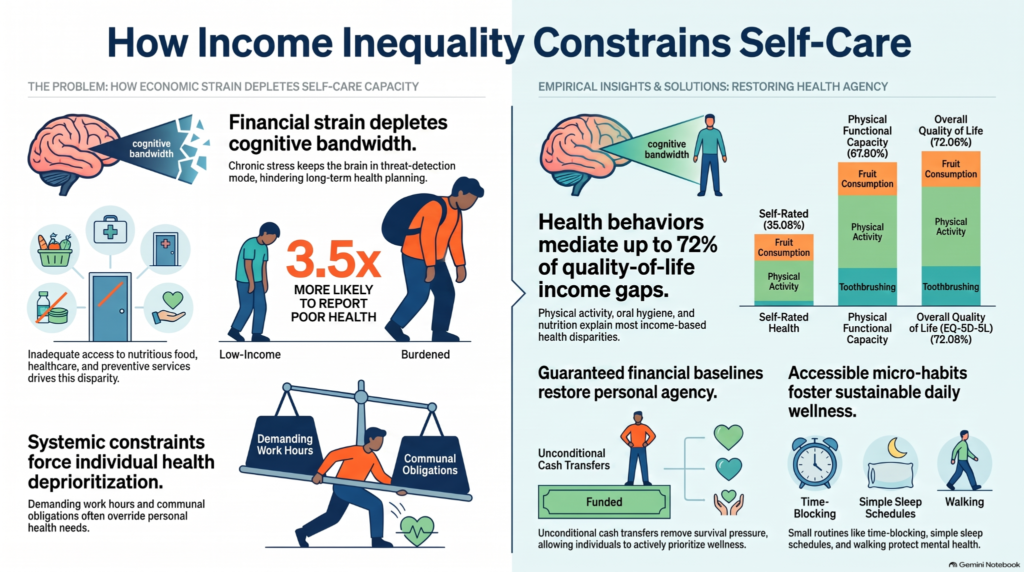
Looking at the empirical research through both a cognitive and nutritional lens, one reality becomes clear: self-care behaviors are not formed in an emotional or economic vacuum. Take, for example, the recent findings from rural cohorts where basic lifestyle habits like physical activity, routine dental hygiene, and daily fruit consumption mediated up to seventy percent of the physical functioning and quality-of-life gaps tied to income.
When you analyze this scientifically, a nutritious meal or an evening walk is not just a personal willpower decision; it represents the presence of disposable energy, reliable access to quality produce, and freedom from acute psychological drain. During my early nutrition work, I saw firsthand how systemic financial strain drains mental endurance. When your neurological resources are depleted by financial instability, the brain naturally reaches for immediate, low-barrier stress relief rather than long-term preventive routines.
Conversely, when individuals are given baseline economic security—as highlighted in recent trials evaluating unconditional cash transfers—we see an immediate resurgence of personal agency, self-efficacy, and purposeful goal planning. When foundational survival needs are met, people instinctively reclaim their health. Sustainable wellness cannot rely on telling people to try harder; it requires recognizing the real behavioral and environmental obstacles people face and building grounded, realistic routines that fit their genuine daily capacity.
Stress and mental health challenges greatly impede your ability to prioritize self-care, creating a barrier that affects overall well-being.
When you experience mental fatigue, your cognitive resources become depleted, making it difficult to engage in activities that promote health and relaxation. Emotional exhaustion exacerbates this issue, leaving you feeling overwhelmed and less motivated to pursue self-care practices.
Research indicates that individuals facing high levels of stress often neglect essential self-care routines, leading to further deterioration in mental and physical health.
The cyclical nature of stress and self-neglect can trap you in a pattern where self-care feels unattainable. This interplay not only affects your immediate well-being but can also have long-term consequences on your health.
Understanding these dynamics is vital for recognizing how stress and mental health challenges limit your ability to care for yourself, ultimately influencing your overall quality of life.
Effective Strategies for Overcoming Self-Care Challenges
To effectively tackle self-care challenges, you should prioritize time management, build support networks, and set realistic goals.
Research shows that structured time allocation can enhance your ability to engage in self-care activities.
Additionally, having a supportive community and attainable objectives can greatly improve your adherence to these practices.
Prioritizing Time Management
While many individuals recognize the importance of self-care, managing time effectively often presents a significant hurdle. You can enhance your self-care practices by adopting specific productivity techniques that improve time allocation. Scheduling even a few minutes each day for a self care activity, such as meditation, journaling, or taking a short walk, can help make wellness more manageable despite financial pressures and busy schedules. Here are a few strategies to take into account:
| Technique | Description |
| Time Blocking | Schedule dedicated slots for self-care activities. |
| Pomodoro Technique | Work in focused bursts followed by short breaks. |
| Prioritization Matrix | Identify urgent vs. important tasks to allocate time wisely. |
| Daily Reflection | Assess daily accomplishments and adjust plans accordingly. |
Building Support Networks
Effective time management can only take you so far if you’re managing self-care alone. Building support networks is essential for overcoming self-care challenges, as community engagement and social support greatly enhance your well-being.
By connecting with others, you can share resources and strategies that foster healthier behaviors. Consider these effective strategies:
- Join local health-focused groups or clubs
- Participate in online forums related to self-care
- Attend workshops on wellness and stress management
- Create a buddy system for accountability
- Volunteer in community initiatives to strengthen ties
These connections not only provide emotional reinforcement but also create a sense of belonging, empowering you to prioritize your self-care.
Engaging with others can lead to improved outcomes and greater fulfillment in your journey to well-being.
Setting Realistic Goals
Setting realistic goals is essential for successfully steering through self-care challenges. By establishing achievable milestones, you can create a structured path that keeps you motivated while managing your expectations. This approach helps you focus on progress rather than perfection, which is vital in overcoming barriers linked to income inequality. Starting with small, achievable changes can help you develop healthy lifestyle habits that support your physical and mental well-being without placing additional strain on your finances.
| Goal Type | Realistic Expectations | Achievable Milestones |
| Daily Habits | Drink 2 liters of water | Increase by 0.5 liters weekly |
| Exercise Routine | 30 minutes, 3 times a week | Add 5 minutes each week |
| Meal Planning | Prepare 3 home-cooked meals | Gradually increase to 5 |
| Mindfulness Practice | 5 minutes of meditation daily | Add 2 minutes weekly |
| Sleep Schedule | 7 hours of sleep | Increase by 15 minutes weekly |
Future Directions for Research on Income Inequality and Health
As researchers investigate the intricate relationship between income inequality and health, it becomes essential to explore how various factors influence self-care behaviors across different socioeconomic strata.
Future research should focus on:
- Income Mobility: Analyzing how movement within income brackets affects health outcomes and self-care practices.
- Health Equity: Investigating disparities in health access and outcomes among different income levels.
- Policy Interventions: Evaluating the effectiveness of targeted outreach and behavioral interventions aimed at low-income populations.
- Community Engagement: Studying how community-driven initiatives can foster healthier self-care behaviors.
- Educational Initiatives: Examining the role of education in enhancing awareness of health resources and self-care strategies.

RELATED STUDIES ABOUT INCOME INEQUALITY IMPACT ON SELF CARE BEHAVIORS
To summarize, income inequality greatly impacts self-care behaviors, with individuals in lower-income brackets facing numerous barriers. For instance, research shows that those living in poverty are 3.5 times more likely to report poor health due to inadequate access to resources. This stark statistic highlights the urgent need for effective strategies to address these challenges. By understanding the psychological and environmental factors at play, we can work towards fostering healthier behaviors across socio-economic divides.
“I feel like my future is in my control”: Exploring young people’s early experiences of the basic income for care leavers in Wales pilot through the lens of self-determination theory
This qualitative evaluation study examines the early lived experiences of young people leaving state care who enrolled in the Welsh Government’s unconditional Basic Income pilot, analyzing how guaranteed direct financial transfers influence personal agency, financial capability, and social connections through the theoretical framework of Self-Determination Theory (SDT).
Policy Context & Conceptual Framework
- The Accelerated Transition Out of Care: While contemporary emerging adulthood is typically characterized by gradual transitions, delayed adult responsibilities, and ongoing familial safety nets, care-experienced youth confront “instant,” “accelerated,” and administrative transitions at age 18. Leaving care is frequently marked by financial precarity, risk of homelessness, isolation, and sudden withdrawal of institutional support based on chronological age rather than developmental need.
- The Welsh Basic Income Pilot: In 2022, the Welsh Government launched a £20 million pilot providing care leavers turning 18 between July 1, 2022, and June 30, 2023, with an unconditional cash transfer of £1,600 gross (£1,280 net after tax) per month for 24 consecutive months. The policy enrolled 97% of the eligible population (n=644) and was designed with principles of trust, respect, and autonomy, delivered without behavioral conditions (e.g., no mandatory education, training, or employment requirements) and provided in addition to existing statutory leaving-care entitlements.
- Theoretical Framing via Self-Determination Theory: SDT posits that psychological well-being, internal motivation, and positive social integration require the fulfillment of three basic psychological needs:
- Autonomy: Feeling in control of one’s life, goals, and actions rather than coerced by external forces.
- Competence: Feeling effective, capable, and confident in navigating life demands and achieving desired outcomes.
- Relatedness: Experiencing meaningful interpersonal connection, mutual care, and a secure sense of belonging.
- Core Research Objective: To explore how unconditional monthly cash transfers shape recipients’ self-determination, decision-making, and relational dynamics during the critical first six months of leaving care.
Methodology & Study Design
- Study Architecture & Governance: Part of the broader government-commissioned, multi-institutional evaluation of the pilot led by CASCADE (Cardiff University). The project integrates an active research advisory group of care-experienced youth who provided direct input on interview design and ethical considerations.
- Sample & Recruitment: Semi-structured qualitative interviews were conducted with 44 young people (representing 13 of Wales’s 22 local authorities) who had been receiving the basic income for 4 to 6 months.
- The sample reflected diverse living circumstances (independent tenancies, supported housing, extended foster care, and kinship living) and varied statuses, including employed individuals, students, unemployed youth, former unaccompanied asylum-seeking children, and disabled young people.
- Data Collection & Ethics: Interviews were completed individually (n=33) or in small groups/pairs (n=11), delivered via flexible formats (in-person in community/home spaces or online via video) according to participant preference. The topic guide explored financial budgeting, service engagement, mental well-being, personal aspirations, and social relationships.
- Analysis: Transcripts were coded in NVivo using a two-stage retroductive approach—combining open, inductive thematic coding with secondary deductive mapping onto SDT constructs (autonomy, competence, relatedness).
Key Empirical Findings Through the Lens of SDT
- Autonomy (The Dominant Psychological Dimension):
- Disrupting the Traditional “Care Leaver Script”: Participants strongly emphasized that the guaranteed income altered the typical care-leaving trajectory, which is usually defined by sudden destitution, rapid eviction, and bureaucratic dependency. Participants reported no longer having to “rely on people for the basics” (such as food or emergency housing deposits), freeing emotional energy to pursue self-directed goals.
- Pacing and Career Control: The income functioned as a critical financial buffer, allowing youth to avoid being rushed into undesirable, exploitative, or precarious employment simply to survive. Recipients reported having the agency to seek meaningful work at their own pace, engage in volunteer work that aligned with their values, enroll in college, or afford driving lessons—an asset widely viewed as essential for long-term mobility.
- Recognition and Equality-Based Respect: Targeting the basic income specifically to care leavers was perceived as state recognition of their systemic disadvantages. Drawing on social recognition theory, the unconditional transfer symbolized societal validation and respect, reducing the stigmatizing feeling of being the “stereotypical broke foster kid” and enabling them to participate on an even playing field with peers.
- Competence (Financial Literacy and Goal Attainment):
- Learning Money Management by Trial and Error: Receiving a substantial monthly sum (£1,280 net) was initially experienced by many as overwhelming, prompting an early phase of rapid discretionary spending on consumer goods (clothing, gaming consoles, trainers). However, this was typically followed by a self-correcting process of budgeting, learning about interest rates and bank accounts, and establishing conscious financial controls.
- Establishing Savings and Safety Nets: Multiple participants established formal savings accounts to self-fund driving lessons, purchase cars, prepare rental deposits, or maintain emergency reserves for when the pilot concluded.
- Long-Term Goal Anxiety: While the income bolstered confidence in pursuing higher education and entrepreneurial ambitions, the time-limited nature of the 2-year scheme created anticipatory anxiety. Several youth acknowledged that current housing or lifestyle goals might become unaffordable once the payments ceased, highlighting the precarious nature of temporary unconditional support.
- Relatedness (Relational Enablement vs. Social Friction):
- Enabling Social Inclusion and Peer Reciprocity: Financial stability reduced social isolation by allowing young people to participate in normative peer activities (e.g., dining out, travel, day trips, recreational outings). Crucially, the income enabled reciprocal family support—allowing youth to contribute toward household utilities or assist struggling parents, transitioning them from dependents to contributing family members.
- Variable Professional Support: While some youth felt supported by their allocated Personal Advisers (PAs), others reported frustration over inconsistent access to dedicated independent financial education, leaving them feeling under-guided in long-term wealth management.
- Relational Strains and Financial Exploitation: A subset of participants reported interpersonal conflict, including pressure from predatory acquaintances or ex-partners requesting money. This prompted several recipients to conceal their enrollment in the pilot to protect their financial boundaries and maintain personal safety.
Policy, Practice, & Theoretical Implications
- Income as an Enabler of Self-Determination: Unconditional cash transfers dismantle the immediate structural and psychological survival pressures that constrain care leavers, demonstrating that financial security directly enhances personal autonomy and intrinsic motivation.
- The Necessity of Complementary Support Systems: The authors emphasize that basic income is not a standalone panacea. It cannot replace relational social work, mental health resources, specialized budgeting advice, or structural reforms in affordable housing.
- The “Cliff-Edge” Challenge of Time-Limited Universal Cash: Providing a substantial two-year income creates a risk of an abrupt transition back to means-tested social assistance or low wages at age 20. Transition planning must actively help young people consolidate gains (e.g., qualifications, savings, driver’s licenses) well before payments conclude.
Study Limitations
- Sample Representativeness: The qualitative cohort (n=44) was drawn from early pilot volunteers and may over-represent individuals who were more stable or engaged with local authority services.
- Early Cross-Sectional Window: Data capture experiences across only the first 4 to 6 months of a 24-month pilot, meaning that long-term trajectories, habituation effects, and the psychological impact of the eventual payment cessation remain to be fully evaluated.
- Retrospective Application of Theory: Self-Determination Theory was applied retroductively after initial coding rather than designed into the primary interview schedule, potentially leaving subtle differences between intrinsic and extrinsic motivations unprobed.
| REFERENCE: Louise Roberts, Zoe Bezeczky, Sally Holland, Vibhor Mathur, David Westlake, “I feel like my future is in my control”: Exploring young people’s early experiences of the basic income for care leavers in Wales pilot through the lens of self-determination theory, Children and Youth Services Review, Volume 188, 2026, 109111, ISSN 0190-7409, https://doi.org/10.1016/j.childyouth.2026.109111. (https://www.sciencedirect.com/science/article/pii/S0190740926003646) |
Mediating Role of Health Behaviors in Income-Related Health Inequalities: Evidence From Socioeconomically Deprived Rural Areas of China
This cross-sectional investigation examines the extent to which modifiable health behaviors mediate income-related health inequalities across socioeconomically deprived rural areas of Shandong Province, China, evaluating whether health-promoting and health-risk behaviors explain variations across subjective, functional physical, and health-related quality-of-life outcomes.
Conceptual Framework & Rationale
- Socioeconomic Status and Health Gradients: In high-income countries, higher income consistently predicts superior health outcomes, largely explained by fundamental cause theory (FCT). This theory posits that socioeconomically advantaged populations possess the flexible material and cognitive resources needed to prioritize health-promoting practices and avoid health-damaging exposures.
- The Countervailing Mechanism in Transitional Contexts: In low- and middle-income countries (LMICs) undergoing rapid economic reform, urbanization, and industrialization, the income-health behavior gradient is frequently non-linear or paradoxical. Rising disposable income in formerly impoverished settings often increases access to and purchasing power for commercial health-risk commodities—specifically tobacco, alcohol, and high-calorie diets—which are culturally perceived as markers of hospitality, wealth, and social status.
- Study Objectives:
- Determine the independent associations between household per capita income, six health-related behaviors (smoking, overdrinking, toothbrushing, fruit consumption, vegetable consumption, physical activity), and multidimensional health status among adults in formerly deprived rural Chinese counties.
- Quantify the proportion of income-related health inequalities that is mediated through these lifestyle behaviors across subjective, physical, and composite health domains.
Methodology & Sampling Architecture
- Study Setting & Population: Conducted in 2023 across rural Shandong Province (the second most populous province in China, with 100.7 million residents).
- Multi-Stage Stratified Cluster Sampling:
- Stage 1 (Prefectures & Counties): Selected 3 prefecture-level cities characterized by a high concentration of formerly poverty-stricken counties (identified as socioeconomically deprived in 2016 and targeted by national poverty-alleviation initiatives through 2021), randomly sampling 2 counties per city (6 counties total).
- Stage 2 (Towns & Villages): Randomly sampled 3 economically underdeveloped towns per county (18 towns total) and 4 administrative villages per town (72 villages total).
- Stage 3 (Households & Individuals): Interviewed approximately 35 households per village.
- Analytical Sample: From 6,674 surveyed individuals across 2,527 households (99.68% response validity), researchers excluded 1,163 individuals aged <18 years (as the EQ-5D-5L is validated only in adults) and 3 physical activity outliers, yielding a final analytical cohort of 5,508 adults.
- Variable Measurement:
- Independent Variable (Income): Natural logarithm of annual household per capita income, calculated by dividing total household income from all sources (agricultural sales, wages, pensions, business income, public transfers) by household size.
- Dependent Variables (Multidimensional Health Status):
- Subjective Health: Self-rated health (SRH) scored from 0 (“very poor”) to 4 (“very good”).
- Physical Functional Capacity: Activities of Daily Living (ADLs) scale (6 functional items: bathing, dressing, self-feeding, dental hygiene, transferring, toileting; total score 0 to 18, Cronbach’s =0.97).
- Composite Health-Related Quality of Life: EuroQol 5-Dimension 5-Level utility index (EQ-5D-5L; covering mobility, self-care, usual activities, pain/discomfort, anxiety/depression; Cronbach’s =0.84).
- Mediating Variables (Health Behaviors):
- Self-Reported Lifestyle Behaviors: Smoking, overdrinking, toothbrushing, fruit consumption, and vegetable consumption rated on 4-point Likert scales (0 = “rarely” to 3 = “most or all of the time”).
- Physical Activity: International Physical Activity Questionnaire Short Form (IPAQ-SF) measuring total metabolic equivalent minutes per week (MET-min/week), log-transformed as (MET-min/week+1).
- Covariates: Biological sex, chronological age (mean 57.1617.49 years), and marital status.
- Statistical Modeling:
- Estimated baseline and adjusted associations using Ordinary Least Squares (OLS) regressions.
- Mediation analysis was executed using the PROCESS macro (Model 4) with 5,000 non-parametric bootstrap resamples to compute indirect effects and 95% confidence intervals. Total mediation proportion was calculated as the ratio of the combined indirect effect to the total income effect.
Key Empirical Findings
- Income Gradients Across Health Outcomes:
- Household income was significantly and positively associated with all three health dimensions after adjusting for sex, age, and marital status:
- Self-rated health (=0.2325,p<0.001).
- Activities of Daily Living (=0.2293,p<0.001).
- EQ-5D-5L quality-of-life utility (=0.0240,p<0.001).
- Household income was significantly and positively associated with all three health dimensions after adjusting for sex, age, and marital status:
- Divergent Income Gradients Across Health Behaviors:
- Health-Promoting Behaviors: Higher income was positively associated with daily toothbrushing (=0.1426,p<0.001), fruit consumption (=0.2363,p<0.001), and total physical activity volume (=0.4656,p<0.001). Income was not associated with vegetable consumption (=-0.0085,p>0.05), which was ceiling-high across the entire rural sample (mean 2.860.42).
- Health-Risk Behaviors: Higher income was significantly and positively associated with overdrinking (=0.0643,p<0.001). Income showed a positive but statistically non-significant association with smoking (=0.0186,p>0.05).
- Simultaneous OLS Regression (Direct vs. Indirect Effects):
- In models including both income and all six health behaviors simultaneously, the direct effect of income on physical ADLs (=0.0735,p>0.05) and EQ-5D-5L (=0.0067,p>0.05) attenuated to statistical non-significance, indicating complete mediation.
- Conversely, income retained a significant direct association with self-rated health (=0.1510,p<0.001), demonstrating partial mediation for subjective health appraisals.
- Bootstrap Mediation Proportions:
- Health behaviors collectively mediated:
- 35.05% of the total effect of income on self-rated health (total indirect effect $\beta = 0.0815, 95\%\text{ CI } [0.0675, 0.0969]$).
- 67.90% of the total effect of income on Activities of Daily Living (total indirect effect $\beta = 0.1557, 95\%\text{ CI } [0.1148, 0.2000]$).
- 72.08% of the total effect of income on EQ-5D-5L health utility (total indirect effect $\beta = 0.0173, 95\%\text{ CI } [0.0141, 0.0208]$).
- Individual Behavior Mediators:
- Physical Activity: Acted as the largest single mediator for ADLs (indirect effect $\beta = 0.0713, 95\%\text{ CI } [0.0481, 0.0967]$) and a primary contributor to EQ-5D-5L ($\beta = 0.0060, 95\%\text{ CI } [0.0041, 0.0080]$).
- Toothbrushing: Strongly mediated functional physical independence (ADLs indirect effect $\beta = 0.0571, 95\%\text{ CI } [0.0380, 0.0796]$) and EQ-5D-5L ($\beta = 0.0041, 95\%\text{ CI } [0.0028, 0.0057]$).
- Fruit Consumption: Strongly mediated subjective self-rated health (indirect effect $\beta = 0.0485, 95\%\text{ CI } [0.0386, 0.0591]$) and EQ-5D-5L ($\beta = 0.0062, 95\%\text{ CI } [0.0046, 0.0079]$).
- Overdrinking: Contributed minor positive indirect effects across SRH (=0.0098), ADLs (=0.0072), and EQ-5D-5L (=0.0011) because alcohol consumption tracked positively with both income and self-reported wellness.
- Health behaviors collectively mediated:
Socio-Cultural & Theoretical Interpretations
- Validation of Fundamental Cause Theory: The strong mediation through toothbrushing, dietary fruit variety, and physical activity confirms that income facilitates health partly by enabling health-promoting behaviors, expanding FCT’s applicability to rural developing contexts.
- The Rural Alcohol Paradox: The positive correlation between income and overdrinking reflects transitional social dynamics in rural China. Alcohol functions as essential social currency for networking, male leisure, and community standing. Its positive association with health ratings likely captures reverse causality (individuals in poor health or with end-stage chronic conditions are forced to cease drinking) alongside the stress-buffering and social-capital functions of shared drinking in rural villages.
- Discrepancy Between Health Dimensions: Health behaviors explained roughly two-thirds to three-quarters of the income gradient for objective physical functioning (ADLs: 67.90%) and multidimensional quality of life (EQ-5D-5L: 72.08%), but only one-third for subjective health (SRH: 35.05%). The authors suggest that self-rated health is directly anchored by psychological optimism, financial security, and perceived healthcare purchasing power, operating through cognitive pathways independent of daily lifestyle habits.
Policy & Public Health Implications
- Coupling Economic Relief with Behavioral Literacy: Direct anti-poverty financial transfers and rural revitalization subsidies are necessary but insufficient on their own. If rising rural wealth is accompanied by increased consumption of tobacco and heavy alcohol without corresponding health literacy, economic development risks fueling non-communicable disease epidemics.
- Targeting High-Yield Preventive Behaviors: Public health strategies in rural communities should emphasize scalable, high-yield positive behaviors that exhibited strong mediation: oral hygiene promotion (toothbrushing), dietary diversification (increasing fruit access), and structured community physical activity.
- Regulatory Measures for Socially Embedded Risks: Because rising rural incomes increase overdrinking, conventional health messaging must be reinforced with structural interventions, such as targeted taxation, purchase age verifications, and cultural shifts in commercial banqueting norms.
Study Limitations
- Cross-Sectional Confounding & Reverse Causation: The cross-sectional design cannot establish causal chronology. Sicker or functionally disabled individuals may earn less income and simultaneously face physical limitations that prevent regular exercise or force smoking/drinking cessation.
- Self-Report Measurement & Lack of Dosimetry: Lifestyle behaviors were measured as ordinal frequencies (rarely to mostly) rather than quantified objective dosages (e.g., pack-years of smoking, standard grams of alcohol consumed, or dietary caloric records).
- Mediation Modeling Assumptions: The bootstrap parallel mediation model assumed no unmodeled mediator-to-mediator interactions or moderate-moderation effects, potentially simplifying complex interrelated behavioral pathways (e.g., the co-occurrence of smoking and alcohol intake).
| REFERENCE: Daopeng Duan, Wenning Sun, Jin Hao, Shuwen Bi, Siqian Zhang, Longrui Zou, Zexuan Yu, Shiju Dong, Jiajia Li, Mediating Role of Health Behaviors in Income-Related Health Inequalities: Evidence From Socioeconomically Deprived Rural Areas of China, American Journal of Preventive Medicine, Volume 70, Issue 1, 2026, 107658, ISSN 0749-3797, https://doi.org/10.1016/j.amepre.2025.107658. (https://www.sciencedirect.com/science/article/pii/S0749379725001503) |
Income inequality and socioeconomic differences in bullying perpetration among adolescents in Europe and Canada: Testing the “golden youth” hypothesis
This cross-sectional, multilevel epidemiological study investigates the moderating role of country-level income inequality in the association between family socioeconomic position (SEP) and bullying perpetration among adolescents across 22 countries and regions in Europe and Canada, testing the cross-national generalizability of the “golden youth” hypothesis.
Conceptual Framework & Rationale
- Socioeconomic Disadvantage vs. Status Competition Models: Bullying research has traditionally focused on socioeconomic disadvantage, positing that poverty, resource deprivation, and family stress drive aggressive behaviors through social marginalization and frustration. However, an ecological perspective suggests that macro-level social structures—specifically income inequality—shape peer dynamics by sharpening social comparison, status competition, and hierarchy visibility.
- The “Golden Youth” Hypothesis: Originally conceptualized in post-Communist European contexts, the golden youth hypothesis proposes that in societies with wide income disparities, adolescents from high-SEP backgrounds experience heightened status anxiety, fear of downward social mobility, and pressure to maintain dominance. To defend their social prestige, affluent youth in highly unequal settings may leverage social aggression and bullying behaviors.
- Knowledge Void Beyond Post-Communist Contexts: While established in Eastern Europe, it remained unknown whether macro-level inequality modifies the socioeconomic distribution of bullying perpetration in Western Europe and Canada, regions characterized by stronger social welfare states, greater wealth, and distinct institutional structures.
- Core Research Objective: To examine whether country-level income inequality (Gini index) acts as an effect modifier on the association between family affluence and adolescent bullying perpetration across high-income European nations and Canada.
Methodology & Sampling Architecture
- Study Design & Data Source: Multilevel analysis utilizing cross-sectional data from the 2017–2018 Health Behaviour in School-aged Children (HBSC) survey, a standardized school-based international study conducted in collaboration with the World Health Organization.
- Analytical Sample: Included 117,238 adolescents aged 11 to 15 years (mean age 13.51.6 years; 49.2% male) across 22 countries and regions (Austria, Belgium [Flanders and Wallonia], Canada, Denmark, England, France, Germany, Greece, Greenland, Iceland, Ireland, Italy, Luxembourg, Malta, Netherlands, Norway, Portugal, Scotland, Spain, Sweden, and Wales). Complete-case analytical models encompassed 103,180 participants after accounting for minimal non-systematic missing data (family SEP missingness: 6.6%).
- Operational Definitions & Instrumentation:
- Bullying Perpetration (Outcome): Evaluated using a standardized definition derived from the Olweus Bully/Victim Questionnaire explicitly distinguishing repeated aggressive behavior with power asymmetry from mutual peer conflict. Dichotomized as engaging in bullying another person at school “at least 2–3 times a month” versus “<2–3 times” over the past couple of months.
- Family Socioeconomic Position (Level 1 Exposure): Measured via the HBSC Family Affluence Scale (FAS III), a validated six-item material asset scale (vehicle ownership, unshared bedroom, computer count, bathroom count, dishwasher ownership, family international holidays). Scores were categorized into country-specific low (bottom 20%), middle (middle 60%), and high (top 20%) affluence tiers.
- Macro-Level Country Variables (Level 2 Exposures):
- Income Inequality: Country Gini index obtained from 2017 World Bank indicators (sample mean: 30.9; range: 26.1 in Iceland to 35.9 in Italy).
- Economic Development: Gross domestic product (GDP) per capita in current USD (mean: $48,158; range: $18,632 in Greece to $110,193 in Luxembourg).
- Welfare-State Generosity: Social protection expenditure as a percentage of GDP derived from Eurostat ESSPROS and OECD SOCX databases (mean: 26.0%; range: 14.5% in Ireland to 34.2% in France).
- Individual-Level Covariates: Age, biological sex, and self-reported bullying victimization (experienced at least 2–3 times in the past couple of months).
- Hierarchical Statistical Modeling: Multilevel logistic regression models with Laplace approximation nested students within countries. Models sequentially introduced individual-level variables (Model 1), GDP per capita (Model 2), social protection expenditure (Model 3), the Gini index (Model 4), and a cross-level interaction term (GinifamilySEP, Model 5). Robustness checks included modeling SEP as a continuous scale and in tertiles, fitting country-level random slopes for SEP, controlling for school- and class-level clustering, and conducting leave-one-country-out iterations.
Key Empirical Findings
- Overall Prevalence & Demographic Patterns:
- The total prevalence of frequent bullying perpetration (2–3times/month) was 3.2% across the surveyed European and Canadian jurisdictions.
- Male sex was strongly associated with bullying perpetration (OR = 2.13, 95% CI: 1.98 -2.30, P < 0.001), as was older age (15 vs. 11 years: OR = 1.59, 95% CI: } 1.45 – 1.75, P < 0.001).
- Prior bullying victimization was the single strongest individual-level predictor of perpetration (OR = 7.45, 95% CI: 6.88 -8.06, P < 0.001), identifying a high-risk bully-victim profile.
- The Non-Linear (U-Shaped) Individual Socioeconomic Gradient:
- Across the pooled multi-country sample, family affluence exhibited a U-shaped association with bullying involvement.
- High-SEP adolescents had 11% higher odds of bullying perpetration compared to middle-SEP peers (P=0.034), but 14% to 15% lower odds compared to low-SEP peers in main-effect models ($\text{OR} = 0.85, 95\%\text{ CI: } 0.76\text{–}0.96, P < 0.001$). Middle-SEP adolescents had the lowest overall probability of perpetrating bullying (OR=0.77 vs. low SEP).
- Validation of the Cross-Level “Golden Youth” Interaction:
- Introducing the cross-level interaction between country Gini index and family SEP significantly improved model fit (2[2]=13.44,P=0.001) and accounted for 33.4% of between-country variance (proportional change in variance).
- As country-level income inequality widened, the relative odds of bullying perpetration among affluent (high-SEP) adolescents increased significantly compared to their low-SEP peers (interaction OR = 1.08, 95% CI: } 1.03 – 1.13, P < 0.001).
- Model-Based Trajectory Across the Gini Spectrum:
- In low-inequality countries (Gini = 26.1, e.g., Iceland), high-SEP youth were significantly protected against bullying perpetration compared to low-SEP youth (OR = 0.58, 95% CI: 0.44 – 0.75).
- At mean country inequality (Gini = 30.9, e.g., Germany, France), the protective effect of affluence diminished (OR = 0.84, 95% CI: 0.75 – 0.95).
- In high-inequality nations (Gini = 35.9, e.g., Italy, Portugal, Spain), the direction reversed: high-SEP youth exhibited higher odds of bullying perpetration than low-SEP peers (OR = 1.19, 95% CI: 0.96 – 1.49).
- Sensitivity and Robustness Analyses:
- The high SEPGini interaction remained stable when family affluence was analyzed as a continuous variable (P<0.001) and in tertiles (P=0.005).
- Leave-one-country-out iterations confirmed the effect was not driven by any single jurisdiction, and targeted exclusion of outlier countries (Portugal, Canada, Italy, Iceland) preserved a significant positive interaction (OR=1.06,P=0.033).
- Accounting for country-level random slopes for family SEP (OR=1.08,P=0.001) and three-level clustering within schools and classrooms (OR=1.08,P=0.001) left effect estimates unchanged.
- Macroeconomic wealth (GDP per capita; P=0.690) and welfare generosity (social expenditure % of GDP; P=0.326) did not explain cross-national variation in bullying perpetration, isolating income inequality as the relevant macro-level modifier.
Theoretical & Public Health Implications
- Expansion of the “Golden Youth” Framework: The findings demonstrate that the golden youth phenomenon is not restricted to transitional post-Communist economies, operating across high-income Western democracies with established market economies and welfare safety nets.
- Psychosocial Mechanisms of Status Anxiety: The observed pattern aligns with psychosocial inequality models, suggesting that wide income dispersion amplifies perceived competition and status anxiety across social strata. For affluent youth in unequal societies, status fragility and fear of social exclusion may drive dominance-seeking, exclusionary, or reputational bullying behaviors designed to defend peer standing.
- Structural Power Asymmetries: Neoliberal macroeconomic policies and wider income disparities can erode collective social solidarity and accentuate socioeconomic power differentials, creating peer environments that enable youth from advantaged backgrounds to leverage social resources for relational dominance.
- Reframing Anti-Bullying Interventions: School anti-bullying programs that focus solely on individual deficits, socioeconomic disadvantage, or externalizing pathology may overlook aggression rooted in affluence, social dominance, and competitive peer hierarchies. Comprehensive interventions should address school climates that reward competitive social dominance and mitigate peer exclusion in high-inequality settings.
Methodological Limitations
- Cross-Sectional Architecture: The observational, cross-sectional design precludes establishing temporal directionality or verifying whether status anxiety directly causes bullying behaviors.
- Ecological Fallacy Risk: Country-level Gini coefficients reflect national income distributions, which may not capture localized school- or neighborhood-level socioeconomic disparities.
- Self-Reported Behavioral Measures: Bullying perpetration relied on self-reports vulnerable to social desirability bias, which might differ across socioeconomic classes if affluent youth are more protective of their self-image.
- Unmeasured School and Institutional Covariates: The study could not control for national differences in educational tracking, school disciplinary climates, or specific anti-bullying policy enforcement.
- Binary Sex Stratification: The survey instrument captured biological sex solely as a binary variable (boy/girl), preventing evaluation of bullying dynamics among non-binary or gender-diverse youth.
| REFERENCE: Armen Torchyan, Inge Houkes, Hans Bosma, Income inequality and socioeconomic differences in bullying perpetration among adolescents in Europe and Canada: Testing the “golden youth” hypothesis, Journal of Epidemiology and Population Health, Volume 74, Issue 4, 2026, 203767, ISSN 2950-4333, https://doi.org/10.1016/j.jeph.2026.203767. (https://www.sciencedirect.com/science/article/pii/S2950433326006014) |
CONCLUSION
True, sustainable wellness can never be measured by how many products we buy or how closely our daily lives mirror an idealized aesthetic. Over years of reporting on lifestyle science and coaching people through sustainable habits, my core philosophy has always centered on small, compassionate, and incremental lifestyle adjustments that honor real life. We have to stop viewing the struggle to maintain self-care as an individual moral failure.
If your current financial situation, caregiving duties, or heavy workload leaves you exhausted, that is not a lack of self-discipline—it is the biological reality of limited mental bandwidth under systemic pressure. Moving forward, bridging the wellness divide demands a dual commitment: we must actively advocate for equitable policies and community-level resources that support everyone, while simultaneously redefining personal self-care on our own terms.
A five-minute breathing break, prioritizing consistent bedtime habits, cooking a simple budget-friendly meal, or taking an evening walk with a friend are powerful, scientifically validated acts of self-preservation. They cost little to nothing, yet they protect our mental and physical baseline. Self-care belongs to everyone, and honoring our well-being starts by meeting ourselves with realistic compassion right where we stand.