

Whenever people ask me why starting a new routine feels like trudging uphill through wet cement, I always bring them back to the biology of the brain. Early in my graduate studies in applied neuroscience, I fell into the exact same trap so many of us do: I believed that personal growth was simply a test of discipline. If I struggled to wake up early, if I caught myself mindlessly reaching for my phone during an afternoon slump, or if I abandoned an ambitious reading goal after two weeks, I chalked it up to a personal moral flaw. I assumed I just wasn’t trying hard enough.
It wasn’t until I spent time examining the brain’s energy budgets and neural architecture that my entire relationship with self-improvement shifted. Your brain is an efficiency machine; it prioritizes familiar, low-friction pathways to preserve cognitive energy. When you introduce a new behavior, you are asking your nervous system to clear an untrodden trail through thick brush.
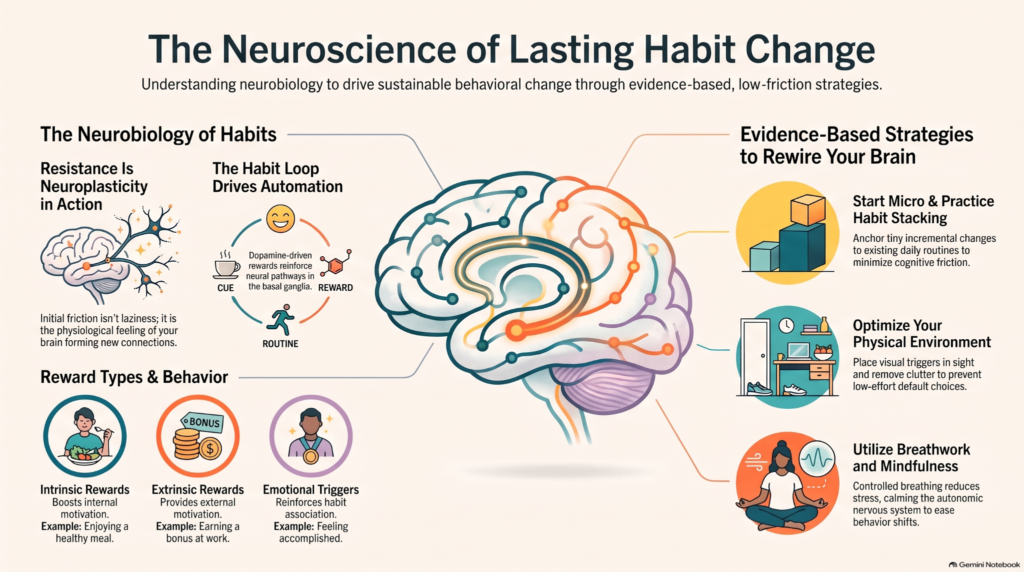
That initial friction—the hesitation, the mental fatigue, the urge to retreat to what is comfortable—isn’t evidence of laziness. It is the physiological sensation of neuroplasticity in real time. Growth inherently destabilizes your existing neural equilibrium. When we drop the harsh self-judgment and meet that initial resistance with clinical curiosity and genuine self-compassion, we stop fighting our own biology and finally begin working with it.
The neuroscience of self-improvement habits shows how neuroplasticity allows your brain to reorganize itself, creating new pathways with consistent practice. Neurotransmitters like dopamine drive motivation, while repetition reinforces behaviors, forming strong habits over time. By understanding the habit loop—cues, routines, and rewards—you can effectively trigger positive changes. Additionally, mindfulness techniques and environmental design play significant roles in shaping your habits. Explore how these elements interact to enhance your personal growth journey.
KEY TAKEAWAYS
- Neuroplasticity allows the brain to form new connections, enabling lasting habit changes through consistent practice and incremental adjustments.
- Neurotransmitters like dopamine and serotonin play crucial roles in motivation, influencing habit formation and emotional stability for personal growth.
- Repetition strengthens neural pathways, making behaviors more automatic and facilitating the integration of new habits into daily life.
- The habit loop, consisting of cues, routines, and rewards, is essential for recognizing triggers and reinforcing desired behaviors for improvement.
- Mindfulness techniques and environmental design can enhance habit adoption by reducing friction and creating supportive contexts for positive change.
HOW TO LEVERAGE NEUROPLASTICITY FOR HABIT CHANGE
Habits are routines or rituals that are automatic or have become almost automatic, second nature. A habit is a practice you repeat so regularly that it can be hard to change. This could be biting your nails when you’re worried, picking up a bottle of wine whenever you pass the liquor store, or cracking open a bag of chips while watching TV at the end of the day. A habit might even be unconscious, like jiggling your leg while you’re on a flight, or licking your lips when you’re forced to do some public speaking.
As you commence on the journey of habit change, understanding neuroplasticity can greatly enhance your efforts. Neuroplasticity principles reveal that your brain can reorganize and form new neural connections throughout your life, making it possible to reshape your habits.
To leverage this, focus on habit formation techniques that promote consistency and repetition. Start small; incremental changes create stronger neural pathways. For instance, if you aim to read daily, set a goal of just five pages. Over time, this will solidify as a routine.
Moreover, utilize cues and rewards to reinforce your new habits. By associating specific triggers with your desired behavior and rewarding yourself, you’ll strengthen the connections in your brain.
How Neurotransmitters Fuel Our Motivation
Understanding how neurotransmitters influence motivation is essential for anyone looking to improve their habits. Your brain chemistry plays a vital role in driving motivation and emotional regulation.
Key neurotransmitters like dopamine and serotonin greatly impact your motivation drive. When these chemicals are balanced, you experience enhanced focus and enjoyment in habit formation.
Here are three ways neurotransmitters fuel your motivation:
- Dopamine Release: This neurotransmitter activates your reward pathways, encouraging you to pursue rewarding activities and reinforcing positive habits.
- Serotonin Levels: Higher serotonin can improve mood and emotional stability, making it easier to tackle challenges and maintain motivation.
- Neurotransmitter Balance: Achieving a balance among various neurotransmitters is essential for sustained motivation and effective habit reinforcement.
Repetition: The Key to Habit Formation
To form lasting habits, repetition plays an essential role in rewiring your brain’s neural pathways. Each time you engage in a behavior, you strengthen the connections associated with that action, making it easier to repeat in the future.
This is where cue consistency comes into play; by maintaining the same cues—like specific times or environments—you enhance your ability to trigger desired behaviors.
Habit stacking is another effective strategy, allowing you to link new habits to existing ones. For instance, if you want to incorporate daily meditation, you might do it right after brushing your teeth.
This repetition, combined with a consistent cue, reinforces the new habit, making it part of your routine. By understanding and applying these principles of repetition, you empower yourself to cultivate habits that lead to personal growth, ultimately granting you greater freedom in your daily life.
Decoding the Habit Loop: Cues, Routines, Rewards
Results are what happens after you engage in the behavior. Whereas triggers spark your habit, results are what fans the flame to keep it going. Our brain gives more preference to short-term rewards over long-term ones. And our most rewarding habits provide us with pleasure while distracting us from the discomfort of living.
To effectively change your habits, you need to recognize the cues that trigger specific routines.
Research shows that these cues can range from environmental triggers to emotional states, directly influencing your behavior.
Meanwhile, understanding how rewards reinforce these routines can help you make lasting changes in your life.
Understanding Cues in Habits
When you recognize the cues that trigger your habits, you gain the power to reshape your behavior. Understanding these cues is essential for effective self-improvement.
Consider these three key aspects of cue recognition:
- Environmental Triggers: Identify specific locations or situations that prompt certain behaviors, like snacking in front of the TV.
- Emotional Signals: Pay attention to feelings that lead to habits, such as stress driving you to overeat.
- Social Influences: Note how the presence of certain people can activate your automatic responses, like smoking with friends.
Impact of Rewards on Behavior
Recognizing cues is only the first part of the habit loop; the impact of rewards plays a significant role in reinforcing behaviors. Reward systems activate dopamine release, enhancing your intrinsic motivation and encouraging habit reinforcement. By anticipating rewards, you can trigger emotional responses that lead to positive feedback. Let’s explore the relationship between rewards and behaviors:
| Type of Reward | Effect on Behavior | Example |
| Intrinsic Rewards | Boosts internal motivation | Enjoying a healthy meal |
| Extrinsic Rewards | Provides external motivation | Earning a bonus at work |
| Emotional Triggers | Reinforces habit association | Feeling accomplished |
Effective goal setting incorporates both intrinsic and extrinsic rewards, creating a balanced approach to behavioral reinforcement.

PRACTICAL MINDFULNESS TECHNIQUES FOR HABIT CHANGE
During my own recovery from severe professional burnout a few years ago, my capacity for self-regulation was practically nonexistent. I couldn’t white-knuckle my way through massive life overhauls, nor could I rely on a sudden surge of inspiration. I was forced to strip everything down to the absolute essentials. I remember sitting on my living room floor, overwhelmed by the simplest tasks, realizing that if I wanted to rebuild my focus and emotional resilience, I couldn’t treat myself like a machine that just needed a software patch.
That experience taught me that true habit formation is deeply identity-based and sensory, not performative. In my own daily practice, whether I’m unrolling my yoga mat in the morning or setting boundaries around digital distractions while writing, I rely heavily on environmental cues rather than sheer determination. I keep my visual field clear of clutter because an overstimulated prefrontal cortex naturally defaults to low-effort, high-dopamine habits.
Moreover, when resistance inevitably surfaces—that familiar restless impulse to abandon the discomfort of a difficult draft or an intense stretch—I pause and practice breath awareness. Slowing down the autonomic nervous system signals to the brain that the awkwardness of growth is safe. You don’t need to force monumental shifts overnight; honoring micro-moments of friction with patience is how real, sustainable rewiring actually happens.
Your brain is designed to save energy. When you repeat a behaviour consistently, the brain stores it in a region called the basal ganglia, which helps automate routines. Over time, the behaviour no longer requires conscious effort, it simply happens. That’s why once a habit forms, it feels natural. It also explains why breaking old habits can take time.
To successfully change habits, you can implement practical mindfulness techniques like breathing exercises and visualization.
Research shows that controlled breathing enhances focus and reduces stress, making it easier to stick to new routines.
Additionally, visualizing your desired habits can strengthen neural pathways associated with those behaviors, increasing the likelihood of their adoption.
Breathing Techniques for Focus
Although many people overlook the power of breath, incorporating specific breathing techniques can greatly enhance focus and facilitate habit change.
By practicing breath awareness, you can ground yourself and sharpen your concentration. Incorporating this simple self care activity into your daily routine can also help you manage stress and stay focused on your habit goals. Here are three effective techniques for focus enhancement:
- Diaphragmatic Breathing: Inhale deeply through your nose, allowing your diaphragm to expand. Exhale slowly through your mouth. This promotes relaxation and clarity.
- Box Breathing: Inhale for four counts, hold for four, exhale for four, and hold for another four. This rhythmic pattern stabilizes your mind and nurtures focus.
- Alternate Nostril Breathing: Close one nostril, inhale through the other, switch, and exhale. This balances your mind and enhances cognitive function.
Visualization for Habit Formation
While many people focus on willpower alone for habit formation, incorporating visualization techniques can greatly enhance your ability to establish and maintain new habits. Research shows that mental imagery activates similar neural pathways as real-life experiences, making your brain more receptive to change.
By vividly imagining yourself successfully engaging in your desired habit, you reinforce motivation and create a mental blueprint. Regularly practicing these visualization techniques can solidify your commitment, helping you visualize potential obstacles and strategize solutions using insights from healthy coping mechanisms psychology.
This proactive approach not only aligns your subconscious with your goals but also fosters resilience against setbacks. Ultimately, harnessing the power of mental imagery empowers you to break free from old patterns and cultivate the habits that lead to personal growth and freedom.
How Environment Shapes Our Habits
Your environment plays an essential role in shaping your habits, often influencing your choices and behaviors in subtle yet powerful ways. Understanding this can empower you to create a space conducive to your personal growth.
Here are three key factors to assess:
- Environmental Triggers: Certain elements in your surroundings can prompt habitual behavior, whether positive or negative. Recognizing these can help you adjust your space for better outcomes.
- Spatial Awareness: The layout of your environment can either facilitate or hinder your habits. A well-organized space promotes productivity, while clutter can distract you.
- Social Influence: The people you surround yourself with greatly impact your behaviors. Positive social cues can encourage healthy habits, whereas negative influences may lead to undesirable ones.
Effective Neuroscience-Based Strategies for Lasting Habit Change
To foster lasting habit change, it’s crucial to leverage insights from neuroscience that illuminate how our brains process and reinforce behaviors. One effective strategy is habit stacking, which involves linking a new behavior to an established habit. This technique exploits the brain’s associative learning, making it easier to adopt new routines and support a personal growth initiative psychology approach to developing lasting positive behaviors. For example, if you already enjoy your morning coffee, you could stack a short meditation session right after.
Additionally, identifying behavior triggers can greatly enhance your success. By recognizing cues that prompt your existing habits, you can intentionally design your environment to support desired changes. For instance, if you want to exercise more, place your workout gear in plain sight. This way, the visual trigger nudges you toward action.

RELATED STUDIES ABOUT NEUROSCIENCE OF SELF IMPROVEMENT HABITS
Incorporating neuroscience into your habit change journey can be a game-changer. By understanding neuroplasticity and the habit loop, you can effectively rewire your brain for personal growth. Remember, persistence is key; with consistent repetition and a supportive environment, you can turn your goals into reality. As you navigate this path, keep in mind that every small step counts—it’s the little things that often make the biggest difference. Embrace the process, and watch yourself thrive.
The (In)flexible self: Psychopathology, mindfulness, and neuroscience
This conceptual review synthesizes clinical psychology, contemplative science, and cognitive neuroscience to examine how mental rigidity in the experience of “self” maintains psychopathology, and how mindfulness meditation can restore self-pattern flexibility.
Study Overview & Theoretical Framework:
- Transdiagnostic Rigidity in Mental Health: Converging clinical research indicates that psychopathological conditions across traditional diagnostic categories share common mechanisms characterized by automaticity and inflexibility. Rigidity—defined as perseverating in cognitive, emotional, or behavioral patterns that are no longer contextually effective—transforms adaptive psychological functions into pathological symptoms.
- The Pattern Theory of Self (PTS): The authors adopt an enactive, pluralist model wherein the human self is not an internal, central agent or static entity, but an emergent, dynamical gestalt. A “self-pattern” integrates heterogeneous processes across multiple levels: embodied, pre-reflective, affective, behavioral, cognitive, reflective, narrative, intersubjective, ecological, and normative. Disruption or inflexible lock-in across these interrelated components characterizes self-disorders such as major depression, complex trauma/dissociation, and addiction.
Mindfulness as a Mechanism for Self-Pattern Flexibility:
- Decoupling Rigid Elemental Links: Mindfulness-Based Interventions (MBIs) train individuals in meta-cognitive monitoring, decentering, and non-judgmental acceptance. Rather than altering single symptoms in isolation, mindfulness weakens rigid, habitual couplings between self-pattern dimensions (e.g., decoupling perceived disability from emotional distress, or interrupting automatic appetitive impulses that drive substance consumption and binge eating).
- Metacognitive Decentering & Present Awareness: In the cognitive domain, decentering allows individuals to shift from immersive identification with a running mental commentary to simple observation, reducing rumination and worry. In affective and intersubjective domains, practice reduces experiential avoidance and enhances prosocial behavior and compassion.
- Transforming the Gestalt Toward Hypo-Egoicism: In group-based MBI settings, collaborative inquiry fosters recognition of common humanity, shifting the overall self-pattern away from self-centered absorption toward a flexible, “hypo-egoic” mode.
Neuroscientific Substrates and Cortical Network Dynamics:
- Two Modes of Self-Processing in the Brain:
- Self-Related Processing (The Narrative Self): Conceptual, autobiographical, and evaluative identity supported predominantly by the Default Mode Network (DMN), encompassing core self-referential, mentalizing, and medial temporal memory subsystems.
- Self-Specific Processing (The Minimal/Experiential Self): Momentary, sensorimotor, and agency-specifying distinctions supported by the Salience, Somatosensory, Attention, and Lateral Frontoparietal (Control) networks.
- Meditation-Induced Network Alterations:
- Activation Shifts: Focused Attention (FA) and Open Monitoring (OM) meditations consistently deactivate major DMN hubs (e.g., posterior cingulate cortex, precuneus) while recruiting Control and Salience hubs (dorsolateral prefrontal cortex, dorsal anterior cingulate cortex, insula). Loving-Kindness (LK) meditation engages somatosensory regions and the anterior insula, supporting interoceptive awareness and empathy.
- Functional Connectivity (FC) Reconfiguration: Experienced practice and acute states reduce internal connectivity within the DMN (reflecting reduced narrative rumination), enhance functional connectivity within and between self-specific networks (Salience and Control, facilitating present-moment awareness and context-switching), and alter functional coupling between the DMN and sensory-attentional networks (attenuating anti-correlations to promote flexible, non-dual awareness).
- Whole-Brain Community Architecture: Emerging longitudinal single-case fMRI data suggest that meditation loosens fixed boundaries between default and executive control systems, indicating dynamic whole-brain network reconfiguration rather than localized modular changes.
Clinical & Scientific Implications:
- Explaining MBI Versatility: The efficacy of mindfulness across diverse disorders (e.g., major depressive disorder, substance abuse, chronic pain) stems from targeting core transdiagnostic rigidity within the self-pattern rather than disease-specific symptoms.
- Future Research Needs: The authors call for the development of validated clinical psychometric instruments to directly assess psychological rigidity, larger preregistered neuroimaging studies to avoid sample aggregation bias, and longitudinal trials to establish whether network plasticity directly mediates improvements in self-pattern flexibility and psychological well-being.
| REFERENCE: Fabio Giommi, Prisca R. Bauer, Aviva Berkovich-Ohana, Henk Barendregt, Kirk Warren Brown, Shaun Gallagher, Ivan Nyklíček, Brian Ostafin, Antonino Raffone, Heleen A. Slagter, Fynn-Mathis Trautwein, David R. Vago, The (In)flexible self: Psychopathology, mindfulness, and neuroscience, International Journal of Clinical and Health Psychology, Volume 23, Issue 4, 2023, 100381, ISSN 1697-2600, https://doi.org/10.1016/j.ijchp.2023.100381. (https://www.sciencedirect.com/science/article/pii/S1697260023000170) |
Toward an evolutionary and syndromic psychiatry: Dogs as a comparative model for the neuroscience of psychopathology
This review develops an evolutionary, syndromic, and neurobiologically grounded framework for canine psychiatry, arguing that domestic dogs represent a valuable comparative model for establishing an objective neuroscience of psychopathology independent of human-centric, language-dependent diagnostic classifications.
Study Overview & Conceptual Framework:
- Limitations of Anthropocentric Nosology: Contemporary human psychiatry relies heavily on subjective introspection, symbolic language, and narrative self-report. Transposing human diagnostic categories (e.g., DSM categories) directly onto non-human animals is methodologically flawed because dogs lack symbolic self-narration, inner speech, and counterfactual introspection, while human observer reports remain susceptible to anthropomorphic projection and cultural bias.
- Evolutionary & Comparative Foundation: Affective circuits and primary emotional systems are deeply conserved across mammals. Dogs share homologous neural architectures with humans—including the amygdala (fear and vigilance), hippocampus (contextual emotional memory), striatum (habits and compulsivity), and prefrontal cortex (inhibitory control).
- Tripartite Selective History: Canine psychiatric vulnerabilities are shaped by three evolutionary filters:
- Domestication: Selected for hypersociability and human attachment, creating unique vulnerabilities to separation anxiety and social deprivation.
- Functional Working Selection: Artificially concentrated specific motivational drives (e.g., predatory sequences in hunting breeds, vigilance in guard breeds, motor sensitivity in herding breeds), resulting in behavioral disorders when modern anthropogenic environments fail to accommodate these evolved drives.
- Modern Morphological Breed Formation: Aesthetic breeding reduced genetic diversity, produced extreme anatomical conformations (e.g., brachycephaly, chronic pain), and increased behavioral vulnerabilities via pleiotropic genetic effects.
Methodological Bottlenecks in Canine Behavioral Medicine:
- Subjective & Incomplete Behavioral Instruments: Diagnostic evaluation depends heavily on owner-reported instruments (e.g., C-BARQ) that leave major Research Domain Criteria (RDoC) domains unaddressed, such as anhedonia, cognitive flexibility, sleep architecture, and interoception. While newer tools capture broader dimensions, they remain vulnerable to cross-cultural discrepancies in owner tolerance thresholds.
- Biomarker Deficits: Research remains dominated by isolated, single-timepoint cortisol sampling, which lacks diagnostic specificity. The field requires multimodal panels combining heart rate variability (HRV), continuous wearable telemetry, inflammatory profiles, and non-verbal electrophysiological paradigms (e.g., mismatch negativity).
- Nascent Neuroimaging Infrastructure: Awake canine fMRI and PET remain constrained by small, single-center cohorts, unharmonized brain atlases, and primate-derived assumptions regarding functional connectivity (such as unresolved anterior-posterior dissociations within the canine default mode network).
- Diagnostic Drift: The absence of operationalized, consensus-based diagnostic criteria leads to high inter-rater inconsistency and impedes clinical trial reproducibility.
The Proposed Syndromic Model:
Rather than forcing dogs into discrete, all-or-nothing categorical buckets, the authors propose a dimensional syndromic model triangulating clinical phenotypes, conserved neural circuits, and the RDoC framework across nine core dimensions:
- Anxiety-Threat Dysregulation: Amygdala-prefrontal-periaqueductal grey hyperreactivity; manifested as hypervigilance, low-threshold reactivity, and autonomic withdrawal (reduced HRV).
- Compulsive-Stereotypic Syndrome: Cortico-striatal-thalamo-cortical loop dysfunction and monoaminergic imbalance; manifested as rigid, repetitive behaviors (e.g., tail-chasing, flank-sucking).
- Impulsivity-Hyperactivity: Prefrontal hypofunction and impaired top-down inhibitory control; manifested as motor disinhibition and low frustration tolerance.
- Depressive-Apathetic State: Mesolimbic dopamine and ventral striatal reward pathway dysfunction; manifested as anhedonia, waking inactivity, and blunted exploratory play.
- Attachment-Related Dysregulation: Oxytocin-vasopressin and HPA-axis disruption within medial prefrontal and anterior cingulate networks; manifested as separation distress or disorganized proximity-seeking.
- Cognitive Rigidity & Reversal-Learning Deficits: Prefrontal-striatal flexibility impairment; manifested as perseverative responding and environmental intolerance.
- Social-Cognitive Dysregulation: Temporo-parietal and prefrontal social brain impairment; manifested as compromised interpretation of conspecific or interspecific communicative signals.
- Age-Related Neurocognitive Dysfunction: Diffuse neurodegeneration, amyloid-beta accumulation, and cholinergic loss; manifested as progressive disorientation, sleep-wake cycle breakdown, and memory decline.
- Atypical Perceptual-Behavioral Episodes: Striatal-cortical dopaminergic gating disturbances; manifested as episodic responsiveness to unidentifiable environmental stimuli (e.g., “fly-biting,” star-gazing), requiring clinical differentiation from partial seizures.
Therapeutic & Translational Implications:
- Circuit-Guided Psychopharmacology: Psychotropic medication is conceptualized as an essential biological intervention designed to lower excessive emotional arousal and restore the neurobiological capacity required for cognitive learning and behavioral therapy. Prescriptions should target specific impaired circuits (e.g., SSRIs like fluoxetine for cortico-striatal compulsivity and amygdala hyperactivity; tricyclics like clomipramine for dual-system separation distress; mirtazapine for apathetic states; selegiline for neurocognitive decline).
- Integrated Behavioral Modification: Systematic desensitization, counterconditioning, and environmental restructuring remain central, requiring owners to recognize early autonomic and postural appeasement signals to avoid triggering unmanageable arousal thresholds.
- Cross-Species Evolutionary Psychiatry: Focusing on observable, somatic, autonomic, and circuit-level dimensions establishes canine psychiatry as an objective discipline, providing a cross-species template for human psychiatry to ground itself in biological systems rather than language-dependent phenomenology.
| REFERENCE: Floriane Fournier, Suliann Ben Hamed, Clément Garin, Toward an Evolutionary and Syndromic Psychiatry: Dogs as a Comparative Model for the Neuroscience of Psychopathology, Neuroscience & Biobehavioral Reviews, 2026, 106960, ISSN 0149-7634, https://doi.org/10.1016/j.neubiorev.2026.106960. (https://www.sciencedirect.com/science/article/pii/S0149763426004173) |
Understanding social media addiction through Ayurveda, Yoga, and Neuroscience: A narrative review anchored in Indian Knowledge Systems
This narrative review integrates modern cognitive neuroscience with classical Indian Knowledge Systems (IKS)—specifically Ayurveda, Yogic philosophy, and foundational spiritual texts—to construct an integrative framework for understanding and treating Social Media Addiction (SMA).
Study Overview & Methodology:
- Objective & Scope: Bridges empirical neuroimaging and neurobiological models of behavioral addiction with traditional Indian paradigms of mind-body balance, cognitive control, and spiritual self-regulation.
- Literature Search & Screening: Screened peer-reviewed English literature (1994–2024) across PubMed, Scopus, Google Scholar, and JSTOR using PRISMA-guided procedures, identifying 23 studies meeting inclusion criteria:
- Neuroimaging studies on internet and social media addiction (n=11).
- Ayurvedic herb-based pharmacological studies on cognitive regulation and addiction (n=6).
- Neuroimaging and clinical studies on Yoga, mindfulness, and cognitive behavioral therapy (n=6).
- Textual Sources: Classical frameworks were drawn from primary texts including the Charak Samhita, Sushruta Samhita, Patanjali Yoga Sutras, Bhagavad Gita, Katha Upanishad, Yog Vasistha, and Sankhya Darshana.
Neurobiological Mechanisms of Social Media Addiction:
- Mesolimbic Dopaminergic Dysregulation: Digital reward cues (likes, notifications, shares) trigger phasic dopamine release in the ventral tegmental area and nucleus accumbens. Prolonged overstimulation induces neuroadaptive down-regulation of dopamine D2 receptors and reduced dopamine transporter (DAT) availability across the striatum (caudate and putamen), blunting sensitivity to natural rewards and reinforcing compulsive use.
- Impaired Executive Control & Network Connectivity: Structural and functional neuroimaging reveals gray matter volume reductions in the dorsolateral prefrontal cortex (DLPFC), orbitofrontal cortex (OFC), and rostral anterior cingulate cortex (rACC), alongside altered white matter tract integrity. This disruption corresponds to the Impaired Response Inhibition and Salience Attribution (iRISA) syndrome, compromising top-down impulse control and cognitive flexibility.
- Adolescent Vulnerability: Adolescence represents a developmental window characterized by peak reward sensitivity in the ventral striatum combined with delayed maturation of prefrontal inhibitory circuits. The heightened activity of the dorsal anterior cingulate cortex (dACC) and anterior insula (AI) during perceived social exclusion or negative peer evaluation drives compulsive social media use to evade social pain.
Classical Indian Knowledge Systems Framework:
- Ayurvedic Model of Behavioral Addiction:
- Manas Roga Etiology: Addiction is conceptualized as an imbalance among mental faculties: intellect (Dhi), retention/volition (Dhriti), and memory (Smriti).
- Pradnyaparadh & Sensory Overload: Social media dependency stems from Pradnyaparadh (volitional error or intellectual failure where a person knowingly engages in harmful habits) and Asatmeindriyartha Samyoga (unwholesome, excessive contact between the senses and digital objects).
- Triguna Imbalance: Compulsive engagement reflects an elevation of Rajas (agitation, restlessness, craving) and Tamas (lethargy, inertia, confusion), suppressing Sattva (clarity, harmony, and cognitive discernment).
- Insights from Scriptural Traditions:
- Patanjali Yoga Sutras: Frames craving and attachment (Raga) as roots of psychological suffering (Kleshas), proposing sustained practice (Abhyasa) and conscious detachment (Vairagya) to quiet fluctuating mental modifications (Chitta Vrittis).
- Bhagavad Gita: Describes the sensory attachment cascade (Chapter 2, Verses 62–63), illustrating how contemplation of sensory objects leads to attachment, unfulfilled desire, anger, delusion, memory loss, and the destruction of rational intellect.
- Yog Vasistha & Katha Upanishad: Highlight analytical discernment (Viveka) to resist instant gratification and overcome ego-driven compulsions.
Integrative Therapeutic Modalities:
- Ayurvedic Pharmacotherapy (Medhya Rasayanas): Nootropic herbal formulations modulate monoaminergic transmission, support HPA-axis regulation, and promote neuroplasticity:
- Bacopa monnieri (Brahmi): Bacosides enhance information processing, protect cholinergic systems, and reduce anxiety.
- Centella asiatica (Mandukaparni): Promotes dendritic arborization and branching in hippocampal CA3 neurons.
- Withania somnifera (Ashwagandha) & Convolvulus pluricaulis (Shankhapushpi): Regulate cortisol reactivity, enhance stress resilience, and exert anxiolytic effects comparable to standard psychotropics.
- Satvavajaya Chikitsa (Ayurvedic Psychotherapy): Employs non-pharmacological cognitive-behavioral tools including Ashwasana (reassurance), Chintya (cognitive reframing), Dhyeya (clarification of life purpose), Sankalpa (positive determination), and Sadvritta (ethical daily lifestyle codes) to restore Sattva.
- Yogic & Contemplative Neuromodulation:
- Cortical & Striatal Reconfiguration: Practicing asanas, pranayama, and meditation enhances functional connectivity within the caudate and cortico-thalamic loops while activating ventrolateral prefrontal circuits to strengthen emotional regulation.
- DMN Modulation: Meditation downregulates default mode network (DMN) hyper-connectivity (posterior cingulate and medial PFC), reducing spontaneous mind-wandering and strengthening cognitive control networks needed to resist digital compulsions.
Clinical, Cultural, & Policy Implications:
- Transdisciplinary Synthesis: Combining neurobiological assessments of striatal-prefrontal dysfunction with culturally congruent lifestyle regimens addresses the whole person across biological, cognitive, and spiritual dimensions.
- Need for Standardization & Longitudinal Trials: Future research requires large-scale randomized controlled trials (RCTs) and longitudinal designs to validate the clinical efficacy, dosage safety, and long-term sustainability of Medhya Rasayana and yogic interventions against digital behavioral addictions.
- Public Health & Digital Ethics: Mitigating youth digital dependency necessitates integrating educational media literacy, school-based mindfulness programs, and regulatory policies that enforce digital platform design accountability.
| REFERENCE: Divyansh Pandey, Arnav Bhavsar, Alok Bajpai, Understanding social media addiction through Ayurveda, Yoga, and Neuroscience: A narrative review anchored in Indian Knowledge Systems, Journal of Ayurveda and Integrative Medicine, Volume 17, Issue 1, 2026, 101293, ISSN 0975-9476, https://doi.org/10.1016/j.jaim.2025.101293. (https://www.sciencedirect.com/science/article/pii/S097594762500169X) |
CONCLUSION
If there is one truth I hope you carry forward from understanding the neuroscience of habits, it is that sustainable growth must be human, gentle, and rooted in genuine self-trust. We live in a culture that often treats personal development like an aesthetic sport—optimizing every waking hour, tracking endless metrics, and expecting immediate, flawless execution. But true neural remodeling doesn’t happen on an aggressive timeline.
It happens quietly in the margins of your ordinary days: when you choose to read two pages instead of giving up entirely, when you take three diaphragmatic breaths before reacting to a stressful email, or when you gently redirect your focus without berating yourself for slipping up. Looking back on my own career pivots and personal transitions, the habits that truly endured were never the ones born from self-criticism or external pressure.
They were the ones built on small, patient repetitions that respected my nervous system’s current capacity. Celebrate the fact that your brain is adaptable, but remember to give yourself the grace to be a beginner every time you embark on a new routine. When you view personal growth through a lens of biological reality rather than unrealistic perfection, the journey stops feeling like an exhausting performance and becomes what it was always meant to be: a deeply grounded way of returning home to yourself.